
Understand the construction
Mattress Types & Materials: Foam, Latex, Coils and Hybrids
Compare what cushions you and what supports it. Then follow the route that matches the change you want.
MattressProducts.com Editorial Team · September 16, 2026
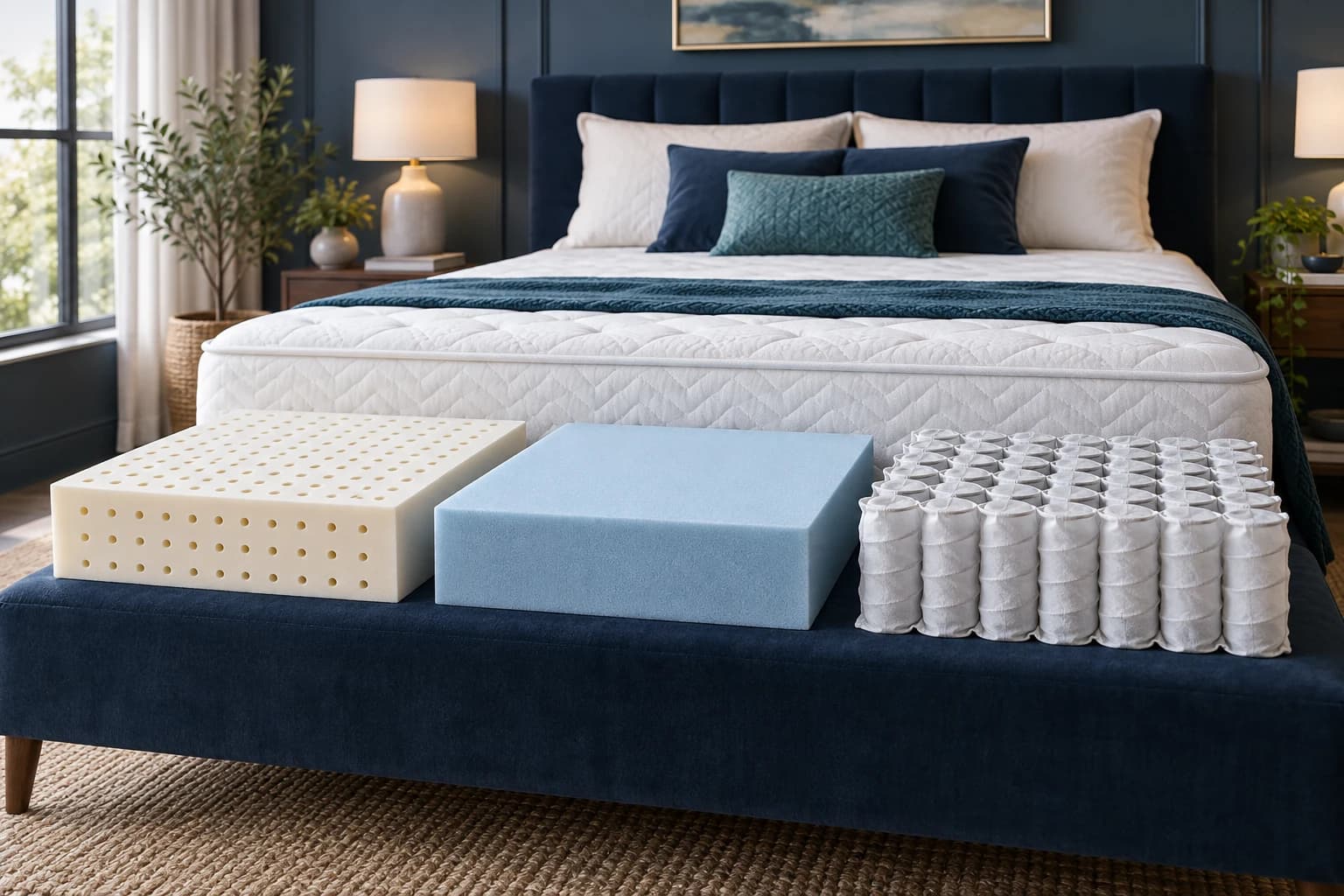
AI-assisted material illustration; not a photograph of a tested mattress.
Start with two questions
What is the comfort layer, and what carries your weight underneath it? A memory-foam surface can sit on a foam core or on springs. Latex can be an entire mattress or just the top layer of a hybrid. The top material helps explain the initial feel; the complete construction determines what you are buying.
This guide compares construction routes rather than declaring one material best for everyone. It is researched education, not a laboratory test or a product ranking. For the full sequence covering budget, room size and purchase terms, use our master buying guide.
Compare the main construction routes
| Route | What is underneath the surface? | Reason to investigate | Tradeoff to investigate | Next comparison |
|---|---|---|---|---|
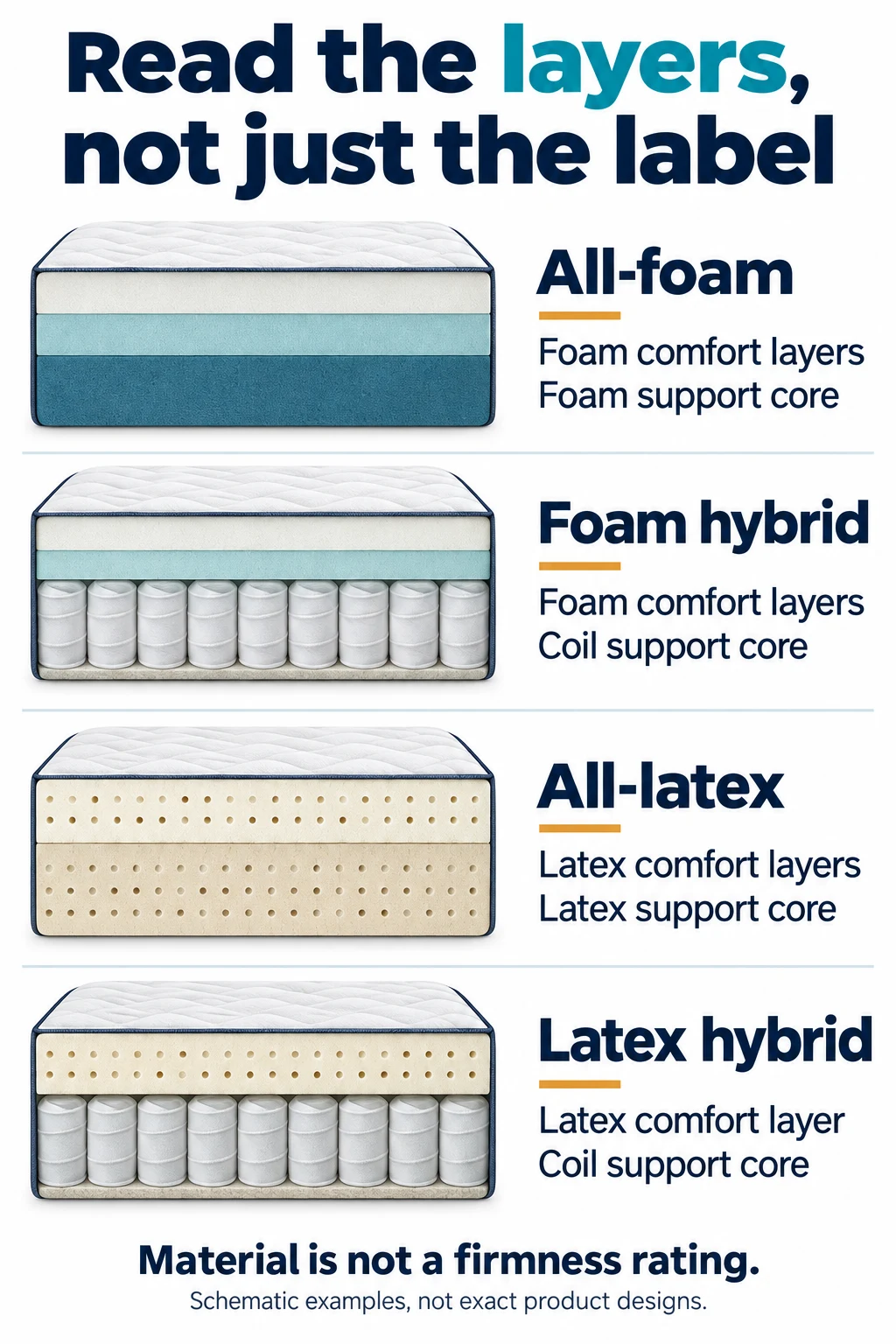
| All-foam | Foam comfort layers over a foam support core | A contouring surface without a coil unit | Recovery speed, edge feel and ease of turning | Memory-foam mattresses |
| Foam hybrid | Foam comfort layers over a coil support core | Foam cushioning with a spring-based structure | The foam depth and coil design vary widely | Hybrid mattresses |
| All-latex | Latex comfort and support layers | A responsive latex construction throughout | Finished weight, firmness configuration and handling | Latex mattresses |
| Latex hybrid | Latex comfort layer over coils | Latex at the surface with a spring-based core | Do not mistake a thin latex layer for an all-latex mattress | Latex material checks |
| Traditional innerspring | Coil core with a relatively limited upholstery package | A spring-led feel | The cushioning above the coils may be very different from a deep hybrid | Brand reviews |
| Adjustable air | Adjustable air chambers form part of the support system | Changing support settings is the main goal | Pumps, controls, service and comfort layers still matter | Smart-bed comparison |
These are practical construction categories, not standardized performance grades. Retailers use “hybrid” broadly. Read the layer description before assuming how much foam, latex or spring structure a label represents. A mattress containing memory foam is not necessarily an all-foam mattress.
Memory foam: identify the surface and the core separately
Memory foam is a comfort material, not a complete blueprint. In an all-foam mattress, the support core is typically a different, firmer foam. In a hybrid, coils replace that foam core while foam remains above them. This distinction matters when comparing two similarly named versions of one product family.
Tempur-Pedic's explanation of Medium and Medium Hybrid provides a concrete manufacturer example: its non-hybrid version uses a foam base, while the hybrid uses coils. That example establishes the structural difference; it does not prove every hybrid is easier to move on or cooler than every foam mattress.
For a shopper who wants close contouring, the surface foam is worth investigating. For someone who dislikes feeling held in place, recovery speed and turning matter as much as softness. Ask how the finished bed behaves with your body on it, rather than pressing a sample with your hand and treating that as a complete trial. Compare foam density separately from firmness: they answer different questions.
Latex: all-latex and latex hybrid are different purchases
An all-latex design uses latex in the main comfort and support layers. A latex hybrid places latex above a spring core. A product title that says “latex” does not tell you which route you are looking at, or whether other comfort materials are included.
Sleep On Latex describes its Pure Green foam as made with the Dunlop process. This is a production-method claim, not a universal firmness rating. Dunlop and Talalay labels do not replace the actual layer specification, selected firmness and mattress configuration.
Use a latex shortlist when response and construction are the features you want to compare. If your mattress is sound and you only want a surface adjustment, a latex topper is a different, smaller intervention. It does not replace the existing core. Do not compare a topper price with a complete mattress price as if they buy the same function.
Coils: read what surrounds them
A coil count alone leaves out the wire, coil arrangement, zones, edge design, mattress size and comfort layers. Two mattresses can both be called pocketed-coil hybrids while having very different tops. Start with whether the comfort layer is foam or latex, then examine the support description and the specific size being offered.
If both partners are choosing together, compare the whole bed for movement, edge use and ease of repositioning. Our hybrid versus memory foam guide for couples keeps those decisions together. A thicker comfort package may change what you feel from the springs; more listed layers are not automatically a better design.
Material does not decide firmness, cooling or lifespan by itself
Keep four columns in your shortlist: construction, selected feel, documented specifications and purchase terms. Do not compress them into one “best material” score.
- Firmness: choose the actual version, then assess it on your intended foundation. Soft and firm options can exist within the same material family. Use the firmness guide to separate surface comfort from adequate support.
- Temperature: covers, comfort depth, compression, protectors, bedding and room conditions all belong to the final setup. Read our cooling technology guide before treating gel, holes or coils as a guaranteed overnight result.
- Durability: inspect what is documented about layers, support and care. A broad material label is not a reliable personalized replacement date. The durability guide explains how to compare evidence without inventing a lifespan.
- Foundation fit: use the exact mattress requirements for slats, center support and adjustable bases. There is no single slat-spacing rule for every mattress. Start with bedroom compatibility planning.
Natural, organic and foam certification answer different questions
“Natural” is a material description; it should not be read as proof of a particular organic certification. A certification may cover one component, a facility or a finished product. Request the relevant scope instead of treating every badge as interchangeable.
CertiPUR-US explains that its certification applies to flexible polyurethane foam. It is not a blanket certification of every part of a mattress. That distinction matters when the actual question concerns a cover, fire barrier or latex component. Use our certifications reference, organic mattress comparison and fiberglass-free material checks for those specific decisions.
Turn the category into a useful shortlist
- Write down the change you want: more cushioning, easier turning, a different material, or an adjustable setting.
- Select two construction routes that plausibly address it. Compare actual models within those routes rather than every product on the market.
- Record size, firmness option, comfort materials, support core and included cover. Use the comparison worksheet so similarly named versions do not get mixed together.
- Follow the matching buying guide, then read the exact model discussion. Our mattress research library lets you find those reviews.
- Check the purchase channel and plan the trial. Use the trial checklist; an attractive construction is still the wrong purchase if it does not suit you or the return arrangement is unacceptable.
For a concrete example, “Queen mattress, responsive surface, compatible with my base” is a useful starting brief. “Best latex” still leaves the core, firmness, dimensions and purchase channel unanswered. The purpose of this guide is to narrow the decision enough that the next product comparison becomes useful.
Questions about mattress materials
Is a memory-foam mattress always all-foam?
No. Memory foam can be a comfort layer above either a foam core or coils. Read the core specification to distinguish all-foam from a foam hybrid.
Does latex mean the mattress is organic?
No. A latex material claim does not establish organic certification. Check the certificate and whether it covers the component or finished product you are buying.
Are hybrids always firmer or cooler?
No. Hybrid describes a construction route. Comfort materials, selected firmness, cover and the rest of the sleep setup affect the result.
Can a topper turn my foam mattress into a latex mattress?
A latex topper adds a latex surface but leaves the existing mattress core in place. It is a comfort adjustment, not a replacement of the underlying construction.