
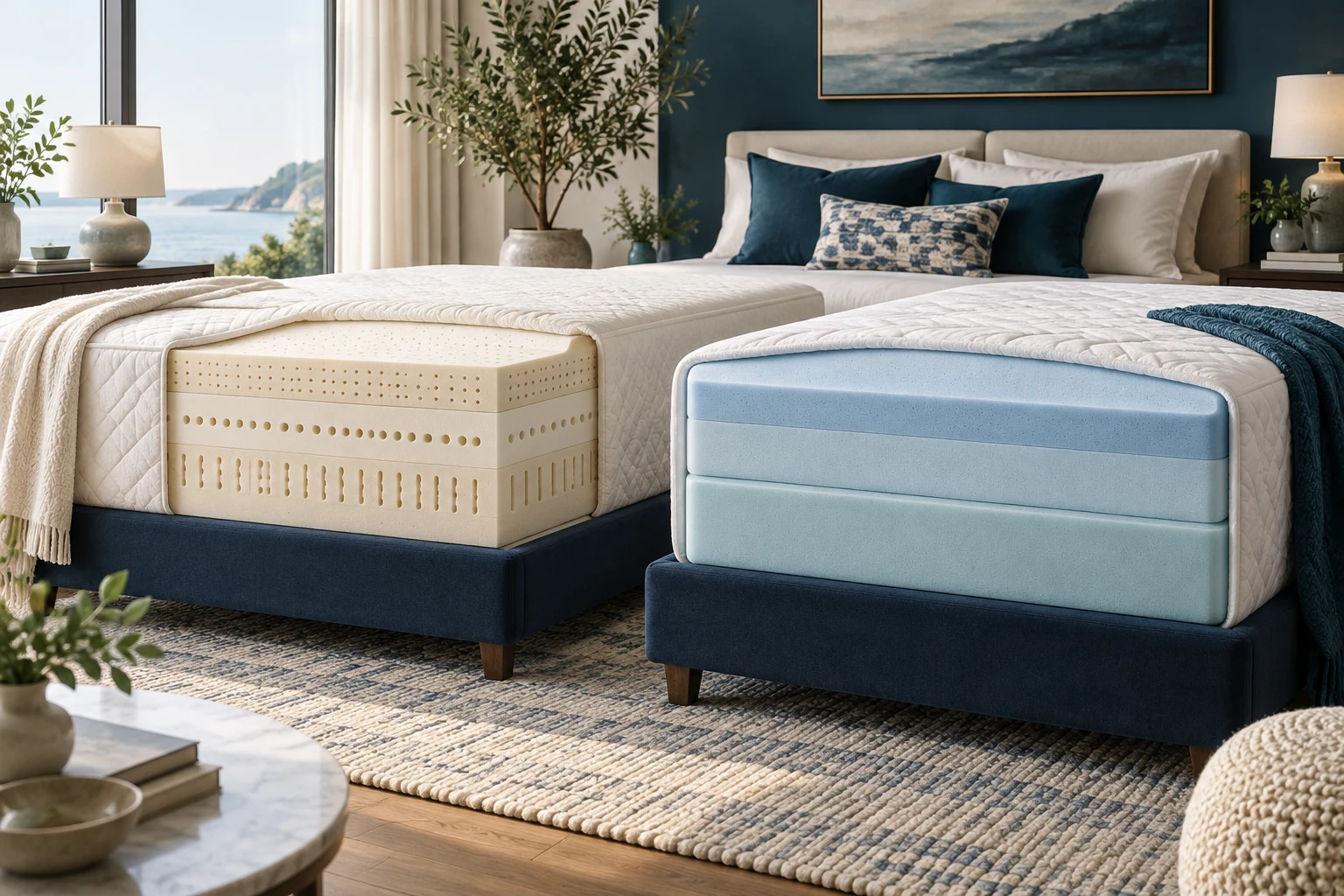
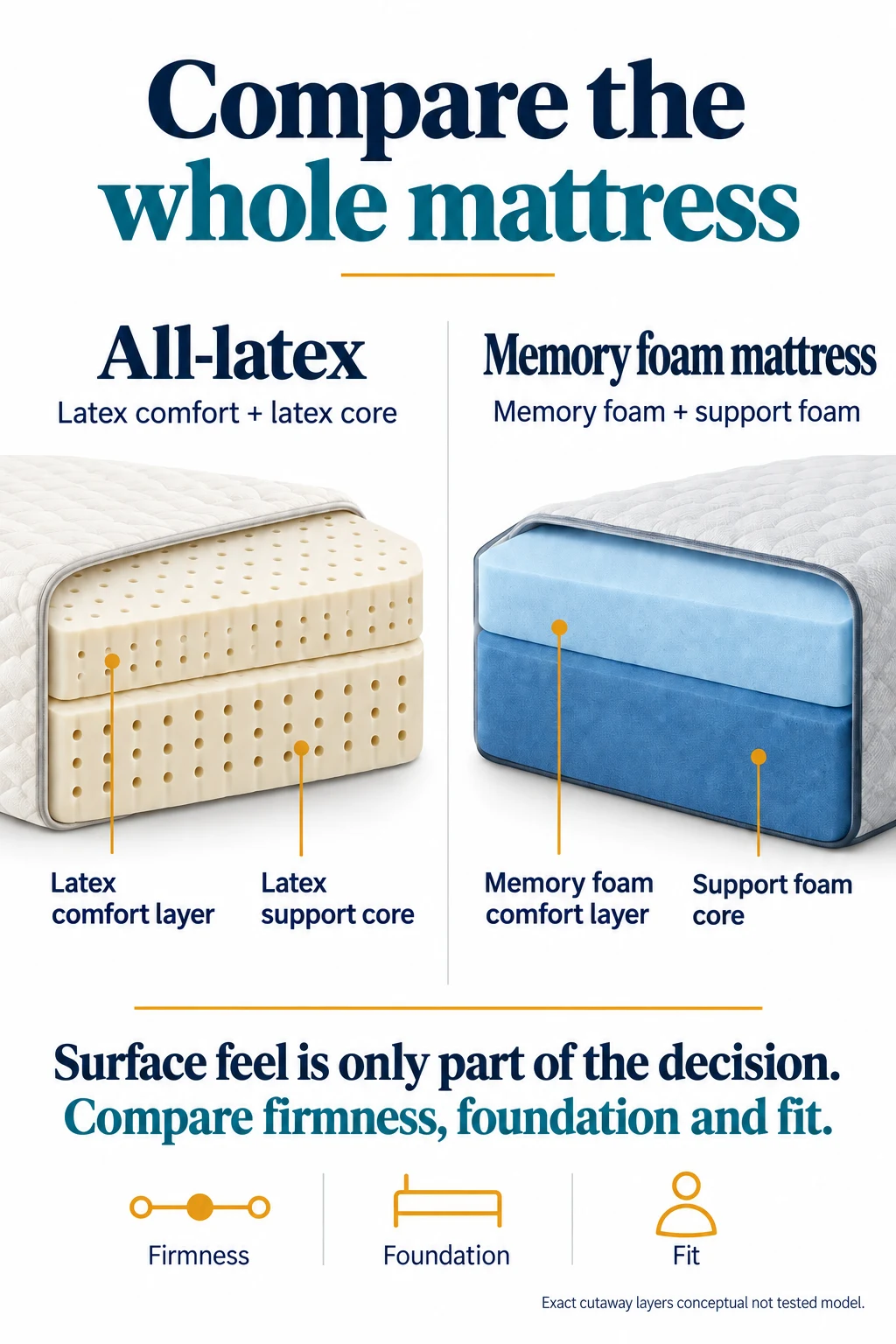
Compare both the comfort material and the support core. An all-latex mattress uses latex through its principal foam construction. A memory foam mattress usually pairs memory foam comfort layers with a different support material; memory foam can also sit above coils in a hybrid. The name on the surface does not identify the whole bed.
Choose the latex route to investigate a more springy response; choose the memory foam route to investigate a slower, closer contour. Those are starting preferences, not guarantees of firmness, cooling, longevity or suitability. This guide compares complete mattresses. For an existing bed that needs a surface adjustment, use the separate topper material comparison.
Read the layer diagram before the marketing name
Ask what you will lie on and what supports those upper layers. Sleep On Latex's mattress is an example of a latex construction. By contrast, Tempur-Pedic explains its non-hybrid and hybrid distinction in terms of a foam base versus coils beneath its TEMPUR material.
These examples establish why a comfort-material label is insufficient; they do not establish a performance ranking between the products. We have not tested them side by side. Our mattress types pillar maps the broader construction choices, including hybrids.
Compare by the decision you actually need to make
| Buyer question | All-latex route | Memory foam route |
|---|---|---|
| Do I want a springier or slower surface? | Investigate resilient cushioning and ease of changing position | Investigate closer contour and whether recovery suits your movement |
| What carries the comfort layers? | Identify latex layers, firmness options and complete build | Identify the support foam or coils separately |
| Will it work for two people? | Compare the exact surface, motion behavior and size | Do the same; a foam label is not a partner-disturbance score |
| Can I manage delivery and moves? | Check listed size-specific weight and handling instructions | Check the actual model and size rather than assuming all foam is light |
| What quality information is available? | Material scope, construction, certifications and warranty details | Foam specifications, certification scope, construction and warranty details |
| Will my base work? | Follow the exact mattress requirements | Follow the exact mattress requirements, including hybrid distinctions |
Firmness and contour are different questions
A responsive material can be offered in more than one firmness. A slow-contouring surface can also sit over a firm underlying structure. Do not translate latex into “hard” or memory foam into “soft” without examining the actual configuration.
When trying a bed, separate your first impression from the decision: does the surface give the amount of cushioning you prefer, can you turn comfortably, and does the complete mattress feel suitable in your usual positions? Our firmness guide explains why one brand's label should not be treated as another brand's identical measurement.
Two people may need different compromises
For a couple, one person's preference for a close contour can conflict with the other's preference for easy movement. List both requirements before selecting a material. Size, edge use and whether the bed will have independent adjustable halves also belong in that conversation.
Do not assume that “latex bounces” or “memory foam isolates motion” settles the exact product choice. The complete construction, shared surface and foundation matter. Where an external review supplies a test, check the model and protocol before treating it as evidence. Our hybrid versus memory foam guide for couples keeps the partner-specific decision separate from this material overview.
Cooling, density and certifications: ask narrower questions
There is no universal temperature winner established here. A cover, comfort-layer depth, bedding and room conditions can complicate a material-only explanation. We do not translate perforations, gel or open-cell wording into an unmeasured overnight cooling advantage.
Density is a specification, not a substitute for a firmness rating or a promised service life. Compare it in the context of the relevant material and layer. The foam density guide explains how to read that evidence without assuming that a denser product is automatically the right feel.
CertiPUR-US explains that its certification concerns flexible polyurethane foam. It is not an all-purpose certification of an entire mattress and should not be applied to latex as though it were the same material. For organic or other claims, identify the certified component and scope instead of counting logos. The durability guide separates useful construction evidence from unsupported lifespan promises.
Three ways to turn the comparison into a shortlist
You dislike slow recovery and want a different surface response. Compare all-latex configurations and, if coils appeal, latex hybrids. The latex versus hybrid comparison explains that fork.
You want a close contour and have liked memory foam before. Investigate the memory foam shortlist, checking the full construction rather than buying by foam name alone.
Your present mattress already has the right support but needs a limited surface change. A whole-mattress purchase may be unnecessary. Investigate the topper decision tool before replacing it. Conversely, neither new material fixes a broken frame: resolve the underlying support first.
Before ordering, compare the exact size, total height, delivery format, listed weight, foundation requirements and seller-specific trial. Those practical differences can matter more than a broad material preference. Return to the latex shortlist once you know whether you want all-latex or a latex comfort layer over another core.
Choose your next step
Talk through the tradeoffs
Open an editable question in the Sleep Advisor. Nothing is sent to AI until you submit it.