
Economy
Construction: Low-density polyfoam, basic coils, limited certification depth
Risk/value signal: Fast body impressions, unclear fire barrier language, weak edge support
Best for: Temporary guest rooms, short-term housing, very light use
Use these anchors to jump directly to the sections that matter most. Prefer a PDF? Print this page from your browser and keep it as a bedside reference.
Published August 21, 2026 / Updated August 21, 2026 / By MattressProducts.com Editorial Team
Start with the size that fits your room, your usual sleep position, and your budget. Then compare comfort, construction, and return terms. The detailed sections below explain what to check before buying.
Decision library
Start with the essentials. Use the specialist hubs below when your question narrows to a model lineup, a final comparison, body mechanics, pain, or bed-system compatibility.
Model research
Understand one current brand lineup, its construction ladder, seller risks, and policy checkpoints before comparing alternatives.
Choose a model-level review →Final shortlist
Use direct decision maps when two brands remain and the real question is construction, fit, service, or return friction.
Compare brands head to head →System compatibility
Match the mattress to an adjustable base, platform, Murphy cabinet, high-capacity frame, dorm room, or guest-room operation.
Check the complete sleep system →Body mechanics
Translate side, back, stomach, and combination movement into pressure relief, response, zoning, and pillow priorities.
Start with sleep position →Symptom-aware route
Separate surface pressure tuning from structural failure and use mattresses, toppers, and replacement timing appropriately.
Open the pain-relief guide →Start here
Use these deep dives when you need a specific answer before comparing mattress listings.
Cheat sheet
Use this page to choose the next research step. Follow the linked material guides, specific model reviews and purchase checklists before comparing an offer. Our separate buying checklist provides a shorter sequence when you already have a shortlist.
Clinical-style buying warning: low-density foam can feel firm at first
A cheap mattress can use low-density polyurethane foam that feels supportive on day one, then softens as body heat and nightly load fatigue the cell structure. If the listing hides density, ILD, coil gauge, or certification details, treat the comfort claims as marketing until proven otherwise.
Engineering selector
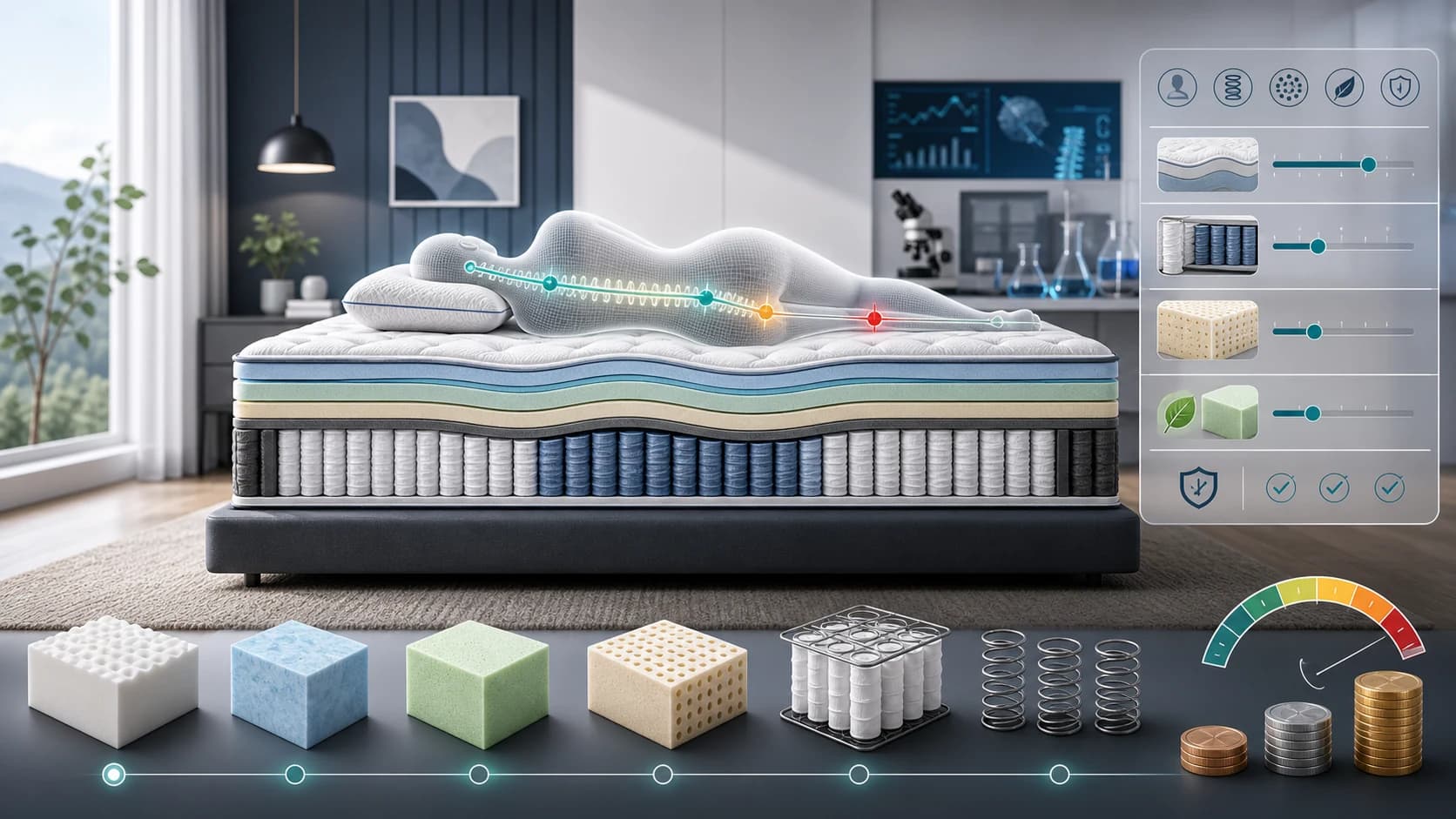
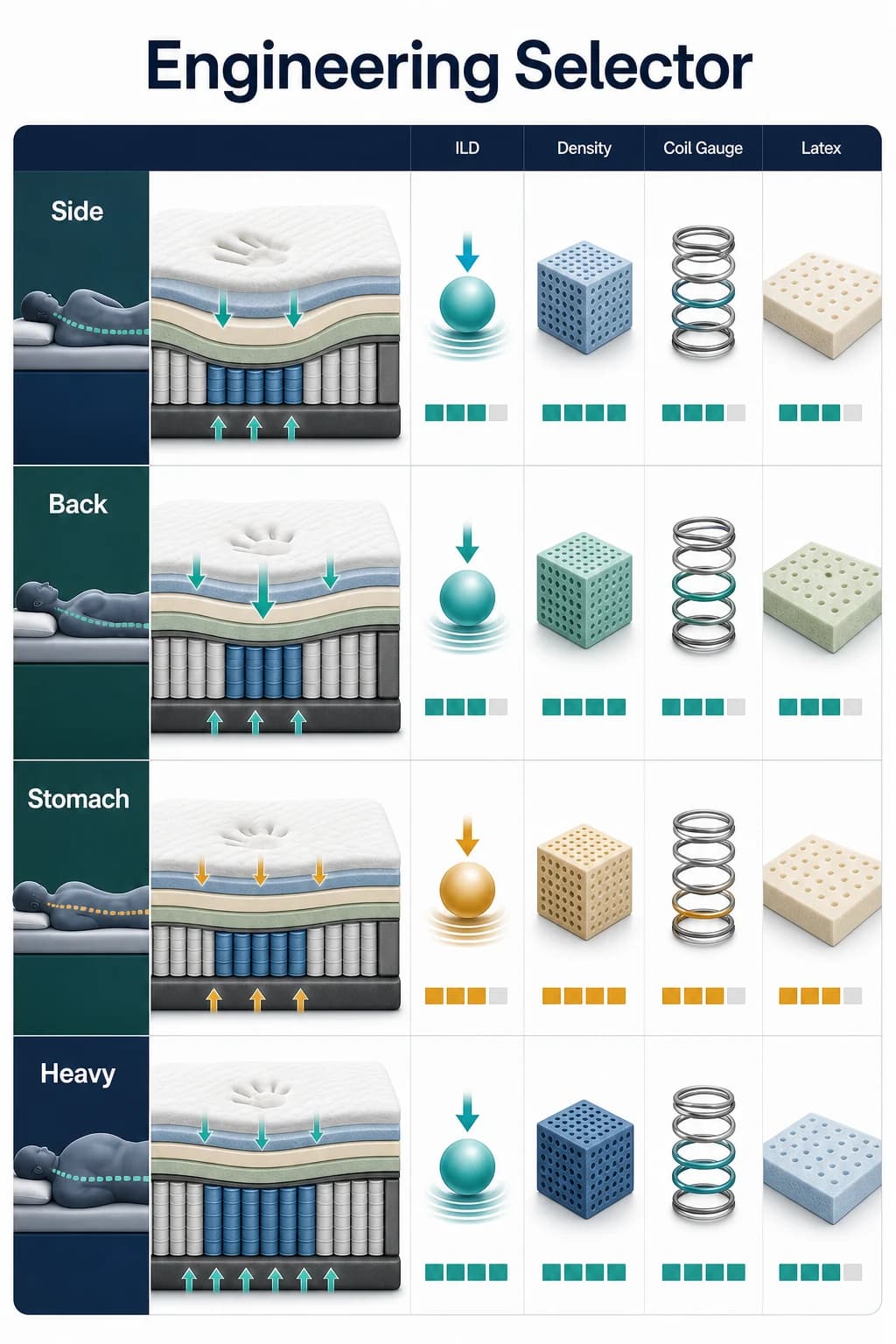
Start with measurable construction before brand preference. ILD, density, support factor, coil gauge, zoning, latex process, and recovery speed explain why two mattresses with the same medium-firm label can perform very differently.
| Metric | Why it matters | What to verify |
|---|---|---|
| Indentation Load Deflection (ILD) | A mechanical firmness measure used for foam and latex compression instead of vague soft/firm labels. | Ask whether comfort layers, transition layers, or latex zones disclose ILD ranges. |
| Foam density | A durability proxy for polyurethane and memory foam; low-density foam can feel firm at first but fatigue faster. | Treat under 1.8 lb/ft3 polyfoam as budget-grade and verify higher-density memory foam in premium builds. |
| Support factor / sag factor | Shows whether foam resists deeper compression instead of bottoming out under pelvis and shoulders. | Heavy sleepers should prioritize progressive support, not just a high initial firmness rating. |
| Coil gauge and zoning | Lower gauge numbers mean thicker wire; zoning changes support under shoulders, lumbar region, and hips. | Look for reinforced edge coils, lumbar zoning, and credible coil-unit diagrams in hybrid listings. |
| Hysteresis and recovery | High-hysteresis foam absorbs movement and contours deeply; low-hysteresis latex rebounds faster. | Combination sleepers usually need faster recovery than dense slow-response memory foam provides. |
| Target profile | Recommended architecture | Mandatory specs | Biomechanical goal |
|---|---|---|---|
| Side sleeper / BMI under 25 | Conforming foam or latex hybrid | 2+ inch comfort layer, 12-18 ILD comfort range, flexible shoulder zone | Reduces shoulder and hip pressure without twisting the pelvis. |
| Side or combo / BMI 25-30 | Zoned Talalay latex or responsive hybrid | 19-24 ILD latex comfort, 14-15 gauge pocketed coils, quick recovery | Balances pressure relief with easier position changes. |
| Back or stomach / BMI under 30 | Dunlop latex, firm hybrid, or dense foam core | 28-36 ILD support range, firmer lumbar third, thinner comfort stack | Limits pelvic dip and lumbar hyperextension. |
| Heavy sleeper / BMI over 30 | Heavy-gauge zoned steel hybrid | 13.5-14 gauge center support, dense foams, reinforced perimeter | Prevents bottoming out and preserves edge-to-edge usable surface. |
Start with an honest assessment of your current pain points, sleep schedule, body type, and climate. If your mattress is older than seven years, sagging more than an inch, or trapping heat year-round, replacement is the smarter long-term move.
Narrow to three mattresses that align with your criteria. Order the top pick, document nights 1-30, and schedule a check-in mid-trial. If issues persist, initiate an exchange before the deadline.
Keep packaging until you’re certain; Amazon often requests it for returns.
Remember: Amazon sometimes lists multiple sellers for the same mattress. Buy from “Amazon.com” or the official brand storefront to ensure full trial and warranty coverage. Screenshot the listing page with trial, warranty, and delivery language before checkout.
Mattress prices reflect materials, height, manufacturing origin, and bundled services, but Amazon pricing changes frequently. A budget-tier bed may still need accessories such as a protector, frame, and breathable sheets to perform; a higher-tier hybrid may bundle more durable comfort layers and stronger policies.
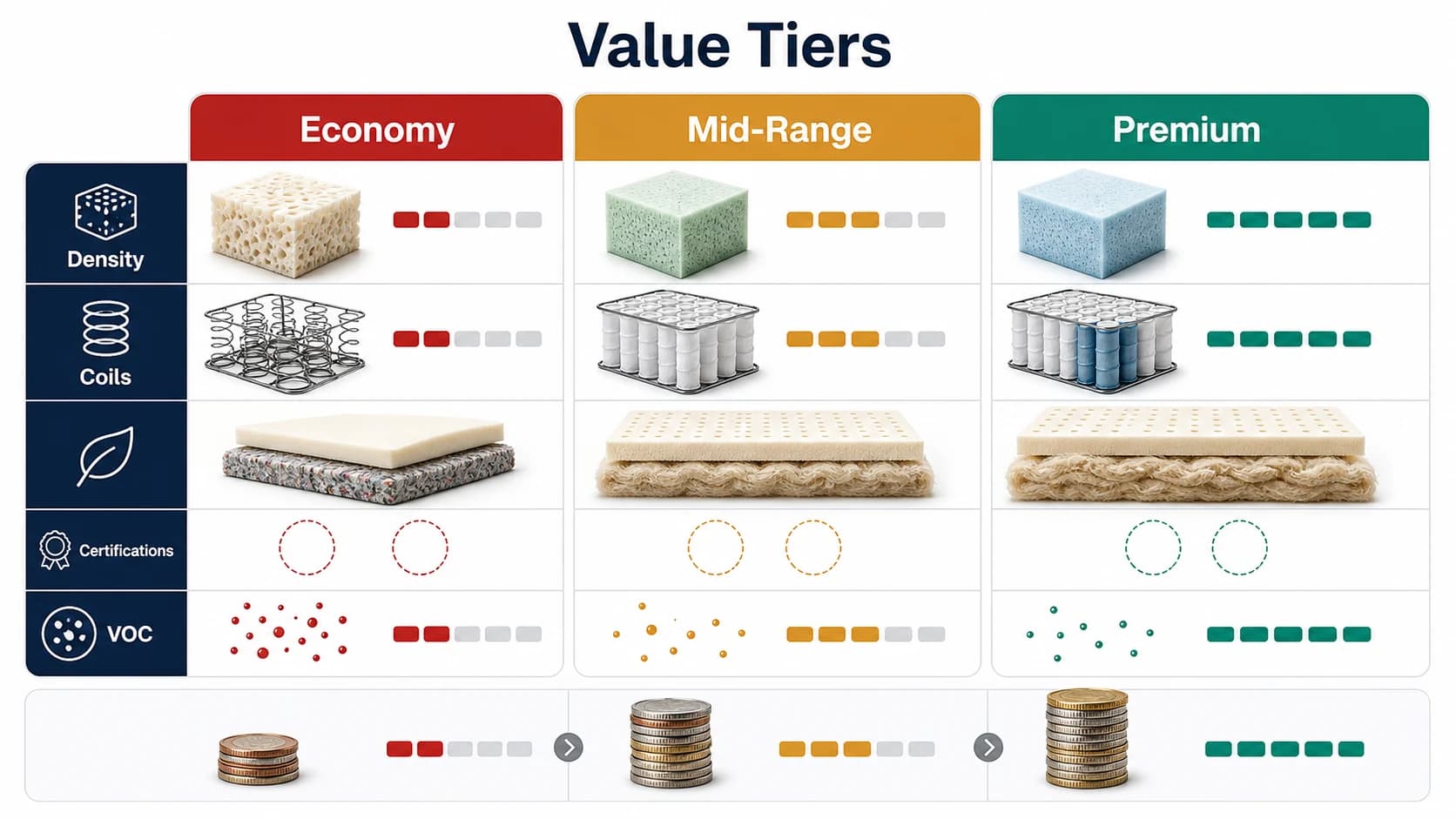
Construction: Low-density polyfoam, basic coils, limited certification depth
Risk/value signal: Fast body impressions, unclear fire barrier language, weak edge support
Best for: Temporary guest rooms, short-term housing, very light use
Construction: 1.8-2.5 lb/ft3 polyfoam, 3.5-4 lb/ft3 memory foam, pocketed coils
Risk/value signal: Best value when specs, return policy, and warranty language are transparent
Best for: Most primary bedrooms and balanced comfort/support needs
Construction: High-density foam, latex, micro-coils, wool/cotton barriers, stronger zoning
Risk/value signal: Worth paying for only when the materials match your body profile
Best for: Long-term use, heavier sleepers, pain-sensitive setups, eco/safety priorities
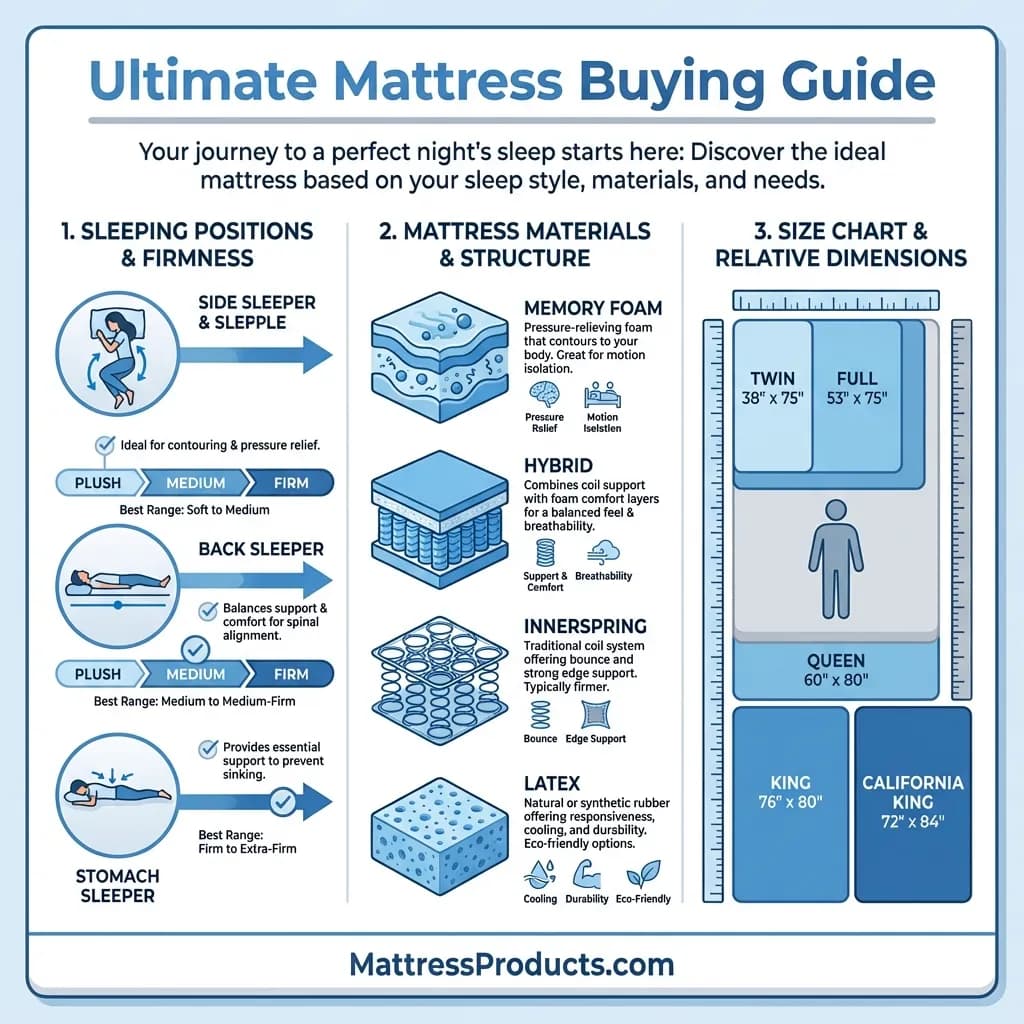
The best mattress is the one built for your comfort preferences and environment. Here’s how major constructions compare.
Exceptional motion isolation and pressure relief. Choose high-density (≥4 lb/ft³) foams if you’re heavier or a back sleeper. Pair with breathable protectors and consider gel or copper infusions for cooling.
Read our Memory Foam Guide
Combine coils and foam for bounce plus contouring. Look for coil counts above 900 in queen size, zoned support, and reinforced edges if you sit or sleep near the border.
Naturally breathable, resilient, and eco-conscious. Pain sufferers appreciate the buoyant feel. Ensure the base support is rigid—latex is heavy.
Read our Latex Buyer’s Guide
Dual chambers let couples customize firmness nightly. Great for evolving needs (pregnancy, injury recovery) but require power and occasional maintenance.
Certification check
Use CertiPUR-US for polyurethane foam claims, OEKO-TEX Standard 100 for textile safety, GOTS for organic cotton/wool textile claims, and GOLS when a latex core is marketed as organic latex. Certifications do not guarantee comfort, but they make material claims easier to verify.
| Position | Firmness target | Key features | Related guide |
|---|---|---|---|
| Back sleepers | Medium-firm (6-7/10) | Lumbar zoning, responsive transition foams | Read guide |
| Side sleepers | Medium to medium-plush | Deep comfort layers, shoulder/hip relief | Read guide |
| Stomach sleepers | Firm (7-8/10) | Reinforced core, thin comfort layer | Read guide |
| Combination | Medium-firm with quick response | Responsive foams, zoned hybrids | Read guide |
Comfort and adequate support should be assessed together. A material name or a lumbar-support claim does not establish that a mattress will relieve pain. Use the focused guides below to compare suitability, limitations and the complete bed setup; persistent or worsening symptoms need appropriate clinical advice.
Explore all condition-based guides:
Eco-conscious shoppers gravitate toward mattresses like EcoComfort Organic Latex and Haven Organic Cotton. Look for GOTS/GOLS, Greenguard Gold, and eco-INSTITUT certifications. When scheduling delivery, ensure white-glove service includes old-mattress pickup if needed. Accessory must-haves include breathable protectors, adjustable bases (if you want elevation), and bedding sized for deep-pocket profiles.
Compare the exact model, size, selected firmness and purchase channel. Use the same fields for every candidate; a brand name alone can refer to several different constructions.
Direct Amazon product checks
These are direct product CTAs with current Amazon product-image URLs. Use them as benchmarks for luxury hybrid, cooling hybrid, elastic grid, and zoned-support designs, then verify seller, size, trial, warranty, and delivery terms before checkout.
Premium hybrid benchmark for shoppers comparing height, pressure relief, trial language, and medium-firm luxury positioning.

Before checkout
Use the listing as the source of truth for current price tier, seller, delivery window, and return terms.
Prices, coupons, availability, shipping, and return terms change often. Confirm current details on Amazon before purchase. As an Amazon Associate, we earn from qualifying purchases.
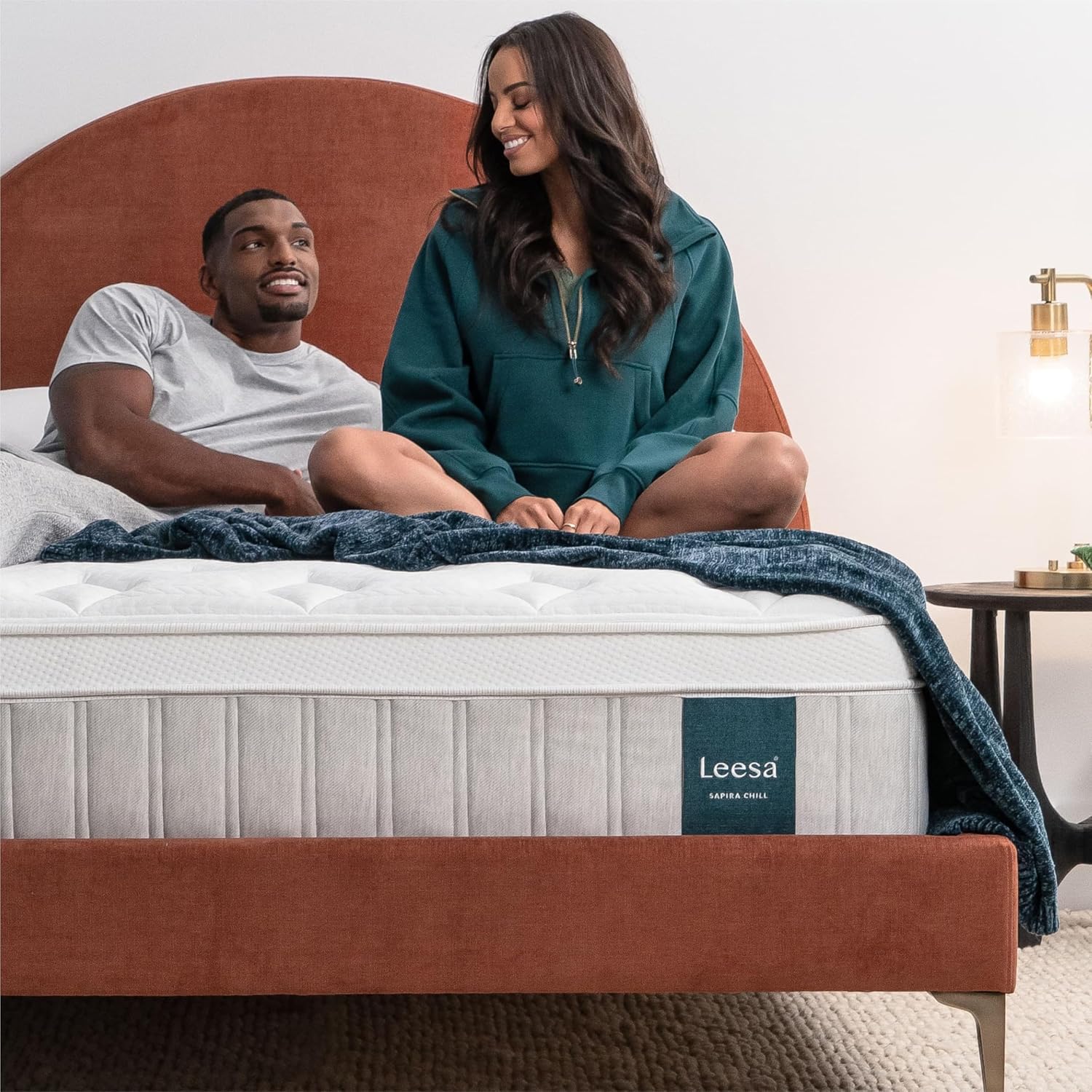
Cooling hybrid benchmark with CertiPUR-US language, coil support, and a premium comfort profile.
Before checkout
Use the listing as the source of truth for current price tier, seller, delivery window, and return terms.
Prices, coupons, availability, shipping, and return terms change often. Confirm current details on Amazon before purchase. As an Amazon Associate, we earn from qualifying purchases.
Elastic grid benchmark for pressure redistribution, airflow, motion isolation, and a nontraditional feel.

Before checkout
Use the listing as the source of truth for current price tier, seller, delivery window, and return terms.
Prices, coupons, availability, shipping, and return terms change often. Confirm current details on Amazon before purchase. As an Amazon Associate, we earn from qualifying purchases.
Zoned-support hybrid benchmark for shoppers who want a mainstream medium feel with foam comfort and coil lift.

Before checkout
Use the listing as the source of truth for current price tier, seller, delivery window, and return terms.
Prices, coupons, availability, shipping, and return terms change often. Confirm current details on Amazon before purchase. As an Amazon Associate, we earn from qualifying purchases.
Answer the prompts to see which curated guide matches your priorities. This is a snap-shot; always test mattresses during the trial.
Select at least one answer in each section to see your tailored recommendation.
We have 0 detailed articles covering sleep positions, budgets, pain scenarios, and mattress technologies. Browse the full library below; each link opens in a new tab so you can maintain your place in this guide.
Buying a mattress is only half the battle; the first month of ownership determines whether you keep it or schedule a return. Use the timeline below to capture impressions while trial windows and Amazon return labels remain active. We designed it so you can revisit the relevant blog posts (firmness, cooling, back pain, heavy sleepers) without leaving this pillar.
| Timeline | Action items | Helpful resources |
|---|---|---|
| Days 1-3 | Unbox, let the mattress fully expand, photograph corners/edges, log initial feel morning and night. | |
| Days 4-10 | Test with usual pillows + sheets, track partner feedback, confirm cooling and motion isolation during peak usage. | |
| Days 11-20 | Layer in protectors or toppers if needed, compare to previous mattress, note any aches that appear or disappear. | |
| Days 21-30 | Decide to keep or exchange, screenshot Amazon return instructions, complete warranty registration if satisfied. |
Tip: Store the workbook inside a cloud doc or note-taking app so you can share it with customer support if you ever request an exchange.
Pair the timeline with quantifiable scores. Rate comfort, cooling, support, edge strength, and partner disturbance on a 1-10 scale every three nights. Trends matter more than single impressions; if comfort drifts downward while support improves, experiment with toppers, adjustable base presets, or pillow swaps before scheduling a return.
Amazon shoppers often overlook small quality signals: zipper alignment, stitch tension, foam density disclosures, and coil gauge diagrams. Run the following checklist before the last day of your return window, then use the call/email scripts to negotiate replacements or partial refunds without confrontation.
Negotiation prompt for Amazon chat:
“Hi, I purchased the [Mattress Name] on [Order Date]. After following the 30-day break-in process outlined in your listing, I noticed [issue]. I have timestamps/photos ready. Could you offer an exchange, courtesy credit, or advice on keeping the warranty valid? I’d like to stay within the Amazon ecosystem for this solution.”
Create a shared folder (Google Drive, Notion, Dropbox, or iCloud) titled “Mattress Evidence.” Store invoices, chat transcripts, unboxing photos, off-gassing logs, and mattress-protector receipts. Most manufacturers require proof that you used a waterproof protector and a supportive foundation; uploading those receipts now saves hours later.
If you rely on financing or buy-now-pay-later plans, take screenshots of payoff schedules. Should you return the mattress, these documents prove you canceled installments in time to avoid surprise interest. The more organized you are, the faster Amazon or the manufacturer resolves the claim.
Need more leverage? Reference industry standards from Foam Density Explained or Heavy Sleeper Support so brands know you understand material science, not hype.
Mattress marketing is packed with jargon. Use this glossary to decode the phrases you’ll see on product pages, then browse the myth-busting list so you avoid outdated sleep advice. When in doubt, cross-reference the Sleep Position Pillar and Firmness Guide for deeper dives.
| Term | Meaning | Where it matters |
|---|---|---|
| ILD / IFD | Indentation Load Deflection, a measure of foam firmness | Comparing toppers and latex layers |
| Gauge | Thickness of steel coils (lower = thicker/stronger) | Edge support & heavy sleeper ratings |
| Micro-coils | Short pocketed springs layered above the main coil unit | Luxury hybrids with extra bounce |
| Phase-change cover | Fabric coated with heat-absorbing minerals | Cooling mattresses for hot climates |
| Zoned support | Foams or coils tuned for shoulders, lumbar, hips | Pain relief guides |
| Off-gassing | Initial odor released as foams cure after unpacking | Memory foam & bed-in-box logistics |
Common myths to retire:
Mattress shopping feels less overwhelming when you assign roles: who researches, who orders, who schedules delivery, and who documents the experience. Borrow the accountability prompts below for couples, families, or roommates sharing the decision.
Households with shift workers or newborns can also log noise or motion events. If a mattress amplifies movement, compare notes against the Couples Guide to justify thicker transition foams, split firmness options, or adjustable air systems.
When every decision-maker sees the same notes, you avoid returns triggered by miscommunication. Plus, sharing documentation with Amazon or the brand proves you followed best practices outlined in this guide.
These questions come up every week when readers compare Amazon mattress listings. Expand any item to get practical, jargon-free context before you check out.
Dunlop latex is denser and often better for support cores. Talalay latex uses vacuum expansion and freezing before vulcanization, producing a more consistent, airy, buoyant comfort layer. Both can be useful, but they solve different support and pressure-relief problems.
ILD measures how much force it takes to compress foam or latex. Side sleepers usually need lower-ILD comfort layers for shoulder and hip travel, backed by firmer transition layers so the pelvis does not sink too far.
Lower gauge numbers mean thicker, stiffer wire. A strong hybrid often combines firmer low-gauge coils in the lumbar or perimeter zones with more flexible coils where pressure relief matters.
Use CertiPUR-US for polyurethane foam emissions, OEKO-TEX Standard 100 for tested textiles, GOTS for organic cotton/wool textile claims, and GOLS when a latex core is marketed as organic latex.
Give it a full 30-night trial when possible. Track morning comfort, temperature, and support every few nights so you can show the seller objective notes if you need to exchange it.
Yes, but read the listing fine print. Some brands shorten in-home trials or require you to register the purchase within 30 days to keep the warranty active.
Medium-firm (around 6/10) is the most versatile. Layer split toppers or adjustable bases on top so each sleeper can fine-tune pressure relief without replacing the core mattress.
Focus on “Verified Purchase” reviews from the last 6-12 months and filter by keywords like firmness, edge support, or weight. Ignore vague comments and double-check for review merges between unrelated products.
Most bed-in-a-box brands require you to keep it for at least 30 nights, but Amazon often provides prepaid pickup if you’re within the return window and the mattress is clean and protected.
Use slatted frames with gaps under 3 inches, platform bases, or adjustable bases. Traditional box springs can void warranties unless the brand explicitly allows them.
If you sit or sleep near the edge, look for reinforced coils or 4 lb+ foam rails. Strong edges increase usable surface area and make it easier to get in and out of bed.
Phase-change fabrics and breathable knits help, but airflow from coils matters more. Pair cooling covers with light, moisture-wicking sheets to see a noticeable difference.
Not necessarily. Choose models with high-density base foam (2 lb+) or zoned coils underneath the memory foam comfort layers so hips stay lifted.
Screenshot the listing’s trial info and chat with the seller to confirm pickup fees. Some brands offer 100+ nights only if you register on their site after purchase.
If you experience snoring, back tension, or swelling, adjustable bases can be game-changing. Ensure your mattress is compatible (most hybrids and foams are) before ordering.
Most deep-pocket sheets cover mattresses up to 15 inches. If your bed exceeds that, look for “extra deep” 18-22 inch sets so corners don’t slip.
Yes—ventilate the room, run a fan, and keep the cover unzipped (if removable) for a few hours. Off-gassing should dissipate within 48 hours for CertiPUR-US foams.
Absolutely. A waterproof, breathable protector keeps stains away and preserves warranty eligibility. It also makes returns easier because the mattress stays clean.
Rotate foam and hybrid mattresses every 3 months to even out wear. Many brands include rotation reminders in their care instructions—set calendar alerts so you don’t forget.
Track position changes in your sleep log. If you swap between side and stomach, keep both plush and firm pillows nearby and adjust toppers or bases instead of replacing the whole mattress.
Organic and natural materials can reduce VOC exposure and chemical odors, but allergen relief mostly depends on using washable covers and vacuuming regularly.
Plan 10-15% of your mattress budget for pillows, protectors, and sheets. Accessories often determine the final feel, so don’t leave them as an afterthought.
Keep PDFs or screenshots of the original specs, trial, and warranty terms. If the listing updates, you’ll have documentation to reference in case of disputes.
You can’t haggle directly, but you can watch price trackers, set alerts for Prime Day and Cyber Week, and chat with the seller about bundling pillows or protectors at no extra cost.
Free decision tools
Use these tools alongside the mattress buying guide to plan budget tier, replacement timing, and room fit before comparing live Amazon listings.
mattress budget calculator
Use the Mattress Budget Calculator to match your sleep position, comfort priorities, and budget tier with practical Amazon mattress shopping guidance.
Open toolmattress lifespan estimator
Estimate whether your mattress is still supportive by checking age, mattress type, wear signs, usage, and maintenance habits.
Open toolbed size calculator
Enter room dimensions and compare Twin, Full, Queen, King, and California King clearance. See what fits before buying a mattress or bed frame.
Open toolBookmark this guide, open the comparison table, and keep the return policy screenshot handy. When you’re ready, head to Amazon through our affiliate links—your price stays the same, and we may earn a commission that funds independent reporting.
Affiliate disclosure: MattressProducts.com participates in the Amazon Associates Program. When you buy through our links, we may earn a commission at no extra cost to you.