The best fiberglass-free mattress on Amazon is not the product with the biggest “safe” badge. It is the exact model you can connect to a current manufacturer disclosure, a clear fire-barrier description, the correct seller, and a usable return path. Tuft & Needle Original is our clearest general starting point because the brand currently says its Original, Mint, and Mint Hybrid contain no fiberglass and explains that those models use a polyester-and-cotton knit barrier treated with a food-grade salt. Bear Original Hybrid, DreamCloud Classic Hybrid, and Avocado Eco Organic are also useful models to research, but Amazon availability and seller terms can change.
This guide does not label any mattress universally “safe,” certify marketplace inventory, or promise that every historical version shares today's construction. It shows what is currently documented and what you must re-check before buying.
Use this shortlist only if you will verify the exact barrier
Use this shortlist if
- You want a current manufacturer statement tied to the exact mattress model, not a marketplace badge.
- You will save the listing, seller, materials statement and return terms before checkout.
- You understand that older generations and merged reviews may describe a different construction.
Use a different route if
- The seller or manufacturer cannot identify the complete fire-barrier material in writing.
- The delivered model, law label or care instructions do not match the saved listing.
- You need diagnosis or remediation advice for suspected fiber exposure rather than a purchase comparison.
Decision-first shortlist
Amazon shortlist: two specific listings to compare
These two entries have specific Amazon product pages. The same five-model comparison below also includes Tuft & Needle, Bear and Avocado as research-only routes. Reviewed September 13, 2026: manufacturer statements and listing identity, not laboratory testing or seller authorization. Naturepedic opens Twin; DreamCloud opens Queen.
1. Firm hybrid listing · Queen
DreamCloud Classic Hybrid
A foam-and-coil option whose current product documentation explicitly identifies the model as fiberglass-free.

- Best for
- Shoppers comparing a firm-feel foam-and-coil hybrid
- Avoid if
- The listing shows a different DreamCloud generation, seller or construction
- Construction
- 12-inch foam-and-coil hybrid
- Price tier
- Lower-mid range
2. Best plush organic latex-hybrid route
Naturepedic Concerto
A plush latex hybrid using organic cotton, wool, latex and coils, whose current Concerto product page excludes fiberglass.

- Best for
- Shoppers prioritizing an organic-material pillow-top construction
- Avoid if
- You need a firmer or lower-cost mattress, or the shown size is not yours
- Construction
- 13-inch latex hybrid with pillow top and dual coil layers
- Price tier
- Luxury
Prices, sizes, sellers, availability and return terms can change. Confirm the exact listing before purchase. Amazon buttons are affiliate links; as an Amazon Associate, we earn from qualifying purchases.
How we researched this guide
We compared current manufacturer product and materials pages, current model names, fire-barrier statements, U.S. mattress flammability requirements, and the way marketplace seller and return terms can diverge from direct purchases. The federal baseline comes from the U.S. Consumer Product Safety Commission: mattresses are subject to the smoldering-ignition standard in 16 CFR Part 1632 and mattress sets to the open-flame standard in 16 CFR Part 1633. Those rules set performance requirements; they do not require one particular barrier material.
We did not cut open mattresses, submit fibers to a laboratory, inspect every Amazon warehouse unit, or certify a manufacturer's claim. Marketplace inventory can change after publication. For that reason, every pick below is a research shortlist, not a permanent guarantee.
Current fiberglass-free mattress shortlist
All five models appear in this comparison and the final verdict. “Direct listing” means we identified a specific Amazon page; “research only” means no exact Amazon offer was established. Neither status independently confirms a delivered unit's materials.
| Model / generation scope | Amazon route checked September 13, 2026 | Manufacturer evidence | Barrier detail / unresolved point |
|---|---|---|---|
| Tuft & Needle Original family: Legacy, 2024 and II must be distinguished | Research only; no ASIN or size verified | Collection FAQ: names Original, Mint and Mint Hybrid; also carries a general fiberglass exclusion | FAQ describes salt-treated polyester/cotton knit. Obtain an answer for the exact generation; do not assume one recipe covers all versions. |
| Bear Original Hybrid | Research only; no ASIN or size verified | Model page: excludes fiberglass fabric | Brand help describes silica/rayon/polyester/cotton blends. Exact model recipe remains to be confirmed. |
| DreamCloud Classic Hybrid, 12-inch | Direct listing: Queen, B0F75Q1K1Y | Classic page: model-specific fiberglass-free statement | Full barrier composition not established from the reviewed page; ask support. Amazon describes a firm feel. |
| Avocado Eco Organic | Research only; no ASIN or size verified | Eco Organic page: excludes fiberglass and identifies wool for fire resistance | Match the Eco Organic model and delivered labels; other Avocado models are outside this row. |
| Naturepedic Concerto pillow top, 13-inch | Direct listing: Twin, B0CT3WZDV5 | Concerto page: excludes fiberglass | Organic cotton, wool and latex are disclosed. Do not infer a separate barrier recipe from the materials list; confirm the Twin listing's Concerto model identity. |
Review scope — September 13, 2026: We reopened the linked manufacturer disclosures and the two Amazon pages. This records published claims and listing identity, not independent material testing. We did not establish seller authorization, stock at your address, or order-specific return rights. Product photos in the two cards come from those Amazon listings and identify appearance, not internal composition.
1. Tuft & Needle Original: clearest general starting point
Tuft & Needle provides the most useful kind of disclosure: it names the affected models and describes the barrier. Its current mattress collection page says the Original, Mint, and Mint Hybrid contain no fiberglass and states that the fire barrier is a polyester-and-cotton knit treated with a food-grade salt to meet the Part 1632 and 1633 tests.
The Original is a sensible starting point for shoppers who want a responsive all-foam bed rather than a deep, slow memory-foam hug. The important Amazon risk is generation confusion. Tuft & Needle now lists a 2024 Original, an Original Legacy Edition and an Original II. The collection FAQ names Original, Mint and Mint Hybrid without assigning its barrier recipe separately to every generation; obtain a generation-specific answer before transferring that recipe to a listing. Confirm the height, foam description, model name, and manufacturer part number instead of trusting a merged review history.
For a broader construction and policy comparison, see our Tuft & Needle mattress review.
Research Tuft & Needle Original on Amazon
Confirm the exact model generation, seller, fiberglass statement, trial, warranty, and return channel before ordering.
Before checkout
Use the listing as the source of truth for current price tier, seller, delivery window, and return terms.
Search results can mix models and sellers. No specific Amazon ASIN or seller authorization was established for this research route on September 13, 2026. As an Amazon Associate, we earn from qualifying purchases.
2. Bear Original Hybrid: value hybrid with a current brand-wide statement
Bear's current help article says its mattresses do not contain fiberglass and describes its fire-safe materials as blends of nonwoven hydrated silica, rayon, polyester, and cotton. The current Bear Original Hybrid product page also explicitly states that the model meets the federal mattress regulations without fiberglass fabric.
This model is a better research route than a basic all-foam mattress when easier movement, airflow through coils, or stronger edge behavior matters. Do not turn “hydrated silica” into a blanket safety conclusion; it is simply the material description Bear currently provides. Ask whether the Amazon unit is the same current construction and whether the seller is authorized for the limited lifetime warranty.
Research Bear Original Hybrid on Amazon
Match the current Bear model, seller authorization, materials statement, sleep trial, warranty, and return process.
Before checkout
Use the listing as the source of truth for current price tier, seller, delivery window, and return terms.
Search results can mix models and sellers. No specific Amazon ASIN or seller authorization was established for this research route on September 13, 2026. As an Amazon Associate, we earn from qualifying purchases.
3. DreamCloud Classic Hybrid: firm-feel hybrid listing
DreamCloud's current Classic Hybrid page says the model is 100% fiberglass-free and uses CertiPUR-US certified foams. Those are two separate claims: CertiPUR-US applies to flexible polyurethane foam, while DreamCloud itself makes the finished-model fiberglass statement.
The Amazon listing describes a firm feel; surface cushioning should not be read as a promise of plushness. Compare that description with your preferred feel before choosing this hybrid. Before buying on Amazon, make sure “Classic,” “Premier,” and other current or historical names have not been mixed in one listing. The direct 365-night trial should not be assumed to apply through an unrelated seller.
DreamCloud Classic Hybrid Mattress
The direct listing is useful only when the model name, height, seller and current fiberglass-free documentation all match.
- Best for
- Hybrid shoppers wanting a current documented fiberglass-free route
- Avoid if
- The listing shows another generation or seller
- Construction
- 12-inch foam-and-coil hybrid
- Price tier
- Lower-mid range
Before checkout
Use the listing as the source of truth for current price tier, seller, delivery window, and return terms.
Listing identity reviewed September 13, 2026: Queen, 12-inch Classic hybrid, ASIN B0F75Q1K1Y. Seller authorization, unit construction and return eligibility are not independently verified. As an Amazon Associate, we earn from qualifying purchases.
4. Avocado Eco Organic: natural-material route
Avocado's current Eco Organic product page identifies GOTS-certified organic cotton and wool, GOLS-certified organic latex, and pocketed coils, while expressly excluding fiberglass. This is the clearest route here for shoppers who specifically want a wool-based barrier and are comfortable with a more responsive latex-hybrid feel.
Natural materials do not make every sleeper comfortable, and certification claims should still be matched to the finished product and current license. Amazon stock may be limited or absent, so compare the direct channel before accepting a third-party listing with weaker policies.
Research Avocado Eco Organic on Amazon
Check model authenticity, current certification details, seller, delivery, trial, warranty, and return channel.
Before checkout
Use the listing as the source of truth for current price tier, seller, delivery window, and return terms.
Search results can mix models and sellers. No specific Amazon ASIN or seller authorization was established for this research route on September 13, 2026. As an Amazon Associate, we earn from qualifying purchases.
5. Naturepedic Concerto: plush pillow-top alternative
The Concerto product page describes a plush organic latex-and-coil pillow top and expressly excludes fiberglass. This makes it a different feel and price route from the firm-feel DreamCloud listing, rather than a substitute chosen solely for a materials badge.
The Amazon link in the opening shortlist is Twin, ASIN B0CT3WZDV5. Its title uses the broader wording “Pillow Top Organic Mattress.” Match the Concerto model, 13-inch profile and chosen size with the brand before ordering; a brand name alone does not establish the model. Changing size can change the ASIN and seller. The source identifies cotton, wool and latex but we have not independently tested the barrier or certified the marketplace unit.
What fiberglass exposure claims can responsibly say
Fiberglass is part of the broader category of synthetic vitreous fibers. The Agency for Toxic Substances and Disease Registry says short-term exposure can cause reversible irritation of the skin, eyes, and lungs. The NIOSH Pocket Guide likewise lists eye, skin, nose, and throat irritation among fibrous-glass-dust symptoms.
That evidence supports a practical containment concern; it does not support sensational claims that every intact fiberglass-containing mattress is poisoning its owner or that a consumer can diagnose exposure from a photograph. Risk depends on the material, whether fibers are released, the amount and duration of exposure, and individual circumstances.
If visible fibers appear outside a mattress, do not keep manipulating the cover to investigate. Isolate the area, document the product and labels, contact the manufacturer, and obtain local professional guidance if contamination is widespread. Persistent breathing difficulty, eye irritation, or skin symptoms belong with a healthcare professional, not a mattress review.
Why common “fiberglass tests” fail
A Do Not Remove Cover warning
This warning means you should not remove the cover. It does not name the reason or the fire-barrier material. Some covers are non-removable for construction, warranty, or cleaning reasons. Treat the warning as an instruction, not a laboratory result.
The word silica
Silica is a broad chemical description, not a yes-or-no synonym for fiberglass. Do not label every silica-containing barrier as glass fiber, and do not label every hydrated-silica claim automatically harmless. Ask the manufacturer to identify whether any glass-based fibrous material is present.
Country of origin or low price
Neither proves composition. A “Made in China” label plus the word silica is not evidence of hidden fiberglass, and a U.S.-assembled mattress is not automatically fiberglass-free. Materials documentation is stronger than geography or price.
CertiPUR-US
CertiPUR-US explains that its program tests flexible polyurethane foam for content, emissions, and durability criteria. Its program rules are explicit that it certifies foam, not the finished product. A mattress can contain certified foam while using a separate fire barrier that the certification does not identify.
Source review: September 13, 2026. These are evidence categories, not safety scores. A manufacturer statement does not test an individual mattress.
Family statement
Tuft & Needle Original
Legacy / 2024 / II: resolve the generation before applying the FAQ barrier recipe.
Read manufacturer sourceModel exclusion + brand recipe
Bear Original Hybrid
The model excludes fiberglass fabric; the brand blend is not an exact model recipe.
Read manufacturer sourceModel statement · Queen ASIN
DreamCloud Classic Hybrid
B0F75Q1K1Y identifies the listing. Complete barrier composition remains open.
Read manufacturer sourceModel statement + wool
Avocado Eco Organic
The model page identifies wool for fire resistance. No exact Amazon offer established.
Read manufacturer sourceModel statement · Twin ASIN
Naturepedic Concerto
B0CT3WZDV5 opens Twin. Match the broader Amazon title to Concerto before ordering.
Read manufacturer sourceNext step for every model: save the exact listing, ask about unresolved materials, then match the delivered labels without opening the cover.
The exact question to ask a manufacturer
Use a question that prevents a vague “no added fiberglass” answer:
For the exact [model name, height, and generation], does any component contain fiberglass, glass fiber, glass wool, glass yarn, continuous-filament glass, or another glass-based fibrous fire barrier? What is the complete fire-barrier composition, and may the outer cover be removed or washed under the current care instructions?
Save the reply with the date, URL, model, and support case number. If support only repeats a marketplace badge or refuses to identify the barrier, the evidence remains incomplete.
What each type of evidence actually proves
Evidence becomes stronger when independent pieces agree, but no single consumer-facing item substitutes for material analysis.
| Evidence | What it can establish | What it cannot establish |
|---|---|---|
| Current exact-model product page | The manufacturer's present public claim for that named model | What is inside older inventory or a listing sold under a similar name |
| Written support answer | A dated representation tied to your precise question and model | Independent laboratory confirmation unless a report is supplied |
| Law and care labels | Delivered model identity, listed filling materials, origin, and care instructions | Every internal component when the label category does not require that detail |
| Finished-product certification directory | Coverage under the named standard when the exact product and license are current | Claims outside that standard's scope or after certification expires |
| Marketplace badge or review | A lead worth investigating | Current composition, seller authorization, or your unit's model generation |
Ask for the certification number when a seller invokes GOTS, GREENGUARD Gold, EWG Verified, or another program. Search the program owner's directory and match the company, product scope, and current status. A logo image copied into a marketplace gallery is weaker than a searchable current listing.
Inspect the delivered mattress without opening it
The verification process continues at delivery. Before setup, compare the box and law label with the saved model, size, height, and manufacturer. Photograph the labels and any damage. Read the cover-care instructions before cleaning anything.
If the delivered model or materials disclosure conflicts with the listing, pause setup and contact the seller. Do not unzip the cover to settle the disagreement. Opening an inner construction can create contamination, damage the product, and complicate a return regardless of which fire barrier is used.
Check for ordinary delivery damage such as torn packaging, punctures, wet areas, or exposed internal material. A manufacturing thread, reflective yarn, or isolated speck is not enough to identify fiberglass visually. When a concern cannot be resolved from labels and written documentation, the appropriate next step is the seller or a qualified local professional—not a home burn, tape, flashlight, or microscope test presented online as definitive.
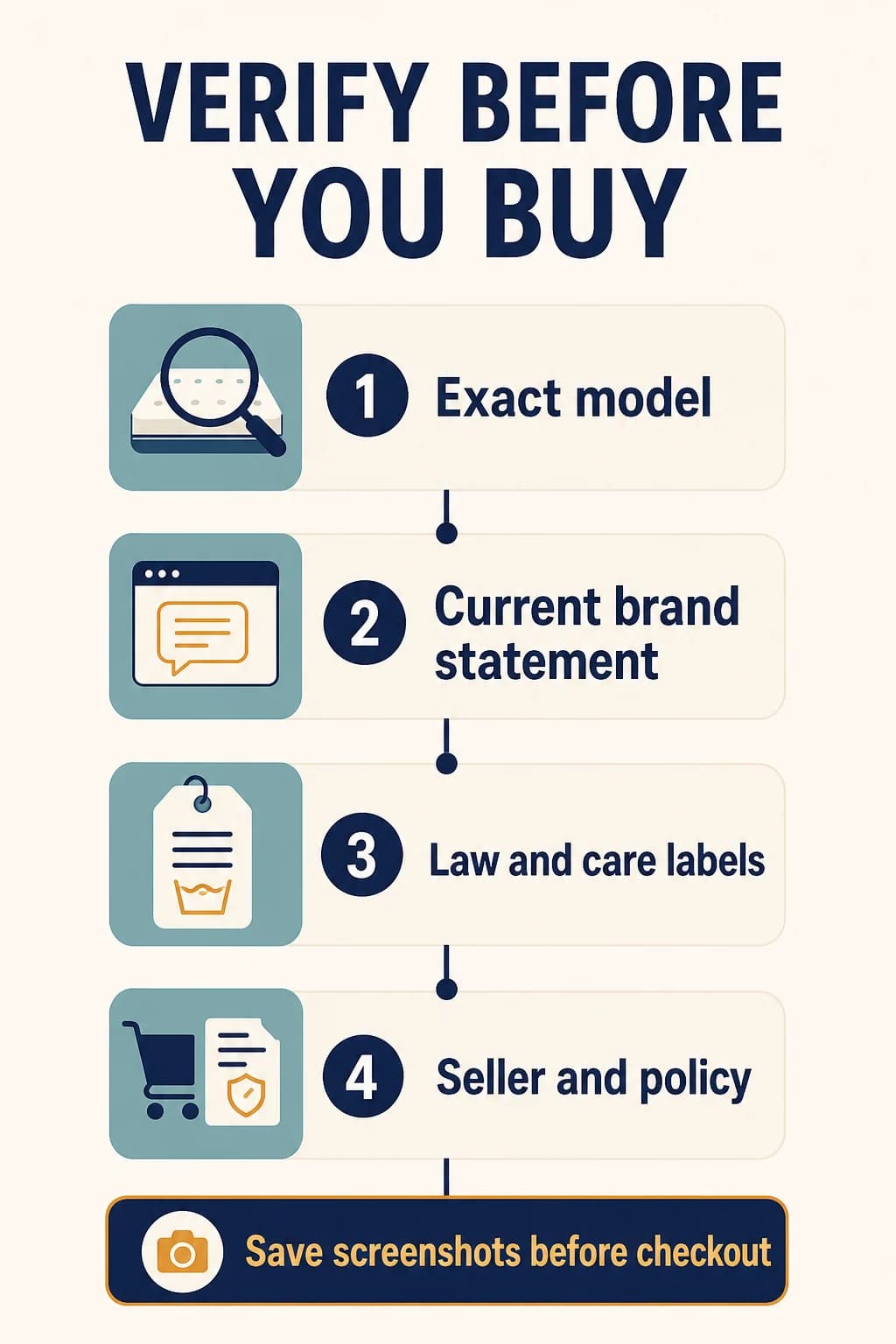
Amazon buying checklist
Before checkout, record:
- the full model name and height;
- who sells the mattress and who ships it;
- the current manufacturer's fiberglass statement;
- the fire-barrier description, if published;
- whether the seller is authorized for warranty coverage;
- which company controls the sleep trial and return;
- whether pickup, donation, disposal, or repackaging is required;
- whether an opened and expanded mattress follows a special process.
Use our mattress trial checklist for the policy side and our off-gassing guide for a separate explanation of new-product odor. Odor does not identify fiberglass.
Final verdict
Tuft & Needle Original is the strongest general starting point in this shortlist because the brand currently provides both a model-family exclusion and a barrier description. Bear Original Hybrid and DreamCloud Classic Hybrid offer coil-based alternatives with current fiberglass-free statements. Avocado Eco Organic is the natural-material research route with wool identified in the construction. Naturepedic Concerto adds the plush pillow-top route and a specific Twin Amazon listing. DreamCloud and Naturepedic have direct listing links here; Tuft & Needle, Bear and Avocado have research searches, not verified Amazon offers.
The decisive step happens after the shortlist: match the exact product, current disclosure, delivered labels, seller, and return policy. That is more trustworthy than a “verified safe” badge—and it remains useful when brands, model generations, or marketplace listings change.
Sources
- CPSC mattress flammability standards FAQ
- ATSDR synthetic vitreous fibers fact sheet
- NIOSH Pocket Guide: fibrous glass dust
- Tuft & Needle mattress materials and fiberglass statement
- Bear fiberglass statement
- DreamCloud Classic Hybrid materials statement
- Avocado Eco Organic materials statement
- Naturepedic Concerto construction and fiberglass statement
- CertiPUR-US certification FAQ