
Side sleepers (~60% of adults)
Need medium to medium-plush mattresses with at least 3" of pressure-relieving foam. Zoned support with softer shoulders is ideal.
Read side sleeper guide →Jump to any section or bookmark this page as your sleep health reference.
Published July 5, 2026 / Updated July 5, 2026 / By MattressProducts.com Editorial Team
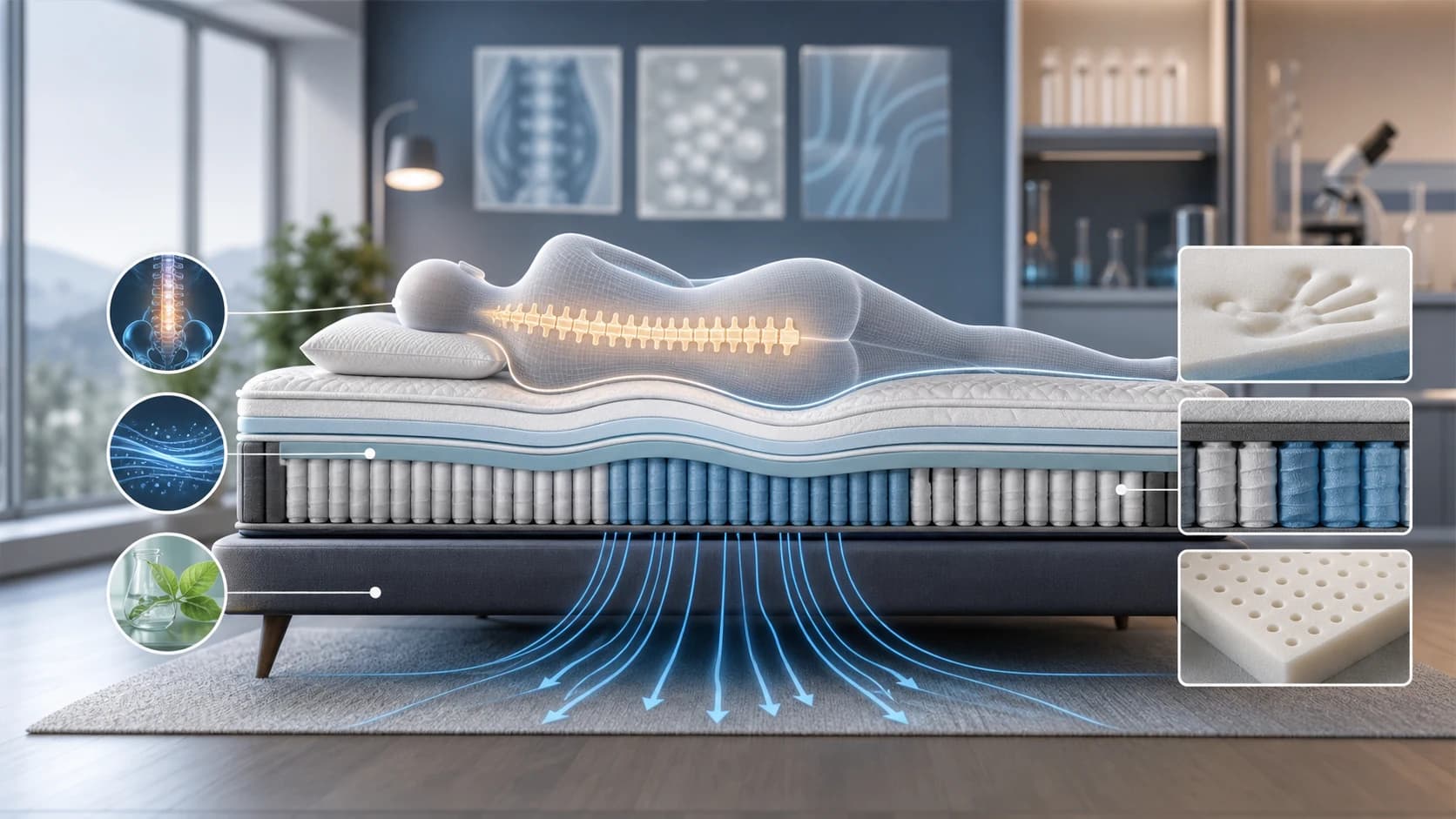
Does your bed feel too firm, too warm, or uncomfortable in your usual sleep position? Start with that question. These guides explain comfort and support, with technical details further down when you need them.
Start here
Choose the pathway that matches the symptom or sleep position you are researching.
Quality sleep depends on more than a quiet room. Your musculoskeletal system rests against a layered mechanical structure for hours at a time. If that structure loses support, traps heat, or contains poorly documented materials, the result can be more movement, more pressure, and less consistent rest.
The right question is not whether a mattress is simply soft or firm. A better evaluation asks how its comfort layers compress, whether the support core resists pelvic sink, how quickly the surface recovers after movement, and whether the material disclosures are clear enough for a health-conscious bedroom.
YMYL note
Mattress guidance is educational and should not replace medical care. Persistent pain, numbness, apnea symptoms, severe insomnia, or unexplained night sweats deserve clinician input. This page focuses on support mechanics, material transparency, and sleep-environment decisions.
Safety warning: fiberglass and VOC claims need verification
U.S. mattresses must meet federal flammability rules such as CPSC 16 CFR Part 1633. Some budget designs use glass-fiber barriers. Check the physical law tag for glass fiber, fiberglass, glass wool, or continuous filament glass language, and do not unzip covers unless the manufacturer explicitly says it is safe.
Mattress mechanics
Marketing phrases like orthopedic support are weak unless they resolve into measurable construction. The useful signals are layer density, ILD, support factor, coil gauge, zoning, recovery speed, and how those features match body weight and sleep position.
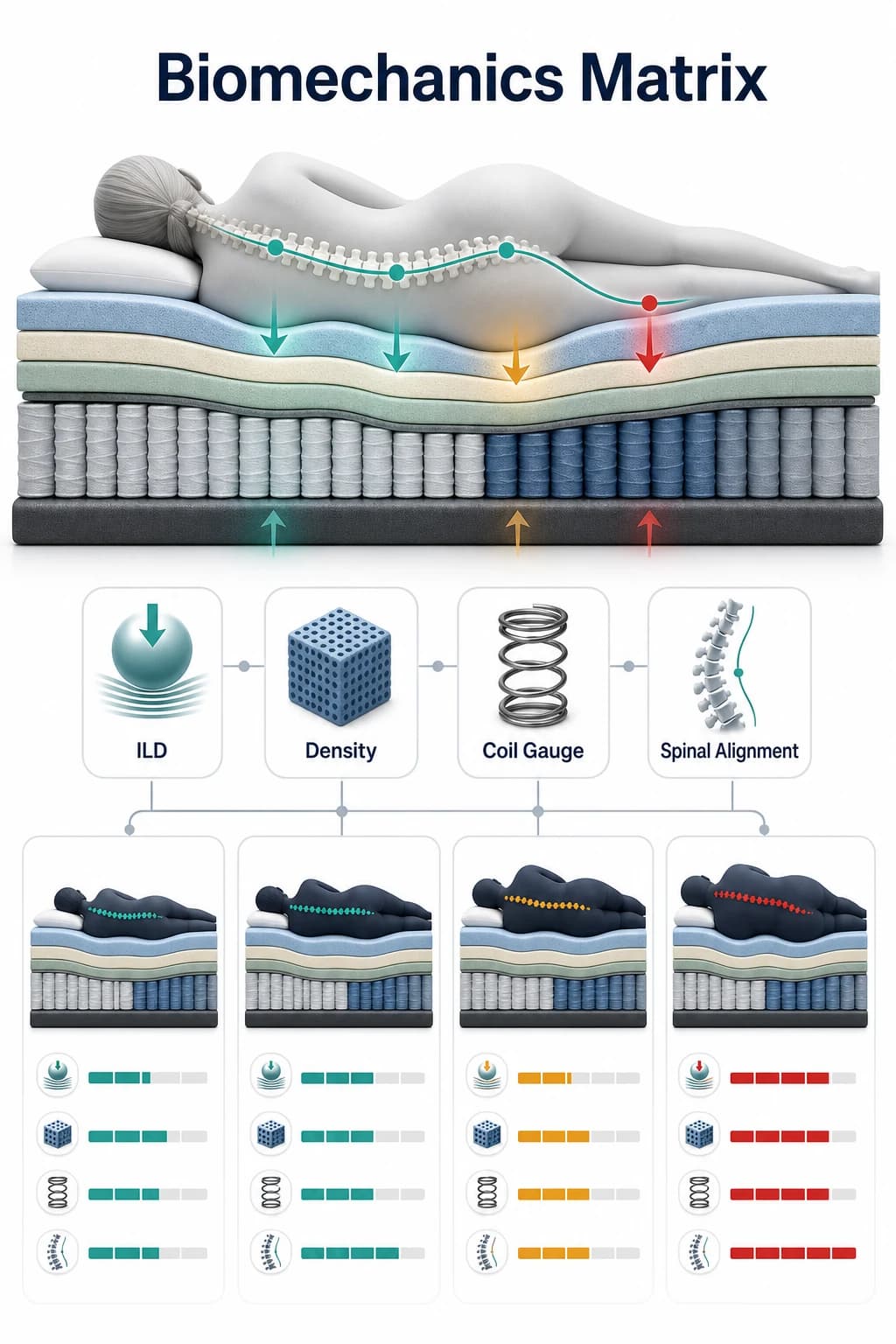
| Metric | Why it matters | How to use it |
|---|---|---|
| Indentation Load Deflection (ILD) | Foam firmness under a standardized compression test, commonly referenced from ASTM D3574-style methods. | Use low-to-mid comfort ILD for pressure relief and firmer transition/support ILD for pelvic control. |
| Foam density | Material mass per cubic foot; a practical durability proxy for polyurethane and memory foam layers. | Be cautious with low-density comfort foam under heavy body mass or long nightly load. |
| Sag factor / support factor | Ratio between deeper and shallow compression resistance; helps explain whether foam bottoms out. | Higher support factor is more relevant than a simple soft/firm label for lumbar stability. |
| Coil gauge and zoning | Steel wire thickness and support distribution; lower gauge means thicker wire. | Look for stronger lumbar/perimeter zones when edge support, pelvic lift, or higher body weight matter. |
| Viscoelastic hysteresis | Energy loss during compression and recovery; high hysteresis can make movement feel slower. | Combination sleepers often need faster recovery than dense slow-response memory foam provides. |
Viscoelastic stress relaxation
sigma(t) = strain x (E_inf + sum(E_i x exp(-t / tau_i)))
Plain English: foam can lose part of its pushback under constant nightly load. Density, support factor, and recovery speed help explain why a mattress may feel supportive at bedtime but less stable by morning.
Spinal deflection model
support profile k(x) should counter body load q(x)
Plain English: the shoulder, waist, and pelvis do not load the bed equally. Zoned coils, latex response, and transition layers matter because the support profile needs to match anatomical load distribution.
Decision matrix
Use body mass, position, heat profile, and material-safety sensitivity before choosing a brand. This prevents the common mistake of buying the same medium-firm mattress for every sleeper.
| Sleeper profile | Main risk | Recommended architecture | Specs to verify | Why it helps |
|---|---|---|---|---|
| Lightweight side sleeper under 130 lb | Shoulder impingement and hip pressure | Latex or adaptive foam comfort layer over responsive support | Comfort ILD around 14-19, enough shoulder travel, breathable cover | More contact area and lower peak pressure without excessive pelvic drop |
| Average multi-position sleeper 130-230 lb | Lumbar strain and restless position changes | Zoned pocketed coil hybrid with responsive transition layer | Alternating 14-15 gauge zoning, medium-firm feel, quick recovery | Balanced spinal alignment while still allowing side-sleep pressure relief |
| Heavy sleeper over 230 lb | Pelvic dip, edge roll-off, early foam fatigue | High-density comfort system over reinforced nested coils or dense latex | 13.75-14 gauge support zones, dense foam or Dunlop latex, strong edge support | Better resistance under concentrated load and less bottoming out |
| Hot sleeper or night-sweat concern | Heat retention and humidity buildup | Coil-forward hybrid, latex, or open-cell foam with breathable textile stack | Phase-change or breathable cover, airflow core, light protector and sheets | More convective airflow and less trapped moisture around the body |
Understanding sleep stages helps you evaluate mattress features more critically. Each stage has different requirements, and your mattress influences how smoothly you cycle through them.
| Sleep Stage | Duration | Purpose | Mattress Role |
|---|---|---|---|
| Light Sleep (N1-N2) | ~50% of night | Transition and memory processing | Comfort layers help you drift off faster |
| Deep Sleep (N3) | ~20% of night | Physical restoration, immune function | Proper support prevents micro-awakenings |
| REM Sleep | ~25% of night | Memory consolidation, emotional processing | Temperature regulation prevents disruption |
Your dominant sleep position determines which mattress features matter most. Side sleepers need pressure relief at shoulders and hips; back sleepers require lumbar support; stomach sleepers need firm surfaces to prevent spinal hyperextension.
Need medium to medium-plush mattresses with at least 3" of pressure-relieving foam. Zoned support with softer shoulders is ideal.
Read side sleeper guide →Need medium-firm support with lumbar fill. Hybrids and latex work well for maintaining neutral spine alignment.
Read back sleeper guide →Need firm mattresses with thin comfort layers. Hip elevation is critical to avoid lower back strain.
Read stomach sleeper guide →Need responsive mattresses with quick recovery and good edge support. Hybrids with zoned coils work best.
Read position pillar guide →Your body temperature drops 1-2°F during sleep to initiate rest. Mattresses that trap heat disrupt this natural process, leading to restlessness and reduced deep sleep. Modern cooling technologies address this through:
Chronic pain and poor sleep can reinforce each other. A better-matched mattress may reduce mechanical pressure points and support spinal alignment, but it should not be treated as medical care.
| Pain Type | Recommendation | Related Guides |
|---|---|---|
| Lower Back Pain | Medium-firm support with lumbar zone reinforcement | |
| Hip Pain | Pressure-relieving memory foam with zoned support | |
| Shoulder Pain | Softer comfort layer with shoulder-zone relief | |
| Chronic Pain | Adjustable firmness or hybrid with targeted zones |
Material safety
A sleep-health page should not rely on vague natural, orthopedic, or doctor-recommended language. Foam, textile, flame-barrier, and emission claims need to connect to real disclosures such as law tags, CertiPUR-US, GREENGUARD Gold, OEKO-TEX Standard 100, GOTS, GOLS, and CPSC 16 CFR Part 1633 compliance.
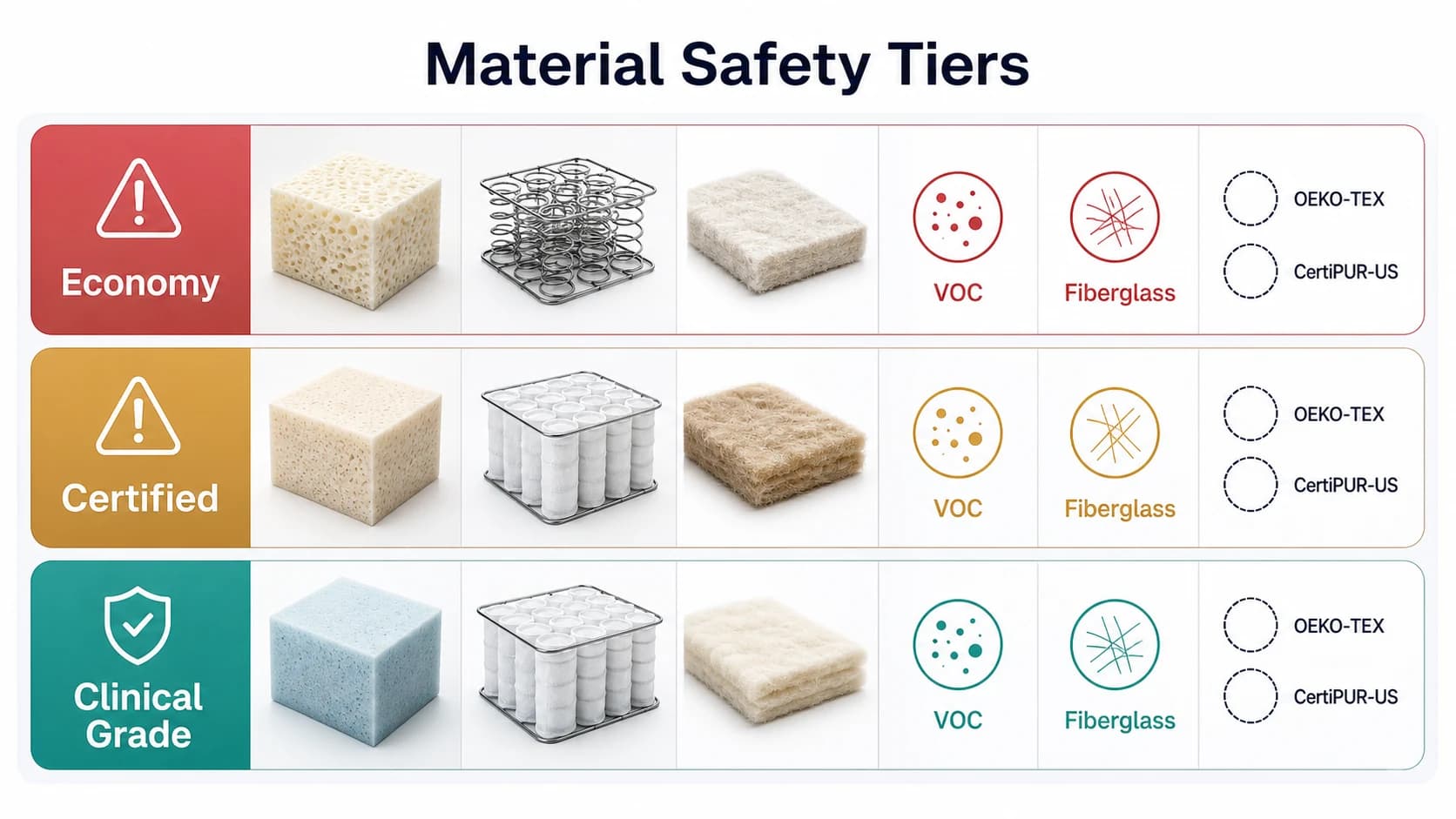
Construction: Low-density polyfoam, generic coils, unclear fire barrier language
Safety signal: Higher risk of early softening, fiberglass confusion, and vague VOC claims
Durability lens: Often shows comfort loss in 12-24 months under adult load
Construction: 1.8-2.5 lb/ft3 foam, zoned coils, CertiPUR-US or GREENGUARD Gold language
Safety signal: Better emissions transparency and usually stronger warranty documentation
Durability lens: Often the best value tier for 5-7 year performance expectations
Construction: High-density memory foam, natural latex, hand-tufting, wool/cotton barriers, stronger coils
Safety signal: Look for OEKO-TEX Standard 100, GOTS, GOLS, or detailed law-tag clarity
Durability lens: Built for longer structural integrity when the design fits body weight
Law-tag check
If a label lists glass fiber, fiberglass, glass wool, or continuous filament glass, treat the cover as non-removable unless the manufacturer states otherwise. If emissions are a concern, match the certification to the material: CertiPUR-US for polyurethane foam, OEKO-TEX for textiles, GREENGUARD Gold for low emissions, and GOTS/GOLS for organic textile or latex supply chains.
Direct Amazon product checks
These direct product CTAs are not a diagnosis or prescription. They are high-quality reference points for comparing hybrid support, elastic pressure relief, topper intervention, and pillow alignment using current Amazon listings and product images.
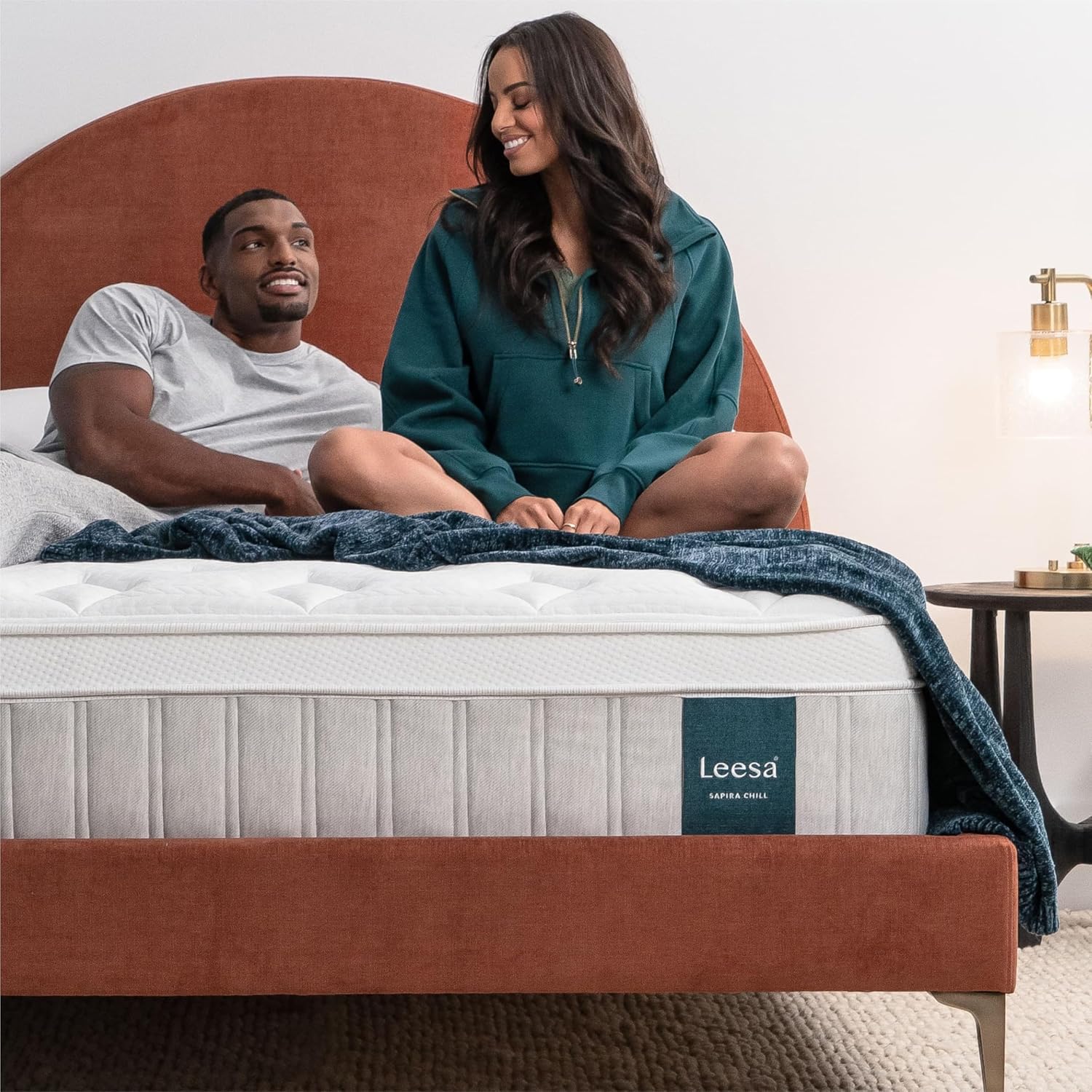
Premium cooling hybrid reference point with CertiPUR-US foam language and a coil-forward support system.
Before checkout
Use the listing as the source of truth for current price tier, seller, delivery window, and return terms.
Prices, coupons, availability, shipping, and return terms change often. Confirm current details on Amazon before purchase. As an Amazon Associate, we earn from qualifying purchases.
GelFlex Grid benchmark for pressure redistribution, airflow, and a nontraditional elastic support feel.

Before checkout
Use the listing as the source of truth for current price tier, seller, delivery window, and return terms.
Prices, coupons, availability, shipping, and return terms change often. Confirm current details on Amazon before purchase. As an Amazon Associate, we earn from qualifying purchases.
Dense viscoelastic topper benchmark for changing pressure relief without replacing a still-supportive mattress.

Before checkout
Use the listing as the source of truth for current price tier, seller, delivery window, and return terms.
Prices, coupons, availability, shipping, and return terms change often. Confirm current details on Amazon before purchase. As an Amazon Associate, we earn from qualifying purchases.
Premium pillow benchmark for matching cervical support to mattress sink and sleep position.

Before checkout
Use the listing as the source of truth for current price tier, seller, delivery window, and return terms.
Prices, coupons, availability, shipping, and return terms change often. Confirm current details on Amazon before purchase. As an Amazon Associate, we earn from qualifying purchases.
Sleep requirements and physical needs change throughout life. Children need support for growing spines; adults face position-specific challenges; seniors need easy mobility and joint protection.
Key needs: Growth support, durability, easy cleaning
Recommendation: Medium-firm with waterproof protector
Read detailed guide →Key needs: Spinal development, temperature regulation
Recommendation: Medium-firm hybrid with cooling features
Read detailed guide →Key needs: Position-specific support, partner compatibility
Recommendation: Based on sleep position and body type
Read detailed guide →Key needs: Easy mobility, joint support, edge stability
Recommendation: Medium-firm with strong edge support
Read detailed guide →Mattresses cannot cure sleep disorders, but sleep setup changes may support comfort while you follow medical guidance:
Comfortable mattresses reduce sleep latency and nighttime awakenings. Focus on pressure relief and temperature neutrality.
Adjustable bases with head elevation may help some sleepers rest more comfortably. Consult a sleep specialist for diagnosis and treatment.
Pressure-relieving mattresses may reduce discomfort. Knee elevation with adjustable bases can also help.
Cooling mattresses with phase-change materials and breathable covers may reduce heat-related sleep disruption.
Always consult a healthcare provider for persistent sleep issues. A mattress supports good sleep but cannot replace medical treatment.
Athletes and active individuals have elevated recovery needs. During deep sleep, the body releases growth hormone, repairs muscle tissue, and consolidates motor learning. Optimizing sleep quality directly impacts performance.
Recovery tip
Treat sleep quality as part of training recovery. A supportive, temperature-neutral sleep setup can make nightly recovery habits easier to maintain.
Indentation Load Deflection is a foam firmness measure based on the force required to compress a foam sample. It matters because comfort layers need enough give for pressure relief while transition and support layers need enough resistance to limit pelvic sink.
Not by itself. Orthopedic support is usually marketing language unless the brand explains measurable construction details such as foam density, ILD, coil gauge, zoning, support factor, and warranty indentation thresholds.
Read the law tag and brand material page. Watch for glass fiber, fiberglass, or glass wool language, and look for CertiPUR-US, GREENGUARD Gold, OEKO-TEX Standard 100, GOTS, or GOLS claims that match the material being used.
No mattress should be treated as medical care. A better-matched mattress can support comfort, pressure relief, and sleep posture, but persistent pain, apnea symptoms, severe insomnia, or neurologic symptoms should be discussed with a qualified clinician.
Explore our in-depth guides covering specific sleep health topics. Each article connects back to this hub for comprehensive reference.
Comprehensive guide to spinal alignment and pain relief
FundamentalsUnderstanding the 1-10 firmness scale and your ideal feel
TemperatureTemperature regulation for hot sleepers
TemperatureLatest technology in sleep temperature control
Pain ReliefTargeted pressure relief for hip discomfort
Life StageAge-appropriate comfort and mobility support
Life StageTrimester-aware comfort, pressure relief, and support guidance
Sleep DisordersElevation, cooling, and support considerations to discuss with a clinician
Pillow SupportMatch pillow loft to side, back, stomach, and combination sleeping
CareKeep your investment performing for years
Pain ReliefComplete pillar guide to pain-conscious shopping
Free decision tools
Use these sleep health tools to estimate sleep debt, tune comfort accessories, and check pillow support before making a purchase decision.
sleep debt calculator
Calculate your recent sleep debt, understand recovery pressure, and get practical sleep routine guidance for better rest.
Open toolweighted blanket calculator
Calculate a common adult weight reference and review comfort checks, including separate references for couples.
Open toolpillow loft calculator
Estimate your ideal pillow loft using sleep position, body build, shoulder width, and mattress firmness.
Open toolStart with position, body weight, support architecture, material safety, and temperature control before comparing brands.