
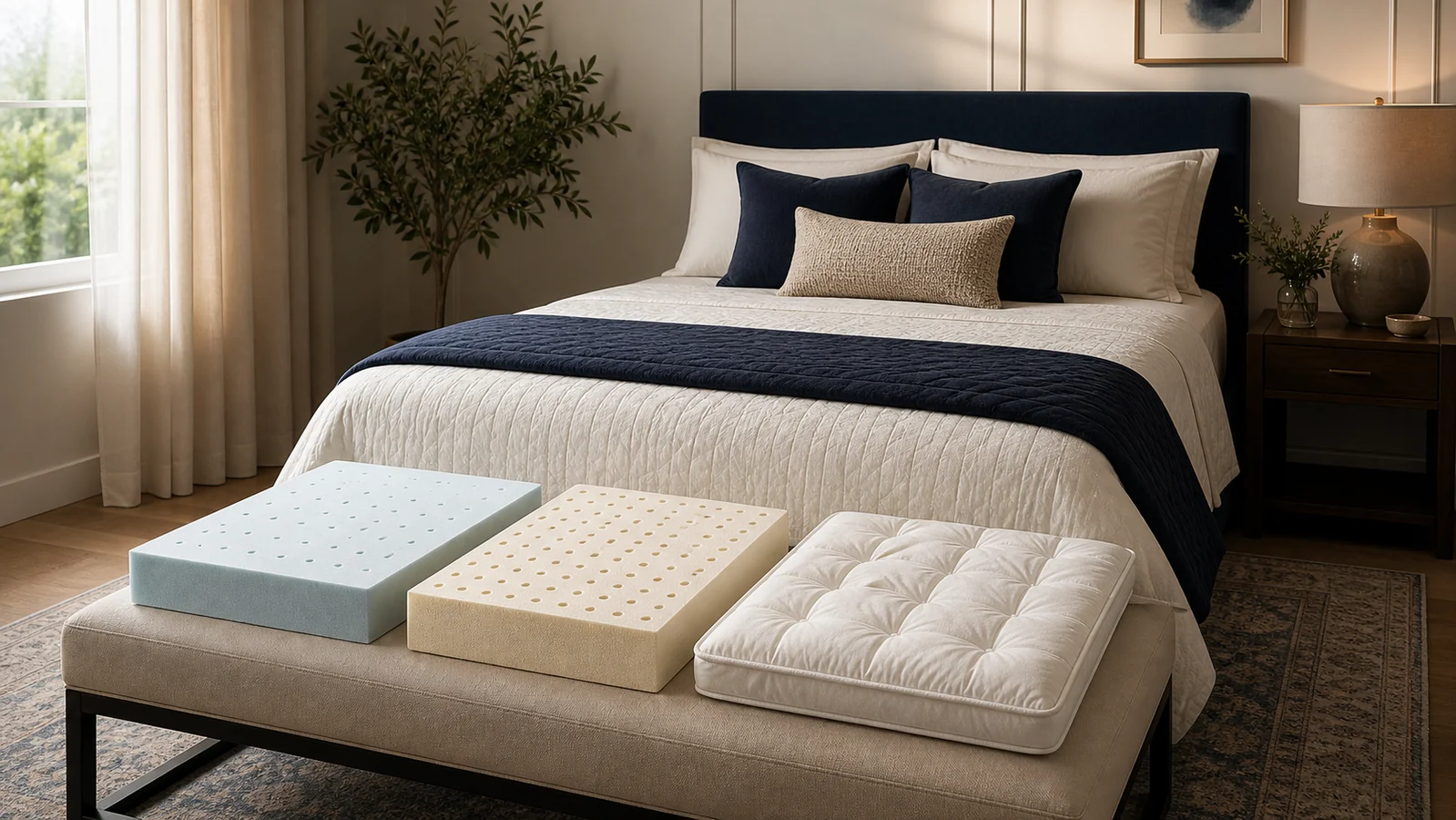
The best mattress topper is the one that makes the specific change your current bed needs. Choose slow-contouring memory foam for deeper cushioning, responsive latex for pressure relief with easier movement, or a quilted pad for a small surface refresh. Do not buy any topper to hide sagging, a damaged foundation, or an unsuitable support core—it will conform to the problem rather than repair it.
Choose the function, material and depth first
- Material: latex or memory foam? Compare response and contour before shortlisting.
- Depth: two inches or three? Match the intended change and complete bed height.
- Category: pad, topper or protector? Separate cushioning from surface refresh and protection.
Choose your topper research route
Use this page for the overall Amazon shortlist. Follow a specialist route when you already know the problem you want to solve.
| Your decision | Start here | What the guide adds |
|---|---|---|
| A firm, flat bed needs more cushioning for side sleeping | Side-sleeper toppers | Softness, turning and two- versus three-inch tradeoffs |
| You want latex and need to choose the configuration | Latex toppers | Thickness, firmness, cover and purchase channel |
| Heat is part of the problem | Cooling toppers | Passive comfort layers versus actual temperature control |
| Discomfort raises a support question | Topper choices for back discomfort | Limits of cushioning and when a topper is the wrong fix |
| You are unsure whether to replace the mattress | Topper or new mattress? | A decision aid before spending on another layer |
Topper, pad or protector: buy the function you need
A topper adds a substantial comfort layer. A quilted pad mainly changes the surface and bedding feel. A protector addresses protection; cushioning and waterproofing are separate product features. Our quilted-pad option below is therefore a light-refresh alternative, not an equivalent substitute for the foam or latex picks. Use the protector guide when protecting the mattress is your main goal.
For the broader construction underneath those accessories, see mattress types and materials. Adding latex to an all-foam mattress changes its surface; it does not replace the core or make the whole mattress all-latex.
Quick answer
For a narrower shortlist, compare toppers for side sleepers, latex topper configurations, or passive cooling toppers. Each guide focuses on a different purchase decision.
Should you buy a topper at all?
Use this shortlist if
- The mattress is flat and supportive but feels somewhat too firm or lacks surface cushioning.
- You want a reversible comfort change for a guest bed, dorm bed, rental, or otherwise sound mattress.
- You can keep the topper clean while evaluating it and have verified the order-specific return terms.
Use a different route if
- The mattress has a visible dip, broken edge, damaged cover, failing support, or incompatible foundation.
- You need a medical treatment, structural repair, or a guaranteed cooling result.
- The topper would make the bed difficult to enter, keep sheets fitted, or remain within a required bed-rail height.
Decision-first shortlist
Fast picks: three verified Amazon product pages
These routes solve different problems. We verified the named product pages on August 12, 2026; availability, selected size, seller, delivered price and return method can change.
1. Best responsive route
Pure Green Natural Latex Topper
A three-inch medium latex option for shoppers who want a substantial comfort layer without the slow recovery of memory foam.
- Best for
- People who value responsiveness, easier movement and a buoyant surface
- Avoid if
- You want a deep memory-foam hug, a very light topper, or the lowest price tier
- Construction
- 3-inch GOLS-certified organic natural latex; Queen medium variant
- Price tier
- Premium
2. Best deep-cushion budget route
Linenspa 3-Inch Gel Memory Foam Topper
A simple plush foam layer that makes a larger feel change than a thin pad and contours more slowly than latex.
- Best for
- A sound but noticeably firm mattress that needs more shoulder and hip cushioning
- Avoid if
- You sleep very warm, dislike sink, or only need a subtle surface change
- Construction
- 3-inch gel-infused memory foam; Queen variant
- Price tier
- Budget
3. Best light refresh
Utopia Bedding Quilted Fitted Mattress Pad
A thin fitted pad for a modest change in hand feel without adding a thick independent foam layer.
- Best for
- Guest beds and mattresses that need only slight surface softness
- Avoid if
- You need meaningful pressure relief, structural support, or a dramatic firmness change
- Construction
- Quilted fiber-filled fitted pad; Queen variant
- Price tier
- Budget
Prices, sizes, sellers, availability and return terms can change. Confirm the exact listing before purchase. Amazon buttons are affiliate links; as an Amazon Associate, we earn from qualifying purchases.
How we researched and what we did not test
We matched the current Amazon detail pages to current manufacturer descriptions and compared the decision variables a shopper can verify: material, thickness, selected size, cover, care guidance, warranty language, seller, and return route. Linenspa lists two-, three-, and four-inch gel-foam profiles; Sleep On Latex describes Pure Green as a solid natural-latex foam sheet; and Lucid lists two-, three-, and four-inch gel-foam profiles plus a three-year limited warranty.
We did not sleep-test every size, pressure-map these toppers, or measure heat flux. We therefore do not award numerical comfort, cooling, or durability scores. “Best” here means the clearest currently verifiable route for a defined use case—not a universal winner.
Memory foam: choose it for a larger softness change
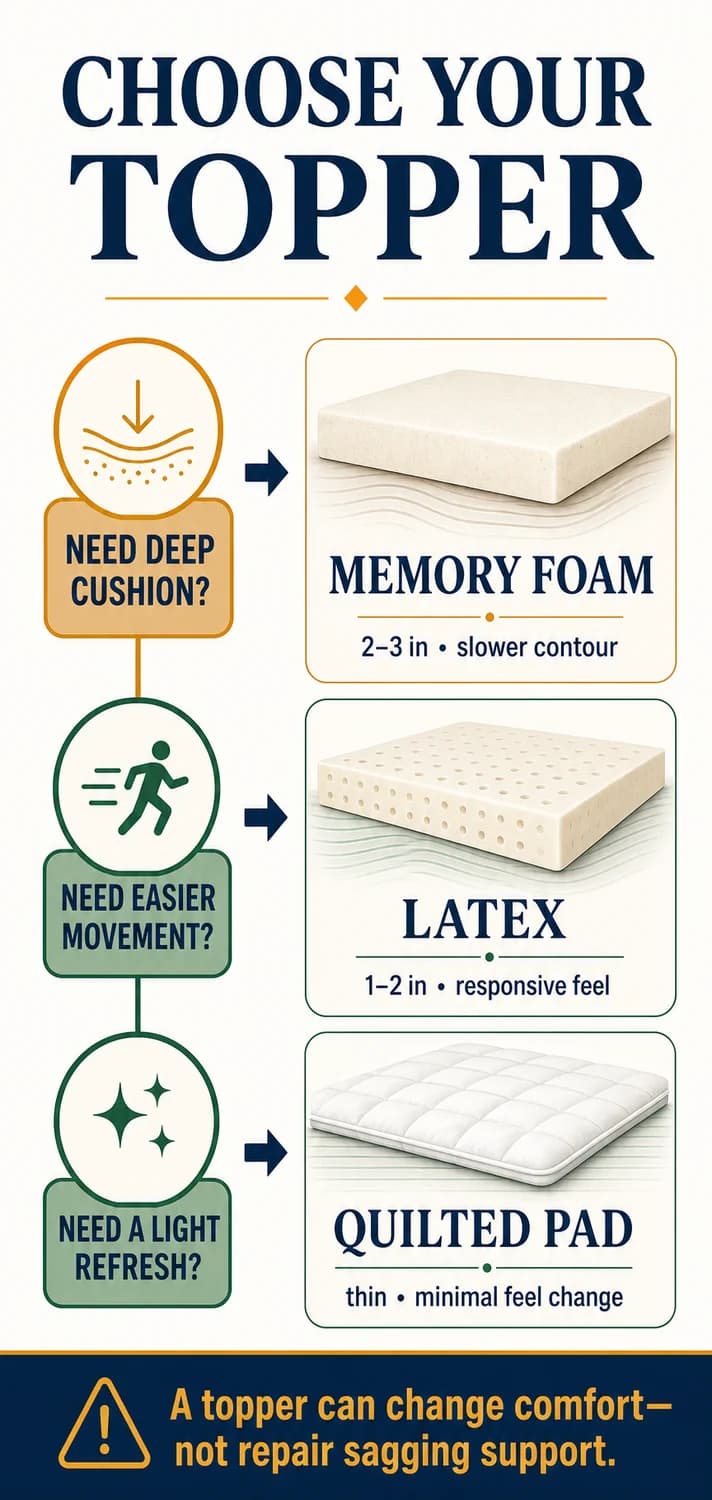
Memory foam compresses and recovers more slowly than springier materials. A thicker piece usually lets the shoulder and hip sink farther, which can reduce the sharp surface pressure of a firm mattress. It also means more body enclosure, slower movement, and a greater chance that someone who already sleeps warm will dislike the result.
Do not treat “gel” as proof of all-night cooling. The label identifies an added material, not the duration or conditions of a thermal test. The room, protector, sheets, duvet, foam depth, and how deeply you sink can matter as much as the marketing term.
Choose the Linenspa route when the current mattress is flat and supportive, the desired change is clearly softer, and the budget matters. Skip it when the mattress already feels slow, the sleeper changes position frequently, or three extra inches create a sheet or bed-height problem.
Latex: choose it for cushioning with faster response
Latex compresses under load but rebounds quickly. That makes it a useful route for shoppers who want pressure relief without feeling as settled into the surface. The tradeoffs are price, weight, and a distinct buoyant feel that is not a substitute for memory foam.
The verified Pure Green link opens the Queen, three-inch, medium-firm variant. Amazon variation families can change the selected size or style, so confirm all three attributes before checkout. Sleep On Latex also sells other thicknesses and firmnesses; one product-family name does not make those variants interchangeable.
Quilted pad: choose it only for a light refresh
A fitted quilted pad can smooth the hand feel, add a little loft, and protect the top surface. It is not a structural topper. That distinction matters because a thin pad is easier to handle and less likely to dominate the mattress feel, but it cannot provide the depth needed to redistribute significant shoulder or hip pressure.
Use this route when “slightly less stark” is the goal. If you are already thinking about stacking two pads, adding blankets under the sheet, or buying a second layer, stop and reassess the mattress itself.
Thickness: start with the smallest change likely to work
Thickness is not a quality grade. It controls how much material can compress before the sleeper feels the mattress below.
- Around one inch: fine tuning; the underlying mattress remains dominant.
- Around two inches: meaningful cushioning for many sleepers without the largest possible sink.
- Around three inches: a major comfort-layer change; more pressure-relief potential, but also more movement, heat, edge, and sheet-fit tradeoffs.
Body shape, weight distribution, sleep position, and foam firmness change the result. A three-inch firm latex topper may feel more supportive than a two-inch soft memory-foam topper. Compare the complete specification rather than choosing the biggest number.
Before checkout: verify these seven fields
- Exact size: Queen, Olympic Queen, RV Queen, Full XL, and California King are not interchangeable.
- Exact thickness and firmness: variation selectors sometimes change more than one field.
- Material: foam, latex, fiber, and blended constructions behave differently.
- Cover and straps: confirm whether they are included, removable, and washable.
- Seller and fulfillment: record both from the live listing.
- Return route: read the current product-page language and save a screenshot.
- Care and warranty: check cleaning restrictions and whether the manufacturer recognizes the seller.
Listing is the source of truth
Do not rely on a review's old price, seller, trial or return window. Save the live variant, seller line, delivery promise and return language for the exact order you place.
A seven-night evaluation that protects the decision
Let an expanded foam or latex topper reach the manufacturer’s stated recovery time. Then use the same pillow, sheets, room temperature, and sleep schedule for several nights before changing another variable.
Use the sleep-trial diary to keep a consistent record. Record four simple outcomes each morning: pressure at shoulder/hip, ease of turning, heat or dampness, and whether the topper shifted. A topper that improves one dimension while creating a larger problem elsewhere is not a successful upgrade.
Keep packaging and documentation until you understand the order-specific return method. Do not fold, compress, wash, trim, glue, or otherwise modify the topper while you are still deciding.
Final verdict
Choose memory foam when the mattress is sound but clearly needs deeper cushioning. Choose latex when you want a substantial comfort layer with faster response. Choose a quilted pad when the mattress needs only a light refresh. If the mattress sags, lacks support, or already creates persistent worsening pain, the smarter purchase is usually not another layer—it is a warranty check, foundation correction, professional advice, or mattress replacement.