
A mattress trial is a contract-defined comfort return window, not a universal promise. Before buying, verify who the seller is, when the trial starts, whether a minimum-use period applies, what condition rules apply, who arranges pickup, and which fees can be deducted. Save the dated policy before checkout, because the current page—not a review's summary—controls the process.
There is no blanket law that forces every brand to block returns for 30 nights, no universal rule that one mark automatically voids every trial, and no fixed day when odor becomes a manufacturing defect. Those claims have been removed from this guide.
How we checked current trial rules
We compared current policy pages from Leesa, Puffy, Tuft & Needle, and Saatva because they show how much trial terms can differ even among major online brands. We also separated direct-brand terms from retailer and marketplace workflows.
This article is practical consumer information, not legal advice. State law, financing, third-party protection plans, retailer agreements, and individual facts can affect a dispute. If a seller's written policy conflicts with what happened, preserve the evidence and consider appropriate consumer-protection or legal help in your jurisdiction.
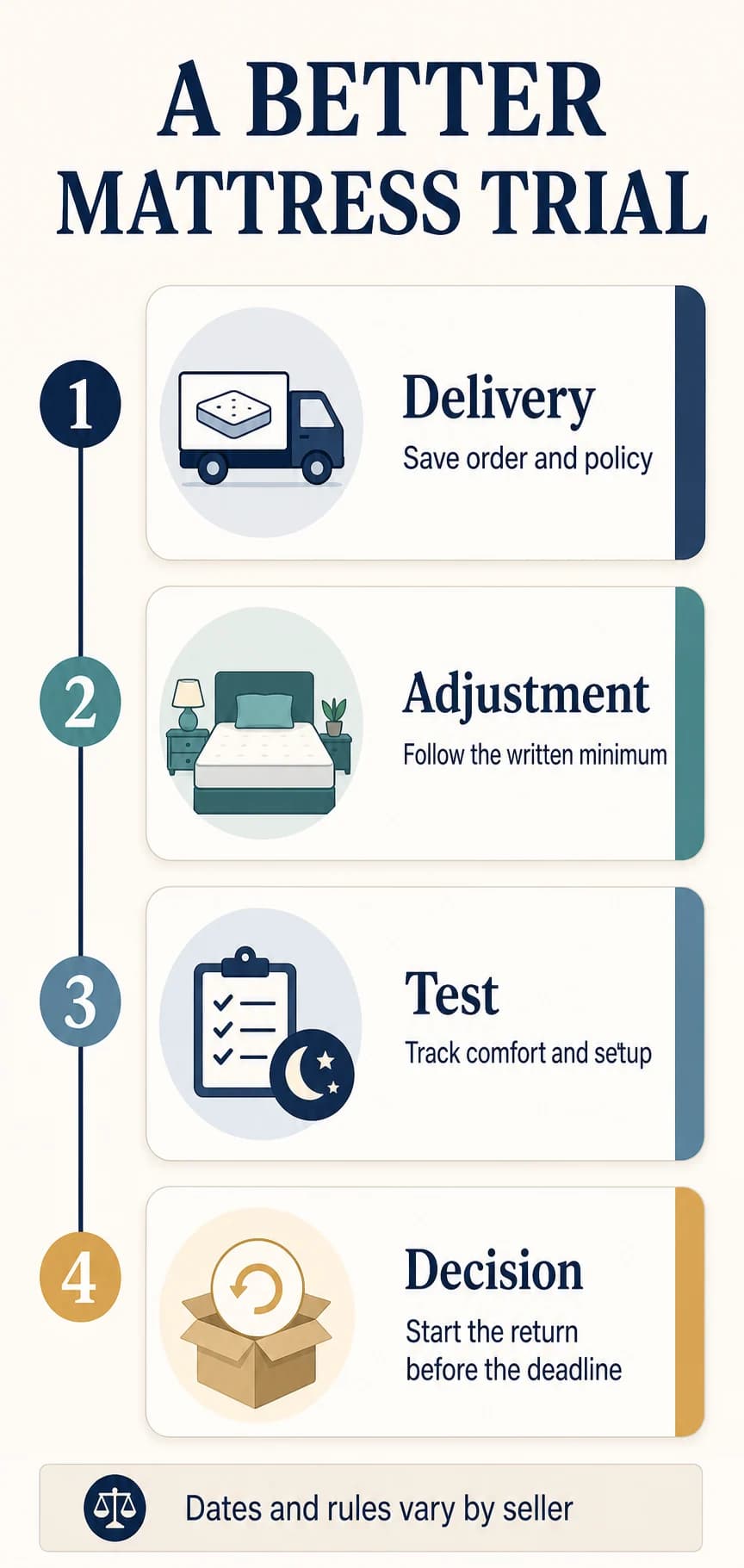
The 10-minute pre-purchase checklist
Keep our Amazon versus brand-direct return comparison open while completing this checklist. It shows why the seller and purchase channel must be verified separately from the trial headline.
1. Identify the legal seller
“Sold by,” “shipped by,” and the brand name can be three different entities. Record the seller displayed at checkout and the company named on the order confirmation. The responsible return channel may be the brand, Amazon, a marketplace merchant, or a physical retailer.
2. Save the exact policy
Save a PDF or screenshots showing:
- trial length;
- start event, such as delivery date;
- deadline and time zone, if stated;
- required minimum-use or adjustment period;
- mattress-condition requirements;
- limits per person, household, address, or year;
- pickup, shipping, donation, or disposal process;
- return, processing, transportation, or regional fees;
- direct-purchase and authorized-retailer limits;
- exchange effect on the trial;
- refund timing and excluded products.
A marketing banner such as “365 nights” is not the complete policy.
3. Separate every product in the bundle
The mattress, adjustable base, frame, protector, bedding, and free gifts can have different return terms. For example, Leesa currently excludes an adjustable base from its trial once removed from the box, while Saatva excludes adjustable bases from its mattress-and-furniture trial. That does not make every adjustable base everywhere final sale; it means the specific product policy matters.
4. Check warranty eligibility separately
A trial covers preference during a limited window. A warranty covers defined defects and normally requires the original purchaser, proper support, normal use, and an eligible seller. A long warranty does not extend the comfort trial, and a trial return does not prove a defect.
5. Confirm expanded-mattress logistics
Ask who will pick up the mattress, whether the home must be accessible to a carrier, whether the company uses donation partners, and what happens when no local organization accepts used beds. Do not assume you must find a charity or that the seller will accept any donation receipt. Follow only the approved written process for that order.
Current policy examples: why no universal rule works
| Brand and direct policy | Trial | Minimum-use rule | Return or fee detail | Important limit |
|---|---|---|---|---|
| Leesa | 120 nights | Return eligibility begins after 30 nights | Brand arranges pickup; some regions have a fee | Two eligible mattress returns per household/address |
| Puffy | 365 nights | Minimum 30 nights | Current direct mattress trial states zero return fees | Lifetime maximum of two returns per household; direct genuine purchases |
| Tuft & Needle | 100 nights | Current help page does not state a universal 30-night minimum | Returns use a partner workflow; Amazon orders return through Amazon | One return or exchange per household per 12 months |
| Saatva | 365 nights | No mandatory minimum | Current mattress return pickup has a processing fee | Adjustable bases excluded; viewing rooms do not accept returns |
These are July 13, 2026 snapshots, not permanent promises. Open the linked policy at checkout.
Leesa: 120 nights with a 30-night adjustment period
Leesa's current trial and returns page says mattresses have a 120-night trial and become eligible for return after the first 30 nights. It currently requires the mattress to be clean and undamaged, limits eligible trial returns to two mattress purchases per household or shipping/billing address, and applies a regional mattress-return fee in Alaska, Hawaii, and Canada.
Leesa also says retail partners can have different terms. This is the exact distinction a buyer should capture: the brand's direct page does not automatically govern a store purchase.
Puffy: 365 nights, 30-night minimum, household cap
Puffy's current 365-night guarantee says the mattress must be tried for at least 30 nights, the return must be exercised by the 365th day after delivery, the benefit applies to original purchasers of genuine products bought directly from Puffy, and the lifetime maximum is two returns per household.
The advertised length is generous, but the direct-purchase restriction and household cap are equally important.
Tuft & Needle: retailer-specific workflow
Tuft & Needle's current 100-night trial help page says direct orders and certain retailer purchases qualify. It currently limits returns or exchanges to one per household per 12 months. Amazon mattress orders receive a 100-night trial but must be returned through Amazon; some other products and Amazon Canada have different terms.
This is why the answer to “Does Amazon include the brand trial?” is not universally yes or no.
Saatva: no mandatory minimum, but a pickup fee
Saatva's current trial page says mattresses and most furniture have a 365-night trial, no mandatory minimum trial period, and a processing fee for mattress pickup. Adjustable bases are excluded. A long trial can still have a return cost.
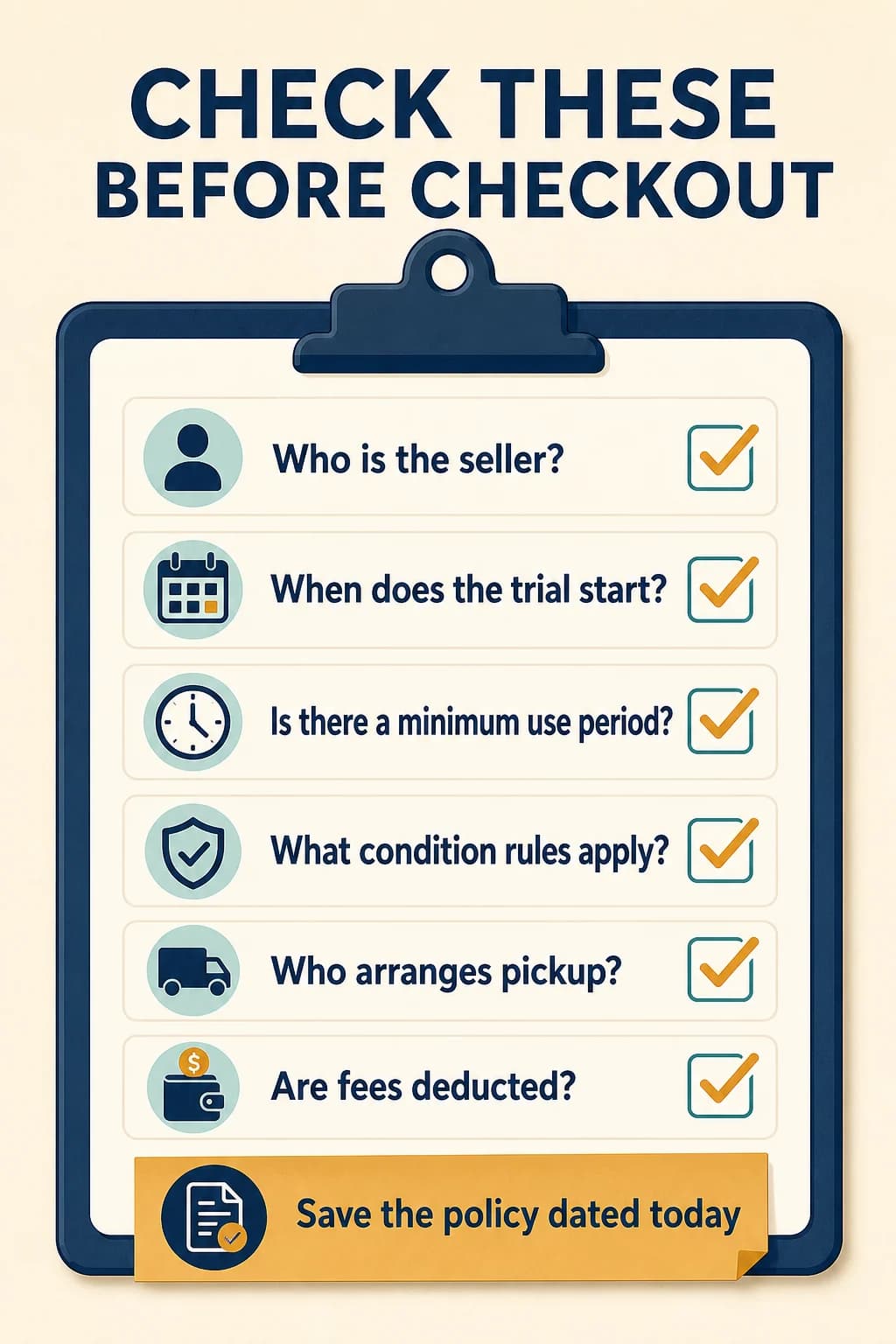
Delivery day: protect evidence without treating the bed like a crime scene
Take a few ordinary photos of the sealed package, shipping damage, mattress labels, and the mattress after setup. Keep tags attached. Save the delivery notification because many trials start on delivery rather than order date.
Use the support required by the warranty. Slat spacing, center support, floor use, and adjustable-base compatibility can differ by model. A mattress can feel too soft because the base flexes; it can also be damaged by unsupported use.
Do not unzip the cover unless the current care instructions for the exact model explicitly allow it. “Removable” does not always mean “machine washable,” and the inner fire barrier may not be intended for consumer access.
The adjustment period: what to test and what not to endure
A new surface and a compressed mattress can change over the first days or weeks. That is why some brands require a minimum-use period. It does not mean a consumer must ignore an unsafe condition, major delivery damage, an allergic emergency, or another urgent problem. Contact the seller promptly when the issue is not ordinary comfort adjustment.
For normal fit, keep variables stable for several nights:
- use the same pillow and bedding;
- keep room temperature similar;
- confirm the frame and foundation are correct;
- rotate only if the manufacturer permits it;
- note sleep position and partner presence;
- record pressure, heat, motion, edge confidence, and morning comfort.
Do not change the mattress, topper, pillow, protector, and room temperature every night; you will not know what solved or caused the problem.
Odor, expansion, stains, and damage
New-product odor
Odor is not automatically a defect. Compressed foam products can release a noticeable smell, and intensity varies. Ventilate the room and follow the manufacturer's setup guidance. If odor is severe, causes symptoms, or persists beyond the brand's guidance, document it and contact the seller. Do not invent a universal “day five” defect rule.
Our off-gassing guide explains the difference between odor, emissions testing, and a medical reaction.
Expansion
Photograph the mattress on a flat, valid support surface and measure it only after the manufacturer's stated expansion window. A rounded corner in the first hour and a persistent height shortfall after the full window are not the same situation.
Stains and sanitation
Many policies require a clean, undamaged, or sanitary mattress, but the wording varies. Use a protector that does not materially change the feel, follow care instructions, and document the mattress before pickup. Do not claim every visible mark automatically cancels every trial; quote the actual policy.
Accidental or structural damage
Comfort returns, shipping damage, accidental damage, and warranty defects are different claim types. Report the facts accurately and use the correct channel. A body impression does not become a covered defect simply because it feels uncomfortable; the warranty defines measurement and exclusions.
How to start a return
Start before the deadline, preferably in writing.
- Contact the seller named in the order.
- State the order number, delivery date, model, and that you want to use the sleep trial.
- Ask for the approved next steps and any fee in writing.
- Do not donate, discard, fold, compress, or ship the mattress until instructed.
- Take condition photos immediately before handoff.
- Keep pickup, shipping, donation, or disposal proof the seller actually requested.
- Record the expected refund amount and timing.
- Follow up until the refund reaches the original payment method or financing account.
If financing was used, confirm how the return affects future payments and any already-paid interest or fees.
Exchanges: the question that prevents surprises
Before accepting a comfort exchange, ask:
Does the replacement receive a new full trial, the remaining days of my original trial, or no comfort trial? What pickup, delivery, price-difference, and future-return terms apply?
Get the answer in writing. An exchange may be processed as a return plus a new order, or it may preserve the original clock. Never assume it resets.
If support gives conflicting answers
Policy conflicts are easier to resolve when the question is narrow and documented. Reply in the same email or chat thread with the dated policy screenshot, order number, seller name, delivery date, and the exact clause you are relying on. Ask the representative to identify which current term applies to the order and to escalate the case if needed.
Keep a simple timeline:
| Date | Event | Evidence to retain |
|---|---|---|
| Before checkout | Policy and seller captured | PDF or screenshots with URL and date |
| Delivery | Product received and inspected | Delivery notice, package and label photos |
| Trial | Comfort and setup tested | Short dated notes, support messages |
| Return request | Request opened before deadline | Case number, email, chat transcript |
| Handoff | Pickup, shipping, donation, or disposal completed | Only the proof authorized by the seller |
| Refund | Credit issued and received | Refund notice and payment-account record |
If a phone call produces an important promise, ask for email confirmation. Do not secretly record calls without understanding the consent law that applies where everyone is located. A written follow-up—“Please confirm what we agreed”—is simpler and usually more useful.
Cancellation is not the same as a return
An order may move from cancellable to in production, shipped, or delivered. White-glove mattresses, made-to-order sizes, and marketplace freight shipments can have separate cancellation terms before the sleep trial even starts. If plans change, contact the seller immediately and ask whether the order can be stopped, redirected, refused, or must proceed to the formal return process.
Refusing delivery without authorization can create storage, redelivery, or refund disputes. Follow the seller's written instruction instead of assuming refusal automatically cancels the transaction.
Marketplace purchases
On Amazon or another marketplace, save the order-page return eligibility and seller identity. A brand may honor its product warranty but require the marketplace to process the comfort return, or it may limit both benefits to authorized sellers. Listing reviews can be merged across models and sellers, so they are not policy evidence.
Our Amazon mattress return playbook focuses on the marketplace workflow.
Research Mattresses with Documented Trial Terms
Compare the exact seller, model, return window, expanded-mattress process, fees, trial owner, and warranty before ordering.
Before checkout
Use the listing as the source of truth for current price tier, seller, delivery window, and return terms.
Prices, coupons, availability, shipping, and return terms change often. Confirm current details on Amazon before purchase. As an Amazon Associate, we earn from qualifying purchases.
Final verdict
The safest assumption is that no summary—including this one—replaces the policy attached to your order. Save the terms, keep the mattress in eligible condition, test it under consistent conditions, contact the correct seller before the deadline, and follow the approved pickup or return route.
That process is less dramatic than “return hacks,” but it is more reliable. It also survives policy changes because it focuses on evidence, dates, seller responsibility, and written instructions.