
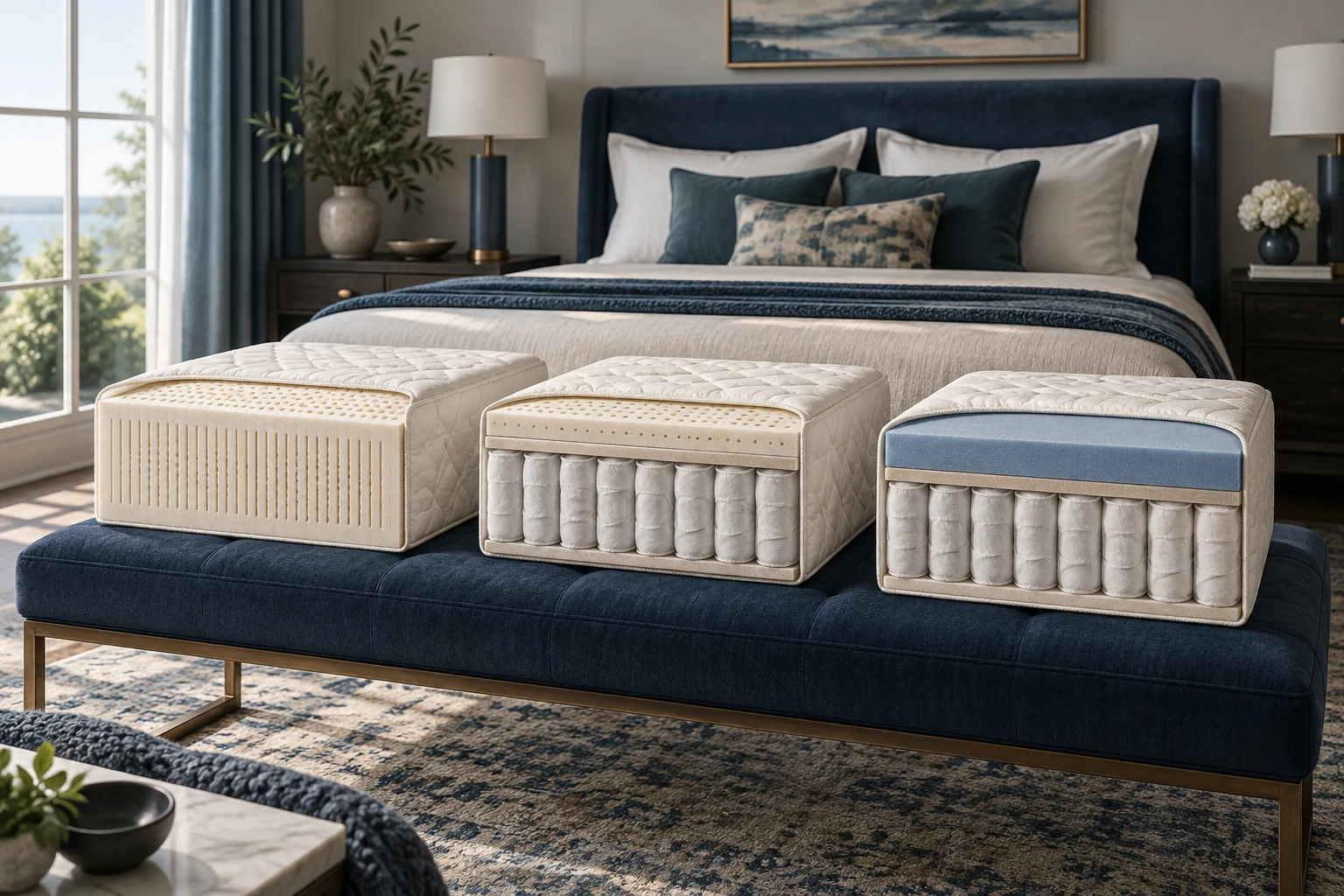
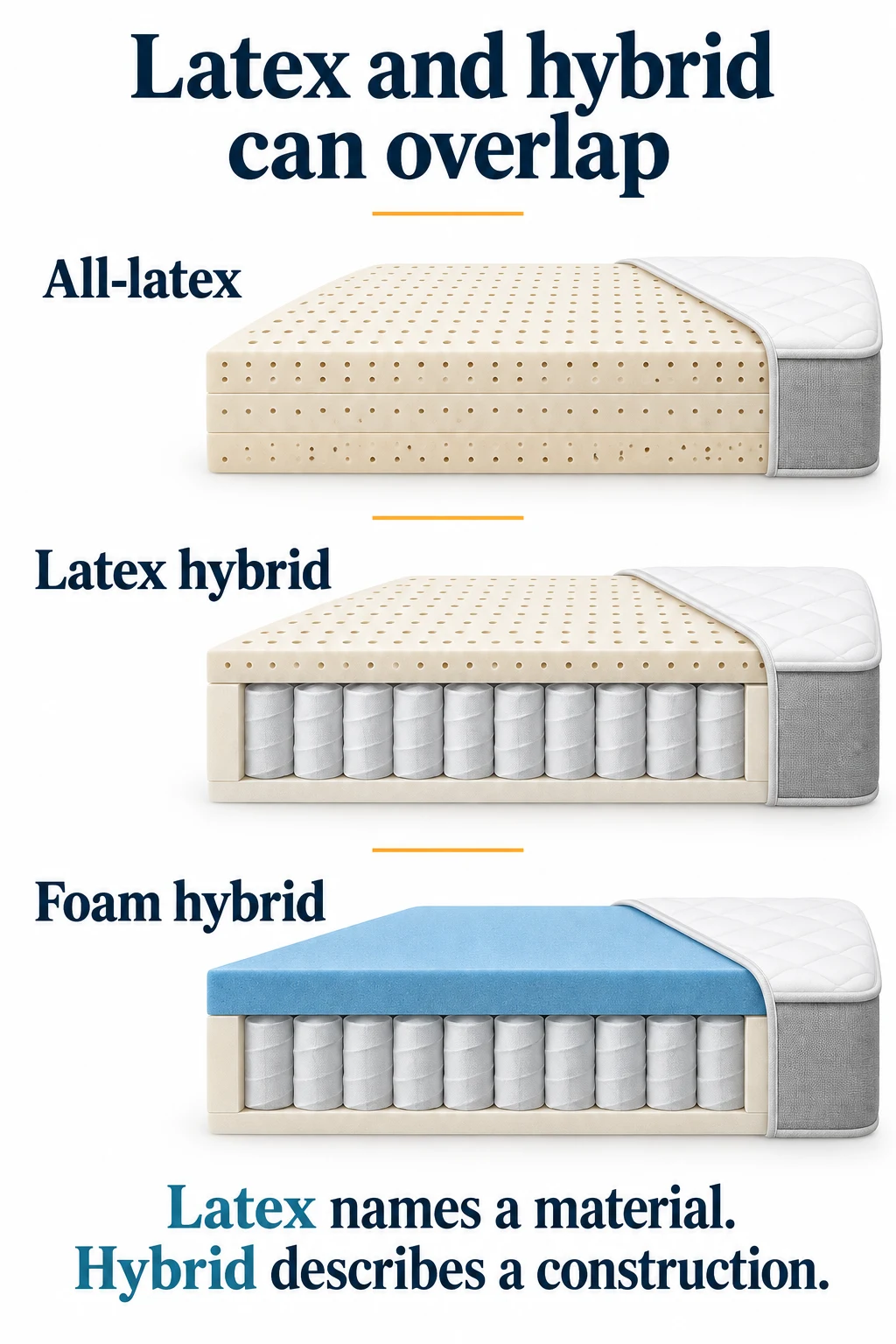
Latex and hybrid are not mutually exclusive choices. Latex names a material; hybrid describes a construction that combines a substantial comfort system with coils. A latex hybrid belongs to both groups. The useful comparison is all-latex versus latex-over-coils versus other foam-over-coils.
Start by deciding whether your uncertainty is about the surface feel or the support core. That prevents you from excluding a suitable latex hybrid because you thought every hybrid used the same comfort foam. This is a researched construction guide, not a hands-on performance test.
The three routes at a glance
| Construction | Comfort system to identify | Support system to identify | Main question before shortlisting |
|---|---|---|---|
| All-latex | Latex layers and their firmness configuration | Latex core | Do I want this complete latex build and its feel? |
| Latex hybrid | Latex, plus any other stated comfort materials | Coils and any additional support layers | Do I want latex over a coil-based system? |
| Foam hybrid | The specific comfort foam; it may or may not be memory foam | Coils and additional layers | Does this foam formulation provide the surface response I prefer? |
For a concrete example, the Avocado Green Mattress combines latex with coils. It therefore demonstrates the overlap directly. Tempur-Pedic's description of its hybrid feel describes another route: TEMPUR material over a coil system. Neither example makes every variant interchangeable or supplies our own measured ranking.
Compare the surface and the core in separate steps
First identify the response you want at the surface. If slow contour is what you dislike, changing from all-foam to a foam hybrid may not remove it when the new bed still uses a similar comfort material. If you like latex's springier response, adding coils below latex is a different comparison from replacing latex with memory foam.
Second compare the complete construction. Layer depth, firmness configuration, cover and coil system can differ at the same time. Do not attribute every difference to the core alone. The latex versus memory foam mattress guide focuses on that separate comfort-material question, while the mattress types pillar maps the categories.
Which route fits your shopping question?
You already like latex and want to compare support designs. Shortlist an all-latex model and a latex hybrid in the appropriate size and intended feel. Compare the actual upper layers and their firmness before drawing conclusions about coils. If one has a thick plush pillow top and the other is a firmer flat build, this is not an isolated core comparison.
You want coils but are undecided about surface feel. Compare latex hybrids with the specific foam hybrids that address your preference. “Hybrid” alone cannot tell you whether a bed will feel quick, slow, close-contouring or relatively buoyant.
You and your partner want different things. Compare size, shared surface, edge use and movement together. Do not pick a category from a generic motion-isolation claim. Our couples comparison provides the partner-specific next step.
Your existing frame is unstable. None of the three mattress categories repairs it. Check the bed-frame compatibility tool and the foundation comparison before placing a new mattress on the same unresolved support problem.
Claims that should not decide the purchase by themselves
More coils is not a complete quality score. Coil count without the size, design and rest of the construction is not enough to compare two beds. Likewise, a latex percentage without a clear definition of what is being measured is not a full description of the mattress.
Do not assume all-latex always lasts longer or every hybrid sleeps cooler. This guide provides no comparable longevity or temperature testing. The durability guide explains the construction and ownership evidence worth checking without inventing a service-life promise.
Natural and organic claims also need a defined scope. Check whether documentation applies to a latex component, a textile or the finished product. Do not transfer a manufacturer's certification for one variant to another model or to every material in the build.
Compare ownership alongside construction
Get the size-specific weight, delivery format and handling directions for the actual model. An all-latex mattress may be flexible and awkward to move, but “hybrid” does not guarantee an easy lift either. Plan the route and help needed from the documented product rather than the category stereotype.
Check base and adjustable-frame approval before checkout. A construction diagram does not establish compatibility. Follow the mattress manufacturer's model-specific instructions for support and the base maker's limits for the complete system.
An owner discussion comparing all-latex with latex hybrids highlights a useful unresolved question: how much of the difference comes from the core? We cannot answer that from the labels alone. Compare the upper layers, firmness and exact models before attributing the change to coils. The discussion informed the question; it is not test evidence.
Finish with a shortlist of actual constructions. Use the latex buying guide when latex is the priority, or the hybrid buying guide when a coil-based system is the priority. Then compare the model-specific tradeoffs, return route and complete installed cost.
Choose your next step
Talk through the tradeoffs
Open an editable question in the Sleep Advisor. Nothing is sent to AI until you submit it.