
Expert Reviews
We aggregate findings from Sleepopolis, Sleep Foundation, Forbes, CNET, and other trusted sleep publications to identify consensus opinions and notable disagreements.
Jump to comparisons, brand profiles, or our methodology for evaluating mattresses.
Published August 21, 2026 / Updated August 21, 2026 / By MattressProducts.com Editorial Team
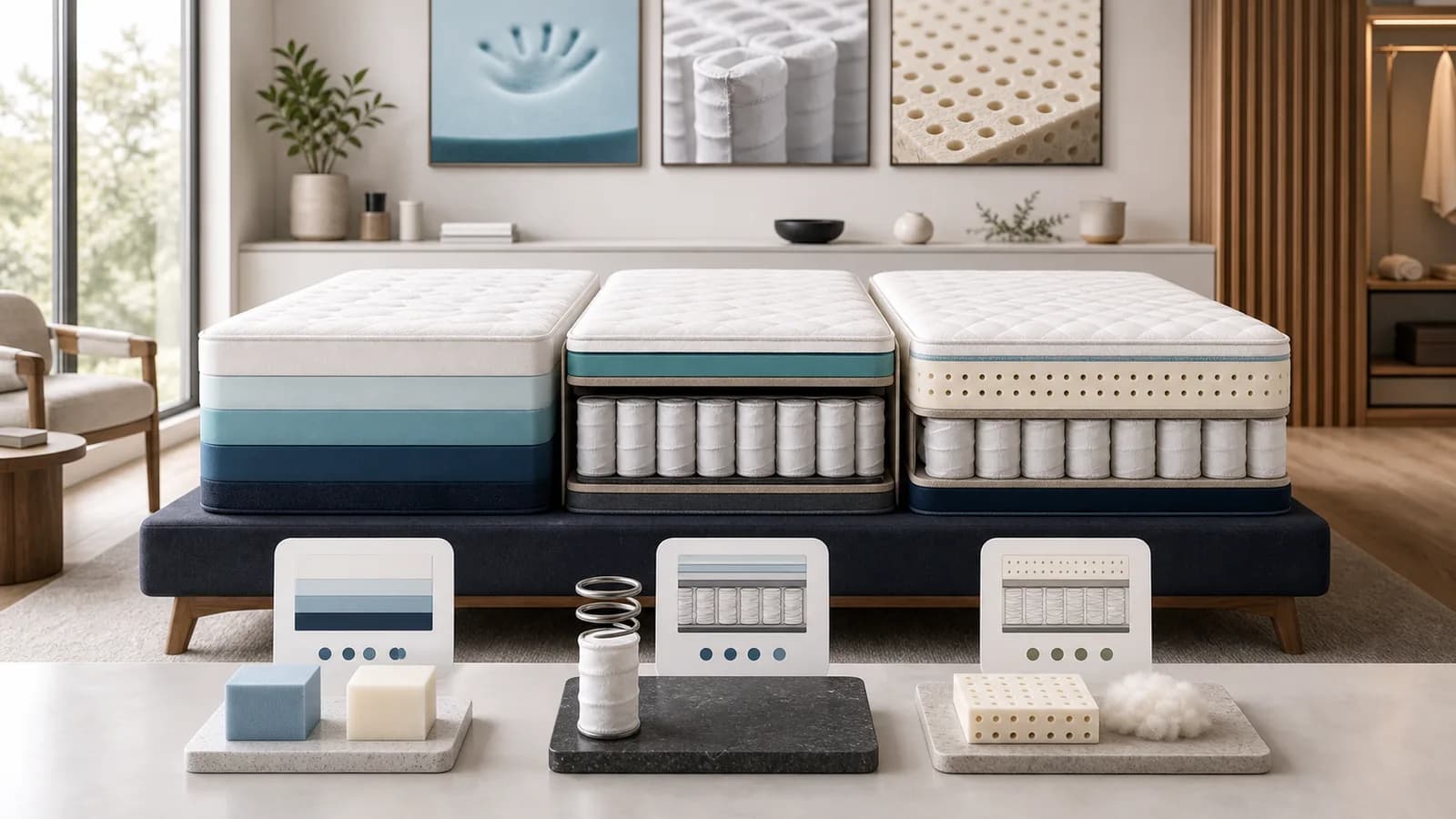
Choose the two brands you are considering, then compare the exact models, who they may suit, their drawbacks, and the seller’s return terms. The construction tables below help explain the differences.
If you still need to understand one lineup before choosing an opponent, begin in the mattress reviews library and return here once the decision is genuinely head-to-head.
Start here
Jump from the hub into the brand review that matches your shortlist.
Brand comparisons help you cut through marketing noise and understand real differences. Selecting a mattress is not only a subjective comfort decision; it is a materials and support decision. Your body weight, sleep posture, temperature profile, and spinal alignment needs require specific physical properties from the comfort layers and support core.
There is no universally “best” mattress brand. The right shortlist depends on whether you need viscoelastic motion damping, coil airflow, latex resilience, stronger edge support, or a split-firmness route.
Our comparisons focus on:
Material integrity warning: the density gap
Low-density polyurethane comfort layers can feel plush on day one but soften faster under heat, moisture, and repeated compression. When a comfort layer loses elastic recovery, the pelvis can sink too far and the support core has to do all the work. For regular adult use, be skeptical when brands hide foam density, ILD context, coil construction, fire-barrier details, or warranty indentation thresholds.
Materials science filter
Brand pages often describe mattresses as plush, supportive, or cooling. Those labels are not enough. A better comparison asks what the mattress is made from, how the layers respond under load, and which specs are actually disclosed.
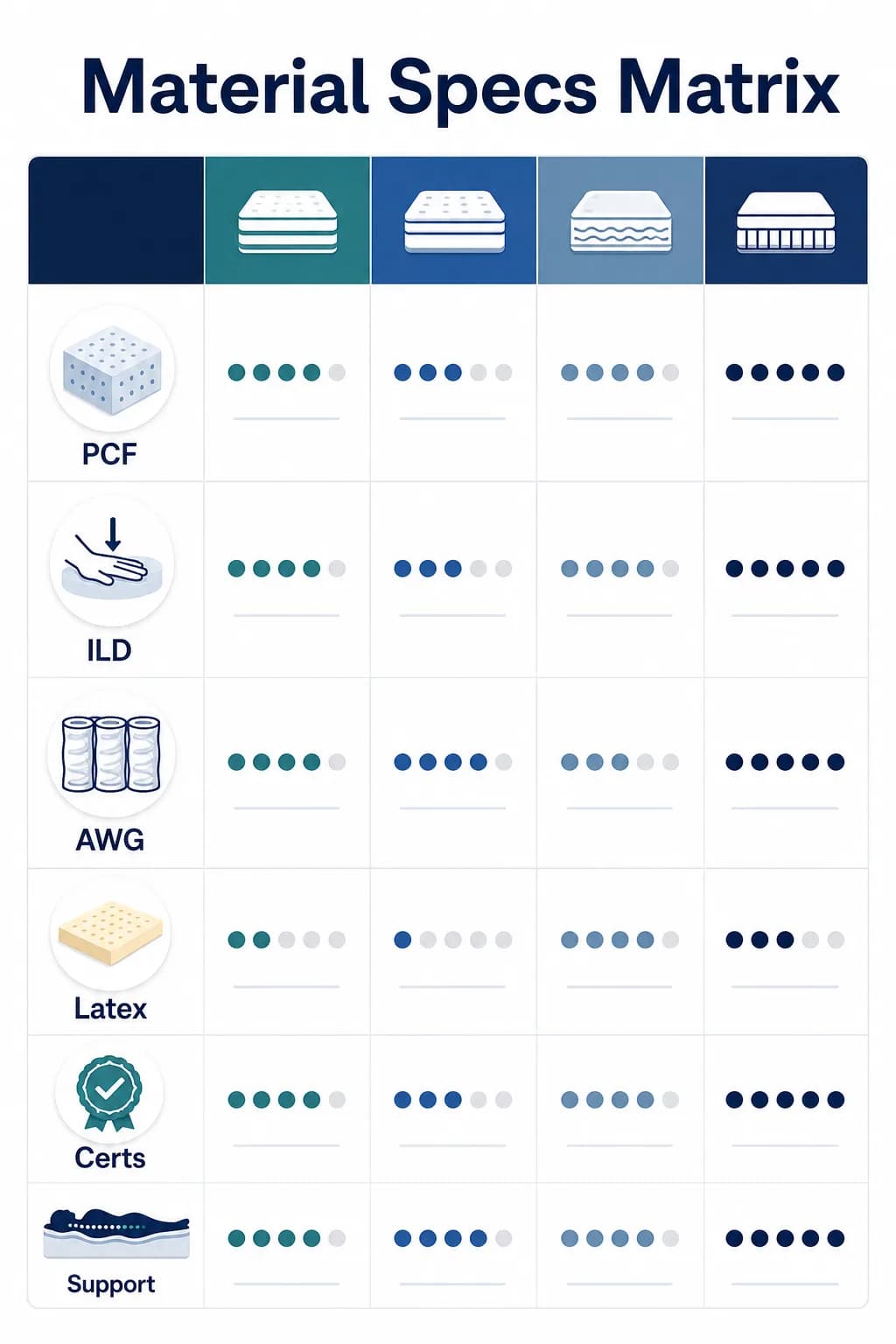
| Spec | Useful benchmark | How shoppers should use it |
|---|---|---|
| PCF foam density | Memory foam: prefer 4.0+ PCF when disclosed; support polyfoam: 1.8+ PCF is a stronger signal | Filters out low-density comfort layers that may soften quickly under heat and cyclic loading. |
| 25% ILD | Comfort layers often sit around 10-18 ILD; support layers need much firmer resistance, often 32-45 ILD | Separates plush pressure relief from the support needed to prevent bottoming out. |
| Coil gauge (AWG) | Common support range is roughly 13.75-15 AWG; lower gauge means thicker wire | Helps judge edge support, pelvic lift, and suitability for heavier sleepers. |
| Latex route | Compare Dunlop for denser lift vs Talalay for a more buoyant, airy feel | Useful for hot sleepers, combination sleepers, and shoppers avoiding deep memory-foam sink. |
| Certification layer | CertiPUR-US, OEKO-TEX Standard 100, GOLS, GOTS, and published fire-barrier language | Adds material transparency beyond brand claims and affiliate ranking language. |
Technical terms should improve the decision, not make the page sound scientific for its own sake. PCF, ILD, AWG, CertiPUR-US, OEKO-TEX, GOLS, GOTS, ASTM D3574, Leggett & Platt Quantum Edge, TEMPUR material, and Talalay latex are useful because they point to real material behavior or verification standards.
Decision framework
Start with the sleeper profile, then choose the architecture. Brand names should come after support needs, not before them.
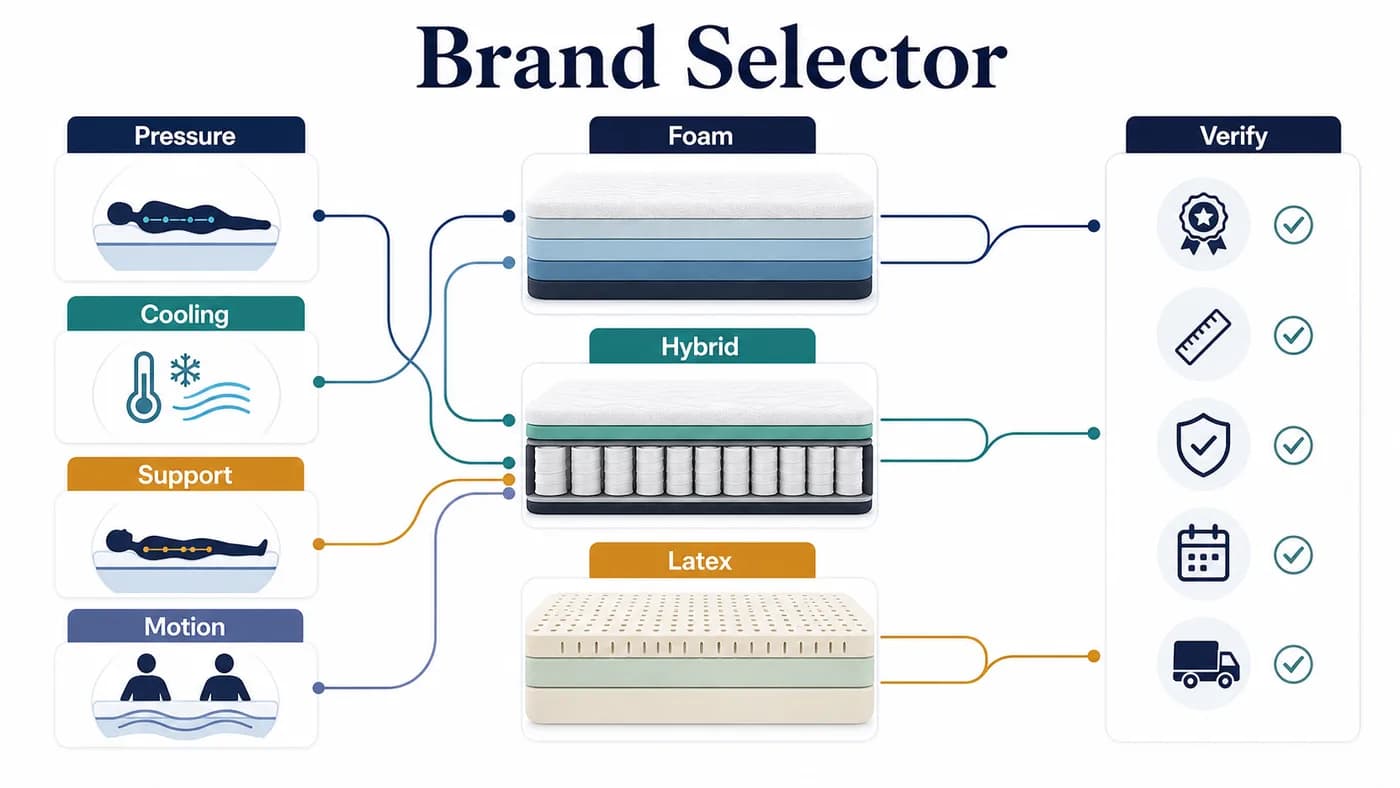
| User profile | Best architecture | Specs to verify | Why it works |
|---|---|---|---|
| Petite side sleeper | Softer memory foam or foam-forward hybrid | Pressure-relief comfort layer, lower ILD top foam, stable base foam | Reduces shoulder and hip pressure without requiring a very firm coil response. |
| Average multi-position sleeper | Medium hybrid or responsive foam | Pocketed coils, moderate comfort stack, breathable cover | Balances movement, pressure relief, and spinal support across positions. |
| Hot sleeper or couple | Coil-forward hybrid, latex hybrid, or grid-style comfort | Airflow through coils, breathable cover, less dense top foam | Controls heat better than dense all-foam when two bodies load the surface. |
| Heavier stomach/back sleeper | High-tensile zoned hybrid or denser latex build | Firmer center third, reinforced perimeter, lower-gauge support zones | Prevents deep pelvic drop and keeps the lumbar area better supported. |
| Lumbar-sensitive shopper | Zoned pocketed coil hybrid | Lumbar zoning, transition foam, medium-firm support path | Targets the hip and lumbar zone without making the shoulder area overly firm. |
We synthesize data from multiple sources to create comprehensive comparisons:
We aggregate findings from Sleepopolis, Sleep Foundation, Forbes, CNET, and other trusted sleep publications to identify consensus opinions and notable disagreements.
We review recurring themes from Amazon owner feedback, focusing on comfort, durability, and customer service experiences while noting that individual listings can change.
Foam density, ILD context, coil specifications, latex type, certifications, fire-barrier language, and warranty terms are cross-checked against current brand or seller documentation where available.
We regularly review trial periods, warranty processing, and return policies since these often change. Always confirm current terms before purchasing.
Transparency note
We’re Amazon affiliates and may earn commissions on purchases. This doesn’t influence our comparisons—we recommend products based on fit, not commission rates. See our affiliate disclosure for details.
Start with the brands on your shortlist:
Natural latex hybrids compared by feel, certification scope, model choice, and return friction
Latex response versus a traditional coil-on-coil feel and service-led buying route
Retail collection names, coil architecture, luxury tiers, and exact-model risk
Value-led hybrid response versus premium slow-adapting pressure-relief foam
Three of the most popular bed-in-a-box brands compared on comfort, cooling, and value
Which mattress type works better for partners with different needs?
Natural and eco-friendly brands compared for materials, certifications, and value
Premium brands that deliver high-end features while live prices are confirmed on Amazon
Quick reference for the most popular mattress brands and the material evidence to verify before trusting a comparison:
| Brand | Specialty | Price tier | Spec checkpoint | Policy check | Best For |
|---|---|---|---|---|---|
| Nectar | Value memory foam | Mid-range tier | Memory foam density, cooling cover, base foam support | Confirm current Amazon vs brand-direct terms | Side sleepers seeking pressure relief on a budget |
| DreamCloud | Luxury hybrid | Premium tier | Pocketed coils, comfort foam thickness, edge support | Confirm current Amazon vs brand-direct terms | Couples wanting edge support and bounce |
| Purple | Grid technology | Premium tier | Grid thickness, coil support, cooling airflow | Confirm current listing and warranty terms | Hot sleepers and back pain sufferers |
| Casper | Balanced foam | Mid-range tier | Zoned support, foam response, hybrid vs foam route | Confirm active seller and return terms | Combination sleepers wanting responsiveness |
| Avocado | Organic latex hybrid | Premium tier | GOLS/GOTS signals, latex type, zoned coils | Confirm organic certifications and current terms | Eco-conscious shoppers comparing latex hybrids |
| Helix | Personalized hybrids | Premium tier | Model firmness, coil zoning, comfort layer route | Confirm active model, firmness, and policy details | Sleepers using quiz-based firmness guidance |
| Tuft & Needle | Simple foam | Mid-range tier | Adaptive foam, base foam density, warranty path | Confirm current Amazon listing terms | Budget-conscious shoppers wanting quality basics |
| Zinus | Budget foam | Budget tier | Foam density disclosure, fiberglass status, return terms | Confirm seller, returns, and warranty eligibility | Guest rooms, apartments, and first mattresses |
| Brooklyn Bedding | Customizable hybrids | Premium tier | Firmness route, cooling cover, coil unit | Confirm active model and seller terms | Different firmness preferences between partners |
| Leesa | Social impact foam | Mid-range tier | Foam stack, hybrid route, CertiPUR-US language | Confirm current Amazon vs brand-direct terms | Conscious consumers wanting quality and giving back |
| Saatva | Luxury innerspring-style builds | Luxury tier | Coil-on-coil support, lumbar zoning, delivery terms | Confirm delivery, return, and fee terms | Shoppers comparing premium support and service models |
| Tempur-Pedic | Premium pressure-relief foam | Luxury tier | TEMPUR feel, cooling route, showroom/retailer terms | Confirm current collection, delivery, and trial terms | Pressure-relief shoppers comparing luxury foam |
| WinkBeds | Reinforced luxury hybrid | Premium tier | Reinforced coils, firmness route, edge support | Confirm firmness, warranty, and return terms | Back sleepers and heavier sleepers comparing hybrids |
Direct Amazon checks
These are direct product CTAs with Amazon image URLs, used as material benchmarks for the hub. They are not a substitute for reading the current listing. Always confirm size, seller, price, delivery, trial, return terms, and warranty path before checkout.
A luxury hybrid benchmark for comparing plush comfort, pressure relief, and coil support against other premium brands.

Before checkout
Use the listing as the source of truth for current price tier, seller, delivery window, and return terms.
Prices, coupons, availability, shipping, and return terms change often. Confirm current details on Amazon before purchase. As an Amazon Associate, we earn from qualifying purchases.
A balanced hybrid benchmark for shoppers comparing zoned support, motion isolation, and breathable foam against all-foam alternatives.

Before checkout
Use the listing as the source of truth for current price tier, seller, delivery window, and return terms.
Prices, coupons, availability, shipping, and return terms change often. Confirm current details on Amazon before purchase. As an Amazon Associate, we earn from qualifying purchases.
A firmer traditional-brand benchmark for buyers prioritizing pocketed coils, edge support, and stronger lift.

Before checkout
Use the listing as the source of truth for current price tier, seller, delivery window, and return terms.
Prices, coupons, availability, shipping, and return terms change often. Confirm current details on Amazon before purchase. As an Amazon Associate, we earn from qualifying purchases.
A memory-foam benchmark for comparing motion isolation, CertiPUR-US language, and firm all-foam support against hybrid options.

Before checkout
Use the listing as the source of truth for current price tier, seller, delivery window, and return terms.
Prices, coupons, availability, shipping, and return terms change often. Confirm current details on Amazon before purchase. As an Amazon Associate, we earn from qualifying purchases.
Understanding what you get at each price point helps set realistic expectations:
Examples: Zinus, Linenspa, Lucid
What you get: Often lower-density polyfoam, thinner comfort layers, simpler coil units or all-foam cores
Best for: Temporary housing, guest rooms, budget-first shoppers
Examples: Nectar, Tuft & Needle, Casper Original
What you get: Better foam density signals, CertiPUR-US language, basic zoning, clearer return terms
Best for: Primary mattress for most sleepers
Examples: DreamCloud, Purple, Helix Luxe
What you get: Pocketed coils, reinforced edges, PCM/cooling covers, latex/grid/advanced comfort layers
Best for: Couples, pain sufferers, quality-focused buyers
Examples: Tempur-Pedic, Sleep Number, Saatva HD
What you get: Premium pressure-relief foam, coil-on-coil support, advanced service models, specialized firmness routes
Best for: Those prioritizing sleep quality above cost
Side-by-side feature comparison of popular brands with the material signal that matters most:
| Brand | Type | Material signal | Support signal | Cooling | Motion | Edge | Price |
|---|---|---|---|---|---|---|---|
| Nectar | Memory Foam | Foam density and base support | Motion damping | Average | Excellent | Good | $$$ |
| DreamCloud | Hybrid | Pocketed coil hybrid | Edge + lift | Good | Good | Excellent | $$$ |
| Purple | Gel Grid Hybrid | Grid comfort layer | Airflow + pressure relief | Excellent | Good | Good | $$$$ |
| Casper | Foam/Hybrid | Zoned foam or hybrid | Balanced zoning | Good | Good | Average | $$$ |
| Zinus | Memory Foam | Budget foam disclosure | Short-term value | Average | Excellent | Poor | $ |
There is no single best brand. The right choice depends on sleep position, body weight, temperature preference, motion sensitivity, support needs, and budget. Compare the architecture first: memory foam for damping, hybrid for airflow and edge support, latex for resilience, and split setups for major firmness disagreement.
Prices and policies can differ by seller, promotion, and channel. Always compare live price, seller identity, trial windows, return shipping, and warranty processing before deciding where to purchase.
Bed-in-a-box brands often offer strong value by cutting showroom overhead. Quality depends on disclosed materials, support design, and return terms. The main trade-off is you can't test before buying, so confirm the current trial and return policy before checkout.
Hybrids combine coils with foam for more bounce, better edge support, and improved airflow. Memory foam offers superior motion isolation and often lower prices. Side sleepers often prefer foam; couples and hot sleepers often prefer hybrids.
Indentation Load Deflection, or ILD, estimates how much force is needed to compress foam by a set amount. Comfort layers are usually softer to relieve shoulder and hip pressure, while support layers need much firmer resistance to keep the pelvis from dropping too far.
Foam density is measured in pounds per cubic foot, or PCF. Higher-density memory foam generally resists permanent impressions better than low-density foam under repeated body heat and compression. When brands hide density, treat durability claims with caution.
Pocketed coils localize support and reduce motion spread. Coil gauge indicates wire thickness; lower gauge numbers are thicker and usually firmer. Stronger perimeter or lumbar-zone coils can improve edge support and reduce pelvic sag for heavier sleepers.
Give any mattress at least 21-30 nights for your body to adjust. The first week often feels different as foams soften and your body adapts. Track comfort nightly to make data-driven decisions about keeping or returning.
Explore more buying resources to complement your brand research:
Complete framework for mattress selection
PositionMatch your position to the right mattress type
Brand ReviewDeep dive into Purple's GelFlex Grid, cooling, and best-fit sleepers
TypeTop hybrid picks for bounce and support
TypeTop foam picks for pressure relief
FirmnessSupportive options for back and stomach sleepers
BudgetQuality sleep in a value-focused category
Start with our most popular comparison or explore brands by your sleep needs.