
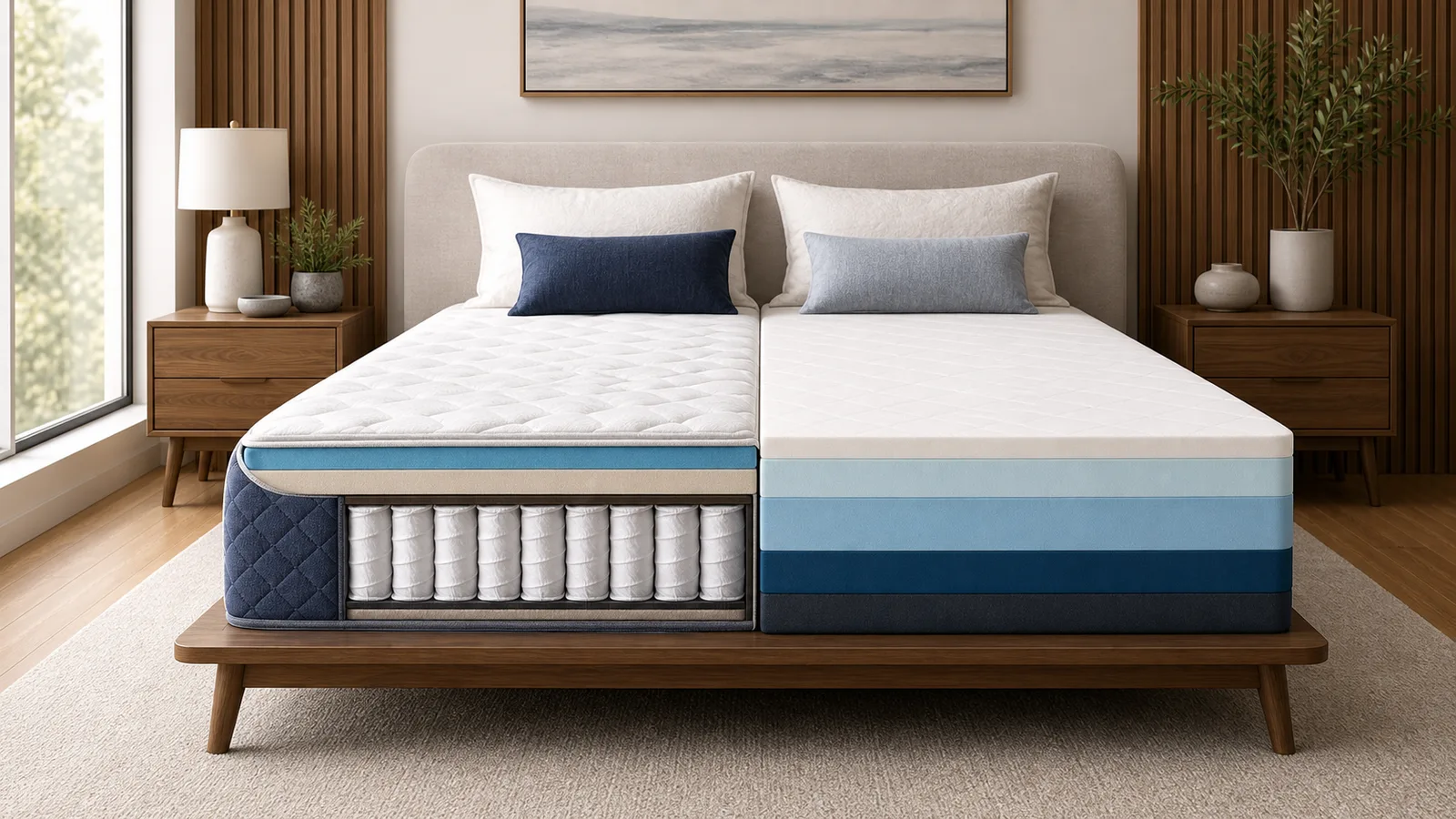
If you sleep with a partner, choosing a mattress is not just a firmness decision. Every turn, hip shift, and edge sit creates mechanical energy that either gets absorbed by the comfort material or travels across the bed. That is why hybrid vs. memory foam is such an important comparison for couples.
Memory foam is the safer starting point for light sleepers who wake when a partner moves. Hybrid mattresses are usually better for hot sleepers, heavier couples, edge users, and anyone who wants easier movement. The best choice depends on your shared problem: motion, heat, weight difference, edge collapse, firmness disagreement, or mobility.
This guide uses practical engineering signals: foam density, Indentation Load Deflection (ILD), viscoelastic hysteresis, pocketed coil gauge, phase-change material (PCM), zoning, and edge construction. Product names, Amazon images, prices, and seller terms change, so verify the live listing before purchase.
For broader shortlists, open our Best Mattresses for Couples, Best Hybrid Mattresses on Amazon, and Best Memory Foam Mattresses on Amazon in nearby tabs.
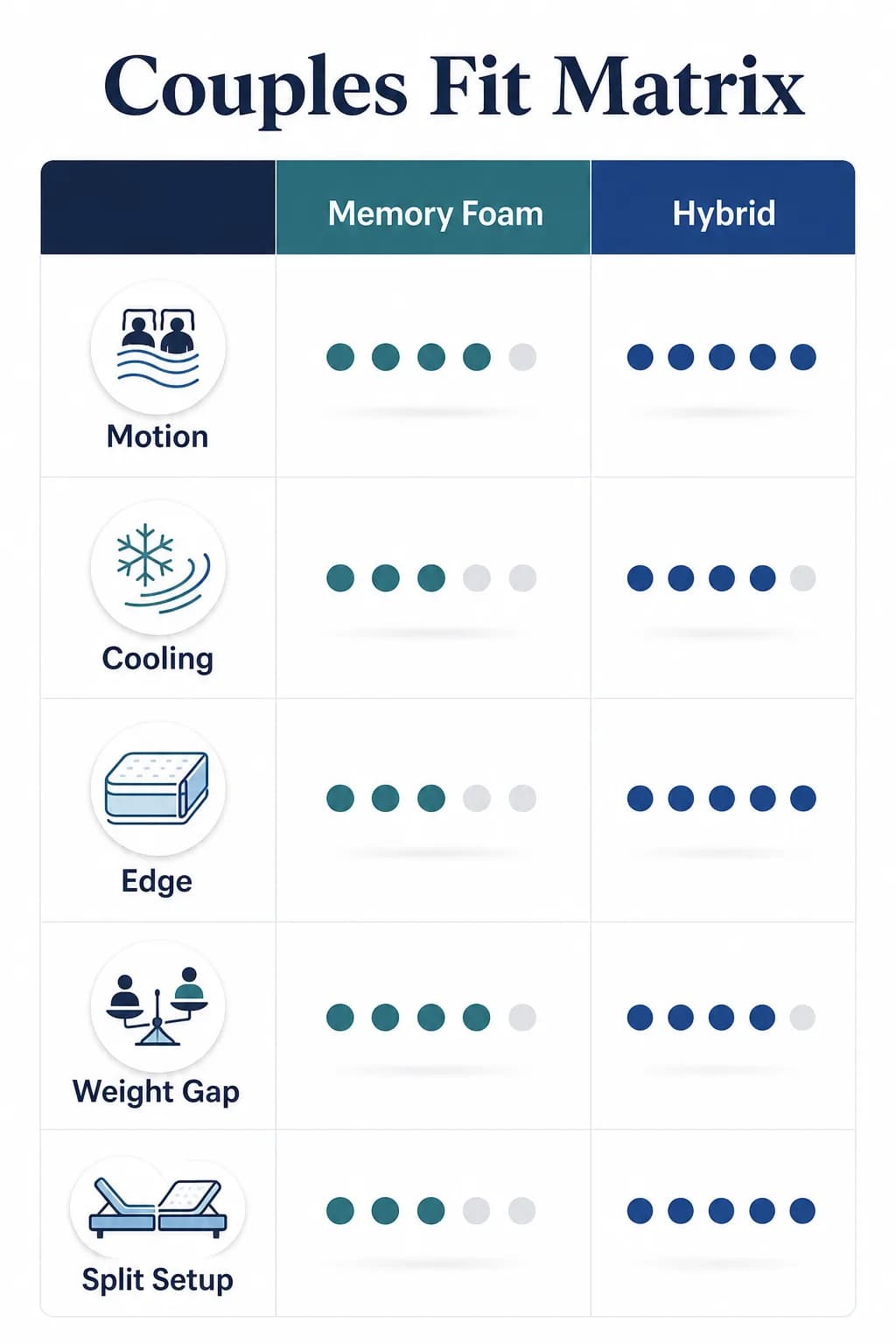
Quick Verdict: Hybrid vs Memory Foam for Couples
| Couple priority | Better starting point | Why |
|---|---|---|
| Maximum motion isolation | High-density memory foam | Slow viscoelastic response absorbs partner movement locally |
| Sleeping hot | Pocketed-coil hybrid | Air moves through the coil unit more easily than through dense foam |
| Strong edge support | Reinforced hybrid | Perimeter coils or dense rails preserve usable width |
| Easy movement and intimacy | Responsive hybrid or latex hybrid | Coils and latex return energy faster than slow memory foam |
| Large weight difference | Zoned hybrid or split king | Stronger center support reduces slope toward the heavier partner |
| Side-sleeper pressure relief | Foam-forward hybrid or memory foam | Comfort layers can cushion shoulders and hips |
| Back or stomach support | Medium-firm zoned hybrid | Coils resist deep pelvic sink better than soft foam stacks |
The practical answer: choose memory foam if one partner's movement is the main problem and neither of you sleeps very hot. Choose hybrid if heat, edge support, body-weight difference, or mobility is the main problem.
Biomechanical warning: avoid the low-density sag trap
Many budget foam beds feel comfortable during the first week because the top layer is soft and conforming. The risk for couples is long-term compression. If low-density polyurethane foam breaks down, the heavier partner can create a center depression that pulls the lighter partner inward.
That center trough can tilt the pelvis and make both partners sleep in a compromised position. This is not a diagnosis, but it is a real support problem. Couples should be cautious with vague low-density foam builds and should prioritize dense comfort foam, zoned pocketed coils, split comfort, or a split king when the weight gap is large.
The Physics: Damping vs Spring Response
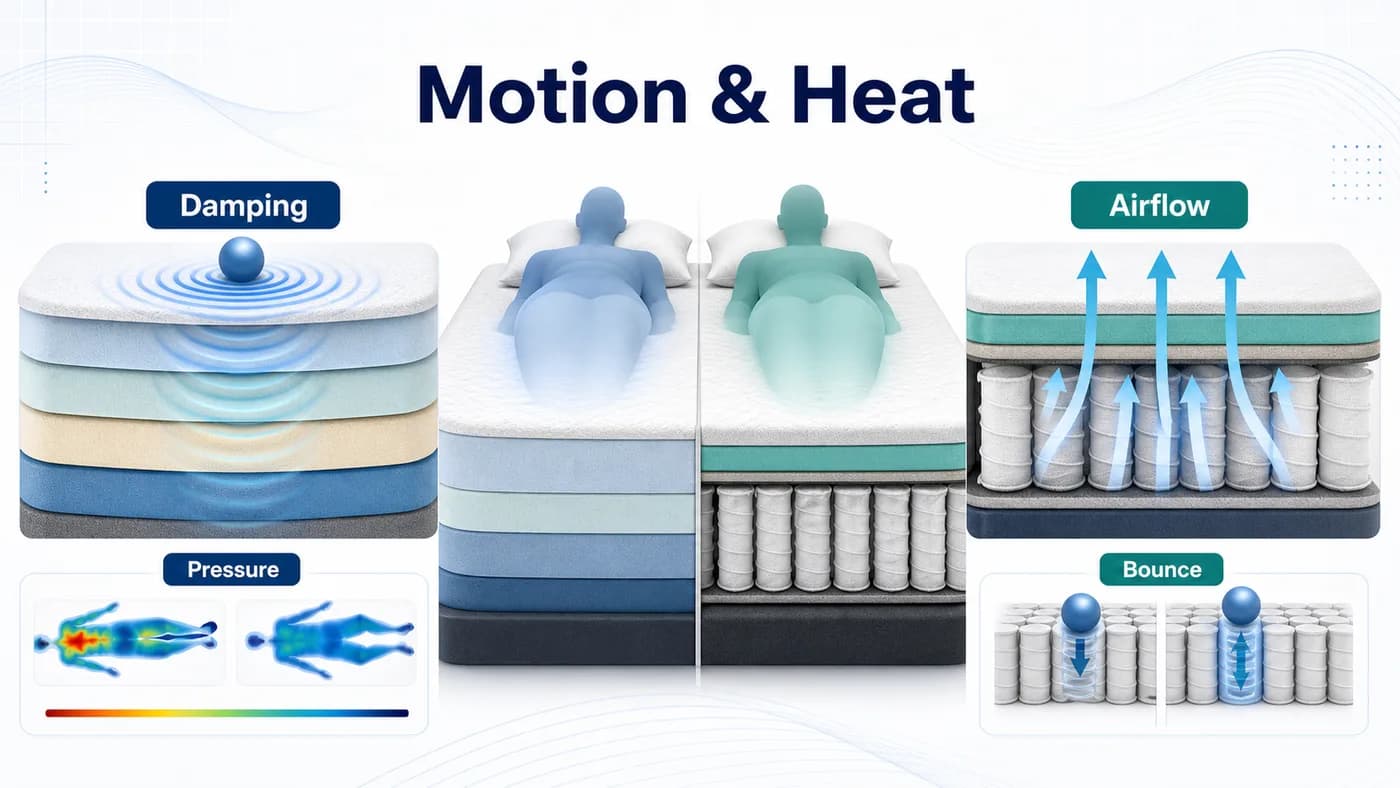
Memory foam and hybrids behave differently because they solve movement in opposite ways.
Memory foam uses viscoelastic hysteresis. When a partner rolls over, the foam deforms slowly and converts some movement energy into low-level heat inside the polymer structure. That damping is why dense memory foam can feel quiet and stable. It is also why some sleepers feel stuck or warm.
Hybrid mattresses use localized spring response. A pocketed coil follows a simple spring logic: F = -k * x, where k is stiffness and x is compression distance. Individually wrapped coils help keep the response local instead of moving the whole surface. The trade-off is bounce. A hybrid needs enough foam, latex, or microcoil comfort material above the coil unit to calm vibration.
Technical Spec Guardrails for Couples
Use these thresholds as buying filters, not as absolute medical rules.
| Spec | What to look for | Why couples should care |
|---|---|---|
| Comfort foam density | Prefer published memory foam around 4.0 lb/ft3 or higher for durability-sensitive couples | Better resistance to early softening than vague low-density foam |
| Transition foam ILD | Firmer transition foam for heavier partners, often in the upper-medium range | Helps prevent bottoming out through the comfort layers |
| Coil type | Individually wrapped pocketed coils, not linked open coils | Localizes movement and improves contouring |
| Coil gauge | Common premium range around 13.75 to 15 gauge, depending on zone | Lower gauge is thicker and firmer; useful for edges and heavier zones |
| Edge system | Perimeter coils, Quantum Edge-style rows, or dense foam rails | Preserves usable width for two sleepers |
| Zoning | Softer shoulder zone, firmer lumbar/hip zone | Helps side/back couples balance pressure relief and spinal support |
| Cooling | Coil airflow, breathable cover, PCM, graphite/copper/gel, and breathable bedding | Two sleepers generate more heat load than one |
| Certification signals | CertiPUR-US for polyurethane foam, OEKO-TEX Standard 100 for textiles where available | Adds chemical-safety and material-verification context |
| Foam testing | ASTM D3574 references when brands publish compression-set or durability data | Helps separate measurable durability from vague comfort language |
Direct Amazon Product CTAs
These are direct product CTAs with Amazon product image URLs. Amazon titles, prices, coupons, seller names, trial language, and return rules can change. Use the listing as the source of truth before checkout.
1. DreamCloud Premier Rest 14-inch Queen Mattress: plush hybrid value check
DreamCloud Premier Rest fits couples who want a thicker, hotel-style hybrid feel with pressure-relieving foam over coils. It belongs in the comparison because it gives shoppers a plush-hybrid reference point against firmer support builds.
DreamCloud Premier Rest 14-inch Queen Mattress
A luxury-feel hybrid benchmark for couples comparing plush comfort, pressure relief, and coil support.
- Best for couples who want a cushioned hybrid without losing coil support.
- Compare recent owner reviews for motion isolation and edge support, not only softness.
- Verify the live seller, size, shipping method, warranty path, and return language before checkout.

Before checkout
Use the listing as the source of truth for current price tier, seller, delivery window, and return terms.
Prices, coupons, availability, shipping, and return terms change often. Confirm current details on Amazon before purchase. As an Amazon Associate, we earn from qualifying purchases.
2. Casper Sleep Original Hybrid Queen Mattress: balanced motion and zoning
Casper Original Hybrid is useful for couples who want a recognizable hybrid with a medium feel, breathable foam, motion isolation positioning, and zoned support. It is not the bounciest hybrid, which can help couples who still care about motion control.
Casper Sleep Original Hybrid Queen Mattress
A balanced hybrid pick for couples who want zoned support, better airflow than all-foam, and less bounce than old-school innerspring.
- Best for couples who want a middle path between contour and responsiveness.
- Check whether the active listing is the exact Original Hybrid model and queen size.
- Read recent reviews for heat, edge support, and center-line motion transfer.

Before checkout
Use the listing as the source of truth for current price tier, seller, delivery window, and return terms.
Prices, coupons, availability, shipping, and return terms change often. Confirm current details on Amazon before purchase. As an Amazon Associate, we earn from qualifying purchases.
3. Serta Perfect Sleeper Enhanced 12-inch Firm Queen Mattress: firm support and edge check
Serta Perfect Sleeper Enhanced is the firmer benchmark in this shortlist. It is useful for back sleepers, stomach sleepers, heavier couples, and edge users who need more lift than a plush foam stack.
Serta Perfect Sleeper Enhanced 12-inch Firm Queen Mattress
A firmer pocket-innerspring option for couples prioritizing edge support, motion isolation, and stronger lift.
- Best for couples who dislike deep sink and want stronger perimeter support.
- Side sleepers may need to confirm pressure relief carefully because firm builds can feel sharp at shoulders.
- Verify the current seller, exact height, return terms, and warranty path on Amazon.

Before checkout
Use the listing as the source of truth for current price tier, seller, delivery window, and return terms.
Prices, coupons, availability, shipping, and return terms change often. Confirm current details on Amazon before purchase. As an Amazon Associate, we earn from qualifying purchases.
4. EGOHOME 14-inch Firm Queen Memory Foam Mattress: foam motion-control benchmark
EGOHOME is included as a direct all-foam benchmark because the current listing is a real memory-foam mattress page with a product image, not a generic search result. It should be treated as a foam-side comparison point, not an automatic winner.
EGOHOME 14-inch Firm Queen Memory Foam Mattress
A firm memory-foam benchmark for couples comparing motion isolation against hybrid airflow and edge support.
- Best for comparing the memory-foam side of the decision against coil hybrids.
- Ask whether both partners are comfortable with less bounce and potentially warmer sleep.
- Confirm foam specs, seller, return language, and recent reviews before treating it as a final pick.

Before checkout
Use the listing as the source of truth for current price tier, seller, delivery window, and return terms.
Prices, coupons, availability, shipping, and return terms change often. Confirm current details on Amazon before purchase. As an Amazon Associate, we earn from qualifying purchases.
Selector Matrix by Couple Profile
| Couple profile | Best architecture | Required material signals | Why it works |
|---|---|---|---|
| High weight variance, such as 120 lb and 260 lb partners | Dual-zone split comfort hybrid or split king | Firmer side under heavier partner, softer side under lighter partner, zoned coils | Reduces pelvic shearing and center troughing |
| Restless partner plus light sleeper | High-density memory foam or foam-forward hybrid | Dense comfort foam, thick transition layer, low-bounce surface | Maximizes damping and reduces wakeups |
| Hot sleepers who still want movement | Latex hybrid or responsive pocketed-coil hybrid | Ventilated latex or responsive foam, coil airflow, breathable cover | Better airflow and easier repositioning |
| Back or stomach sleeper plus side sleeper | Medium-firm zoned hybrid | Firmer lumbar/hip zone and softer shoulder zone | Keeps hips lifted while giving shoulder relief |
| Edge users, pets, or kids joining | Reinforced hybrid | Perimeter coils, Quantum Edge-style rows, or dense rails | Preserves usable width and reduces roll-off |
| Strong firmness disagreement | Split king with two Twin XL mattresses | Separate firmness, separate toppers, adjustable-base compatibility | Stops one mattress from forcing a compromise |
Budget Tiers: What Couples Are Paying For
| Tier | Typical materials | Couple risk |
|---|---|---|
| Budget, roughly $300 to $700 | Low-density foam, thin comfort layers, unclear edge systems | Early softening, heat retention, edge collapse, weak warranty clarity |
| Mid-range, roughly $800 to $1,600 | CertiPUR-US foams, pocketed coils, better covers, some zoning | Best value zone if specs and returns are clear |
| Premium, roughly $1,700 to $3,500+ | Higher-density foams, latex, microcoils, reinforced edges, PCM covers | Better durability and cooling, but avoid paying for branding without specs |
If the page does not publish foam density, coil count/gauge, edge construction, or trial logistics, treat that as missing evidence. A popular mattress can still be a poor fit for couples if the structure does not match the shared problem.
Cooling: Why Two Sleepers Change the Equation
Memory foam can feel warm because it increases body contact and restricts airflow near the skin. Two sleepers amplify the heat load. Hybrid mattresses solve part of this with convective airflow through the coil cavity, but the cover, protector, and sheets can still trap heat.
| Cooling feature | Helps with | Limitation |
|---|---|---|
| Pocketed coils | Airflow through the support core | Needs breathable comfort layers above the coils |
| PCM cover | Initial temperature regulation | Can feel less dramatic after the first contact period |
| Gel/copper/graphite foam | Conductive heat spread | Does not replace airflow |
| Latex comfort layer | Breathability and responsiveness | More bounce than memory foam |
| Separate duvets | Partner-specific temperature control | Does not fix a heat-trapping protector |
For one hot sleeper and one cold sleeper, a hybrid plus separate duvets is usually more flexible than an all-foam bed plus one shared heavy comforter.
How to Test a Couples Mattress During the Trial
Use a 30-night test instead of deciding from the first evening.
| Test window | What to check | Pass/fail signal |
|---|---|---|
| Nights 1 to 3 | Expansion, smell, base stability, first comfort notes | No obvious support failure or strong chemical issue |
| Nights 4 to 10 | Motion wakeups, heat, edge use, getting in/out | Problems repeat even after normal bedding adjustments |
| Nights 11 to 20 | Morning back/hip/shoulder comfort for each partner | One partner consistently compensates for the other |
| Nights 21 to 30 | Center trough, edge compression, firmness disagreement | If a large dip appears early, document and contact seller |
Take two photos: one from the foot of the bed while both partners lie in normal sleep positions, and one side view. You are looking for hip drop, shoulder pressure, and center slope, not a perfect clinical measurement.
Accessories That Change the Result
| Accessory | Good use | Avoid |
|---|---|---|
| Split toppers | Small firmness differences | Trying to fix a failed support core |
| Breathable protector | Spill protection without heat buildup | Vinyl-backed protectors that stiffen and trap heat |
| Percale or Tencel sheets | Cooler surface feel | Heavy flannel if one partner sleeps hot |
| Adjustable base | Snoring, reflux, reading, split king routines | One-piece base when partners need separate angles |
| Solid foundation | Adds stability and reduces sag mimicry | Wide slats or flexing metal grids |
Final Recommendation
Choose memory foam if the main problem is motion transfer and both partners tolerate close contouring. Choose hybrid if the main problem is heat, edge support, weight difference, or mobility. Choose split king if partners disagree sharply on firmness or adjustable-base settings.
The highest-confidence couples purchase is rarely the softest mattress. It is the mattress with the clearest structural evidence: dense comfort materials, individually wrapped coils when relevant, reinforced edges, zoning, breathable textiles, credible certifications, and a trial policy that lets both partners test it honestly.
FAQ
Is a hybrid or memory foam mattress better for motion transfer?
High-density memory foam is usually better for motion transfer because it has high viscoelastic damping. It absorbs movement locally instead of bouncing it back across the mattress. A hybrid can still work well if it uses individually wrapped coils plus a thick comfort stack.
What foam density should couples look for?
When density is published, couples should be cautious with low-density comfort foam below roughly 3.0 lb/ft3 for nightly shared use. Memory foam or transition foam around 4.0 lb/ft3 or higher is a stronger durability signal, especially for higher combined body weight.
What coil gauge should couples look for in a hybrid mattress?
Pocketed coils around 13.75 to 15 gauge are common in stronger hybrid designs. Lower gauge means thicker wire and a firmer response. The best choice depends on body weight and zone: firmer perimeter and lumbar coils can help edge support and hip lift.
Why do memory foam mattresses sleep hot for couples?
Memory foam sleeps hot for some couples because dense viscoelastic foam increases body contact and limits airflow. Two sleepers add more heat and humidity. Cooling additives help, but coil airflow, breathable covers, sheets, protector, and room temperature matter just as much.
Are hybrids better for intimacy and movement?
Usually yes. Hybrids return energy faster than slow memory foam, which makes repositioning easier. Latex hybrids are even more responsive. The trade-off is that more bounce can create more motion transfer for very sensitive partners.
What if partners have very different body weights?
Start with a zoned hybrid, split comfort, or split king. A single soft all-foam mattress can tilt toward the heavier partner over time if the comfort layers compress too much. The heavier partner's support needs should usually set the baseline.
Does edge support matter for couples?
Yes. Weak edges reduce usable width and push partners toward the center. This matters most on queen mattresses, for couples with pets or kids, and for anyone who sits on the edge while getting dressed.