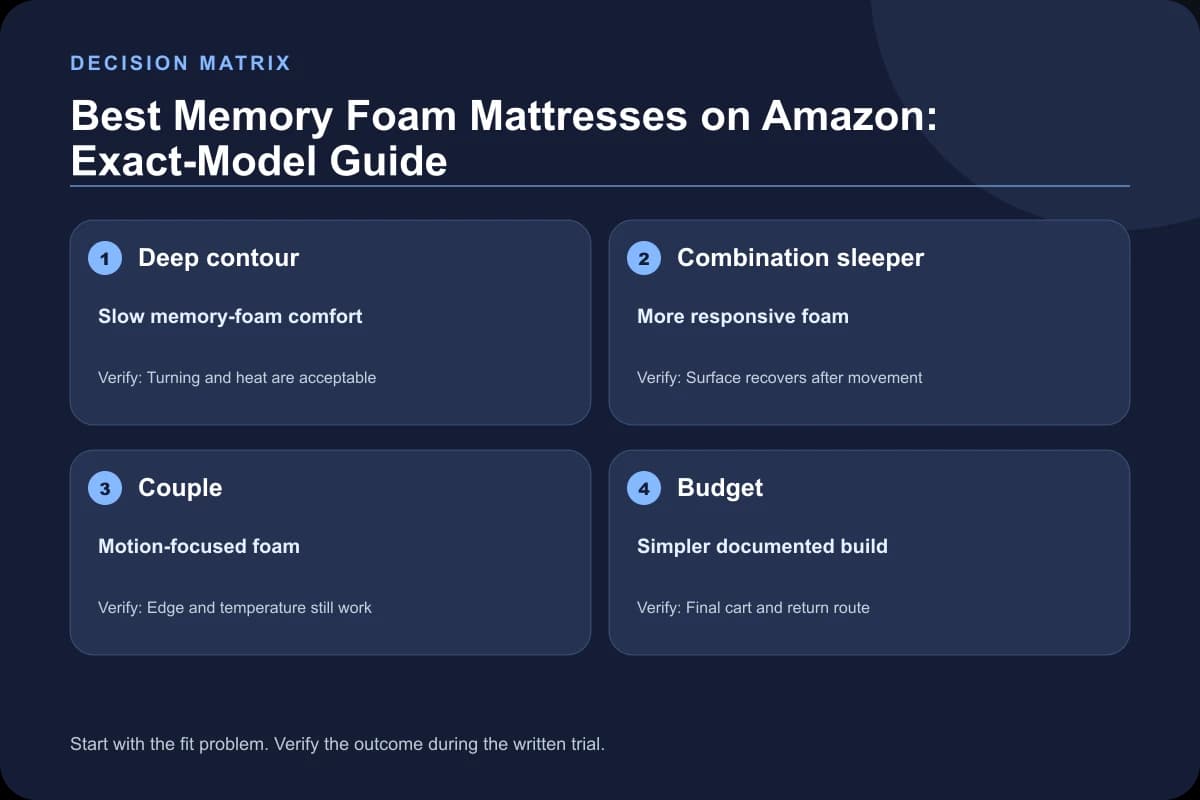
The Nectar Classic is our best overall starting point for memory-foam shoppers on Amazon. Choose the Zinus Original Green Tea for a lower-cost entry point, the Casper One for a more balanced feel with less of a deep hug, or the EGOHOME Black 12 if cooling features are high on your list. Before buying, match the exact model and size and confirm the seller, opened-mattress return route and warranty eligibility on the live listing.
Is a memory-foam shortlist the right route?
Use this shortlist if
- You want closer contour, quieter movement and stronger motion isolation than a typical responsive hybrid.
- You can choose between a lower-cost foam route and a more substantial branded all-foam model.
- You will verify the exact height, current generation, seller and return route before ordering.
Use a different route if
- You strongly prefer bounce, easy repositioning or frequent edge sitting.
- You sleep very warm and already know that deep surface contact causes discomfort.
- You need a medical recommendation rather than a consumer product comparison.
Decision-first shortlist
Fast picks: choose your foam lane
These direct product links cover the clearest verified memory-foam routes in this guide. Casper One remains a research option below, but we do not present a generic search result as a verified product listing.
1. Best overall starting point
Nectar Classic
A contour-focused all-foam option for shoppers prioritizing pressure relief and partner-motion control.
- Best for
- Side sleepers, couples and people who enjoy a closer foam hug
- Avoid if
- You dislike slow response, sleep very warm or rely heavily on the edge
- Construction
- 12-inch all-foam memory foam
- Price tier
- Lower-mid range
2. Best budget starting point
Zinus Original Green Tea
A straightforward value route for guest rooms, first apartments and shoppers keeping the live total low.
- Best for
- Guest rooms, lighter-use beds and tighter budgets
- Avoid if
- You want premium edge support, advanced cooling or a substantial hybrid feel
- Construction
- 10-inch memory-foam mattress
- Price tier
- Budget
3. Cooling-focused budget alternative
EGOHOME Black 12
A taller all-foam option with a cooling-oriented cover for side sleepers comparing affordable contour.
- Best for
- Side sleepers wanting a taller foam profile on a budget
- Avoid if
- You expect a cooling cover to eliminate heat or prefer easy movement
- Construction
- 12-inch all-foam mattress
- Price tier
- Budget
Prices, sizes, sellers, availability and return terms can change. Confirm the exact listing before purchase. Amazon buttons are affiliate links; as an Amazon Associate, we earn from qualifying purchases.
Need to distinguish all-foam from a memory-foam hybrid? Start with our mattress types and materials guide.
If the material choice is still open, compare latex and memory foam mattresses before building a shortlist. Identify the comfort layer and support core separately.
Our picks at a glance
| Pick | Feel direction | Best starting point for | Main tradeoff |
|---|---|---|---|
| Nectar Classic | Medium-firm, slow contour | Side sleepers and couples who like a closer hug | Deep contour can feel warm or restrictive |
| Zinus Original Green Tea | Traditional budget memory foam | Guest rooms and value-focused shoppers | Simpler build; verify the exact height and seller |
| Casper One | Balanced, more responsive foam | Combination sleepers and people who dislike deep sink | Less pressure-relieving hug than slower foam |
| EGOHOME Black 12 | Medium-firm with cooling-focused cover | Hot sleepers comparing affordable all-foam beds | Cooling claims do not guarantee a cool night |
These are purchase lanes, not universal winners. Body weight, sleep position, room temperature, pillow and foundation can change how the same mattress feels.
1. Nectar Classic — best overall starting point
The Nectar Classic is the strongest all-around starting point here because its current five-layer all-foam design is built around contouring comfort and motion control. That combination makes the most sense for side sleepers, light sleepers sharing a bed and anyone who already knows they enjoy the slower response of memory foam.
Choose it if: you want a noticeable cradle and less partner movement reaching your side of the bed.
Skip it if: you frequently change position, sleep very warm or dislike feeling settled into the surface. A mattress with faster response may be easier to live with.
Nectar Classic
A contour-focused, medium-firm all-foam option for shoppers who value pressure relief and motion isolation. Match the current Classic model and size before ordering.
Before checkout
Use the listing as the source of truth for current price tier, seller, delivery window, and return terms.
Confirm the seller, trial route and warranty eligibility shown for the exact Amazon listing. As an Amazon Associate, we earn from qualifying purchases.
Nectar's direct-purchase trial and warranty language should not be assumed to cover every marketplace order. The company says eligibility depends on the purchase channel and authorized seller, so the seller line matters as much as the product title.
2. Zinus Original Green Tea — best budget starting point
The Zinus Original Green Tea Memory Foam Mattress is the clearest budget-oriented Amazon pick. Zinus currently describes the 10-inch model as an all-foam, fiberglass-free design using CertiPUR-US certified foam. It is a practical route for a guest room, a first apartment or a shopper who wants memory foam without moving into a higher price tier.
Choose it if: the live total matters most and you want straightforward memory-foam contour.
Skip it if: you need a more substantial edge, a luxury finish or extensive performance evidence. Also check the selected height carefully; marketplace listings can group several configurations together.
Zinus Original Green Tea Memory Foam Mattress
A straightforward 10-inch memory-foam option for value-focused shoppers. Select the exact Original Green Tea model, height and size rather than relying on a merged rating.
Before checkout
Use the listing as the source of truth for current price tier, seller, delivery window, and return terms.
Do not remove the mattress cover. Verify the current seller, model height and opened-item return terms. As an Amazon Associate, we earn from qualifying purchases.
“Fiberglass-free” is a manufacturer claim about the current model, not permission to open or alter the cover. Follow the care label and avoid treating any certification badge as proof of the entire finished mattress.
3. Casper One — best for less sink
The Casper One Foam Mattress uses a three-layer, medium-firm all-foam design. Its appeal is balance: enough foam cushioning to reduce a hard, flat feel, but a more responsive direction than the slowest memory-foam beds. That can suit combination sleepers and people who want an all-foam mattress without a pronounced “stuck” sensation.
Choose it if: you move between sleeping positions or want a flatter, more buoyant surface than Nectar.
Skip it if: your top priority is a deep pressure-relieving hug. Casper also states that retailer return policies can differ from its direct 100-night trial.
Casper One Foam Mattress
A medium-firm, three-layer foam mattress for sleepers who want a more balanced surface and easier movement than deeply contouring memory foam.
Before checkout
Use the listing as the source of truth for current price tier, seller, delivery window, and return terms.
Verify that the listing is the current Casper One and check the retailer-specific return and warranty terms. As an Amazon Associate, we earn from qualifying purchases.
4. EGOHOME Black 12 — cooling-focused alternative
The EGOHOME Black 12 is the cooling-focused alternative in this group. The current manufacturer page describes a 12-inch, medium-firm all-foam mattress with a cooling cover and a fiberglass-free fire-resistant inner cover. Those features make it worth comparing if heat is a major concern but you still want close foam contact.
Choose it if: you want a taller, medium-firm foam build and cooling-oriented materials without automatically stepping into a premium tier.
Skip it if: the words “graphene” or “cooling” are doing all the persuading. No cover can override a warm room, insulating bedding or the greater contact area created by deep contour.
EGOHOME Black 12-Inch Mattress
A 12-inch, medium-firm all-foam option with a cooling-focused cover. Match the Black 12-inch model; EGOHOME sells multiple designs with similar names.
Before checkout
Use the listing as the source of truth for current price tier, seller, delivery window, and return terms.
Check the exact model, seller and written return terms. Cooling features are not a performance guarantee. As an Amazon Associate, we earn from qualifying purchases.
Which one should you choose?
- Start with Nectar if pressure relief and partner motion matter more than easy repositioning.
- Start with Zinus if you want the lowest sensible entry point and can accept a simpler build.
- Start with Casper if you dislike deep sink or move frequently during the night.
- Start with EGOHOME if heat is your first concern and you want to compare a cooling-oriented foam build.
If you are a side sleeper, use our side-sleeper mattress guide to narrow the pressure-relief question. If warmth is the deciding issue, compare these picks with the options in our Amazon cooling mattress guide.
What to verify on Amazon before you buy
Use the foam-density chart and converter to interpret density claims without confusing density with firmness. For marketplace purchases, also compare the brand promise with our Amazon mattress return-policy table.
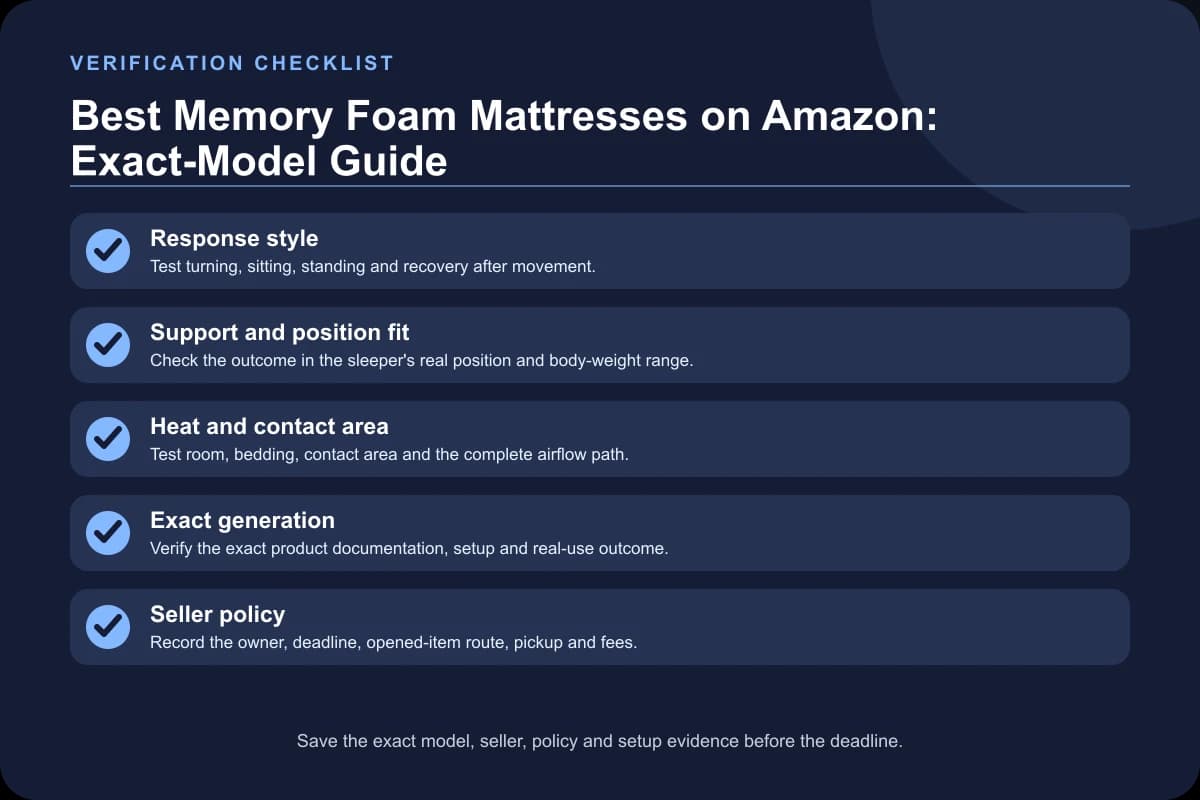
Amazon search results can mix heights, sizes, old generations and third-party sellers. Complete this check on the exact product page:
- Product identity: Match the model name, height and size to the current manufacturer page.
- Seller: Record who sells the mattress and who fulfills the order. Do not infer brand warranty coverage from the logo alone.
- Condition: Confirm that the item is new and note any special delivery or setup language.
- Return route: Find out what happens after the mattress has expanded and whether pickup, repacking or return shipping is required.
- Warranty eligibility: Read the brand's authorized-seller requirement and save the invoice and listing.
- Delivered total: Compare the exact size after coupon, shipping and tax rather than a promotional “from” price.
Our Amazon mattress return playbook explains what to save before opening the box and how to document a pickup or return problem.
How we chose these mattresses
We prioritized four things: a true memory-foam or memory-foam-led construction, current manufacturer documentation, a distinct use case and a model-specific Amazon search path. We excluded static prices and star scores because both can change or merge across variants.
We also removed products that do not fit the page promise. Tuft & Needle explicitly says its Original's proprietary foam is not memory foam, so it may be a useful responsive-foam alternative but not a strict memory-foam pick. Siena remains a valid direct-to-consumer budget comparison, but its Amazon availability is not consistent enough to anchor an Amazon shortlist.
We did not cut open marketplace units, measure foam density, perform pressure mapping or run controlled heat and durability tests. Product facts come from current manufacturer documentation; fit assessments are editorial comparisons, not claims of personal long-term testing.
What CertiPUR-US does—and does not—mean
CertiPUR-US evaluates qualifying flexible polyurethane foam against its program criteria. It does not certify the complete mattress, prove comfort or cooling, or replace seller and warranty verification.
A practical at-home trial
Once the correct mattress arrives, keep the law label, packaging information, order page and photos. Use a compatible foundation and start with familiar bedding so you are not changing every variable at once. Track pressure, movement, heat and edge use over several nights while the return window is still comfortably open.
Keep the mattress if the model is correct, the support setup meets the written requirements and comfort is trending in the right direction. Contact the seller promptly if the wrong model arrives, the mattress does not expand as documented, there is damage or the return deadline is approaching. Get written authorization before donation, disposal or pickup.
For a structured evaluation, follow our mattress trial checklist. Persistent odor or ventilation concerns are covered in the mattress off-gassing guide.
Sources and verification notes
- Nectar Classic product information
- Nectar trial policy and warranty policy
- Zinus Original Green Tea Memory Foam Mattress
- Casper One Foam Mattress, trial terms and warranty terms
- EGOHOME Black 12-Inch Mattress
- CertiPUR-US certification FAQ
- FTC online-shopping guidance
Product names, constructions, sellers, prices and policies can change. Recheck the exact product and purchase channel on the day you buy.