
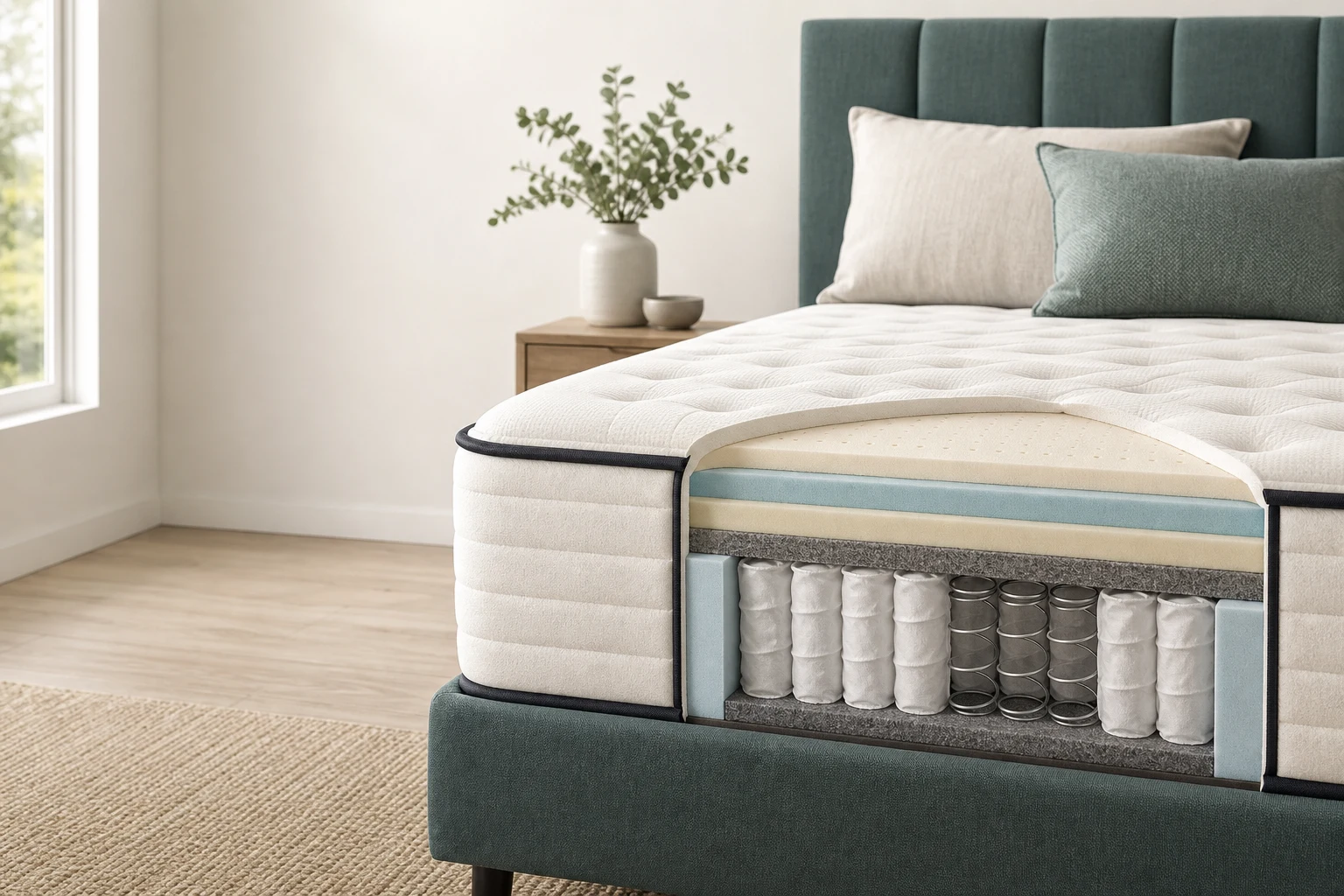
The DreamCloud Classic Hybrid is our best overall hybrid mattress starting point on Amazon because it combines cushioning, coil response and a lower-mid-range price position. Choose the Helix Midnight Luxe for a more cushioned side-sleeper route, Leesa Sapira Chill when cooling design and firmness choice matter, or Titan Plus Luxe when stronger higher-weight support is the priority.
Is a hybrid the right construction lane?
Use this shortlist if
- You want easier repositioning and more coil response than slow all-foam beds usually provide.
- You need a clear route for side sleeping, cooling design or stronger higher-weight support.
- You will match the exact current model and retailer policy instead of importing brand-direct terms.
Use a different route if
- Maximum motion isolation matters more than response or edge use.
- You prefer a very light mattress or the slowest, closest memory-foam contour.
- You are choosing only by coil count, height or a cooling label.
Decision-first shortlist
Fast picks: four distinct hybrid routes
Each button opens the verified listing named in the card. The ASIN can point to one size or firmness, so select your actual variant before checkout.
1. Best overall hybrid
DreamCloud Classic Hybrid
A balanced starting point for cushioning, coil response and easier repositioning without entering the premium tier.
- Best for
- Back and combination sleepers wanting balanced response
- Avoid if
- You need maximum motion isolation
- Construction
- 12-inch foam-and-coil hybrid
- Price tier
- Lower-mid range
2. Best hybrid for side sleepers
Helix Midnight Luxe
A deeper cushioned hybrid for shoppers prioritizing shoulder and hip relief over the lowest price.
- Best for
- Side sleepers wanting deeper cushioning
- Avoid if
- You want a budget or very firm mattress
- Construction
- Luxury foam-and-coil hybrid
- Price tier
- Premium
3. Best cooling and firmness choice
Leesa Sapira Chill
A taller cooling-oriented pillow-top hybrid with multiple feel choices in the current model family.
- Best for
- Hot sleepers wanting a firmness choice
- Avoid if
- You want a low-profile budget hybrid
- Construction
- 14-inch cooling pillow-top hybrid
- Price tier
- Premium
4. Best for higher-weight sleepers
Titan Plus Luxe
A reinforced route when combined load, edge use or pelvic support exposes weakness in mainstream hybrids.
- Best for
- Higher-weight sleepers and stronger edge needs
- Avoid if
- You are a lighter sleeper wanting a plush first contact
- Construction
- 13-inch reinforced hybrid
- Price tier
- Mid range
Prices, sizes, sellers, availability and return terms can change. Confirm the exact listing before purchase. Amazon buttons are affiliate links; as an Amazon Associate, we earn from qualifying purchases.
Before comparing models, our mattress types and materials guide explains how the comfort layer differs from the coil support core.
A hybrid can contain latex. Compare all-latex, latex hybrid and foam hybrid constructions before treating every coil-based mattress as the same surface feel.
Our research method and limits
We compared current manufacturer construction pages, current model families, published policy documents, certification scope, foundation requirements where available, and Amazon channel risks. We did not conduct personal long-term use, cutaway inspection, pressure mapping, edge-force measurement, motion testing, or climate-controlled cooling tests.
Accordingly, we describe what the manufacturers currently publish and explain how to choose. We do not turn marketing claims into lab findings, ratings into evidence, or an arbitrary coil count into an engineering standard.
Current hybrid comparison
| Pick | Feel direction | Best starting point for | Main caution |
|---|---|---|---|
| DreamCloud Classic Hybrid | Responsive, medium-firm direction | Broad hybrid shoppers and easier movement | Coil response can transfer more motion than dense foam |
| Helix Midnight Luxe | Cushioned hybrid | Side sleepers and pressure-sensitive hips or shoulders | Premium price and thicker build |
| Leesa Sapira Chill | Cooling pillow-top with firmness choice | Hot sleepers and shoppers wanting plush, medium-firm or firm | Cooling claims are not active climate control |
| Titan Plus Luxe | Supportive reinforced hybrid | Higher-weight sleepers and stronger edge priorities | May feel too substantial for lighter sleepers |
1. DreamCloud Classic Hybrid — best overall
The current DreamCloud Classic Hybrid is the firmer entry point in DreamCloud's current tiered family. It is the route to research when a sleeper wants coil response and less surface plushness.
DreamCloud's direct 365-night trial does not automatically govern an Amazon order, and its current direct warranty text contains clauses that warrant clarification. Read our DreamCloud review before relying on the headline alone.
DreamCloud Classic Hybrid Mattress
A balanced foam-and-coil hybrid for shoppers who want cushioning, response and easier repositioning without entering the premium price tier.
- Best for
- Back and combination sleepers wanting response
- Avoid if
- You need maximum motion isolation
- Construction
- 12-inch foam-and-coil hybrid
- Price tier
- Lower-mid range
Before checkout
Use the listing as the source of truth for current price tier, seller, delivery window, and return terms.
Verified Queen listing: ASIN B0F75Q1K1Y. Confirm size, seller, trial route and warranty eligibility. As an Amazon Associate, we earn from qualifying purchases.
2. Helix Midnight Luxe — best for side sleepers
The Helix Midnight Luxe is the side-sleeper route because it uses a deeper cushioned comfort system over a responsive coil core. It is the first comparison here for shoppers whose shoulders or hips feel concentrated pressure on flatter hybrids.
Choose it when pressure relief matters more than the lowest price. Skip it if you prefer a very firm, flat surface or want a lighter mattress that is easier to move. Our Helix review compares the current model family.
Helix Midnight Luxe Mattress
A cushioned luxury hybrid for side sleepers comparing shoulder and hip relief with responsive coil support.
- Best for
- Side sleepers wanting deeper cushioning
- Avoid if
- You want a budget or very firm mattress
- Construction
- Luxury foam-and-coil hybrid
- Price tier
- Premium
Before checkout
Use the listing as the source of truth for current price tier, seller, delivery window, and return terms.
Verified Queen listing: ASIN B0D3SJ2FXN. Confirm the Luxe tier, size, seller and return path. As an Amazon Associate, we earn from qualifying purchases.
3. Leesa Sapira Chill — best cooling and firmness choice
The Leesa Sapira Chill adds a cooling quilt top, a taller comfort package and a choice of plush, medium-firm or firm. It is the most flexible premium route here for shoppers who want to choose feel instead of accepting one universal firmness.
Cooling language describes design intent, not a guaranteed temperature reduction. Skip it when price matters more than the quilted surface or when a low-profile mattress is easier to handle. Compare it with other Leesa tiers in our Leesa review.
Leesa Sapira Chill Hybrid Mattress
A 14-inch cooling pillow-top hybrid with multiple comfort choices for shoppers comparing a more tailored premium feel.
- Best for
- Hot sleepers wanting a firmness choice
- Avoid if
- You want a low-profile budget hybrid
- Construction
- 14-inch cooling pillow-top hybrid
- Price tier
- Premium
Before checkout
Use the listing as the source of truth for current price tier, seller, delivery window, and return terms.
Verified Plush California King listing: ASIN B0F796PLNT. Select your size and firmness before checkout. As an Amazon Associate, we earn from qualifying purchases.
4. Titan Plus Luxe — best for higher-weight sleepers
The Titan Plus Luxe is the higher-weight route because it targets stronger support, a more stable perimeter and deeper resistance to pelvic bottoming out. It makes more sense than choosing a mainstream hybrid only because it is tall or has a large coil count.
Choose it if body weight, combined couple load or edge use exposes weakness in standard hybrids. Skip it if you are a lighter side sleeper who needs a very plush first-contact feel. Our higher-weight sleeper guide explains the support logic.
Titan Plus Luxe Mattress
A reinforced hybrid for higher-weight sleepers comparing stronger support, edge stability and easier movement than slow foam.
- Best for
- Higher-weight sleepers and stronger edge needs
- Avoid if
- You are a light sleeper wanting a plush feel
- Construction
- 13-inch reinforced hybrid
- Price tier
- Mid range
Before checkout
Use the listing as the source of truth for current price tier, seller, delivery window, and return terms.
Verified King listing: ASIN B0BNWC2XYG. Confirm your size, seller, combined-load needs and return path. As an Amazon Associate, we earn from qualifying purchases.
For a purchase you can maintain over time, our mattress durability comparison looks beyond springs to comfort-layer specifications, replacement options and ownership costs.
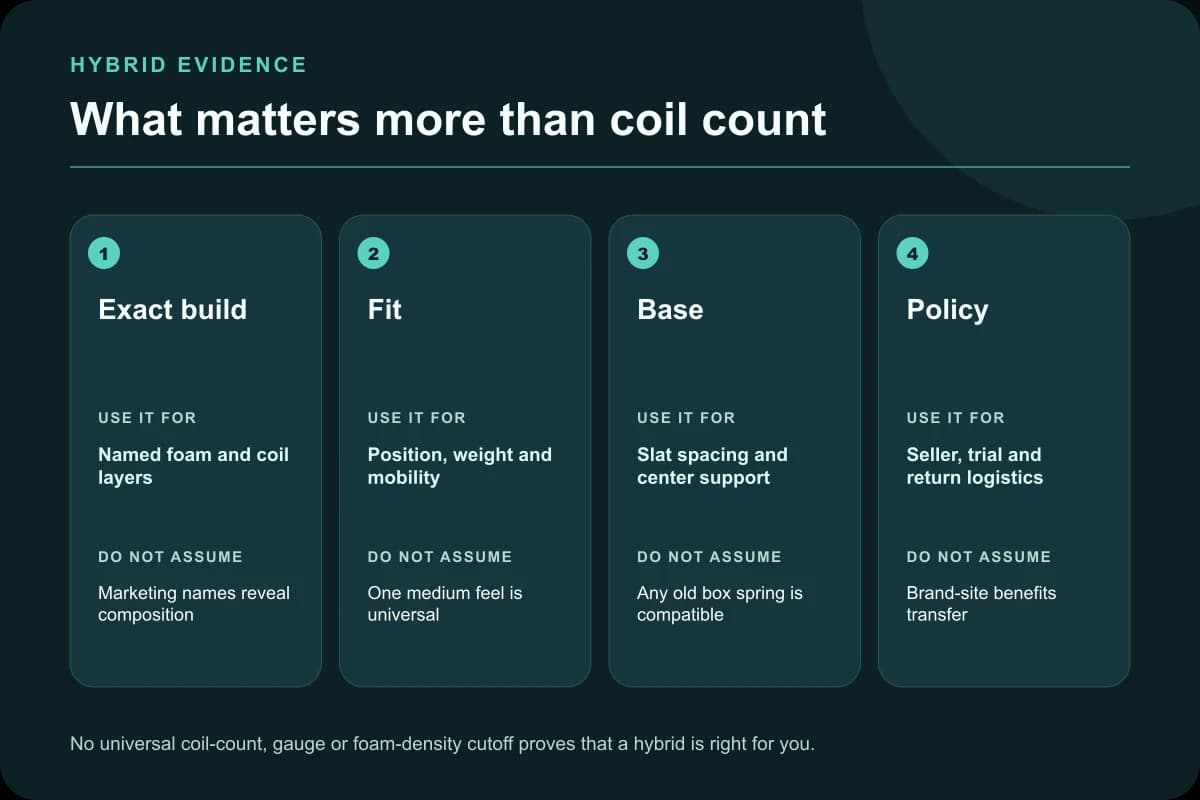
Why coil count is not a quality score
Raw coil counts are not comparable unless size, coil diameter, coil type, zoning, edge system, and counting method are also comparable. A mattress with microcoils can report a much larger number without using the same support architecture as a single-coil-core design.
Gauge is also incomplete. Lower gauge generally means thicker wire, but feel depends on coil geometry, turns, preload, zoning, arrangement, and the layers above it. A universal “good,” “better,” and “best” chart built only from count and gauge creates false precision.
When a brand does not publish a number, ask how the system is constructed. Lack of a count is not proof of poor quality, and a large count is not proof of fit.
Choose by sleeper profile
Side sleepers
Look for enough cushioning to reduce concentrated shoulder and hip pressure while maintaining pelvic support. Helix Midnight Luxe is the cushioned route here, while Leesa Sapira Chill adds firmness choice. Body weight changes compression. See our side-sleeper guide.
Back and stomach sleepers
Start with a flatter response and monitor midsection sink. DreamCloud Classic is the broad first comparison, while Titan Plus Luxe adds stronger support for higher loads. The correct pillow and a rigid, compatible foundation remain part of the system.
Couples
Coils can make movement easier, while the foam stack influences partner disturbance. Strong edges can add usable surface, but “reinforced edge” is not a standardized performance result. Use our couples mattress guide.
Hot sleepers
The coil cavity permits airflow, but thick foam, deep sink, bedding, protector, humidity, and room temperature can dominate the experience. Our hot-sleeper guide helps isolate those variables.
Higher body weights and mobility needs
Prioritize an appropriate total-load specification, stable base, usable edge, and easy repositioning. Do not use a generic 200- or 230-pound cutoff as a substitute for model-specific support. See our heavy-sleeper guide.
Amazon purchase and return reality
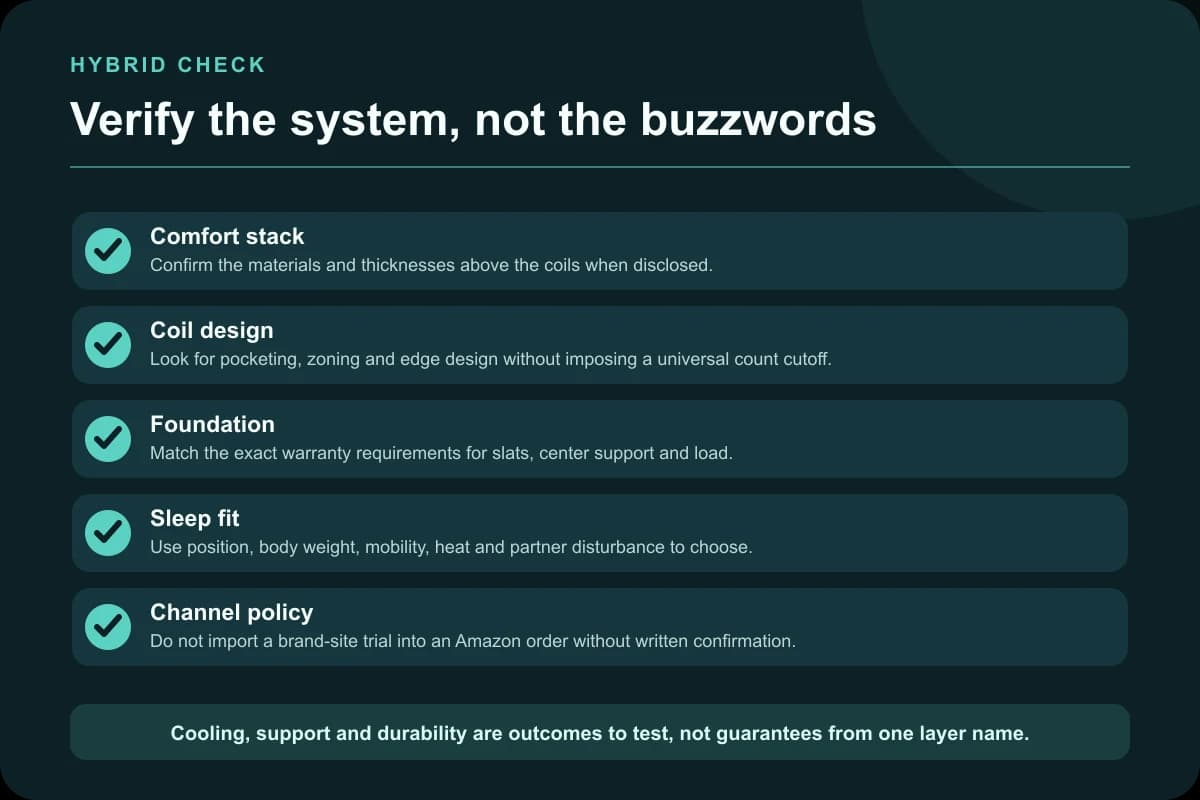
The manufacturer's direct trial, free return language, or warranty headline does not automatically transfer to Amazon. Record the seller and fulfillment party, then identify who authorizes an opened-mattress return, arranges pickup, and pays any cost.
Compare the channels in our Amazon mattress return-policy table, then check the verified mattress weights by size before assuming a boxed hybrid will be easy to carry or return.
Use a mattress trial checklist, photograph the delivered box and law tag, and confirm the foundation before setup. A hybrid can be heavy and difficult to move after expansion, so delivery and return logistics are part of suitability.
Materials and certifications
CertiPUR-US certifies participating flexible polyurethane foam, not the entire hybrid, springs, textile cover, fire barrier, seller, or warranty. Finished-product certification claims need an exact current record and model scope.
Fiberglass status also requires exact-model evidence. Price, coil count, origin, and odor do not identify a fire barrier. Use our fiberglass-free verification guide.
How to read a hybrid layer diagram
A useful diagram identifies each functional part without turning marketing names into performance proof:
Cover and quilt package
The cover affects initial hand feel, moisture movement, and how close the sleeper is to the foam. A “cool-touch” textile may feel cool at first contact without maintaining the same sensation all night. Thick quilting can add cushioning but also separates the body from deeper support layers.
Comfort layer
Memory foam generally contours more slowly, while more responsive polyfoam or latex-like foam can make movement easier. Infusions such as gel, graphite, or copper are not standardized cooling scores. Ask for thickness and material type when published.
Transition layer
This layer can reduce abrupt contact with the coils and influence how quickly the mattress firms up under load. Its presence does not guarantee durability, and density values are useful only when the manufacturer discloses them consistently.
Coil core
Individually wrapped coils can respond more independently than an interconnected unit. Zoning may change resistance across regions; edge coils or foam rails may change the perimeter. None of these labels tells you the final feel without the complete system.
Base layer
A thin base foam can stabilize the coil unit and protect it from the foundation. It is not the same as the bed frame. The mattress still needs the support specified in the warranty.
Edge support and motion without invented scores
Edge performance has at least two different uses: sitting stability and lying stability. A firm perimeter can feel secure when sitting but create a noticeable transition when lying near it. Couples who need the full surface should evaluate both.
Motion also has multiple sources. Pocketed coils may reduce some cross-bed transfer compared with interconnected coils, while thicker comfort foam can damp surface movement. The frame, headboard, floor, and partner movement type can dominate. That is why we do not assign an unsupported “motion score” from a construction diagram.
Cooling: separate mechanisms from outcomes
Hybrid airflow is plausible because the coil cavity contains more open space than a solid foam core. The actual sleeper still interacts with the cover and comfort layers. A thick memory-foam stack, impermeable protector, high humidity, heavy duvet, or warm room can offset the core's airflow.
Evaluate cooling claims in layers:
- Initial contact: Does the cover feel cool for minutes?
- Heat escape: Can heat move through the comfort stack?
- Sink depth: Is the body surrounded by more material?
- Moisture: Does the cover and bedding manage perspiration?
- Room load: Are temperature and humidity already high?
Manufacturer cooling language is useful for identifying design intent. It is not our proof of a measured temperature change.
Foundation and setup
Check the exact warranty before using an old box spring, flexible slats, or a frame without center support. A base that bows can create a false impression of mattress softness and may complicate a warranty claim.
Before delivery, confirm package weight, stair access, and whether help is required. Hybrids are often heavier than comparable all-foam beds and cannot be recompressed at home. Protect the return path by photographing the sealed box, damage, model label, and foundation.
Follow the current expansion instructions. A compressed corner during the stated window is not automatically a defect; a persistent size or shape problem after that window should be documented and reported.
A practical home trial
Use normal sleep rather than a staged one-week script. Record:
- primary position and time spent in secondary positions;
- shoulder, hip, and midsection support observations;
- turning effort and whether the edge feels usable;
- partner disturbance and frame movement;
- heat with the normal protector and bedding;
- any change after the mattress reaches full expansion.
Avoid changing the pillow, topper, protector, room temperature, and foundation simultaneously. If too many variables change, you cannot tell whether the mattress caused the improvement or problem.
Hybrid listing red flags
Do not rely on a listing that:
- gives a coil count without naming the mattress size or counting method;
- calls every foam “high density” without a comparable specification;
- promises medical treatment, pain elimination, or guaranteed alignment;
- guarantees a temperature drop without test conditions;
- merges foam and hybrid reviews under one rating history;
- copies the brand's direct trial without confirming Amazon eligibility;
- omits the seller or refuses warranty-authorization confirmation;
- shows a removable cover when the care instructions prohibit removal.
These gaps matter more than a large star count or a temporary badge.
When an all-foam mattress is the better fit
Choose all-foam first when lower product weight, quieter contouring, minimal bounce, or the lowest possible partner disturbance matters more than perimeter response and coil airflow. A hybrid is not an automatic upgrade; it is a different system.
Our hybrid versus memory foam guide for couples compares those tradeoffs, while the under-$1,000 guide helps apply a strict budget.
Sources
- DreamCloud Classic Hybrid
- Helix Midnight Luxe
- Leesa Sapira Chill Hybrid
- Titan Plus Luxe
- Amazon seller-return overview
- CertiPUR-US
Final verdict
Choose DreamCloud Classic for the broadest overall hybrid fit, Helix Midnight Luxe for side-sleeper cushioning, Leesa Sapira Chill for cooling design and firmness choice, or Titan Plus Luxe for stronger higher-weight support. Then verify the exact size, seller, foundation, trial owner, warranty and return pickup. The hybrid label—and especially one coil number—cannot make that decision for you.