
For durability-minded shopping, start with Naturepedic EOS Classic for replaceable comfort layers, Sleep On Latex Pure Green for a clearly described latex construction, or Leesa Sapira Hybrid for disclosed comfort-foam specifications. These are different evidence-based routes, not a claim that we have measured which mattress survives the most years.
A useful durability comparison asks what is inside the bed, what can be replaced, and what happens if comfort changes. A long warranty, heavy mattress or hard feel alone answers none of those questions completely.
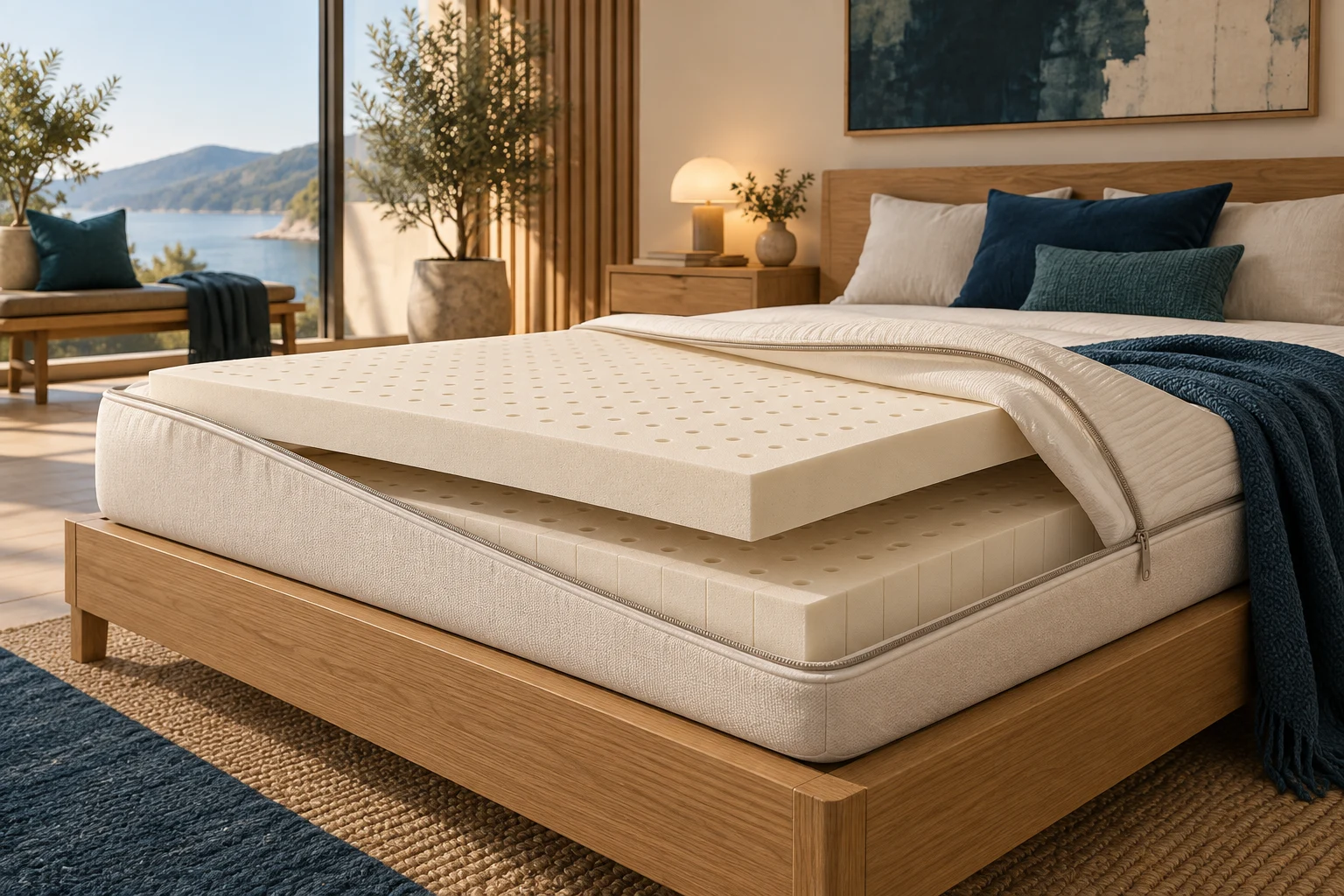
We researched current U.S. manufacturer documentation on September 13, 2026. We have not performed accelerated-wear or long-term ownership tests. No comparable failure-rate dataset establishes a lifespan winner here. The featured image is an AI illustration of a generic modular design, not a Naturepedic product photograph.
Three ways to make the evidence more concrete
| Starting point | Documented reason to investigate | Important limitation |
|---|---|---|
| Naturepedic EOS Classic | Modular latex-and-coil construction and replacement comfort layers | Repair options do not guarantee fit or free future parts |
| Sleep On Latex Pure Green | Eight inches of organic latex foam; Medium and Firm options | Material disclosure does not establish an exact useful life |
| Leesa Sapira Hybrid, current GreenFlex version | Published densities for two comfort foams | Partial layer disclosure is not whole-bed fatigue testing |
These choices are not ordered by projected lifespan or cheapest annual ownership cost. We lack the comparable long-term evidence needed for either ranking.
EOS Classic: choose repairability as a feature
Naturepedic documents a zippered modular design with interchangeable layers. Its layer-swap program allows comfort adjustment, and replacement comfort layers can be purchased later. That offers a practical route to changing one component instead of automatically discarding the whole mattress. EOS Classic, layer-swap program.
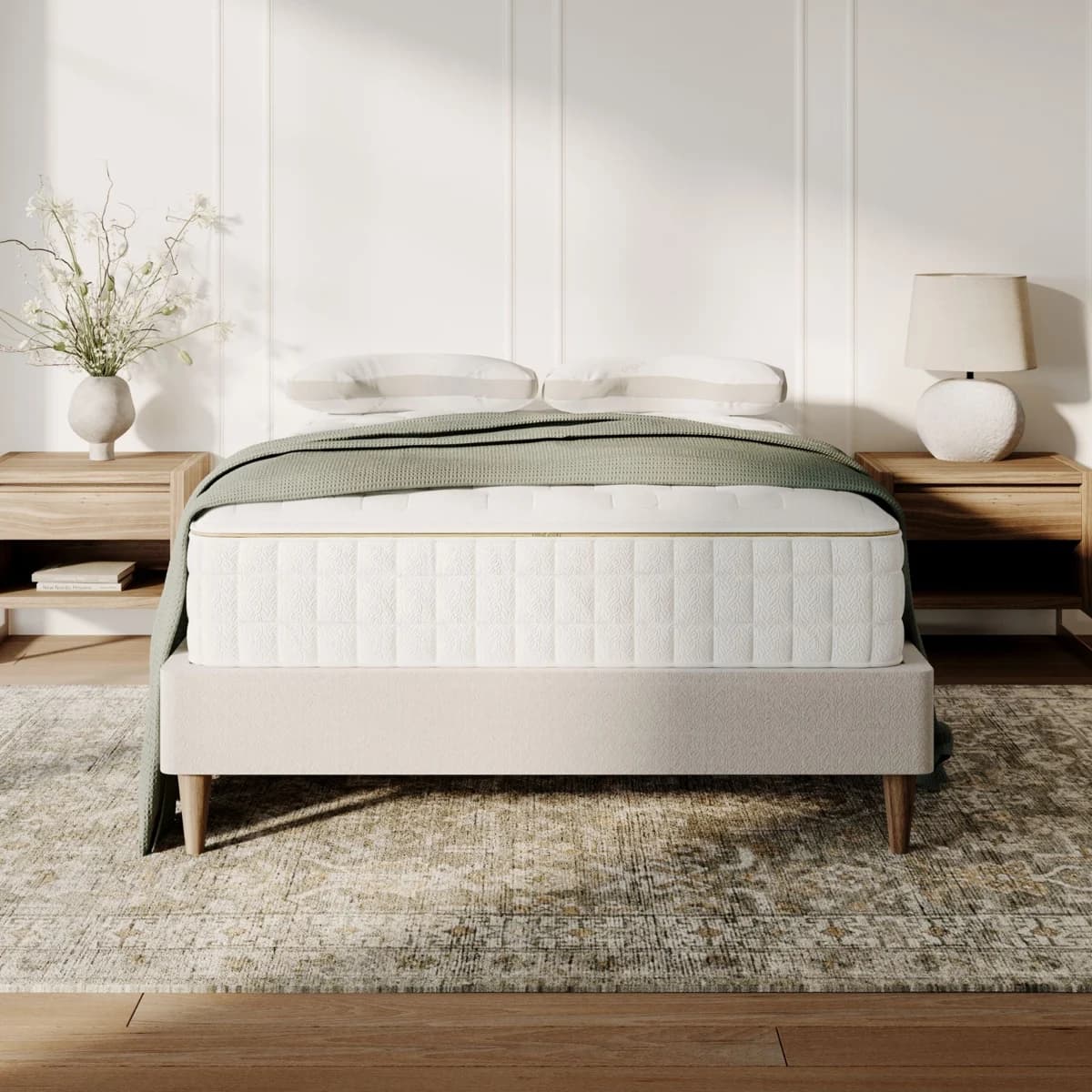
The important boundary is repairable does not mean indestructible. A new comfort layer will not necessarily solve damage elsewhere in the mattress or an unsuitable configuration. Before paying a premium for modularity, obtain the relevant replacement-layer price and establish which parts the program actually covers.
Choose EOS when adjustment and component replacement have tangible value to you. Pause if you want a sealed, assembled bed with no layer decisions. Its customization can add useful choices, but it also makes identifying the exact configuration more important.
Explore EOS Classic at Naturepedic →
Pure Green: a transparent latex route
Sleep On Latex lists eight inches of organic latex foam with cotton fabric and wool. The Queen is listed at 125 pounds in Medium and 145 pounds in Firm. Those details make construction and handling more concrete; the extra weight is not proof that Firm lasts longer. Pure Green specifications.
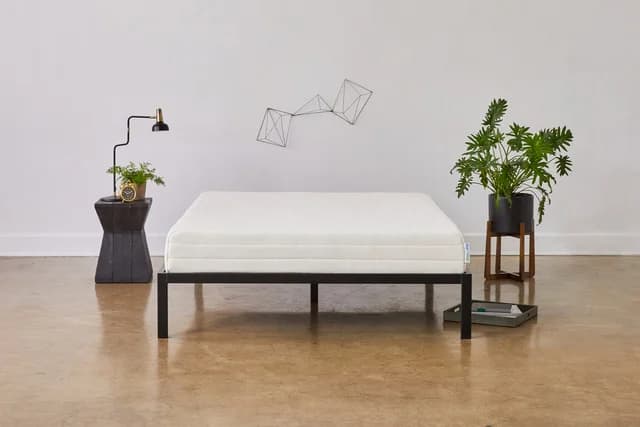
This is worth investigating if you want the mattress's latex content to be explicit rather than a vague “latex feel” claim. It arrives assembled, unlike a purchase built around choosing separate internal layers. Do not assume the EOS replacement program applies to it simply because both products contain latex.
For ownership planning, decide how you will move and maintain a mattress of this weight. Handling that is unrealistic for your household can undermine an otherwise attractive purchase. Use our mattress weight resources to plan logistics and read the manufacturer warranty for covered conditions.
Explore Pure Green at Sleep On Latex →
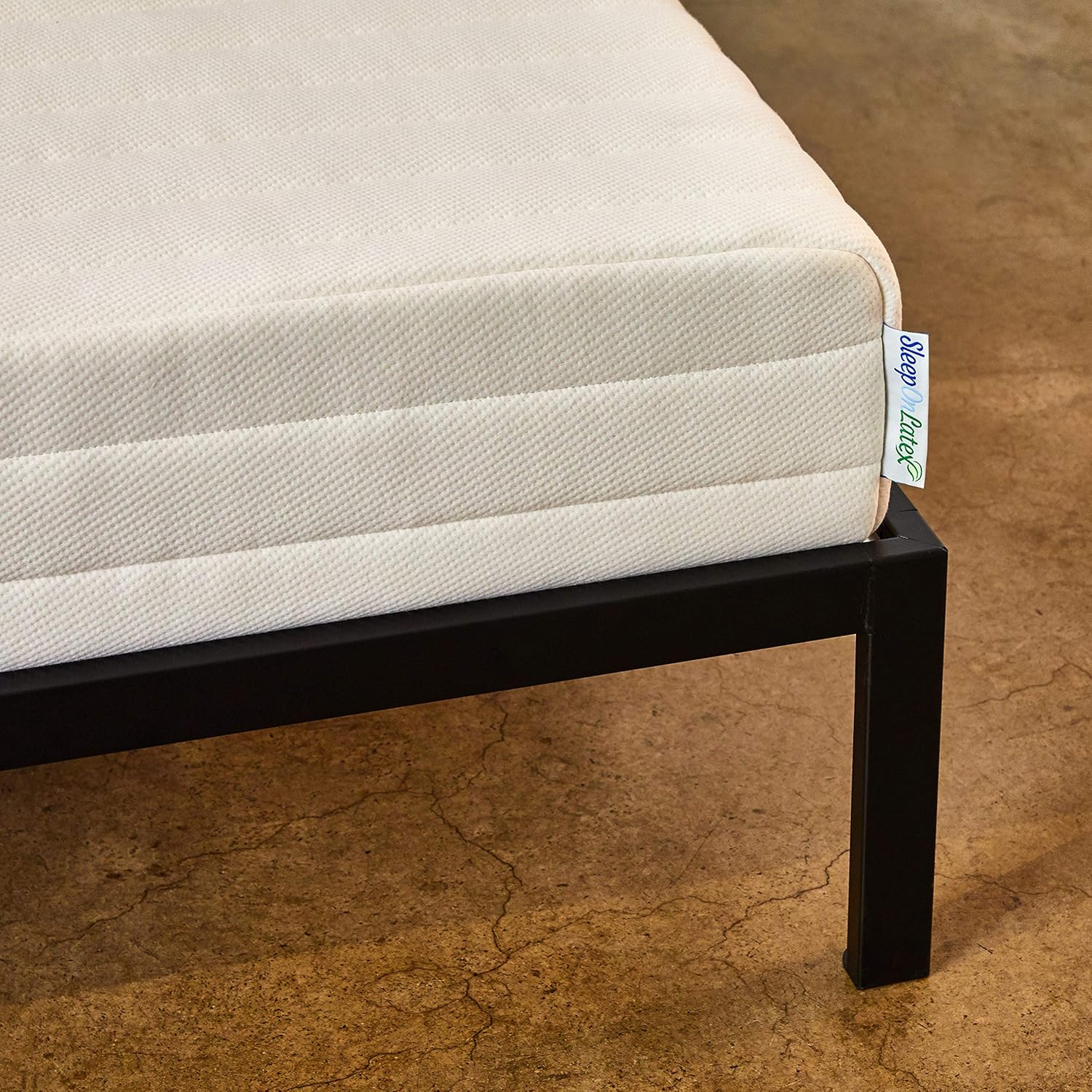
Pure Green Organic Latex: view the Queen Medium listing
A direct offer reference for the all-latex route. Medium is the selected firmness; choose the correct variation rather than treating the photo as proof of feel.
Before checkout
Use the listing as the source of truth for current price tier, seller, delivery window, and return terms.
ASIN B01KPWG11O identity checked September 13, 2026. Seller authorization, final U.S. price and shipping were not established. Do not copy the listing's apparent weight-limit field into a support recommendation. As an Amazon Associate, we earn from qualifying purchases.
Sapira Hybrid: useful partial specification disclosure
For its current GreenFlex version, Leesa lists a 3-pound GreenFlex layer and a 4-pound memory-foam layer in its construction specification. That is more informative than describing every foam merely as premium. It still leaves the shopper without a complete long-term wear comparison. Sapira Hybrid specifications.
Consider it when you prefer a conventional foam-and-coil hybrid and want some layer-level disclosure. Do not convert the two figures into a whole-mattress density or a prediction of years. Nor should old-version owner experiences be treated as a durability study of the current formulation.
Our medium-firm shortlist discusses its feel category. This is a separate question from how long a particular unit remains comfortable.
Compare the Sapira Hybrid Amazon offer
Compare a conventional foam-and-coil purchase with the latex and modular routes. Establish the offered generation before using the current manufacturer's foam specifications.
Before checkout
Use the listing as the source of truth for current price tier, seller, delivery window, and return terms.
ASIN B01N6ZDQG9 identifies Sapira Hybrid. The inspected listing did not establish the current GreenFlex build. Its existence is not evidence of a measured lifespan or warranty eligibility. As an Amazon Associate, we earn from qualifying purchases.
What can you replace without buying a whole mattress?
Inside the shortlist
What are you actually sleeping on?
Choose a model to see its construction and the buying decision it changes. Diagrams group materials; layer heights are not to scale.
EOS Classic
Modularity is the feature being compared, not a promised lifespan.
Zippered encasement
The design provides access to the configured internal layers.
Replaceable comfort layer
Naturepedic documents a layer-swap program and later comfort-layer purchases.
Coil support construction
Inspect the rest of the mattress before deciding that one new layer solves the problem.
Reason to choose
A documented route to adjust or replace a comfort component has value to you.
Tradeoff to weigh
Later parts may cost extra, and the configuration still has to fit.
Warranty wording: a concrete example instead of a headline
Sleep On Latex's reviewed warranty identifies foam sinkage or indentations of one inch or more among covered defects. It also addresses qualifying splits or cracks and requires proof of an authorized purchase. Subjective comfort dissatisfaction, improper support and normal wear are among the exclusions. The specified remedy is governed by the full agreement. Pure Green warranty.
For a buyer, the important consequence is that “I no longer like how it feels” and “this meets the defined defect condition” are different claims. A bed can become unsuitable for you without triggering the warranty. Conversely, visible damage may deserve a documented claim rather than an immediate replacement purchase.
For EOS, distinguish the initial comfort-layer swap arrangement from a later paid refresh and from defect coverage. Before buying, request a quote for the specific size and component you might replace. For Sapira, a limited-lifetime headline does not tell you whether the comfort change you are worried about would qualify. Use the actual warranty attached to the seller and version of the order.
Compare ownership costs without inventing a lifespan
An inexpensive mattress replaced early can cost more per year than a more expensive one kept longer. But reversing that sentence does not prove a premium mattress will last longer. Run both possibilities using your own quotes.
Include the delivered mattress, required foundation changes and setup. For a modular option, add the proposed replacement layer and its delivery cost to the scenario. Leave out a future repair only when you intend to compare a no-repair scenario; do not assume repair is always necessary or always free.
Ownership scenario
What would your mattress cost per year?
Enter a quote and your own assumed useful life. Try a shorter and longer period to see how much the decision depends on that assumption. This does not predict lifespan. Values stay in this page.
Enter nonnegative costs and a useful-life assumption greater than zero to calculate a scenario.
Try the same purchase over a shorter assumed period, then a longer one. If the premium option only looks attractive under a very optimistic assumption, price or repair access should carry more weight in your decision. This comparison is especially useful for EOS: modularity has economic value only if a compatible part solves the problem at a cost you consider worthwhile.
A condition check: surface problem or structural problem?
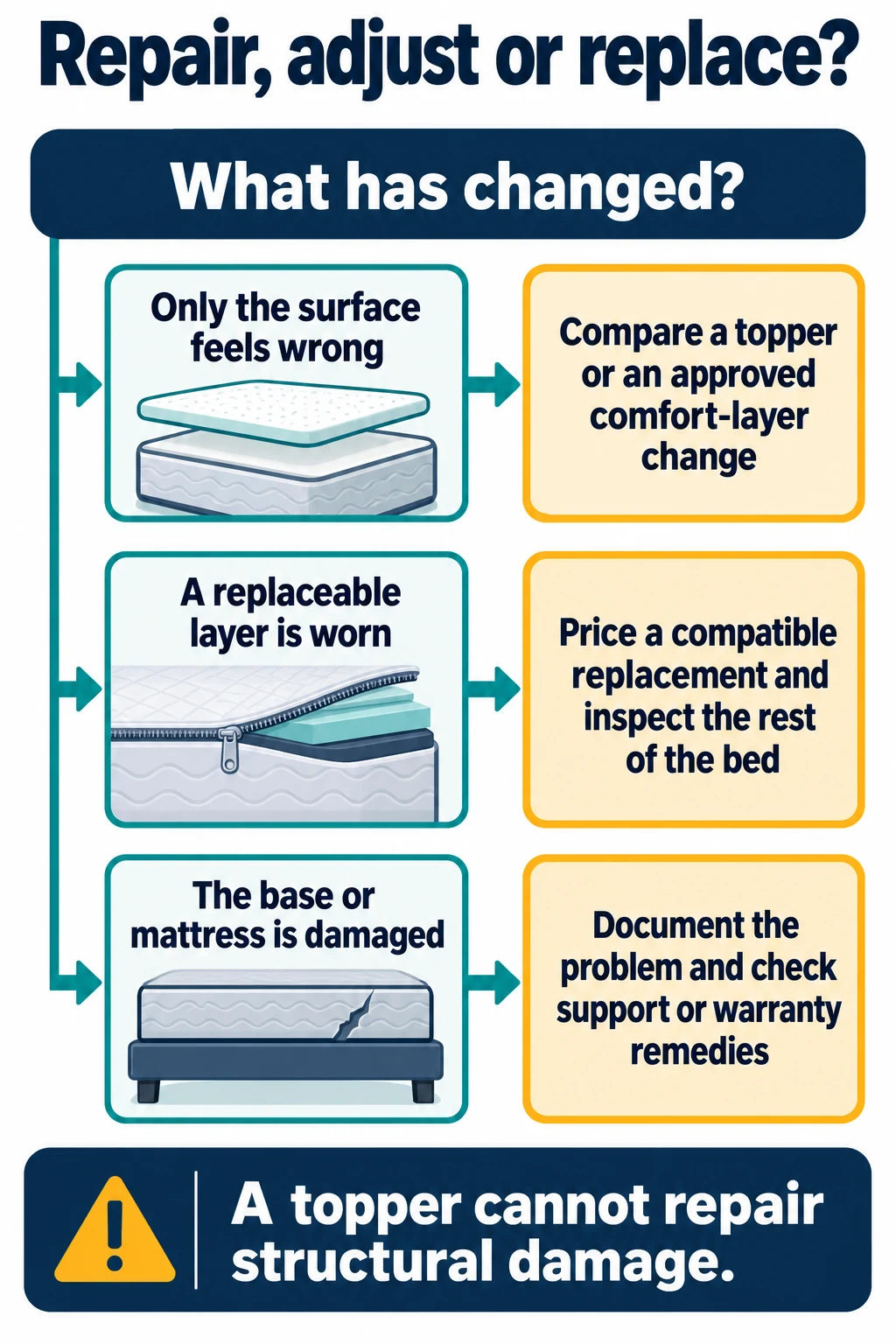
Only the surface preference changed: compare a topper or an approved comfort-layer change if the remaining bed is sound. With EOS, ask for the exact replacement component; with the assembled alternatives, do not open the mattress merely because another brand sells swappable layers.
The mattress or base is visibly damaged: document what changed and inspect the support arrangement. Follow the manufacturer's measurement and claim instructions. Putting a topper over a dip changes the surface but does not repair the underlying condition.
The whole configuration remains uncomfortable: preserve the return option while it exists. A durable material story is not a reason to keep an unsuitable mattress. In a shared bed, record each person's complaint separately so that an adjustment intended for one sleeper does not create a new problem for the other.
Four checks before paying for longevity
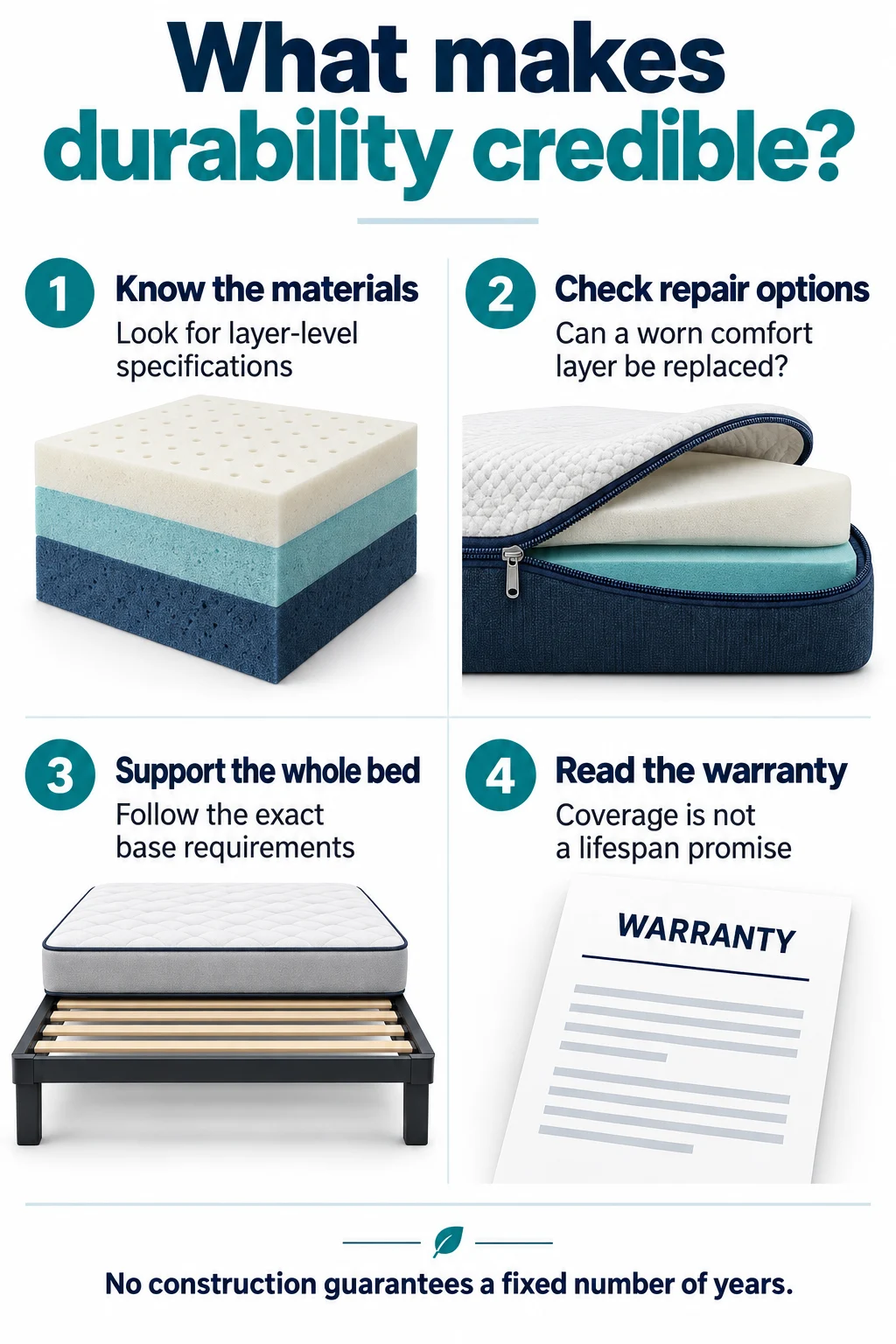
1. Ask for the layer information. Separate material type, thickness, density and firmness. The Polyurethane Foam Association distinguishes density from firmness; one cannot stand in for the other. Our foam density guide explains the units and the limits of using them.
2. Price the repair route. Ask what one replacement comfort layer costs, whether your size and configuration are available, and whether shipping or installation adds expense. Treat continued future availability as uncertain rather than guaranteed by today's catalog.
3. Check the entire support setup. Use the exact manufacturer's base instructions, including the foundation, slats and center support where applicable. Do not buy a stronger-looking mattress to conceal an unsuitable frame. Keep assembly records and follow the model's care guidance.
4. Read the remedy, not just the warranty duration. Identify the covered defect, measurement method, exclusions and customer costs. A comfort preference that changes over time is not automatically the same as a covered indentation. Preserve photographs and order records if a problem develops.
What owner discussions can teach us
An EOS owner discussion raises useful questions about layer changes, cover wear and the difference between discomfort and a warranty defect. It also mixes configurations and contains conflicting personal experiences. We use it to identify questions, not to calculate a defect rate or decide whose medical explanation is correct.
That leads to a concrete purchase question: if the bed becomes uncomfortable, what can actually be changed, at what cost, and under which agreement? Get that answer while the trial is active. A modular design should not persuade you to keep a mattress that still does not suit you.
For your existing bed, our lifespan estimator can structure a condition review; it is not a laboratory life prediction. Follow the maintenance checklist for practical ownership planning.
Favor the durability evidence you can inspect and the repair options you can use. None of these brands earns a fixed-year promise here. The better purchase is the one whose construction, fit, support setup and future repair costs make sense together.