
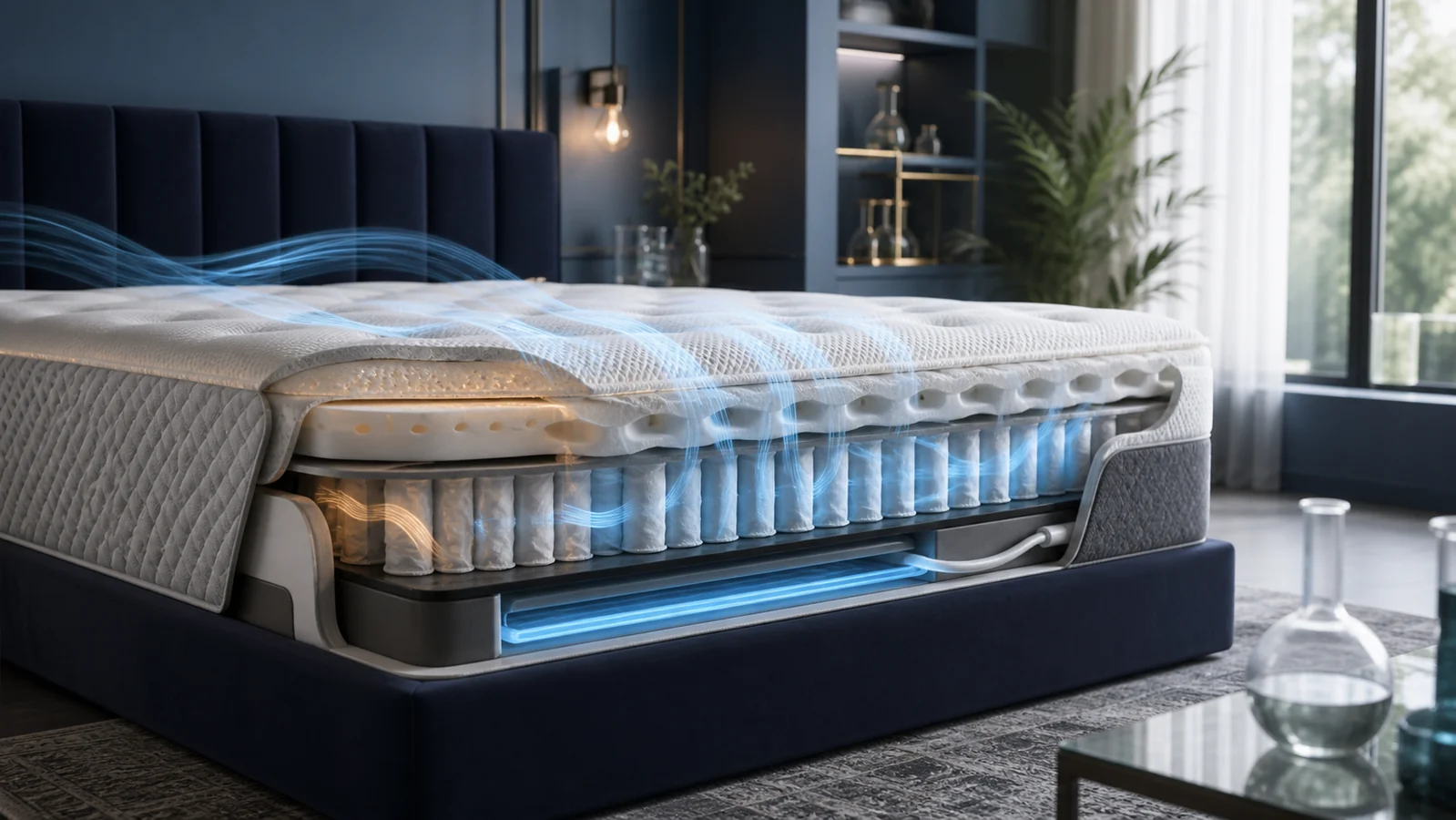
“Cooling” is not one mattress feature. A cool-to-touch cover affects the first contact, open-cell foam and coils create airflow pathways, high-heat-capacity or phase-change materials absorb heat for a limited period, and active systems circulate air or water. The most credible product claim tells you which mechanism was tested, for how long, in what room, at what measurement point and against which mattress.
Choose the scale of the change
| What you want to change | Follow this route |
|---|---|
| Keep a sound mattress but change the comfort layer | Passive cooling toppers |
| Replace the mattress and compare the whole construction | Mattresses for hot sleepers |
| Control the bed climate with a separate device | Air versus water cooling systems |
| Compare a connected mattress or adjustable sleep system | Smart-mattress research |
Start with the problem and the existing bedding. A passive material change, a replacement mattress and powered equipment are different purchases. The sections below explain the mechanisms before you choose a route.
Quick answer
Which cooling route matches the actual problem?
Use this shortlist if
- A cool-to-touch cover when the first minutes in bed feel uncomfortably warm.
- A breathable hybrid or responsive material when deep body enclosure and stagnant air are the main issue.
- An active system when a controllable, side-specific temperature is worth the added complexity.
Use a different route if
- The product uses a cooling adjective without identifying a mechanism or test method.
- A warm room, heavy duvet or impermeable protector is likely to overwhelm a small surface feature.
- New or persistent night sweats are being treated as a shopping problem instead of a possible health symptom.
What the sleep research actually supports
Thermal comfort matters, but mattress advertising often leaps farther than the evidence. A 2018 review of sleep environments and physiology concluded that skin temperature, rapid temperature change and sweating can reduce sleep quality, while also noting that research on bedding microclimates remained limited. A broader review of the thermal environment and sleep found that heat exposure can increase wakefulness and reduce slow-wave and REM sleep under real-life bedding conditions.
That supports taking overheating seriously. It does not prove that every gel infusion, graphite particle or cold-feel yarn produces a meaningful whole-night difference. The bed microclimate is a system: sleeper, room, humidity, mattress, protector, sheets, sleepwear and covers interact.
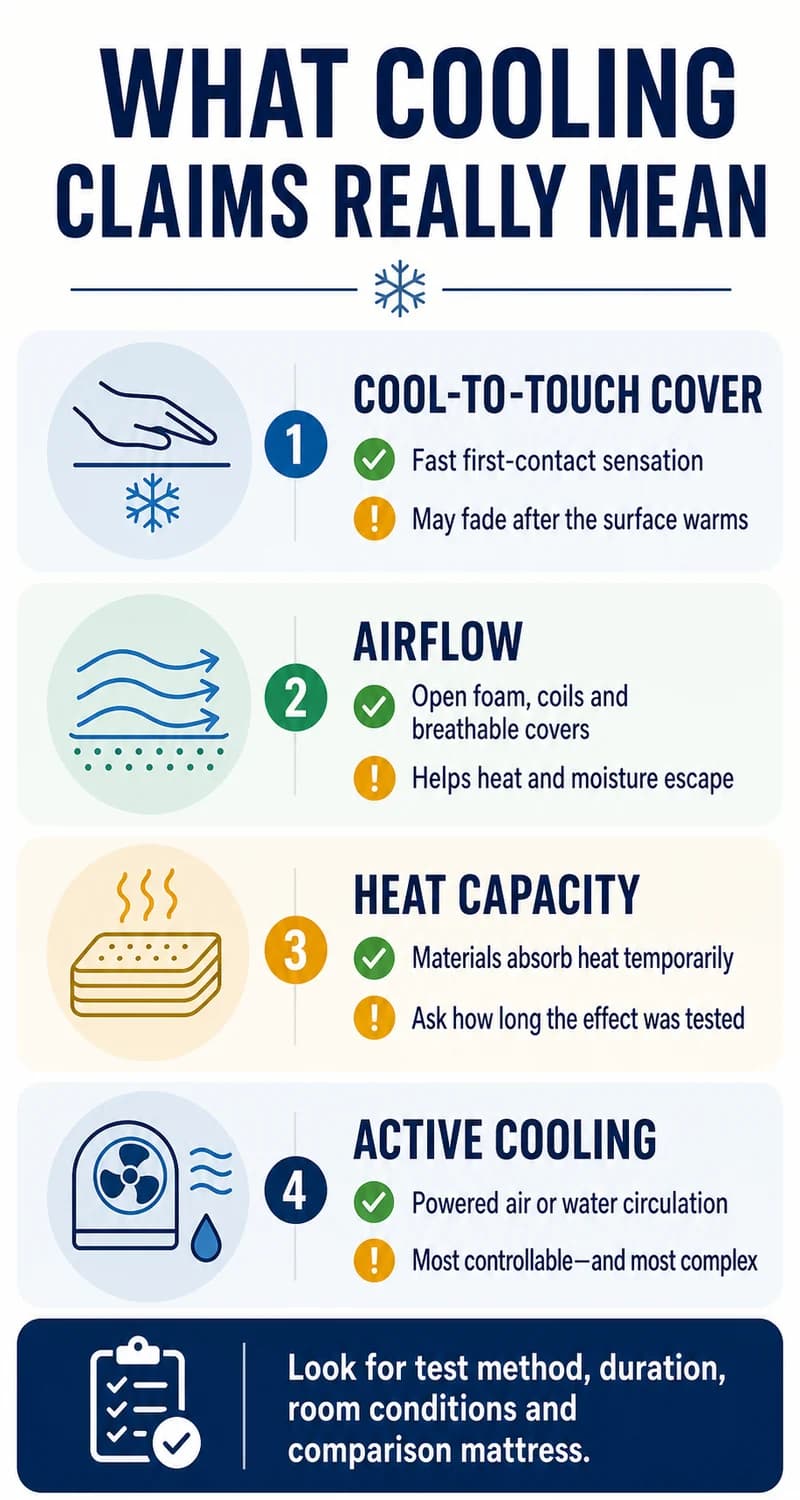
1. Cool-to-touch covers: useful, but transient
Cold-feel yarns and conductive additives can make the surface feel cooler when skin first contacts it. That can improve the settling-in experience. The surface then absorbs heat and moves toward a new equilibrium, so the initial sensation should not be translated into “stays cold for eight hours” without long-duration evidence.
When comparing listings, look for:
- the test property: thermal effusivity, conductivity, surface temperature or subjective rating;
- the contact duration;
- the room temperature and humidity;
- whether a sheet or protector covered the test surface;
- the exact comparison fabric.
A bare-hand demonstration on an uncovered showroom mattress measures a different experience from sleeping under sheets and a protector.
2. Airflow: pathways matter more than buzzwords
Airflow is a structural route, not a material badge. Coils leave open volume. Convoluted or perforated foam can create channels. Spacer fabrics and breathable covers can reduce resistance near the surface. Latex and responsive foams may also keep the sleeper less deeply enclosed than a slow, soft foam.
But airflow does not happen merely because a hole is visible. Warm air must move through connected spaces and exchange with the surrounding room. A dense perimeter, thick comfort layer, waterproof protector or fitted foundation can change that route.
For Amazon listings, inspect the cutaway and ask where air enters and exits. “Ventilated” foam with no explanation of the cover, comfort-layer depth or base is incomplete evidence.
3. Gel, graphite and copper: ask what property changed
These additives can alter thermal conductivity, heat capacity or early heat distribution. The practical effect depends on concentration, geometry, location and the rest of the mattress. A small amount dispersed through a thick foam is not automatically equivalent to a continuous conductive layer near the surface.
The responsible question is not “Does copper cool?” It is “What was measured in this complete mattress, over what period and against what comparator?” Without that, an additive is a construction detail—not a quantified benefit.
4. Phase-change materials: a thermal buffer with a limit
Phase-change materials absorb or release heat as they change state within a designed temperature band. In bedding they may reduce a temperature spike or prolong a cooler first-contact period. Once the available material has absorbed its working capacity, it cannot continue storing heat indefinitely without releasing it again.
Useful documentation should state where the phase-change material is used and report a time curve rather than one instant. A claim at minute one and a measurement after several hours answer different questions.
5. High-heat-capacity surfaces: promising under defined conditions
A 2025 randomized crossover study of 15 healthy young active participants found that a high-heat-conductivity topper improved several sleep outcomes during a 32°C heat night. The controlled result is relevant, but the small, specific sample and hot laboratory condition do not make every conductive topper a universal winner.
The study illustrates the right reading habit: identify the population, temperature, comparator, duration and measured outcomes before applying a result to a purchase.
6. Active cooling: most controllable, most complex
For actual product choices, our BedJet, Chilipad and Eight Sleep comparison separates air from water systems, maintenance, controls and ownership costs.
If you are considering a complete replacement bed rather than an added cover, our smart-mattress comparison distinguishes integrated climate systems from adjustable firmness and remote-only alternatives.
Active systems use a powered fan, air channels or circulating water to change the bed microclimate. Their advantage is control: some allow schedules and independent sides. Their disadvantages include price, pump or fan noise, hoses, cleaning, power use, condensation risk, leak risk and a device that can fail.
Evidence is developing. In a 2025 randomized crossover study of 34 healthy adults, a temperature-controlled mattress cover improved perceived sleep quality and thermal comfort, but did not produce significant differences in the objective sleep or biometric measures reported. The authors noted that expectancy or placebo effects could contribute.
That is a useful, nuanced result: feeling more comfortable matters, yet subjective improvement and objective change are not interchangeable.
Hybrid versus foam: why category labels are insufficient
A hybrid usually offers more open volume in the support core than an all-foam mattress. However, the sleeper is closest to the cover and comfort layers. A hybrid with thick, soft memory foam may enclose the body more than a responsive all-foam mattress with a thin comfort layer.
Compare these fields instead:
| Field | Why it matters |
|---|---|
| Cover and protector | Closest to skin; controls first touch and moisture transfer |
| Comfort material | Determines contour, contact area and recovery speed |
| Comfort-layer depth | More sink can enclose more of the body |
| Support core | Coils create open volume; solid foam does not |
| Edge system | Can help or restrict lateral air paths |
| Foundation | Changes ventilation under the mattress |
A credible cooling claim checklist
Before treating a cooling feature as a reason to buy, find answers to these questions:
- What exact physical mechanism is claimed?
- Was the complete mattress tested or only a material sample?
- What was measured—surface temperature, heat flux, humidity, sensation or sleep outcome?
- How long did the test run?
- What were the room temperature and humidity?
- Was weight or a heated body simulator applied?
- What mattress or material was the comparator?
- Were sheets and a protector included?
- Is the report public enough to evaluate?
- Does the live Amazon variant use the same construction?
If most answers are missing, downgrade the claim from evidence to marketing.
Fix the sleep system before paying for a feature
For a specific passive-layer purchase, see our cooling-topper comparison, which separates documented construction from unmeasured overnight cooling claims.
Run the inexpensive checks first: room temperature, humidity, duvet weight, sleepwear, protector breathability and sheets. Wash or replace a clogged or impermeable layer only according to its care instructions. Confirm that the foundation allows the ventilation required by the mattress maker.
Change one variable at a time for several nights. Otherwise, a new mattress, lighter duvet and cooler room introduced together will not tell you what helped.
Best practical buying rule
Prefer a transparent construction and return path over the largest cooling multiplier. The feature should match your heat problem, and the live listing should show the exact model, seller and terms you will receive.
Final verdict
The strongest passive cooling route is usually a complete breathable construction—not a single infused ingredient. Cool-to-touch covers can improve first contact; open layers and coils can support airflow; heat-capacity materials can buffer heat for a time; and active systems can provide the most direct control at the highest complexity.
No mattress can guarantee a cool night for every person and room. Buy the mechanism you can explain, verify the test you can evaluate, and keep the purchase-channel return terms for the exact order.