

A new mattress can have a noticeable smell after unpacking. The useful question is what to do next—not whether the smell deserves a reassuring or alarming label. Check for urgent hazards first. If there are no symptoms or signs of a gas, smoke or electrical problem, follow the setup instructions, remove loose packaging and ventilate with clean outdoor air when conditions allow.
Smell cannot tell you which chemicals are present, their concentrations or whether a room is suitable for a particular person. Less odor is an observation, not a safety certificate. This guide helps you organize the next steps; it does not diagnose an exposure or test your mattress.
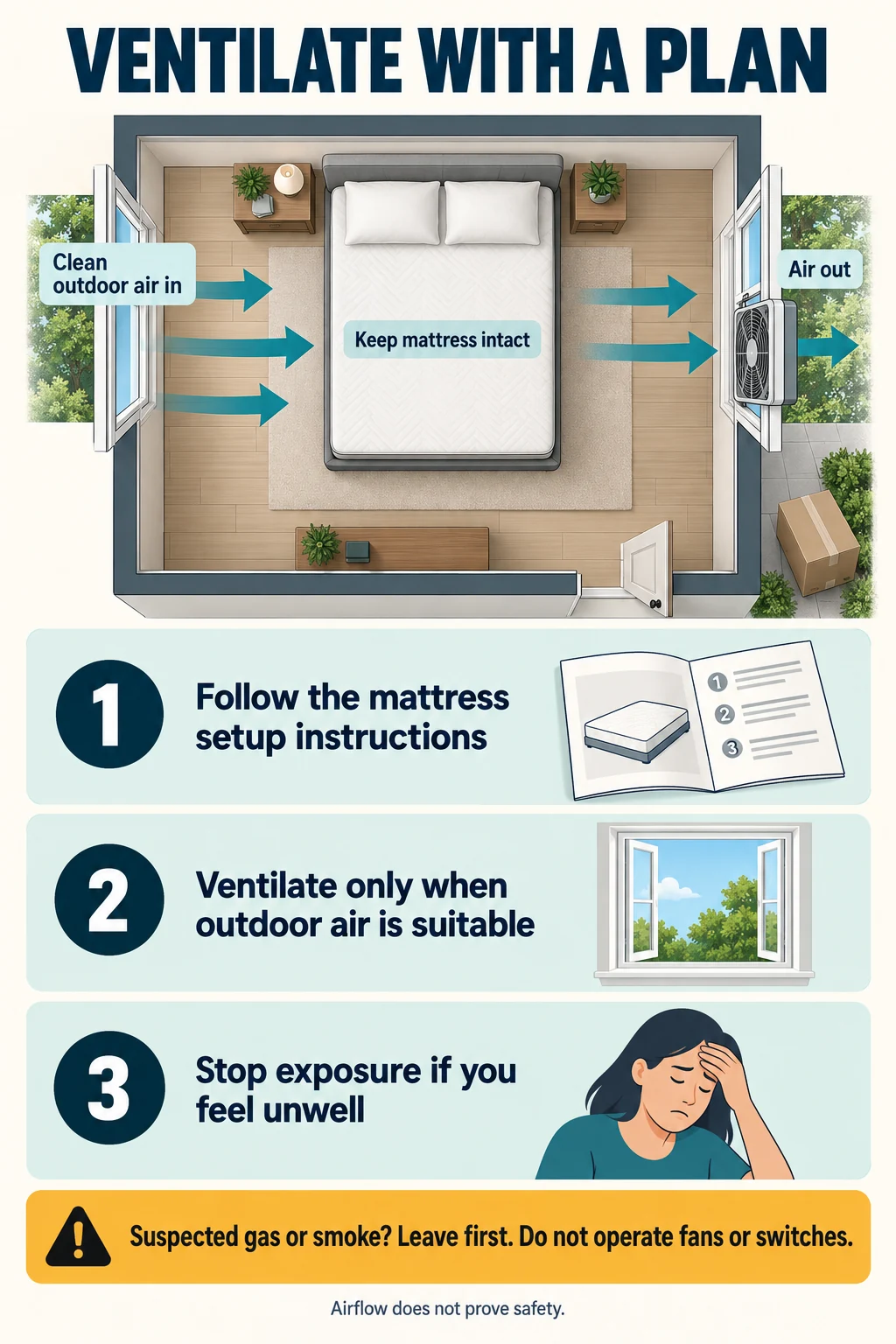
Editorial illustration: ventilation arrows show an airflow concept, not measured emissions or proof that a room is safe.
Leave first if there is an urgent warning sign
If someone has trouble breathing, collapses, has a seizure or cannot be awakened, call 911 in the United States. For suspected inhaled poison, move to fresh air and contact Poison Control at 1-800-222-1222. If you suspect a gas leak, smoke or an electrical fire, leave the building and call emergency services or your utility from outside. Do not stay to find the source or operate fans and switches during a suspected gas leak. Outside the U.S., use local emergency and poison services.
These actions follow Poison Control first-aid guidance and PG&E gas-safety guidance. A newly delivered mattress must not distract from another possible household hazard.
Choose your next step
Start at the top. No branch certifies the air or the mattress as safe.
01 · Urgent hazard
Breathing trouble, collapse, suspected gas or smoke
Leave and obtain urgent help. Do not use the ventilation plan below as a substitute.
02 · Symptoms or uncertainty
Irritation, headache or feeling unwell in the room
Stop using the room and seek medical or poison-center advice. Do not repeatedly return to test your tolerance.
03 · Odor without those warning signs
Check setup, ventilate appropriately and document
Follow the product instructions. If the odor remains unacceptable, contact the seller before the return deadline. Any new warning sign moves the decision back up.
What off-gassing means—and what odor cannot prove
Off-gassing describes substances being released from a material into the surrounding air. VOCs, or volatile organic compounds, are one category relevant to indoor air. EPA explains that health effects depend on the specific substance, exposure level and duration; indoor sources extend well beyond mattresses.
A smell noticed after delivery does not establish which part of the product or room produced it. Record when it began and what else changed, such as paint, cleaning products or other furniture. Avoid putting your face against the mattress or opening its cover to investigate.
Odor, gas emissions and loose fibers are different issues. A fiberglass-free claim does not mean zero VOCs, and a chemical smell does not identify fiberglass. If your concern is the fire barrier or visible fibers, use the separate fiberglass verification guide. Do not unzip the mattress to settle either question.
A ventilation plan for odor without urgent warning signs
EPA's general indoor-air approach prioritizes reducing sources and exchanging air with clean outdoor air; filtration is an additional measure. The following setup checklist applies that principle to an ordinary unpacking situation. It is not a tested mattress-specific clearance procedure.
- Read the exact model's setup and care instructions. Keep the mattress in the permitted position on a suitable support. Leave its cover intact unless the instructions expressly permit removal. Expansion time and odor advice answer different questions.
- Remove loose shipping materials from the sleeping area. Keep photographs, labels and useful order records. Store packaging only where it does not block an exit or create a hazard; keep plastic away from children and pets.
- Check outdoor conditions before opening windows. Wildfire smoke, exhaust or other outdoor pollution can make this counterproductive. When outdoor air is suitable, use available openings to exchange room air. A circulating fan in a closed room does not bring in fresh air.
- Avoid spreading the problem through occupied spaces. If using a fan in an ordinary non-emergency situation, arrange it to exhaust outward rather than blow across the mattress toward someone. Follow the fan's instructions and keep electrical equipment away from rain and unsecured windows.
- Reassess without deliberately exposing yourself. Note ventilation conditions and whether the smell is less noticeable, unchanged or stronger during necessary brief access. Do not stay in the room to complete an observation log if you feel unwell.
If you cannot ventilate suitably or are uncomfortable using the room, arrange another sleeping space where possible and ask the seller about next steps. Do not treat buying a purifier as a requirement for keeping an unsuitable mattress.
How long should you wait—and can you sleep on it tonight?
There is no universal 24-, 48- or 72-hour point at which this guide can declare every new mattress ready to use. A manufacturer's expansion instruction tells you about product setup; it is not a measurement of your indoor air or individual tolerance.
For tonight, separate three decisions: has the mattress met its setup instructions, are there any symptoms or unresolved household hazards, and is the room acceptable to use? If symptoms occur, stop exposure and seek advice rather than waiting for a countdown. For known sensitivities or a condition affected by indoor air, ask your clinician for individual guidance.
An odor that remains unacceptable is a reason to contact the seller promptly, even if a suggested airing period has not ended. Obtain written advice while the return option is open. A fading smell can help describe the trend, but neither it nor the absence of symptoms proves that emissions have stopped.
HEPA, activated carbon and ozone: different functions
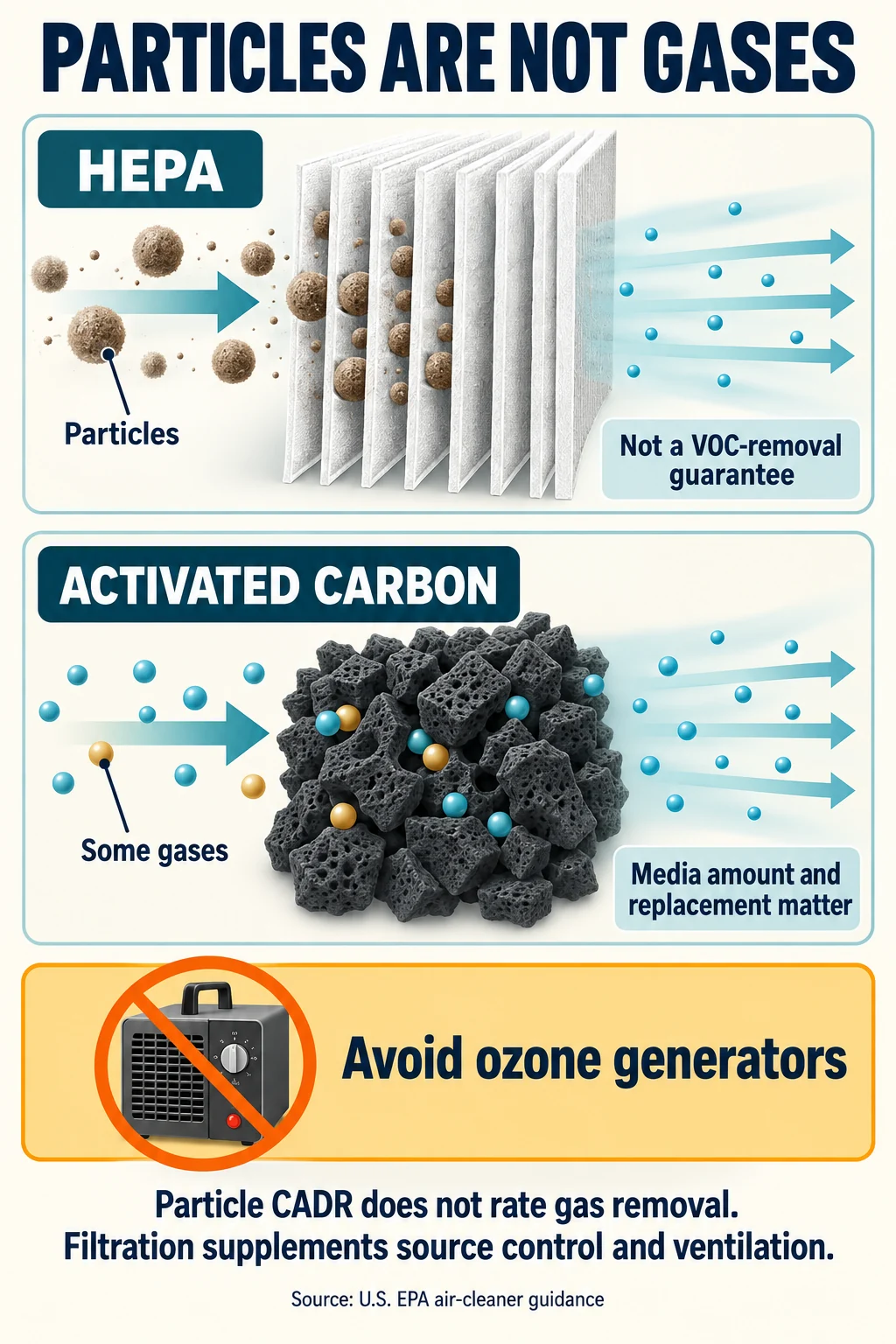
According to EPA's air-cleaner guide, HEPA and particle CADR concern particles. Gases require suitable gas-removal media, often activated carbon; performance depends in part on having substantial media. A particle CADR cannot demonstrate VOC removal. Filters also require replacement, and no cleaner removes every pollutant.
| Feature on the box | What to check | What it does not establish |
|---|---|---|
| HEPA / particle CADR | Room coverage and particle filtration | Removal of mattress gases |
| Activated carbon / gas filter | Target gases, quantity of media and replacement instructions | Removal of every compound or a safe room |
| Odor reduction claim | The substance and conditions tested | Your mattress's emissions or medical suitability |
| Ozone / ionization feature | Whether the device intentionally generates ozone | A safe treatment for new-mattress odor |
Do not use an ozone generator to treat this problem. EPA warns that ozone can harm the lungs, is ineffective against many indoor pollutants at concentrations meeting public-health standards, and can produce irritating reaction products. A seller's “unoccupied room” procedure does not turn this guide into approval for ozone treatment.
Avoid fragranced sprays, essential oils, powders, wet cleaning and deliberate heating or “bake-out” experiments. They do not identify the source and may conflict with care instructions. Ask the manufacturer before applying anything to the mattress.
Can a home VOC monitor answer the safety question?
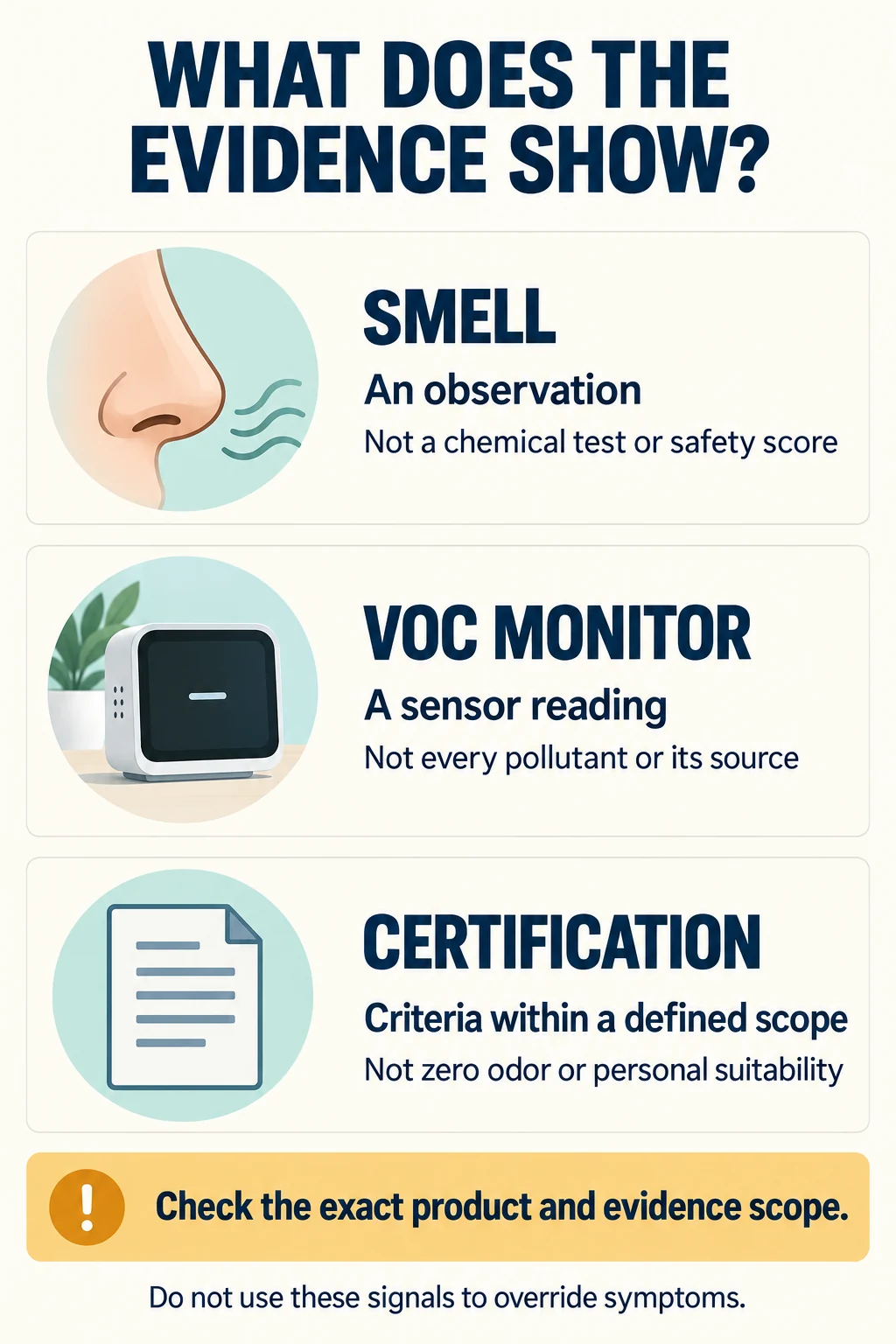
A monitor can provide a reading for the pollutants its sensors detect. It cannot measure everything in the room or automatically attribute a change to the mattress. EPA's consumer-monitor guidance explains that these devices have pollutant-specific capabilities and limitations.
A TVOC figure aggregates a sensor response; it is not a list of identified chemicals or a mattress-specific medical threshold. Do not use a green display or a falling number to override symptoms. If measurements are needed to resolve a persistent concern, ask a qualified indoor-air professional what question the testing would answer. A consumer VOC monitor does not replace smoke or carbon-monoxide alarms.
What certification labels actually cover
CertiPUR-US applies to qualifying flexible polyurethane foam under its program. It does not certify the entire mattress, its fire barrier or every textile and adhesive. Ask which foam and manufacturer the claim covers.
UL GREENGUARD evaluates chemical emissions within the certified product's scope. Gold uses stricter emissions limits. Check the exact product in the certification record; neither version is a promise of no odor or individual symptom-free use.
Request a current model-specific record rather than relying on a gallery logo. “Natural,” “organic” and “fiberglass-free” answer different materials questions and should not be substituted for emissions evidence. Our organic-mattress guide explains the separate certification checks.
Keep a short record and protect your return option
A useful record reports observations without diagnosing their cause. Keep symptoms in your private notes and share relevant details with a healthcare professional; you do not need to send a retailer your full medical history.
| Record | Example of a useful entry |
|---|---|
| Product identity | Exact model, size, seller, delivery and unpacking dates |
| Setup | Manufacturer instructions followed; packaging removed from bedroom |
| Conditions | Windows open or closed, fan use, outdoor smoke or other room changes |
| Trend | Odor still noticeable on entering; less noticeable than yesterday |
| Use and symptoms | Stopped using the room; sought appropriate advice |
| Return evidence | Deadline shown in order, support reference and written instructions |
Download the blank observation log (CSV). It is a local worksheet, not an exposure calculator. Do not use it to conduct repeated sniff tests or postpone getting help.
Here is a message you can adapt to the seller:
I received [exact model and size] on [date] and unpacked it on [date]. I followed [setup instructions]. The odor is [plain description and trend], and I have stopped using the mattress / room if applicable. Please confirm the model-specific setup advice, current materials or emissions documentation, my return deadline, and the authorized collection and packaging procedure. Please provide the instructions in writing.
Contact the responsible seller before the actual deadline. Ask about an opened and expanded mattress specifically. Do not cut, wash, donate or dispose of it without authorization. Use the Amazon return playbook for the order-specific process and the trial checklist to separate a comfort trial from a warranty.
Sources and editorial review
Reviewed September 13, 2026. This is an editorial synthesis of the public guidance below, with practical documentation steps. We did not test mattress emissions, sample the room, establish a universal airing time or medically review an individual's exposure. The featured image and three explanatory infographics are AI-generated editorial illustrations reviewed against the cited guidance. Diagrams are schematic, not measurements; the decision graphic is an action guide, not an air-quality assessment.