
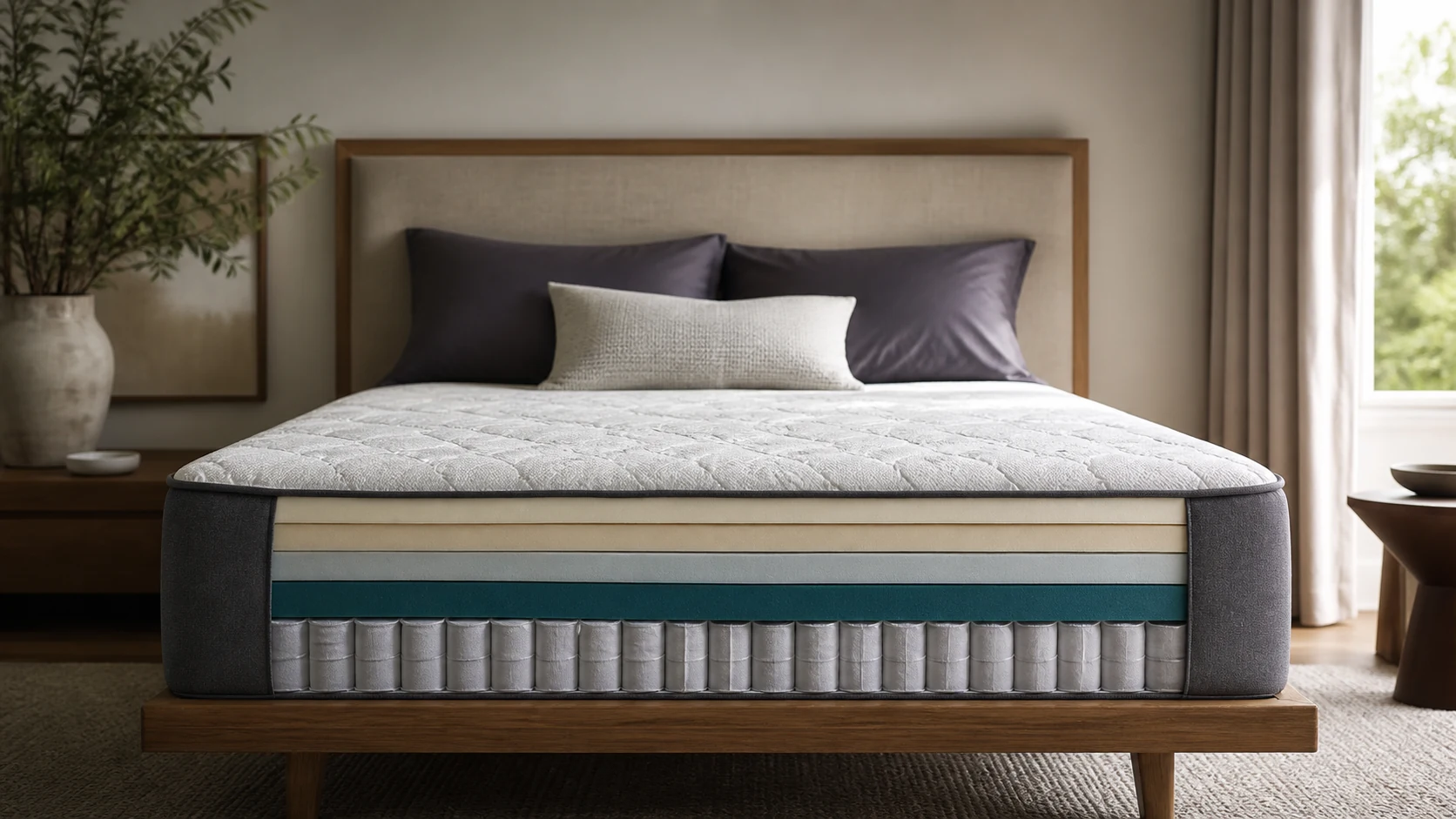
A medium-firm, responsive surface that limits excessive pelvic sink is the strongest general starting point for nonspecific lower-back discomfort. Leesa Sapira leads for balanced support, Saatva Classic for access and firmness choice, WinkBed for a traditional hybrid feel, and Nectar for foam-focused motion control.
Scope and safety boundary
Lower-back pain has many causes. This guide covers sleep-surface comfort only. Pain with weakness, numbness, bowel or bladder changes, fever, trauma, unexplained weight loss, or rapid worsening requires medical evaluation.
Is mattress comparison appropriate for your back discomfort?
Use this shortlist if
- Symptoms are stable and you are comparing support, pressure relief, movement and mattress condition.
- Your current surface visibly sags or consistently feels worse than another bed.
- You can use a written trial without treating a comfort recommendation as medical treatment.
Use a different route if
- Pain followed trauma or comes with weakness, numbness, fever, unexplained weight loss, or bowel or bladder changes.
- You expect one commercial mattress to diagnose, treat or cure the cause.
- A broken foundation, inadequate center support or deep structural sag has not been addressed.
Decision-first shortlist
Fast picks: three exact Amazon comfort routes
These are consumer comfort starting points, not medical prescriptions. Each card opens a verified product page; confirm the exact variant, seller, return path and warranty eligibility before ordering.
1. Best responsive hybrid starting point
DreamCloud Classic Hybrid
A balanced foam-and-coil route for sleepers who want cushioning without the deepest sink and need easier repositioning.
- Best for
- Back and combination sleepers wanting a responsive medium-firm direction
- Avoid if
- You need maximum motion isolation or a very plush side-sleeper surface
- Construction
- 12-inch foam-and-coil hybrid
- Price tier
- Lower-mid range
2. Best cushioned hybrid route
Helix Midnight Luxe
A taller hybrid for sleepers needing more shoulder and hip cushioning while retaining coil response.
- Best for
- Side and combination sleepers wanting deeper cushioning
- Avoid if
- You want a budget, low-profile or very firm mattress
- Construction
- Luxury foam-and-coil hybrid
- Price tier
- Premium
3. Best motion-isolating foam route
Nectar Classic
A slower-contouring all-foam option for shoppers prioritizing pressure distribution and partner-motion control.
- Best for
- Foam fans, side sleepers and motion-sensitive couples
- Avoid if
- You sleep very warm, change position often or depend on a rigid edge
- Construction
- 12-inch all-foam memory foam
- Price tier
- Lower-mid range
Prices, sizes, sellers, availability and return terms can change. Confirm the exact listing before purchase. Amazon buttons are affiliate links; as an Amazon Associate, we earn from qualifying purchases.
How we reviewed this topic
We reviewed current construction and policy documentation plus the often-cited randomized trial comparing firm and medium-firm surfaces. We did not diagnose participants, measure spinal angles in a laboratory, or verify that any mattress relieves pain.
Our evidence hierarchy puts current manufacturer documentation and relevant primary or standards-body guidance ahead of marketplace copy and star averages. The starting source for this guide is PubMed mattress-firmness trial. Consumer reviews can reveal questions to investigate, but they do not verify hidden materials, medical outcomes, durability, or policy eligibility.
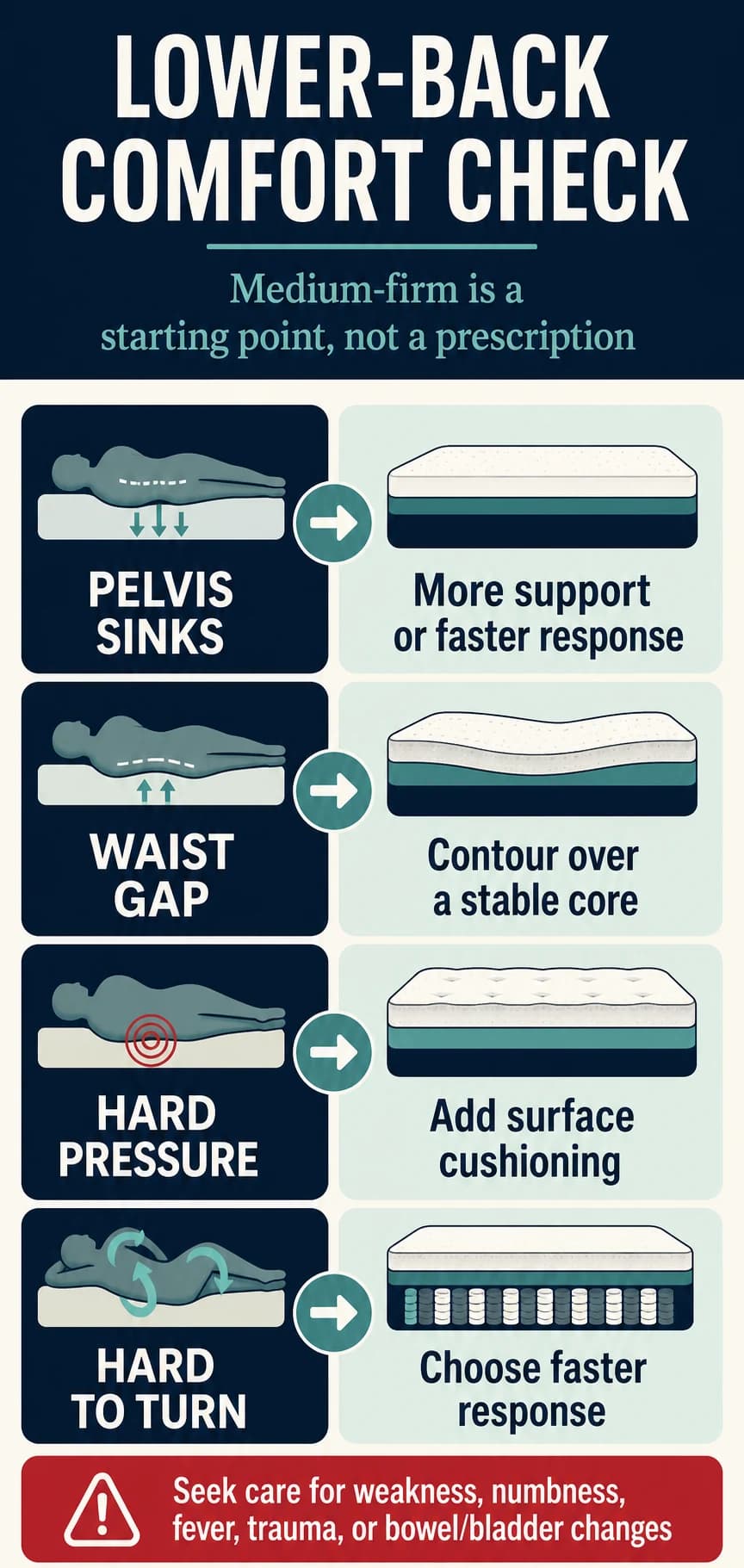
Start with the decision, not the product
| Need | Starting point | Verify in real use |
|---|---|---|
| Pelvis sinks | More supportive or more responsive build | Side profile improves without new pressure |
| Waist feels unsupported | Contouring with stable core | Surface fills the gap without pulling hips down |
| Pain improves away from home | Inspect mattress and base | Look for sag, broken slats or missing center support |
| Movement is difficult | Latex or responsive hybrid | Turning and standing require less effort |
A row is a starting lane, not a prescription. Two people with the same position or age can compress a mattress differently, use different pillows and bases, or have opposite preferences for bounce and contour. Write down the outcome you need before opening retailer tabs.
What we weighted most
- Pelvic support: track whether the pelvis settles noticeably lower than the rib cage in your normal position, especially after the bed warms overnight.
- Lumbar comfort: zoning or added center support is useful only if it feels supportive rather than like a hard ridge under your anatomy.
- Pressure relief: insufficient give at the shoulders, hips or ribs can cause bracing and frequent position changes even when the middle feels supported.
- Movement: assess whether rolling, sitting up and getting out of bed are easier or harder; comfort while motionless is only part of the decision.
- Mattress and base condition: visible sag, weak slats or missing center support can imitate a firmness problem and should be checked before a replacement purchase.
These criteria prevent a common error: replacing a real decision with a marketing proxy. A label, component name, rating or badge is evidence only within a defined scope; it is not a guarantee of fit, safety, durability or policy coverage.
What the firmness evidence can—and cannot—support
The most cited randomized trial followed 313 adults with chronic nonspecific low-back pain for 90 days and found better outcomes on medium-firm than firm mattresses. That supports medium-firm as a reasonable starting direction, not a prescription for every body or a ranking of today's commercial brands. The study did not test the products in this guide, and marketing firmness scales are not standardized across manufacturers.
Use the evidence to reject the simplistic rule that harder is always better. Then personalize the starting point by sleep position, body weight, pressure sensitivity and mobility. Side sleepers typically need more shoulder and hip travel. Stomach sleepers often need shallower cushioning. People who struggle to turn or stand may prefer faster response and a stable edge over deep slow foam.
Mattress shopping is appropriate only after urgent or concerning symptoms are separated from a comfort decision. Weakness, numbness, bowel or bladder changes, fever, trauma, unexplained weight loss or rapidly worsening pain warrant medical evaluation rather than a longer adaptation period.
Current research shortlist
1. Leesa Sapira Hybrid
Leesa Sapira Hybrid is the balanced brand-direct route. Its current 11-inch construction layers ventilated responsive foam and memory foam over reinforced springs. That combination targets contour without the deepest sink and keeps repositioning easier than many slow all-foam beds.
Main tradeoff: Medium feel is not universal. Match the current model name, height, firmness, seller, trial, warranty and return owner before purchase.
2. Saatva Classic
Saatva Classic offers three feel choices, two height options, a Euro top and dual-coil construction. Luxury Firm is the broad medium direction; Plush Soft and Firm serve narrower comfort preferences. In-room delivery can also matter when lifting or setup would aggravate symptoms.
Main tradeoff: Account for height and return terms. Match the current model name, height, firmness, seller, trial, warranty and return owner before purchase.
3. The WinkBed
The WinkBed is another multi-firmness hybrid route with a Euro pillow top, zoned wrapped coils and reinforced perimeter. Luxury Firm and Firmer create meaningfully different starting directions, while the Plus build changes the support architecture for sleepers above the brand's stated weight range.
Main tradeoff: Do not choose Softer solely for pain. Match the current model name, height, firmness, seller, trial, warranty and return owner before purchase.
4. Nectar Classic
Nectar Classic is the slower-response all-foam route. It may suit shoppers who value contour and motion isolation, but it deserves extra scrutiny if getting out of bed is difficult or if deep pelvic sink is already the suspected problem.
Main tradeoff: May feel warm or restrictive. Match the current model name, height, firmness, seller, trial, warranty and return owner before purchase.
Nectar Classic Memory Foam Mattress
A contouring foam route for shoppers who prioritize motion isolation and already know they tolerate slow foam.
- Best for
- Foam fans and motion-sensitive couples
- Avoid if
- You sleep hot or need quick movement
- Construction
- 12-inch all-foam memory foam
- Price tier
- Lower-mid range
Before checkout
Use the listing as the source of truth for current price tier, seller, delivery window, and return terms.
Verified Queen listing: ASIN B0DCXFXGBM. No mattress is presented as a treatment or cure. As an Amazon Associate, we earn from qualifying purchases.
Shortlist comparison
| Option | Best research fit | Primary caution |
|---|---|---|
| Leesa Sapira Hybrid | Balanced response, cushioning and coil support | Medium feel is not universal |
| Saatva Classic | Firmness choice and a stable edge | Account for height and return terms |
| The WinkBed | Traditional hybrid response with multiple feels | Do not choose Softer solely for pain |
| Nectar Classic | Slower foam and strong motion isolation | May feel warm or restrictive |
Separate mattress, pillow and foundation effects
Before replacing the mattress, inspect it with the bedding removed. Look for visible body impressions, broken slats, excessive slat spacing, missing center support and a base that flexes where the manufacturer requires rigidity. A topper may soften a level support core but cannot repair a structural dip.
Keep the usual pillow stable during the first part of a mattress trial. Changing mattress and pillow together makes it difficult to identify why symptoms changed. Record morning discomfort, night waking, ease of turning and how the bed feels in the second half of the night. A pattern across one to two weeks is more useful than a single first-night reaction, provided symptoms are not worsening and no red flags are present.
A five-step purchase and trial process
- Freeze the exact identity. Save the model, generation, size, height, firmness, seller, fulfillment party and condition.
- Verify the complete system. Check the mattress, foundation, protector, pillow, room climate and any adjustable base together.
- Read the live policies. Identify the trial owner, minimum-use rule, opened-item return route, pickup cost, warranty eligibility and required support.
- Change one variable at a time. Keep familiar bedding and pillow at first unless one is clearly incompatible.
- Document the trend. Track comfort, pressure, movement, heat, access and visible support while preserving labels, photos and correspondence.
A trial is not permission to ignore health or safety signals. It is a controlled consumer test of comfort and function under the written policy. See our mattress trial checklist before ordering.
Claims we deliberately do not make
- We do not claim personal long-term use, laboratory cooling, pressure mapping or chemical analysis unless such work actually occurred.
- We do not publish static sale prices, future discount predictions or permanent Amazon inventory.
- We do not treat a firmness number, material specification, component count or certification logo as a universal pass/fail score.
- We do not turn customer reviews into medical, durability or safety evidence.
Common mistakes to avoid
- Treating one firmness number as clinical advice.
- Assuming zoning is always better.
- Ignoring the foundation.
- Waiting through worsening symptoms.
When to keep, exchange or return
Keep the product when the documented model is correct, the setup follows support requirements, comfort and function trend acceptably, and no policy or safety problem has emerged.
Exchange when the system is fundamentally sound but the written program permits a clearly better firmness, height or configuration. Do not assume an exchange restarts the trial.
Return or escalate when the wrong model arrived, documentation conflicts, the setup cannot be made compatible, symptoms or access worsen, a material or odor concern persists, or the return deadline is approaching without a workable fit. Get written authorization before donation, disposal or pickup.
Related guides
Lower-back and hip pain need two separate trial checks
For shoppers searching for the best mattress for lower-back and hip pain, treat pelvic support and side pressure as separate outcomes. A thicker plush surface may reduce hip pressure but let the pelvis rotate or sink; an extra-firm surface may reduce visible sink while loading the hip and increasing repositioning. Test the most common sleep position first, then the secondary position, and record symptoms instead of relying on one overall comfort score.
If the current mattress is flat and supportive but too hard, our topper guide for back pain provides a lower-cost, reversible path. If there is a valley, broken edge, or weak foundation, correct that structure rather than burying it under more foam.
- best mattresses for back pain
- mattress firmness guide
- mattress maintenance checklist
- best mattresses for stomach sleepers
Sources and verification notes
- PubMed mattress-firmness trial
- NCBI overview of symptoms that warrant medical evaluation
- Leesa Sapira Hybrid current construction
- Saatva Classic current firmness and construction choices
Policies, model names, sellers and certifications can change. Recheck the exact product and purchase channel on the day you buy.