
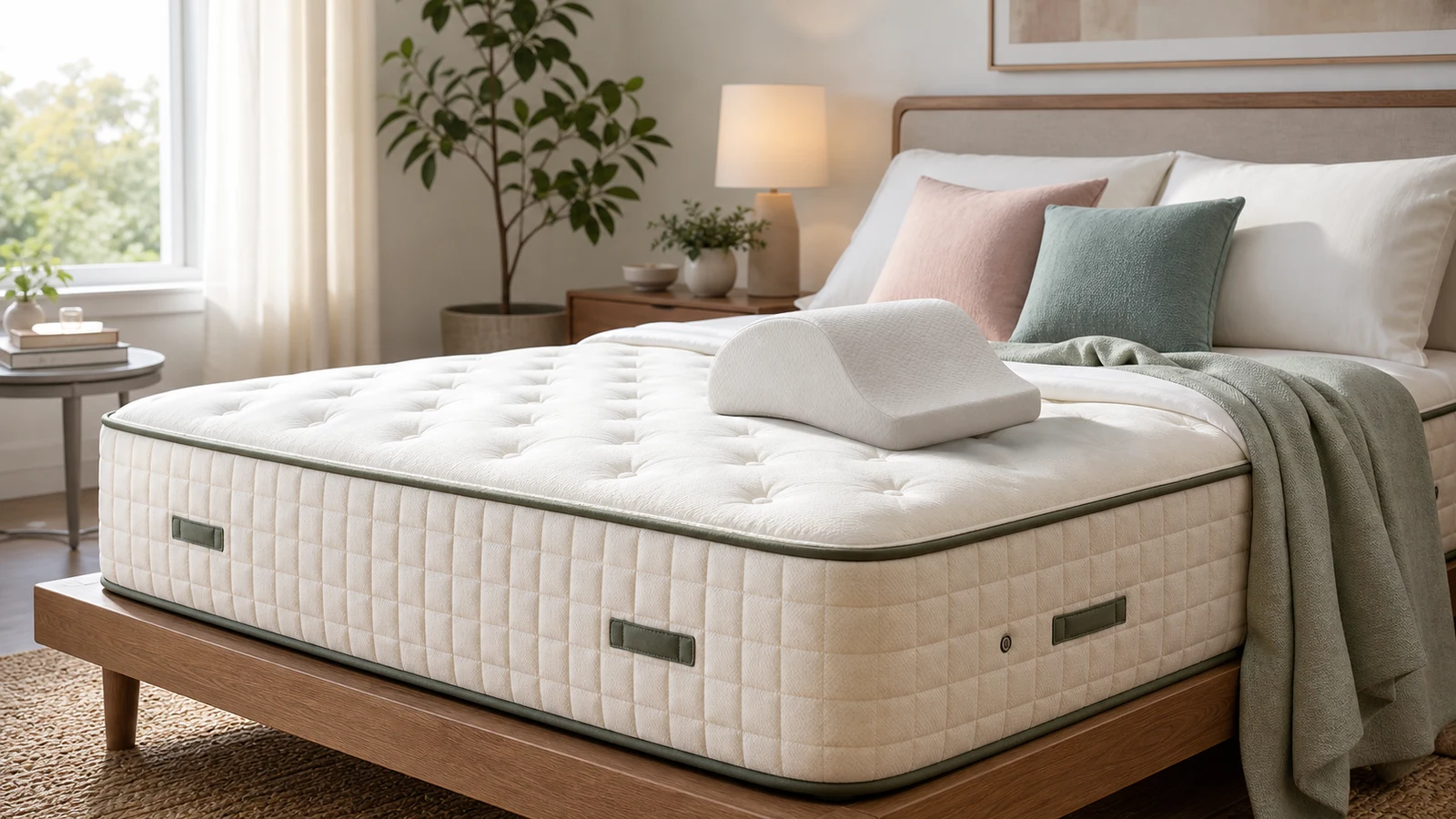
If you wake up with outer-hip soreness, a dull ache around the side of the thigh, or hip pain that eases once you move around, your mattress may be failing a pressure-and-alignment test. A mattress for hip pain has to do two jobs at once: spread pressure around the greater trochanter and keep the pelvis from sinking below the shoulders and lumbar spine.
This guide is not medical advice and it does not diagnose hip bursitis, osteoarthritis, sacroiliac joint pain, or Greater Trochanteric Pain Syndrome. It gives you a better buying framework: comfort-layer depth, ILD, foam density, transition support, zoned coils, airflow, edge stability, and return-risk checks.
For broader context, compare our Best Mattresses for Side Sleepers, Best Mattresses for Back Pain, and Mattress Firmness Guide.
The Plush Foam Trap
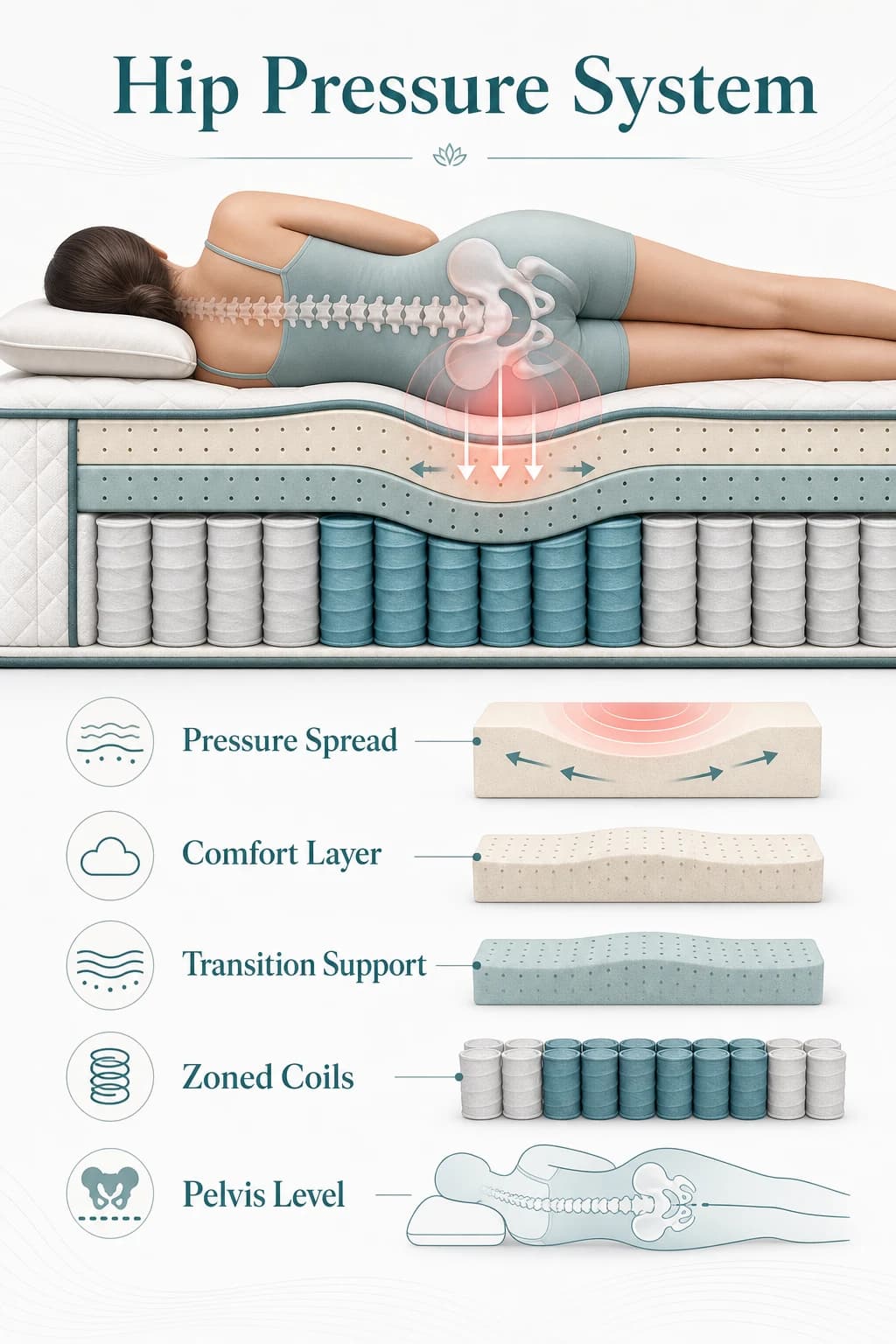
The common advice "buy the softest mattress" is incomplete. A very plush surface can feel soothing for ten minutes, then fail after a few hours if the comfort layer collapses under the pelvis. That creates two problems:
| Failure Mode | What It Feels Like | Why It Matters |
|---|---|---|
| Pressure spike | Outer hip feels sore, numb, or hot | The greater trochanter is not being spread over enough surface area |
| Pelvic drop | Hip sinks lower than shoulder and mid-back | The spine and SI area can rotate out of a neutral line |
| Bottoming out | You feel the firmer core under the hip | The comfort layer is too thin, too soft, or fatigued |
| Heat buildup | You wake and reposition repeatedly | Muscles stay tense and pressure relief feels worse |
You want progressive support: a conforming top layer, a stronger transition layer, and a support core that keeps the pelvis level.
What Specs Actually Matter
Mattress brands rarely publish every lab metric, but these are the signals to look for.
| Spec | Good Sign for Hip Pain | Watch Out |
|---|---|---|
| Comfort depth | 3 inches or more of foam, latex, microcoils, or pillow-top material | Thin "plush" layer over a hard core |
| Foam density | Around 3 to 5 lb/ft3 memory foam where disclosed | Low-density foam below about 1.8 lb/ft3 in daily-use comfort layers |
| ILD | Soft top around 14-19 ILD; transition around 24-28 ILD where disclosed | One very soft layer with no stronger transition |
| Latex | Talalay for more surface plushness, Dunlop for denser support | Latex that is too firm for side-sleeper hips |
| Coils | Pocketed coils, zoning, reinforced edges | Weak perimeter or non-zoned support with visible sag |
| Certifications | CertiPUR-US, OEKO-TEX, GOLS/GOTS where relevant | Vague "eco" or "medical-grade" claims without evidence |
ASTM D3574 is one common family of foam testing methods used for flexible cellular materials. Shoppers do not need to read lab reports, but density, indentation force, compression fatigue, and durability language are better signals than adjectives like "cloud."
Hip Pain Fit Matrix
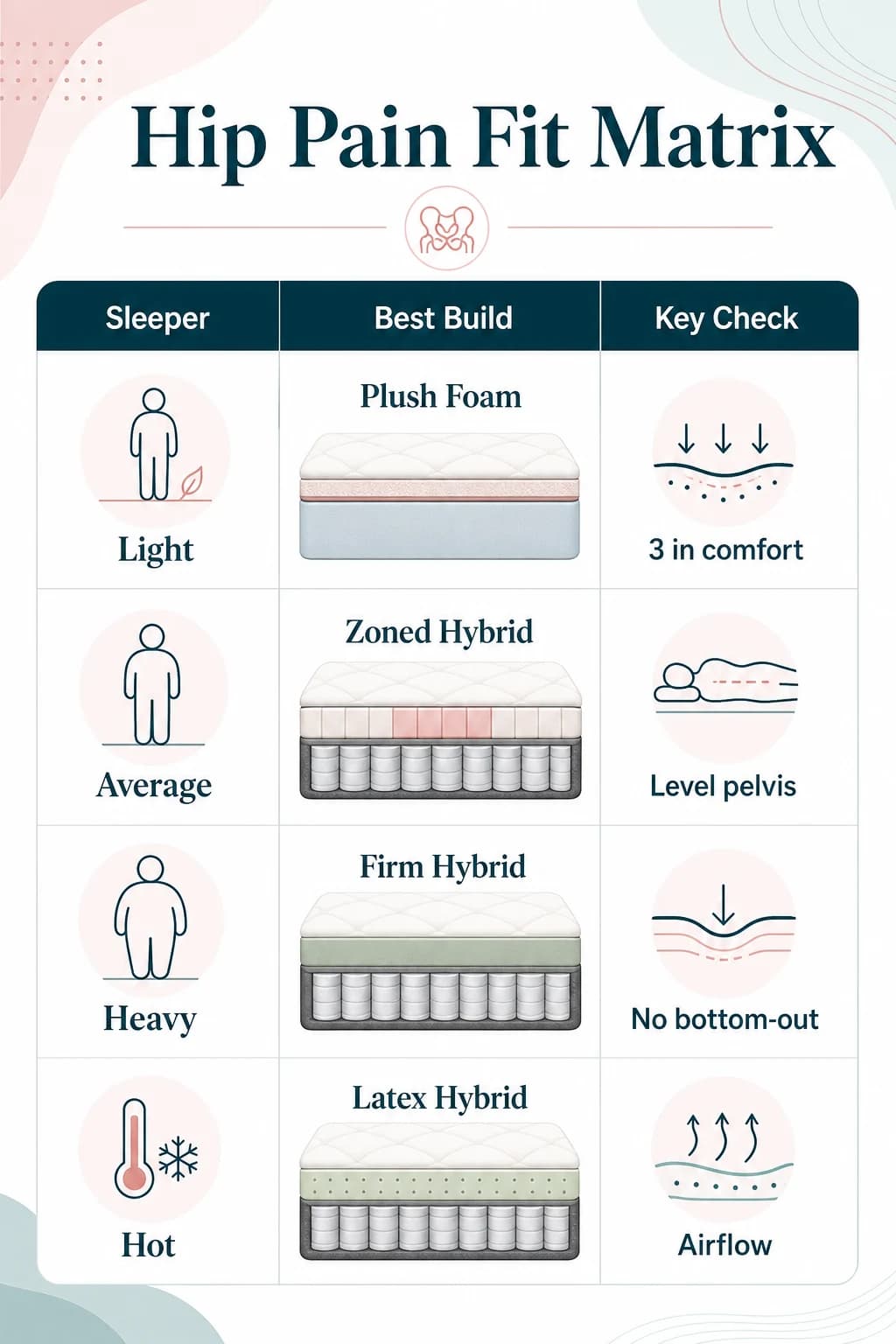
Use this matrix before looking at brand names.
| Sleeper Profile | Best Starting Build | What to Check |
|---|---|---|
| Lightweight side sleeper | Plush foam or soft hybrid | Enough softness for the hip to compress the comfort layer |
| Average side sleeper | Zoned hybrid or balanced foam hybrid | Hips stay level while the surface still cushions the trochanter |
| Heavier side sleeper | Medium-firm heavy-duty hybrid | No bottoming out, strong edge support, deeper comfort stack |
| Hot side sleeper | Latex hybrid or cooling hybrid | Airflow through coils and breathable bedding |
| Hip plus back pain | Zoned support with firmer center | Pelvis does not drop below the thoracic spine |
| Partner disturbance | Foam-forward hybrid | Better motion damping than bouncy latex-only builds |
Best Mattress Types for Hip Pain
Plush Memory Foam
Best for lighter and average-weight side sleepers who need the deepest pressure relief. Memory foam increases contact area around the hip, which can reduce the peak pressure that wakes you up.
The risk is heat and sag. If the foam is low-density or the transition layer is weak, the first few weeks may feel good and then the hip zone can trough.
Zoned Hybrid
Best all-around starting point for many side sleepers because it combines surface cushioning with coil support. The important part is not "hybrid" by itself; it is whether the comfort layers are deep enough and the support core keeps the pelvis from dipping.
Latex Hybrid
Best for hot sleepers and combination sleepers who need easier movement. Latex is responsive and breathable, but it can feel firmer under the hip than memory foam. Pressure-sensitive side sleepers should look for a softer comfort layer or a plush topper.
Heavy-Duty Hybrid
Best for sleepers over roughly 230 lb who need stronger resistance to pelvic bottoming out. Look for deeper comfort, denser transition materials, reinforced coils, and stable edges.
Premium Amazon Product CTAs
These are product-specific CTAs with direct Amazon product pages and Amazon image URLs. Listings, seller status, sizes, trials, coupons, and return terms change, so verify the exact page before checkout.
Helix Midnight Luxe
A strong side-sleeper hybrid benchmark with a plusher comfort surface and support structure that fits many hip-pressure shoppers.
- Best starting point if hip pressure is your main problem but you still need lumbar lift.
- Verify current size, Luxe tier, cooling cover status, seller, and return path.

Before checkout
Use the listing as the source of truth for current price tier, seller, delivery window, and return terms.
Prices, coupons, availability, shipping, and return terms change often. Confirm current details on Amazon before purchase. As an Amazon Associate, we earn from qualifying purchases.
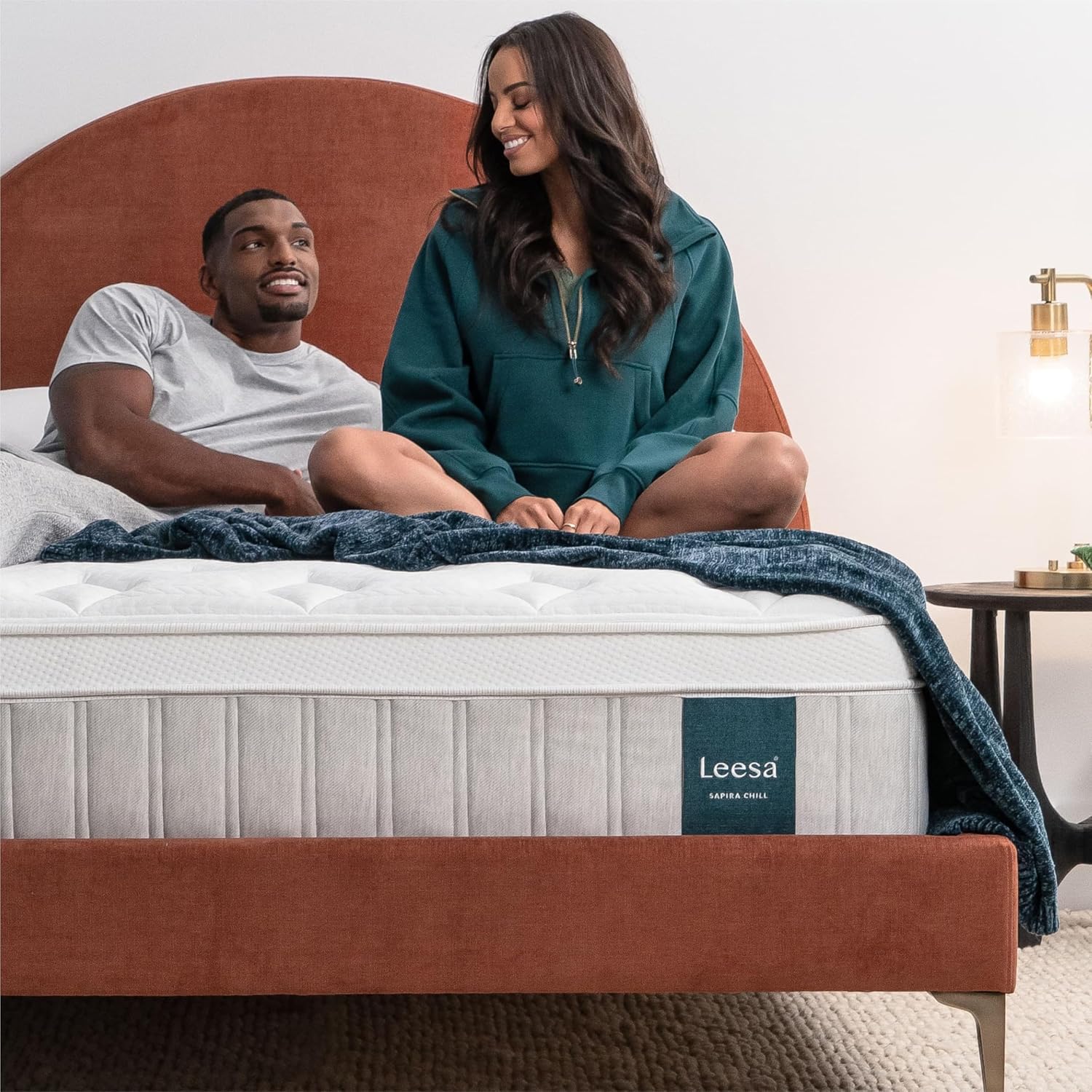
Leesa Sapira Chill Hybrid
A cooling pillow-top hybrid for sleepers comparing pressure relief, responsive support and a choice of comfort levels.
- Good comparison pick for side and combo sleepers who want cushioning without an all-foam feel.
- The verified link opens the Plush California King listing; select your size and firmness before checkout.
Before checkout
Use the listing as the source of truth for current price tier, seller, delivery window, and return terms.
Prices, coupons, availability, shipping, and return terms change often. Confirm current details on Amazon before purchase. As an Amazon Associate, we earn from qualifying purchases.
Brooklyn Bedding Aurora Luxe
A premium cooling hybrid comparison pick for hip-pain shoppers who also wake hot and need a breathable support core.
- Best fit if heat makes hip discomfort worse through repeated repositioning.
- Confirm firmness option because the same model family can vary by feel.

Before checkout
Use the listing as the source of truth for current price tier, seller, delivery window, and return terms.
Prices, coupons, availability, shipping, and return terms change often. Confirm current details on Amazon before purchase. As an Amazon Associate, we earn from qualifying purchases.
Purple Restore Hybrid
A responsive grid-over-coil option for sleepers who want pressure distribution, easier movement, and less foam heat buildup.
- Worth comparing if memory foam feels too warm or too slow.
- Check the exact firmness and size because Purple model names can be easy to confuse.

Before checkout
Use the listing as the source of truth for current price tier, seller, delivery window, and return terms.
Prices, coupons, availability, shipping, and return terms change often. Confirm current details on Amazon before purchase. As an Amazon Associate, we earn from qualifying purchases.
Titan Plus Luxe
A heavier-sleeper hybrid comparison pick when hip pain is paired with sag, edge weakness, or pelvic bottoming out.
- Best comparison pick for sleepers who need stronger support under the hip zone.
- Avoid choosing it only for softness; the point is pressure relief plus structural resistance.

Before checkout
Use the listing as the source of truth for current price tier, seller, delivery window, and return terms.
Prices, coupons, availability, shipping, and return terms change often. Confirm current details on Amazon before purchase. As an Amazon Associate, we earn from qualifying purchases.
30-Night Hip Pain Test
Do not judge a mattress from one night unless the pain is obvious and severe. Use a simple test.
| Timing | What to Check |
|---|---|
| Night 1-3 | Base support, slat spacing, pillow height, and whether the hip feels pressure immediately |
| Night 4-7 | Morning hip pain score, heat, shoulder comfort, and whether you roll away from the painful side |
| Night 8-14 | Side-profile photo: hips should not sit visibly lower than mid-back and shoulders |
| Night 15-21 | Try knee pillow, pillow loft, sheet/protector changes before blaming only the mattress |
| Night 22-30 | Keep, exchange, add topper, or return based on repeated pattern, not one bad night |
Take photos of the mattress surface, base, slats, and side-profile alignment. That evidence helps with returns and warranty conversations.
Topper or New Mattress?
A topper is useful only if the support underneath is still healthy.
| Situation | Better Move |
|---|---|
| Mattress is flat but too firm | Add a 2 inch memory foam or latex topper |
| Hip and shoulder both hurt | Use softer comfort or a deeper pressure-relief layer |
| Hip sinks and lower back aches | Use firmer support or replace the mattress |
| Visible sag or body impression | Replace the mattress, do not hide it with a topper |
| You sleep hot | Try latex, microcoil, cooling hybrid, or breathable bedding first |
Bedding and Pillow Setup
Back and hip pain: do not solve one by worsening the other
When hip and back symptoms overlap, test pressure relief and pelvic support separately. A plush topper or deep foam layer can reduce direct hip pressure while allowing the pelvis to travel too far; a firm bed can stabilize the torso while increasing side-sleeping pressure. Our best mattress topper for back pain guide explains when a sound but overly hard mattress is a reasonable topper candidate. Visible sag, broken support, or a persistent valley calls for structural correction instead.
Hip pain is not only the mattress. Side sleepers often need a knee pillow so the top leg does not pull the pelvis forward. Pillow height also matters: if the head pillow is too low, the shoulders rotate and the pelvis can follow.
Use this stack:
- Knee pillow between thighs to keep hips stacked.
- Head pillow that keeps neck, shoulder, and rib cage level.
- Breathable protector without a thick vinyl-like feel.
- Percale, linen, or Tencel sheets if heat increases tossing.
- Supportive base with slats close enough for the mattress warranty.
When to Avoid Mattress-Only Thinking
Mattress changes can help pressure and alignment, but they are not a substitute for care. Seek medical guidance when hip pain is severe, sudden, persistent, follows a fall, affects walking, radiates with numbness or weakness, or comes with fever, swelling, or unexplained weight loss.
Final Verdict
The best mattress for hip pain is not simply the softest bed. It is a system: a pressure-relieving comfort layer, a resilient transition layer, a support core that keeps the pelvis level, and enough airflow to reduce restless repositioning.
For most side sleepers, start with a medium-soft to medium zoned hybrid or a pressure-relieving foam hybrid. For hot sleepers, compare latex or cooling hybrids. For heavier sleepers, prioritize deeper comfort and stronger transition support before chasing plushness. Always verify the live Amazon listing, product image, seller, return terms, and warranty route before buying.