
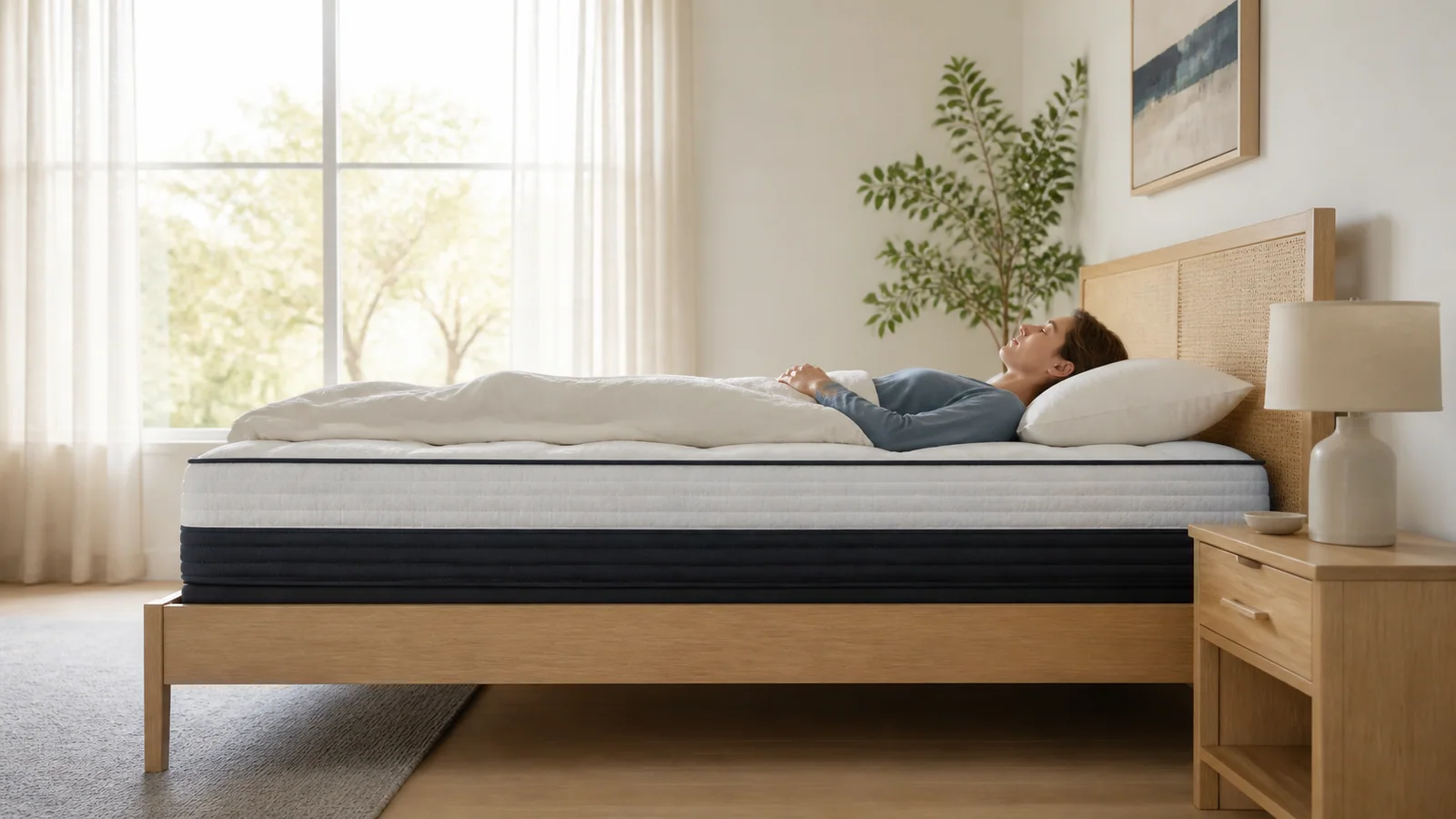
The best mattress for back sleepers should lift the hips, fill the lumbar curve, avoid shoulder pressure, stay cool, and keep the spine neutral without forcing the body onto a hard board. For many back sleepers, medium-firm support around 6-7/10 is the best starting point, but body weight, pillow height, base support, cooling, edge stability, and partner motion can change the final fit.
This guide keeps the "best mattresses" promise with concrete picks, but the picks are not shortcuts around fit. Use them as starting points, then verify the exact model, firmness, height, trial, warranty, seller, return path, and recent reviews before checkout.
For comprehensive sleep health guidance, visit our Sleep Health Hub.
Decision-first shortlist
Fast picks for back sleepers
Start with the construction route that matches your body and movement needs. DreamCloud and Nectar use verified direct Amazon product pages; the other buttons use narrowly matched marketplace results because stable direct pages were not available for every current model.
1. Best overall starting point
DreamCloud Classic Hybrid
A balanced coil-and-foam route that combines hip lift with enough surface cushioning for many average-weight back sleepers.
- Best for
- Average-weight back sleepers, back/side couples and people who want easier movement
- Avoid if
- You need maximum motion isolation, an extra-firm surface or a deeply plush side-sleeper feel
- Construction
- 12-inch foam-and-coil hybrid
- Price tier
- Mid range
2. Best contouring foam route
Nectar Classic
A slower all-foam option for sleepers who want lumbar contour and partner-motion control without hybrid bounce.
- Best for
- Light to average-weight back sleepers, foam fans and motion-sensitive couples
- Avoid if
- You overheat easily, need a reinforced edge or change position frequently
- Construction
- 12-inch all-foam mattress
- Price tier
- Lower-mid range
3. Best zoned-support research route
Helix Dusk Luxe
A taller zoned hybrid direction when stronger midsection support and a more substantial comfort stack matter.
- Best for
- Back and back/stomach sleepers wanting zoned support and a responsive surface
- Avoid if
- You want a low-profile bed, budget pricing or the quietest all-foam motion control
- Construction
- Zoned premium hybrid with foam over coils
- Price tier
- Premium
4. Best latex-hybrid research route
Avocado Green Mattress
A buoyant latex-hybrid route for sleepers who prioritize airflow, quick response and third-party material certifications.
- Best for
- Hotter back sleepers, latex fans and shoppers comparing certified materials
- Avoid if
- You want deep memory-foam contour, minimal bounce or a lower price tier
- Construction
- Latex over a pocketed-coil support core
- Price tier
- Premium
Prices, sizes, sellers, availability and return terms can change. Confirm the exact listing before purchase. Amazon buttons are affiliate links; as an Amazon Associate, we earn from qualifying purchases.
Important: a mattress is not medical treatment
A mattress can influence alignment, pressure relief, heat, and sleep comfort. It cannot diagnose or treat back pain. Medium-firm surfaces have some supportive evidence for chronic nonspecific low-back-pain comfort compared with very firm surfaces, but mattress changes are not a substitute for medical care.
If back pain is severe, worsening, radiating below the knee, paired with numbness or weakness, linked with fever or unexplained weight loss, connected to bladder or bowel changes, or follows trauma, seek qualified medical care. Mayo Clinic lists these types of symptoms as reasons to contact a clinician. For evidence context, see the Kovacs medium-firm mattress study on PubMed and a 2021 mattress-and-sleep-quality review on PMC.
How we ranked mattresses for back sleepers
Last verified August 12, 2026. We matched DreamCloud and Nectar to the direct Amazon product pages shown above and checked the current manufacturer pages for the remaining model routes. We did not pressure-map or sleep-test every model; the ranking is a transparent construction-and-fit shortlist, not a clinical treatment recommendation.
We rank mattresses for back sleepers by support mechanics first: hip lift, lumbar fill, body-weight fit, pressure relief, edge stability, cooling, motion control, trial terms, warranty protection, and foundation compatibility. A mattress does not win because it says "orthopedic" or "luxury"; it wins if it keeps back sleepers level without creating pressure or heat problems.
| Criterion | Weight | Why it matters |
|---|---|---|
| Hip support and anti-hammock effect | 25% | Back sleepers need lift under the pelvis and hips. |
| Lumbar fill and contour | 20% | Too firm can leave a gap under the lower back. |
| Medium-firm fit by body weight | 15% | Light, average, and heavy sleepers compress the same bed differently. |
| Pressure relief | 10% | Back sleepers still load shoulders, buttocks, and heels. |
| Edge support | 10% | Strong edges keep the full bed width usable. |
| Trial, warranty, and return friction | 10% | Online mattress fit needs real testing time and a clear return path. |
| Cooling and breathable build | 5% | More body contact can increase heat retention. |
| Motion isolation and couples fit | 5% | Partner movement and shared edge use matter. |
Best mattress picks for back sleepers
These are practical buyer routes, not universal awards. Back sleepers should still verify current specs, sleep trial terms, seller path, and recent reviews before purchase.
1. DreamCloud Classic Hybrid: best overall starting point
DreamCloud is a strong starting point for back sleepers who want a medium-firm hybrid feel, coil lift, and pressure-relieving foam without jumping into the highest luxury tier. It is especially sensible for average-weight back sleepers and couples who want a balance of support and contour.
- Best for: average-weight back sleepers, back+side couples, shoppers wanting a balanced hybrid
- Why it fits: coil support can help hip lift, while foam comfort layers add lumbar fill and pressure relief
- Watch out for: model naming, firmness descriptions, seller terms, and return path can vary by listing
Check DreamCloud Classic Hybrid Listings on Amazon
Compare DreamCloud hybrid listings, current seller details, firmness language, delivery options, and recent back-sleeper reviews before buying.
Before checkout
Use the listing as the source of truth for current price tier, seller, delivery window, and return terms.
Verify exact model, height, seller, delivery, trial terms, and warranty path before purchase. As an Amazon Associate, we earn from qualifying purchases.
2. Helix Dusk Luxe: best zoned hybrid route
Helix Dusk Luxe is a useful research route for back sleepers who want a more tailored hybrid feel with zoned support. It is a stronger fit for shoppers who want the bed to feel supportive under the hips without turning into an ultra-firm surface.
- Best for: back sleepers who want zoned support, average to heavier bodies, back+stomach sleepers
- Why it fits: zoned hybrid designs can add more support through the midsection
- Watch out for: exact Helix model, Luxe versus Core naming, pillow-top feel, and seller/return terms
Check Helix Dusk Luxe Listings on Amazon
Compare Helix Dusk and Dusk Luxe listings, firmness notes, zoned-support details, current seller path, and recent reviews from back sleepers.
Before checkout
Use the listing as the source of truth for current price tier, seller, delivery window, and return terms.
Confirm exact Helix model, construction, seller, delivery, trial terms, and current price before checkout. As an Amazon Associate, we earn from qualifying purchases.
3. Avocado Green Mattress: best cooling latex hybrid route
Avocado Green is a strong research route for hot back sleepers and back+combo sleepers who want a more buoyant, breathable feel than memory foam. Latex hybrids often make it easier to change position while still delivering lift through the core.
- Best for: hot back sleepers, latex fans, eco-focused shoppers, back+combo sleepers
- Why it fits: latex and coils can add airflow, responsiveness, and sturdy support
- Watch out for: latex bounce, firmness choice, pillow-top choice, and premium pricing
Check Avocado Green Mattress Listings on Amazon
Compare Avocado Green listings, firmness and pillow-top options, seller details, current return terms, and recent reviews from back sleepers.
Before checkout
Use the listing as the source of truth for current price tier, seller, delivery window, and return terms.
Verify firmness, pillow-top choice, seller, delivery, trial terms, warranty path, and current certifications before purchase. As an Amazon Associate, we earn from qualifying purchases.
4. Nectar Classic Memory Foam: best budget foam route
Nectar is a budget-friendly research route for back sleepers who want a memory-foam feel and strong motion isolation without paying premium hybrid prices. It is best for light to average-weight back sleepers who do not overheat easily and who like a slower contour.
- Best for: budget shoppers, foam fans, motion-sensitive couples, light to average-weight back sleepers
- Why it fits: foam contour can fill the lumbar curve and absorb partner movement
- Watch out for: heat, edge support, deeper sink, and whether the current model is firm enough for your body
Check Nectar Classic Listings on Amazon
Compare Nectar Classic listings, current model details, seller path, delivery options, return terms, and reviews mentioning lumbar support or hip sink.
Before checkout
Use the listing as the source of truth for current price tier, seller, delivery window, and return terms.
Confirm exact model, height, firmness, seller, trial eligibility, warranty path, and recent heat or edge-support reviews. As an Amazon Associate, we earn from qualifying purchases.
5. Titan Plus: best heavy-back-sleeper research route
Titan Plus is a better research route for heavier back sleepers who need more resistance against hip dip. The goal is not simply "harder"; it is a stronger support core with enough comfort material to avoid pressure and lumbar floating.
- Best for: heavier back sleepers, sleepers who bottom out on softer hybrids, edge-support shoppers
- Why it fits: heavier bodies often need firmer support, stronger edges, and a stable base
- Watch out for: too-firm feel for lighter partners, pressure at shoulders, and the need for a compatible foundation
Check Titan Plus Listings on Amazon
Compare Titan Plus listings, seller details, firmness notes, edge-support reviews, delivery options, and return terms before buying.
Before checkout
Use the listing as the source of truth for current price tier, seller, delivery window, and return terms.
Verify exact model, firmness, seller, trial terms, weight guidance, warranty path, and base requirements before purchase. As an Amazon Associate, we earn from qualifying purchases.
If you are narrowing the search to a medium-firm feel, our medium-firm mattress shortlist compares foam-over-coils, latex-over-coils and a neighboring cushioned innerspring option. Use it to compare constructions, not as a universal prescription for back sleepers.
Firmness and build matrix by body weight
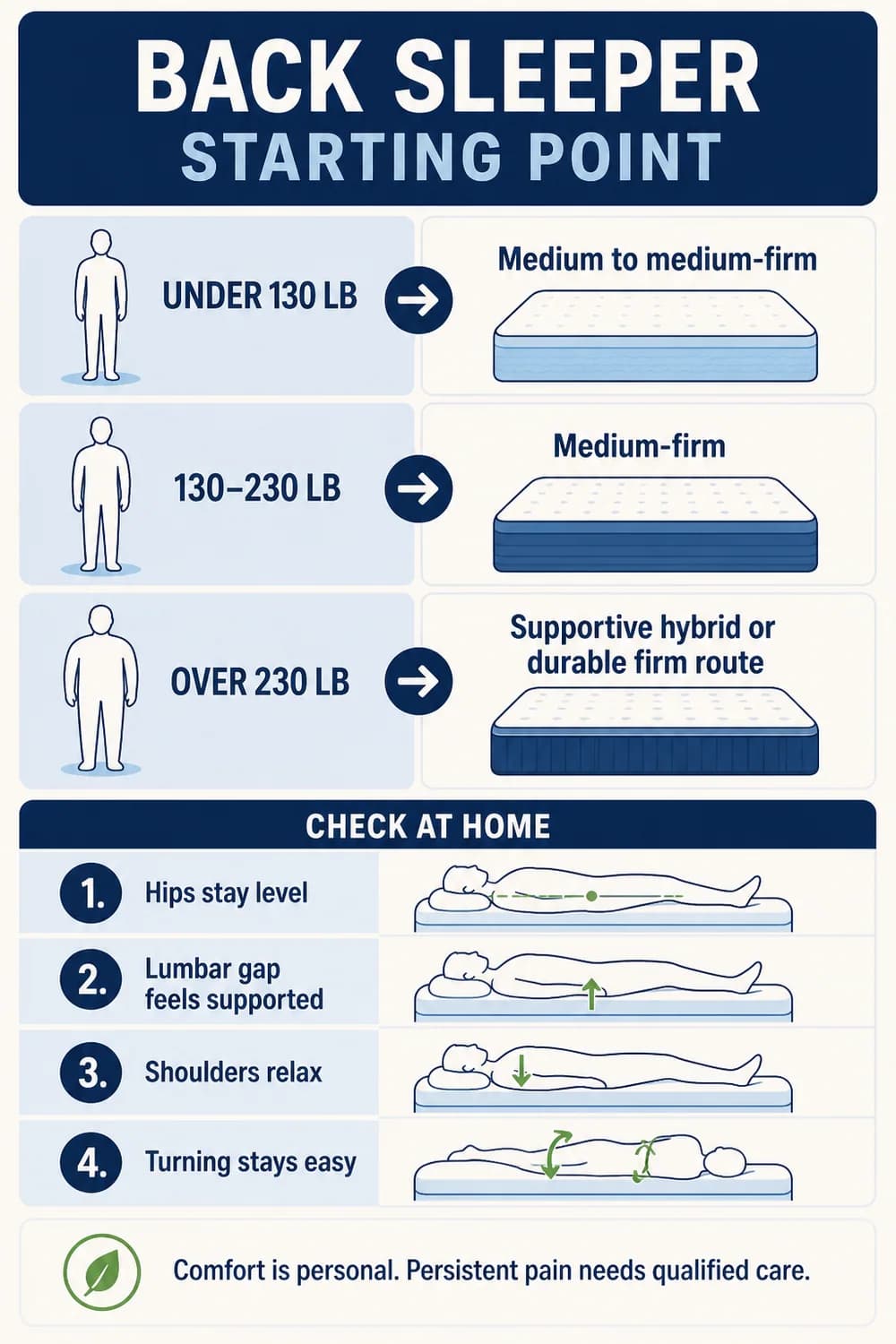
Medium-firm is the safest starting point for many back sleepers, but it is not a universal rule. Lighter back sleepers may need slightly more contour. Heavier back sleepers may need firmer zoning and stronger coils. Back+side combo sleepers may need more shoulder give.
| Body / position | Target firmness | Best build | Notes |
|---|---|---|---|
| Under 150 lb back sleeper | 5.5-6.5/10 | Medium hybrid, latex, or responsive foam | Needs lumbar fill without an over-firm surface |
| 150-230 lb back sleeper | 6.5-7/10 | Zoned hybrid or balanced foam-over-coil hybrid | Best mainstream target range |
| 230+ lb back sleeper | 7-7.5/10 | Firm zoned hybrid, latex hybrid, or heavy-duty hybrid | Prevents hip sink; edge and base support are critical |
| Back+side combo | 6-6.5/10 | Responsive hybrid or latex hybrid | Needs easier movement and shoulder give |
| Back+stomach combo | 6.5-7.5/10 | Zoned hybrid with firmer midsection | Keeps pelvis level and avoids swayback |
Spec guardrails: useful filters, not universal rules
Specs help you avoid vague listings, but one number does not decide comfort. Coil gauge, coil count, foam density, zoning, cover, height, edge design, body weight, and sleep position all interact. If a listing hides every meaningful spec, choose a more transparent option.
| Spec | Useful as a filter? | Caveat |
|---|---|---|
| Foam density | Yes | Many brands do not publish it; judge with warranty, reviews, and return terms too |
| Coil gauge | Yes | Coil design, zoning, foam stack, and body weight matter |
| Coil count | Sometimes | More coils does not automatically mean better support |
| Edge rail density | Yes | Relevant when foam rails are used instead of reinforced perimeter coils |
| Mattress height | Sometimes | Taller is not always better; layer quality matters |
| Cover material | Yes | Thick protectors and sheets can block cooling benefits |
| Zoning | Yes | Helpful for many back sleepers, but not automatically better for every body |
Alignment tests you can do at home
- Hand test: Slide a hand under the lower back. Slight contact is ideal. A large loose gap can mean too firm; no space and hip drop can mean too soft.
- Photo test: Take a side-profile photo while lying on your back. Neck, chest, hips, and legs should look level rather than hammock-shaped.
- Sit-edge test: Sit near the edge and note whether the perimeter collapses. Weak edges reduce usable width and can pull you inward.
- Breathing check: Back sleeping can worsen snoring for some people. A slight head lift may help some sleepers, but persistent snoring or breathing pauses should be medically evaluated.
- Pillow reset: Change pillow loft before returning a mattress. A pillow that is too high or too low can mimic mattress problems.
Back-sleeper pillow stack: mattress alone is not enough
Back sleeping can support a neutral head, neck, and spine when the pillow and mattress match the body's curves. Sleep Foundation notes that back sleepers generally need a pillow that fills the space between the neck and mattress without forcing the head forward.
| Problem | Likely setup issue | First fix |
|---|---|---|
| Neck bends forward | Pillow too high | Lower loft or use adjustable fill |
| Chin tips up | Pillow too low | Slightly higher cervical support |
| Lumbar feels tight | Hip flexor/lumbar tension | Small pillow under knees |
| Snoring worsens on back | Airway position or medical issue | Slight head elevation; medical check if persistent |
| Upper-back tightness | Pillow or shoulder contour mismatch | Adjust pillow before blaming mattress |
| Back+side combo discomfort | One pillow cannot serve both positions | Adjustable pillow or split pillow strategy |
| Heat around head/neck | Dense pillow or cover | Breathable pillow and pillowcase |
30-day back-sleeper testing plan
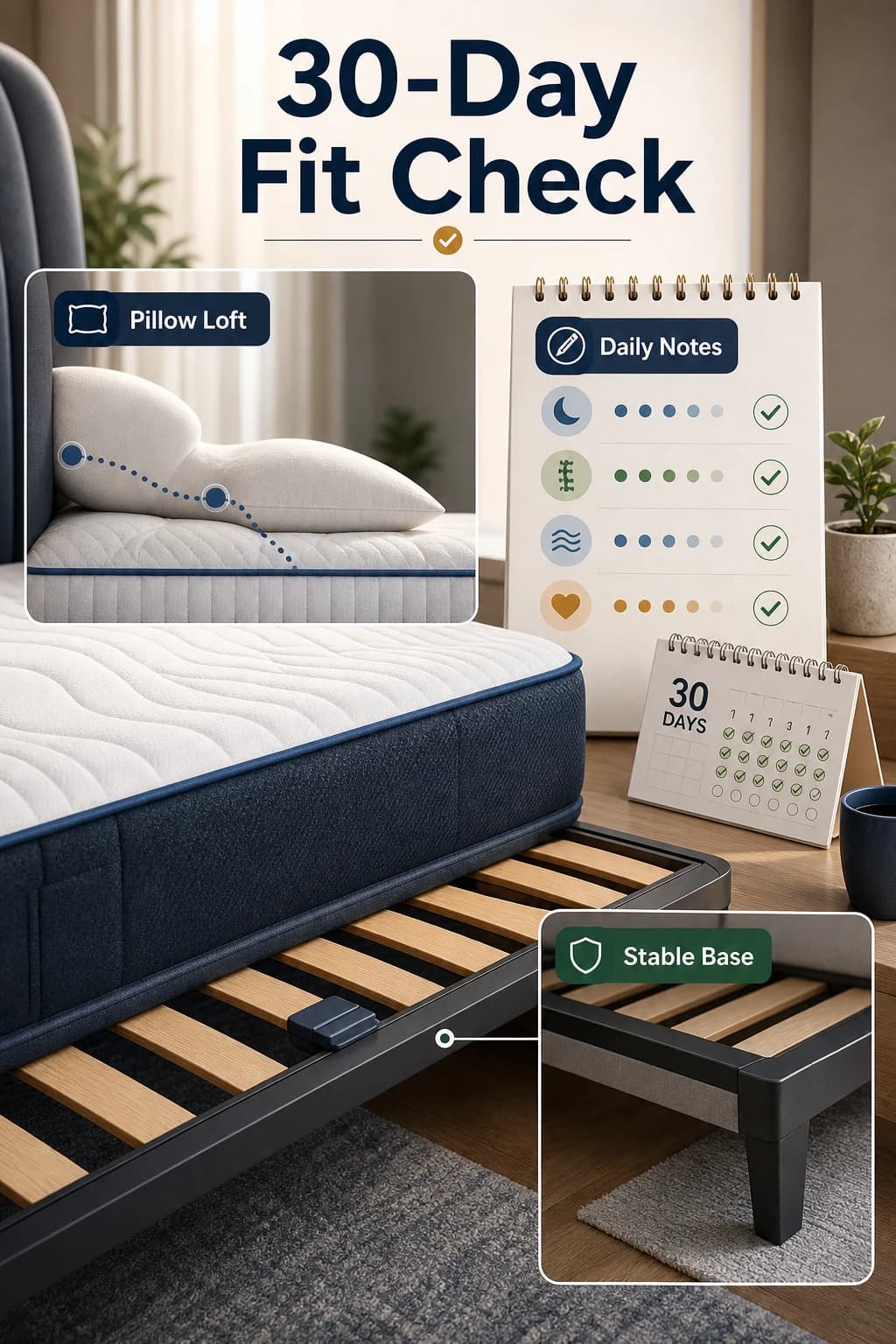
- Days 1-3: Unbox, protect the mattress, photograph edges/profile/base, and use your normal pillow first.
- Days 4-7: Log morning comfort at hips, lumbar, shoulders, and neck. Track heat, edge feel, and partner motion.
- Days 8-14: Rotate once if the brand allows. If hips dip, check base support. If the lower back floats, test a thin contouring topper.
- Days 15-21: Re-run the photo test, tighten frame bolts, measure slat gaps, and test pillow loft again.
- Days 22-30: Decide keep, exchange, or return. Use notes, photos, seller terms, and return deadline before the window closes.
30-day back-sleeper testing log
| Field | Track |
|---|---|
| Pillow height/material | Daily |
| Sleep position percentage | Back, side, stomach |
| Morning comfort | Hips, lumbar, shoulders, neck on a 1-10 scale |
| Heat | 1-10 scale plus bedding used |
| Edge feel | Stable, drop, or roll-in |
| Base | Platform, slats, adjustable, center support |
| Changes | Pillow, topper, bedding, base, room temperature |
| Photos | Side profile, edges, slats, impressions |
| Notes | Snoring, restlessness, partner motion |
Foundation rules for back sleepers
A mattress that looks perfect on paper can fail on the wrong base. Back-sleeper alignment depends as much on the base as on the mattress: a medium-firm mattress on flexing slats can feel too soft, while a solid platform can make the same mattress feel firmer.
| Base type | Back-sleeper impact | Check |
|---|---|---|
| Close slats | Stable support | Gap under 3 inches, center support for queen+ |
| Wide slats | Hip-dip risk | Add bunkie board only if warranty allows |
| Solid platform | Firmer feel | Airflow and moisture control |
| Adjustable base | Can help head elevation | Avoid over-flexing hips |
| Metal grid | May need board or better support | Center legs and warranty compatibility |
| Box spring | Can flex too much | Often avoid for foam and hybrid mattresses |
| Floor | Firmer but risky | Moisture, airflow, and warranty concerns |
Cooling for back sleepers
Back sleepers often have more body surface in contact with the mattress than stomach sleepers who use a firmer surface or side sleepers who load smaller zones. Dense foam can still trap heat.
- Choose coil cores, latex, perforated foam, or breathable covers when heat is a known issue.
- Use percale cotton, linen, Tencel, or other breathable sheets.
- Avoid thick vinyl-like protectors that block airflow.
- Avoid thick slow-foam toppers if heat and sink are already problems.
Troubleshooting: lumbar gap, hip dip, heat, and edge roll
| Symptom | Likely cause | First move |
|---|---|---|
| Lumbar gap or strain | Surface too firm or pillow/base mismatch | Test pillow, thin contouring topper, or softer shoulder/lumbar fill |
| Hips dipping | Mattress too soft, weak base, or failed core | Check slats/base, then consider firmer zoned hybrid |
| Shoulder/upper-back tightness | Pillow too low or shoulder zone too firm | Adjust pillow loft and retest |
| Runs hot | Dense foam, protector, bedding, warm room | Improve bedding and airflow; consider latex or hybrid |
| Edge roll | Weak perimeter or wrong size for couple | Exchange early if edge support fails |
| Morning stiffness improves elsewhere | Bed setup likely contributing | Document symptoms, base, pillow, and photos for return/warranty |
Amazon research shortcut: what to verify before buying
Use Amazon listings as live data, not proof that a mattress is right for back sleeping. Check model, firmness, build, seller, delivery, returns, warranty, recent reviews, and whether users mention hip dip, edge collapse, heat, or lumbar gaps.
| Check | Why it matters |
|---|---|
| Exact model | Brand lines and names change |
| Firmness | Listed firmness and user reviews can disagree |
| Mattress type | Hybrid, foam, latex, and adjustable designs solve different problems |
| Height | Avoid vague 9-10 inch builds with no support details |
| Coil or foam specs | Transparency is a trust signal |
| Trial and returns | Amazon seller terms vary |
| Seller | Brand store, authorized seller, or third-party path matters |
| Warranty | Marketplace ambiguity can create claim friction |
| Delivery/returns | Heavy mattresses are hard to return |
| Recent reviews | Look for edge, sag, heat, odor, and support complaints |
Compare Mattresses for Back Sleepers on Amazon
Use Amazon to compare live pricing, seller details, return terms, and recent reviews after you narrow your target firmness and build.
Before checkout
Use the listing as the source of truth for current price tier, seller, delivery window, and return terms.
Confirm exact model, firmness, seller, delivery, return terms, warranty path, and recent complaints before purchase. As an Amazon Associate, we earn from qualifying purchases.
Final checklist before you buy
- Target medium-firm first, then adjust for body weight and combo sleeping.
- Verify hip lift, lumbar fill, pillow loft, and base stability before judging comfort.
- Choose the archetype: zoned hybrid, latex hybrid, foam-over-coil hybrid, dense foam, or heavy-duty hybrid.
- Check edge support if sharing the bed or using the full width.
- Confirm trial, warranty, return, seller, delivery, and foundation terms.
- Track the first 30 nights with notes and photos.
The best mattress for back sleepers lifts the hips, fills the lumbar curve, eases shoulder pressure, stays cool, and offers stable edges. Use specs as filters, not slogans. Test methodically and fix the pillow/base stack before assuming the mattress is wrong.