
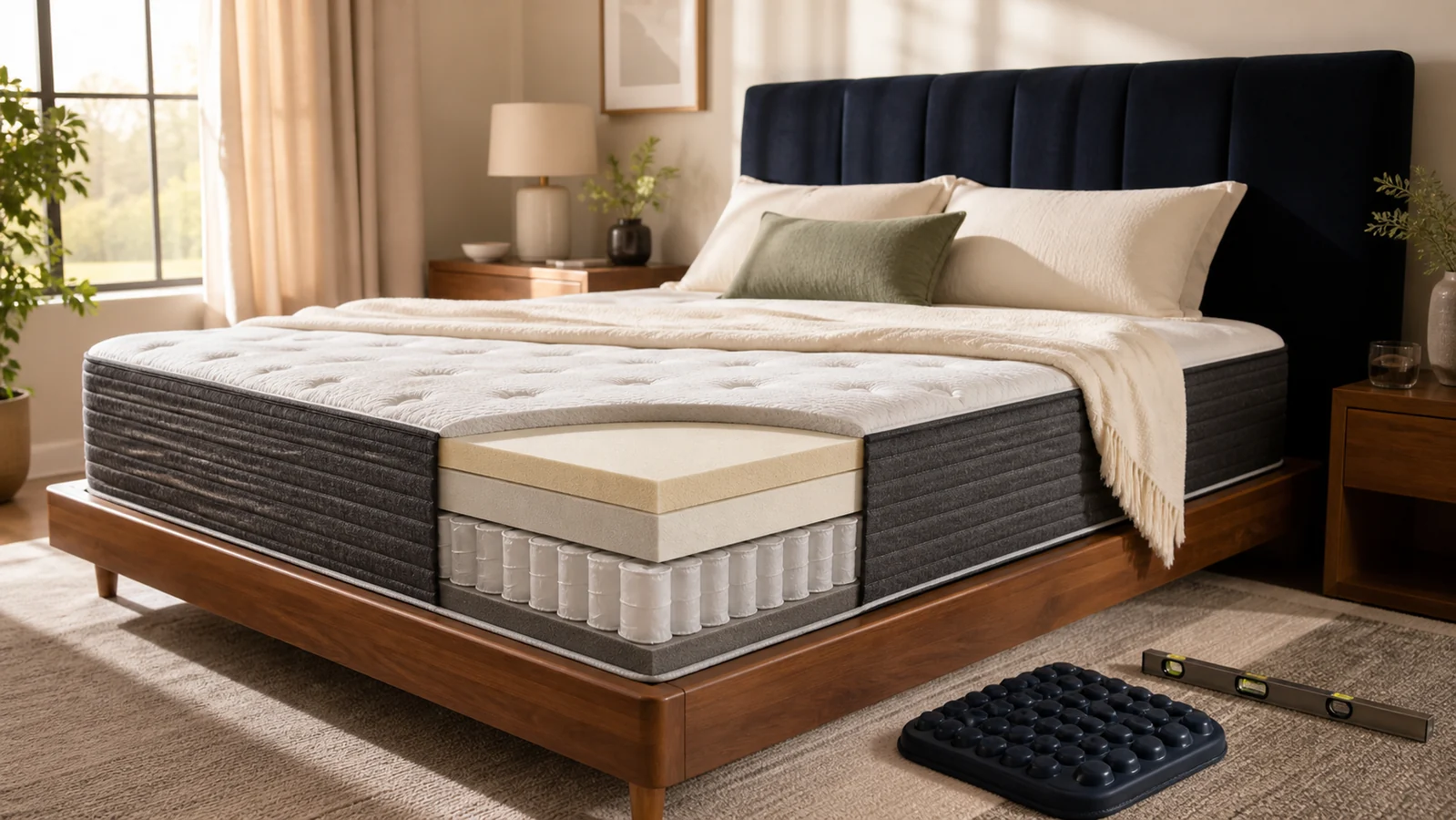
For a firm-feel Amazon mattress, start with Nectar Classic if you want close memory-foam contour, DreamCloud Classic if you want a more responsive coil-and-foam build, or Zinus Original Green Tea if budget matters and medium-firm is firm enough. Do not choose the hardest label by default. The bed still needs enough pressure relief for your shoulder, hip and sleep position.
Quick answer
Scope clarification, September 13, 2026: this page covers mainstream Amazon firm-feel shopping, with Zinus explicitly included as a medium-firm alternative, not an extra-firm recommendation. The Amazon listing checks below date to August 12; this clarification does not represent a fresh verification of those listings. For an explicit hard-surface comparison, use our extra-firm mattress guide. For neighboring feels across retailers, see medium-firm mattresses or soft and plush mattresses.
Firm is not a standardized number
Brand labels describe direction, not a shared laboratory scale. Compare the comfort layers, support core, sleeper fit and return terms for the exact model instead of assuming every “firm” mattress feels alike.
Decision-first shortlist
Two firm-feel routes and a medium-firm alternative
These Queen product pages were checked on August 12, 2026. Zinus is a neighboring medium-firm option, not a firm or extra-firm equivalent. Confirm the selected size, seller, delivered price and return method before checkout.
1. Best close-contour firm route
Nectar Classic
A firm-direction memory-foam mattress that adds slow contour rather than a flat, springy surface.
- Best for
- Back sleepers, foam fans and couples prioritizing motion damping
- Avoid if
- You sleep very warm, change position often or want pronounced edge reinforcement
- Construction
- 12-inch all-foam: memory foam, responsive foam and base foam
- Price tier
- Lower-mid range
2. Best responsive firm hybrid route
DreamCloud Classic Hybrid
A balanced hybrid direction for shoppers who want stronger pushback and easier movement than slow all-foam contour.
- Best for
- Back and combination sleepers wanting coils and responsive support
- Avoid if
- You want extra-firm, maximum motion isolation or a deeply plush side-sleeper surface
- Construction
- 12-inch foam-and-coil hybrid
- Price tier
- Lower-mid range
3. Medium-firm alternative — not a firm pick
Zinus Original Green Tea
A straightforward ten-inch foam mattress when delivered cost matters more than premium edges or a substantial hybrid core.
- Best for
- Guest rooms, lighter-use beds and shoppers who need a lower-cost medium-firm option
- Avoid if
- You need extra-firm support, strong edge sitting, advanced cooling or a tall durable build
- Construction
- 10-inch all-foam memory-foam mattress
- Price tier
- Budget
Prices, sizes, sellers, availability and return terms can change. Confirm the exact listing before purchase. Amazon buttons are affiliate links; as an Amazon Associate, we earn from qualifying purchases.
How we chose the shortlist
We opened the direct Amazon product pages, matched the current product titles and Queen variants, and checked that the pages did not show a current-unavailable message at verification. We then compared current manufacturer construction descriptions and excluded low-confidence recommendations that relied only on an Amazon title, an unknown seller or unverifiable coil-count and foam-density claims.
We did not independently measure indentation force, pressure-map every size, or run long-term durability tests. The shortlist therefore uses transparent construction and use-case routing rather than invented firmness scores.
Why “harder” is not a health rule
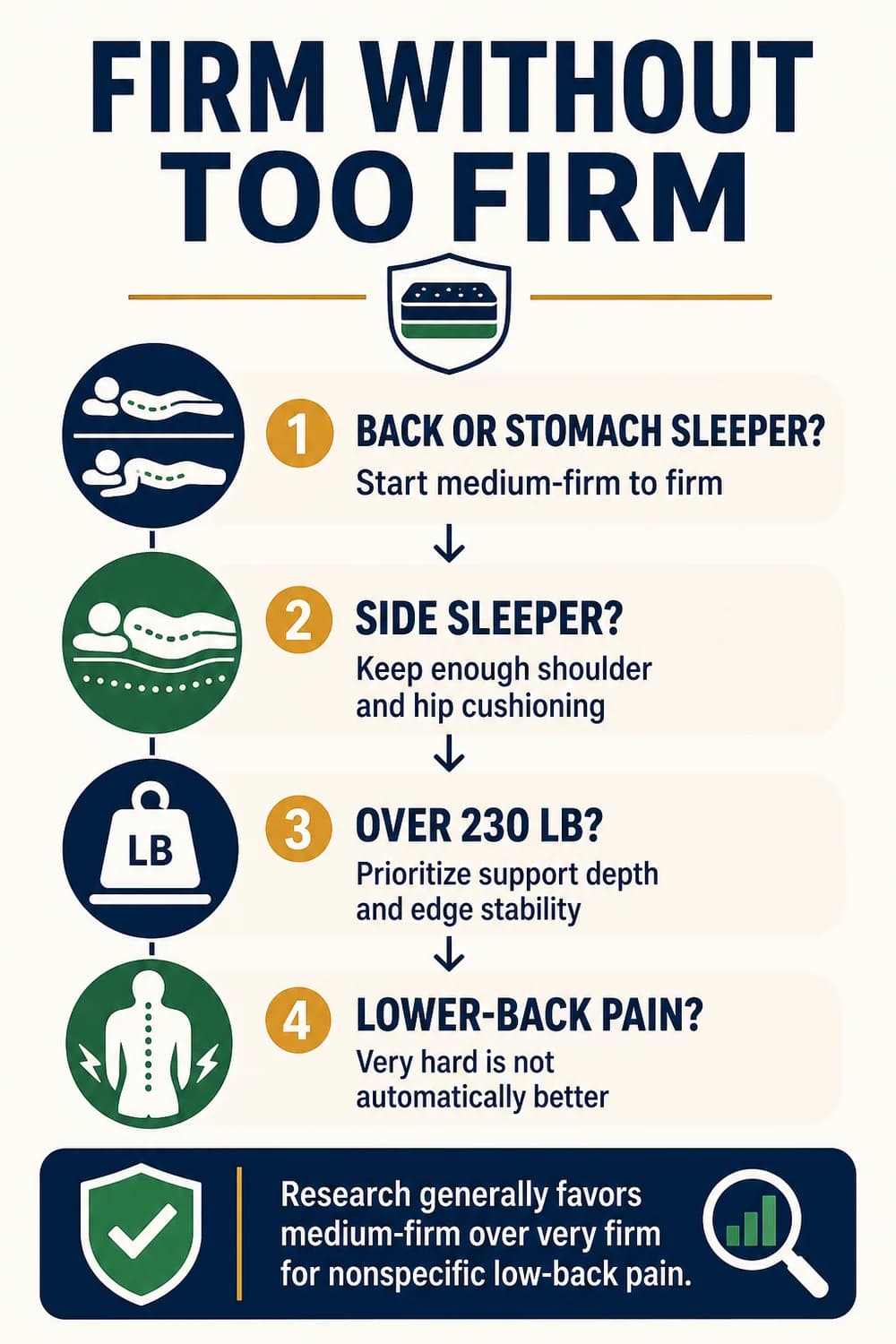
A common shortcut says that a hard mattress is automatically better for the back. The best-known controlled evidence does not support that as a universal prescription. In a randomized, double-blind trial of 313 adults with chronic nonspecific low-back pain, a medium-firm mattress produced better outcomes than a firm mattress for several pain and disability measures at 90 days.
A systematic review of controlled mattress trials likewise found medium-firm and self-adjusted surfaces the most defensible general direction for sleep comfort, quality and spinal alignment. These findings do not identify one Amazon model or treat an individual condition. They do show why “as hard as possible” is a poor default.
Nectar Classic: firm direction with slow contour
The current Nectar Classic uses one inch of memory foam above three inches of responsive support foam and an eight-inch base. Nectar describes it as firm with some cradling. That makes it the route for someone who wants support resistance but not a flat, fast-rebounding surface.
The benefit is motion damping and close contour. The tradeoff is slower repositioning, more body enclosure and an all-foam edge. A side sleeper may appreciate the pressure response; a hot or highly mobile sleeper may not.
Before ordering, verify that the selected Amazon variant still says Queen, 12 inches and Nectar Classic. Do not transfer Nectar's brand-direct trial language onto the marketplace order without written confirmation for that purchase.
DreamCloud Classic: firm support with coil response
DreamCloud Classic is the more responsive option here. Coils add pushback and open volume in the support core, while foam above provides cushioning. It should be easier to turn on and more familiar to shoppers moving from an innerspring than the Nectar route.
It is not an extra-firm plank. Choose it when “supportive with cushioning” describes the target. Skip it when you want maximum motion damping, minimal bounce or a very hard surface.
The live direct link is for the Queen Classic 12-inch new-version variant. Amazon variation families can change the selected size, style or version, so read the selector again at checkout.
Zinus Original Green Tea: budget medium-firm, not a premium substitute
The ten-inch Zinus is the lowest-cost route of these three and the only one we describe as explicitly medium-firm, based on the current Amazon product title. Its simpler foam build can suit a guest room, first apartment or lower-use bed.
That lower tier comes with tradeoffs: less total depth, simpler edges, less open airflow and less margin for someone who compresses comfort layers deeply. It should not be presented as equivalent to a heavier hybrid or as an extra-firm heavy-sleeper mattress.
Match firmness to sleep position
Back sleepers
Look for enough resistance to prevent the pelvis from sinking far below the ribcage, plus enough surface give to avoid a hard pressure ridge. Nectar offers more contour; DreamCloud offers more response; Zinus is the budget middle.
Stomach sleepers
Deep hip sink can increase discomfort for some stomach sleepers. A responsive firm direction is often easier to evaluate than a thick plush top. Pillow height also matters because excessive neck elevation can make the bed feel like the problem.
Side sleepers
Do not buy a flat hard surface merely because it says firm. The shoulder and hip need space to compress the comfort layers. A side sleeper who wants a firmer support core may still need a pressure-relieving top.
Combination sleepers
Prioritize recovery speed and ease of turning. DreamCloud is the clearest route here; Nectar is the slowest. Test whether the mattress helps position changes without creating hip or shoulder pressure in the primary position.
Body weight changes the feel
Firmness is an interaction between the sleeper and the mattress. A lighter sleeper may barely engage deeper layers and experience the surface as harder. A heavier sleeper can compress the same comfort layer farther and reach the support core sooner.
Above roughly 230 pounds, do not stop at the word “firm.” Compare total height, comfort-layer thickness, edge construction, foundation requirements and any manufacturer weight guidance. A dedicated heavy-duty mattress may be a better route than forcing a general-purpose model to act extra firm.
Edge support and base compatibility
An edge matters when two people share a Queen, someone sits to dress, or mobility makes a stable perimeter important. Coil hybrids can add structural opportunities, but the exact perimeter design still matters. Foam bases can be supportive while compressing more under concentrated sitting.
The foundation is part of the feel and warranty. Follow the exact manufacturer's slat spacing, center-support and adjustable-base rules. Do not add plywood, remove required support or change the frame solely to manipulate firmness without confirming compatibility.
Before checkout: verify the exact order
- Model, height, size and version
- Seller and fulfillment
- Live delivered price and coupon conditions
- Product-page return language
- Manufacturer warranty eligibility for that seller
- Foundation and slat requirements
- Expanded mattress weight and setup plan
Do not buy by review average alone
Amazon reviews can combine sizes, heights and older product versions. Filter for the closest body type and use case, then verify that the review concerns the same variant shown in your cart.
A practical 21-night test
Follow the exact trial rules first; do not outwait the return deadline to complete a generic schedule.
- Nights 1–3: confirm expansion, base, protector and pillow; record obvious defects.
- Nights 4–10: track shoulder/hip pressure, lower-back comfort, heat, movement and edge use.
- Nights 11–21: keep variables stable and look for a trend, not one unusually good or bad night.
Stop and seek appropriate advice for persistent or worsening pain, numbness, weakness, radiating symptoms, injury or other concerning signs. A mattress guide cannot diagnose their cause.
Final verdict
Choose Nectar Classic for a firm direction with slow memory-foam contour, DreamCloud Classic for responsive hybrid support, or Zinus Original Green Tea when a lower-cost medium-firm mattress is sufficient. If your real target is extra firm, heavy-duty or medically prescribed support, these mainstream Amazon starting points may not be the right category—and saying so is better than pretending the hardest marketing label wins.