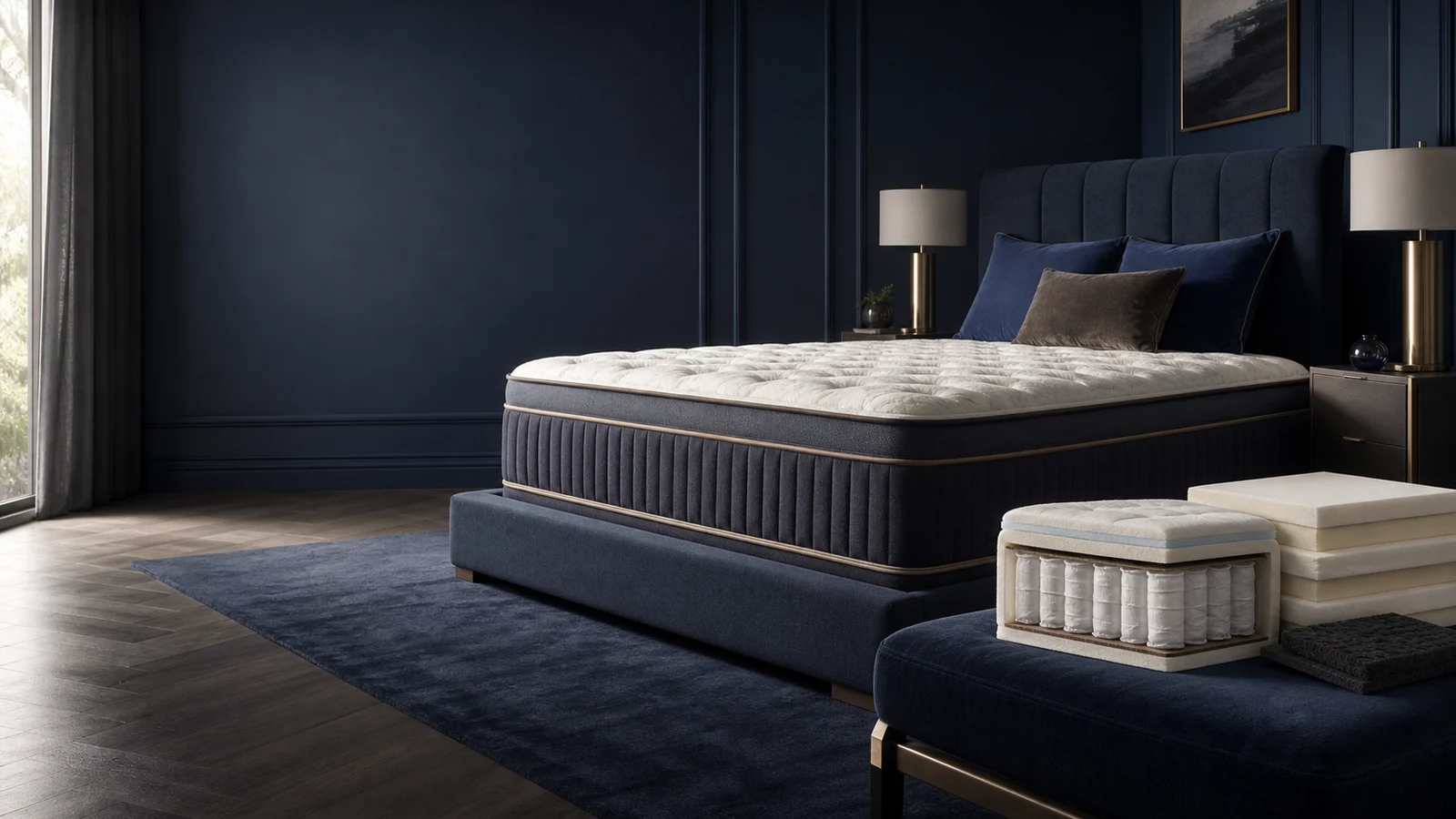
DreamCloud makes the most sense in 2026 for shoppers who want a substantial hybrid with a long direct trial and an understandable firm-to-soft progression. Premier Hybrid is the safest overall starting point. Classic Hybrid is firmer and simpler, Luxe Hybrid adds more cushioning and three-zone support, and Ultra Hybrid is the tallest, softest, most specialized option. Each tier also has a foam counterpart.
The old idea that DreamCloud is one “luxury hybrid” is no longer accurate. The current lineup spans eight core models, and the better choice depends on construction, body weight, position, and mobility—not the number of layers or a star score.
How we evaluated DreamCloud
We reviewed current DreamCloud product pages, the trial policy effective June 9, 2026, the warranty document, and official ownership information. This is research, not a claim that we personally slept on all eight models or ran laboratory pressure, cooling, motion, or durability tests. We do not publish unsupported scores, lifespan predictions, or first-person anecdotes.
Construction can indicate likely tradeoffs. Coils create open space for airflow and pushback for movement; foam reduces bounce and usually isolates partner motion better. Those tendencies are not guarantees. Room climate, protector, sheets, body shape, foundation, and partner movement all affect the result.
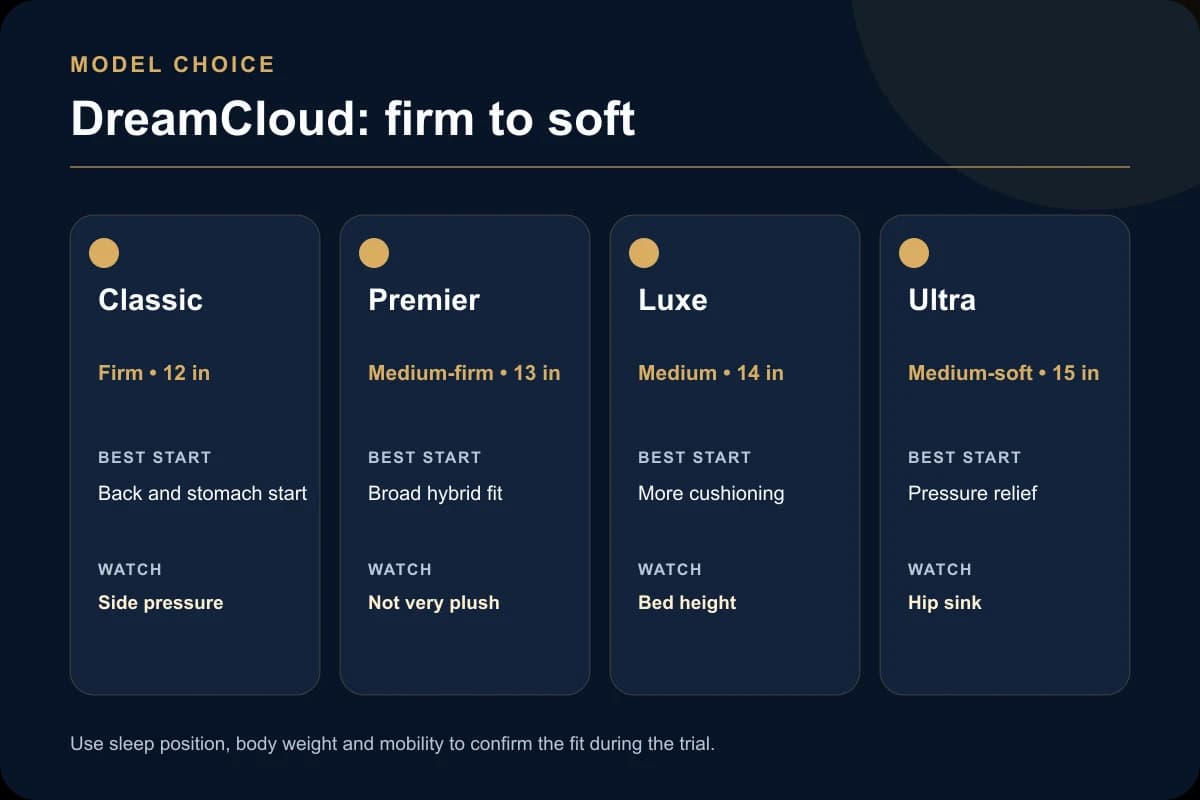
Current DreamCloud models compared
| Tier | Hybrid | Foam | Feel direction | Primary fit risk |
|---|---|---|---|---|
| Classic | 12-inch, firm | 12-inch, firm foam | Flatter and more supportive | Shoulder pressure for side sleepers |
| Premier | 13-inch, medium-firm | 13-inch, more contouring | Broad middle ground | May satisfy neither very plush nor very firm preference |
| Luxe | 14-inch, medium, three-zone | 14-inch luxury foam | More cushioning | Added sink and bed height |
| Ultra | 15-inch, medium-soft, five-zone | 15-inch soft foam | Deepest pressure relief | Mobility and pelvic support |
Classic: the firmer entry point
Classic Hybrid is a 12-inch firm model. Its best audience is back sleepers, some stomach sleepers, and combination sleepers who want a responsive surface without a thick pillow-top cradle. Classic Memory Foam keeps the firmer direction but removes coils, trading some airflow and edge pushback for quieter contouring.
A firm label is not proof of support. A very light side sleeper may not compress the surface enough, while a heavier sleeper may reach deeper layers quickly. Test shoulder pressure, pelvic position, and low-back comfort rather than treating firmness as a quality rating.
Research DreamCloud Classic listings
Verify hybrid versus foam, exact model generation, 12-inch profile, seller, trial source, warranty text, and return pickup before checkout.
Before checkout
Use the listing as the source of truth for current price tier, seller, delivery window, and return terms.
Prices, coupons, availability, shipping, and return terms change often. Confirm current details on Amazon before purchase. As an Amazon Associate, we earn from qualifying purchases.
Premier: the general-purpose choice
Premier Hybrid is the broadest starting point for an average-weight back sleeper, combination sleeper, or couple who wants a medium-firm surface. The coil core should aid movement and make more of the perimeter usable. Premier Memory Foam suits a partner-sensitive sleeper who accepts a slower response.
Side sleepers should check whether the shoulder settles comfortably; stomach sleepers should watch for pelvic drop. A couple with a large weight difference may need a split-firmness solution that DreamCloud's one-feel tiers do not provide.
Research Premier Hybrid listings
Confirm the current 13-inch model, seller authorization, delivery method, trial owner, warranty claim route, and foundation requirements.
Before checkout
Use the listing as the source of truth for current price tier, seller, delivery window, and return terms.
Prices, coupons, availability, shipping, and return terms change often. Confirm current details on Amazon before purchase. As an Amazon Associate, we earn from qualifying purchases.
Luxe: medium feel and three-zone support
Luxe Hybrid is a 14-inch medium model with a tri-zone support design. Zoning can change resistance under different body areas, but it does not automatically correct posture. Its usefulness depends on height, weight distribution, and where the sleeper's shoulders and hips land.
Luxe is the more logical DreamCloud route for an average-weight side sleeper who finds Premier too firm, or a couple who wants a fuller comfort layer without choosing the softest tier. Luxe foam emphasizes contour and motion control further. Stomach sleepers and people who struggle to roll should proceed carefully.
Research DreamCloud Luxe listings
Check the current 14-inch Luxe, foam versus hybrid, zoning description, seller, trial, warranty language, sheets, and final bed height.
Before checkout
Use the listing as the source of truth for current price tier, seller, delivery window, and return terms.
Prices, coupons, availability, shipping, and return terms change often. Confirm current details on Amazon before purchase. As an Amazon Associate, we earn from qualifying purchases.
Ultra: maximum cushioning, maximum specialization
Ultra Hybrid reaches 15 inches, uses a medium-soft direction, and adds five-zone support. Ultra foam is the deepest all-foam cradle. These are intentional soft-luxury choices for pressure-sensitive side sleepers—not universal upgrades.
Measure the combined mattress and frame height. Check deep-pocket sheet compatibility and adjustable-base limits. A taller comfort stack can make turning harder and let a higher-weight sleeper's hips settle too deeply. Compare a reinforced hybrid if support reserve is the main goal.
Research DreamCloud Ultra listings
Verify the exact 15-inch Ultra generation, five-zone hybrid construction, seller, delivery logistics, trial, warranty, and return channel.
Before checkout
Use the listing as the source of truth for current price tier, seller, delivery window, and return terms.
Prices, coupons, availability, shipping, and return terms change often. Confirm current details on Amazon before purchase. As an Amazon Associate, we earn from qualifying purchases.
Best DreamCloud by sleep profile
| Sleeper or priority | First model to compare | Reason | Trial checkpoint |
|---|---|---|---|
| Back sleeper | Classic or Premier Hybrid | Firmer surface with responsive core | Pelvis level with ribs; lumbar comfort |
| Side sleeper | Premier or Luxe | More shoulder and hip cushioning | Pressure, numbness, spinal line |
| Stomach sleeper | Classic Hybrid | Flatter, firmer starting point | Hip drop and low-back tension |
| Combination sleeper | Premier Hybrid | Easier movement than slow foam | Turning effort and surface resistance |
| Motion-sensitive couple | Premier foam | Less coil bounce | Partner wake-ups and edge space |
| Hot sleeper | Hybrid before foam | More open airflow path | Temperature with normal protector/bedding |
For more criteria, use our side-sleeper guide, back-sleeper guide, couples guide, and hot-sleeper guide.
Higher body weights and edge use
Among DreamCloud models, Classic Hybrid and Premier Hybrid are the better initial comparisons for higher body weights because they avoid the deepest soft comfort stacks. That is not the same as a mattress engineered specifically for sleepers over 230 or 250 pounds. Ask about total supported load, coil design, edge reinforcement, and base requirements, then compare purpose-built choices in our heavy-sleeper guide.
Edge support is especially important when two adults share a smaller mattress, one partner sits at the side, or mobility is limited. Test lying and turning near the perimeter—not just sitting on it for a few seconds.
Cooling and motion isolation
DreamCloud markets cooling features across its lineup. Without instrumented testing, we treat those as brand claims, not measured outcomes. Hybrids have the clearer physical advantage because the coil unit contains more open air space. Foam models should absorb movement better, but deeper contour can feel warmer and make repositioning harder.
Do not ignore the sleep system. A waterproof protector, dense microfiber sheets, high-tog duvet, humid room, or foam foundation can change temperature more than a cover label.
Fiberglass, certification, odor, and expansion
Current DreamCloud product pages describe the mattresses as fiberglass-free and the polyurethane foams as CertiPUR-US certified. CertiPUR-US is foam certification, not certification of the entire finished bed and not proof of a health outcome. Verify the law label and generation when buying third-party, clearance, returned, or used inventory. Do not remove a sewn cover.
A compressed mattress needs time and ventilation after opening. Follow the model instructions, allow corners and edges to regain shape, and avoid making a firmness judgment in the first minutes. Temporary packaging or new-material odor can occur; our off-gassing guide explains ventilation and escalation steps.
Trial and returns
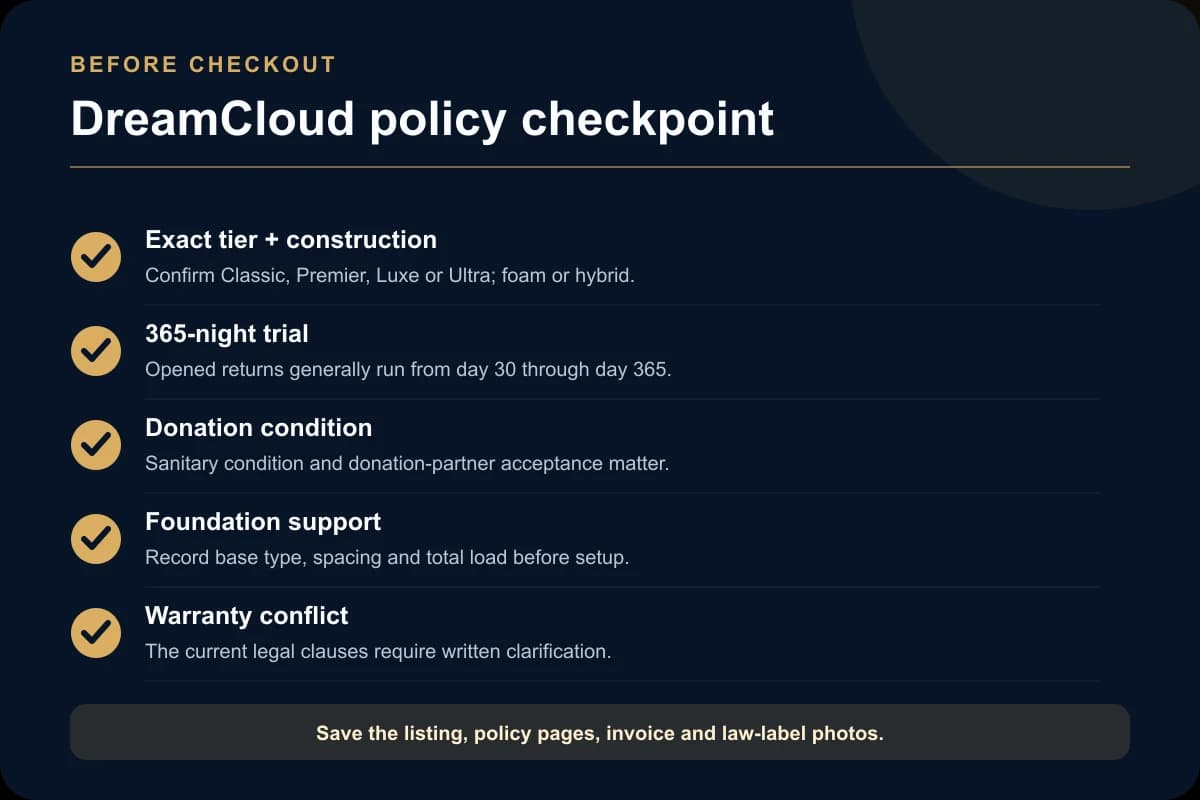
The trial policy effective June 9, 2026 offers 365 nights from delivery for eligible purchases. An opened mattress generally becomes returnable on day 30 and remains eligible through day 365. An unopened mattress may be returned sooner, but leaving it compressed for more than 90 days can make it ineligible. It must remain sanitary and suitable for donation, and a donation partner may decide acceptability.
Those terms depend on channel. A third-party retailer can use its own clock, fees, and pickup rules. Record delivery, use a protector, keep the law label and invoice, and evaluate the mattress with our trial checklist.
Warranty: do not rely on the headline alone
DreamCloud calls its coverage a “Forever Warranty,” but the June 2026 warranty document is internally inconsistent. Its coverage clause states one full year; its remedy section describes free replacement in the first ten years and repair, recovering, or replacement after ten years, with conditions and potential transport charges.
That conflict is too important to smooth over. Save the policy, ask DreamCloud which clause controls, and retain the written answer. Also verify original-owner status, authorized seller, indentation threshold, stains, cover removal, foundation rules, and transport costs. This is a practical contract check, not legal advice.
Ownership and retailer-specific models
DreamCloud is part of Resident, and Ashley acquired Resident in 2024. Nectar is a sister brand. Similar trial and warranty structures are therefore unsurprising, though the brands use different model positioning and feel language.
You may also encounter PressureSmart or older DreamCloud names through particular retailers. Do not merge reviews across models. Match the law label, exact height, construction, invoice name, and policy source before using third-party feedback.
Bottom line
Choose Classic Hybrid for the firmer DreamCloud route, Premier Hybrid for the broadest balance, Luxe Hybrid for more cushioning and three-zone support, and Ultra Hybrid only when a tall medium-soft mattress is the intended fit. Choose the corresponding foam version when motion isolation and contouring outweigh airflow, edge pushback, and mobility.
The 365-night trial is useful; the contradictory warranty language is a real documentation risk. A current model match and written policy confirmation are more valuable than a fixed sale price, star score, or unsupported claim that a bed will last a certain number of years.