
October 24, 2025
Mattress Maintenance Checklist: Keep Your Amazon Purchase Fresh for Years
A quarterly maintenance routine that protects comfort, hygiene, and warranty coverage for your new mattress.
Why maintenance matters
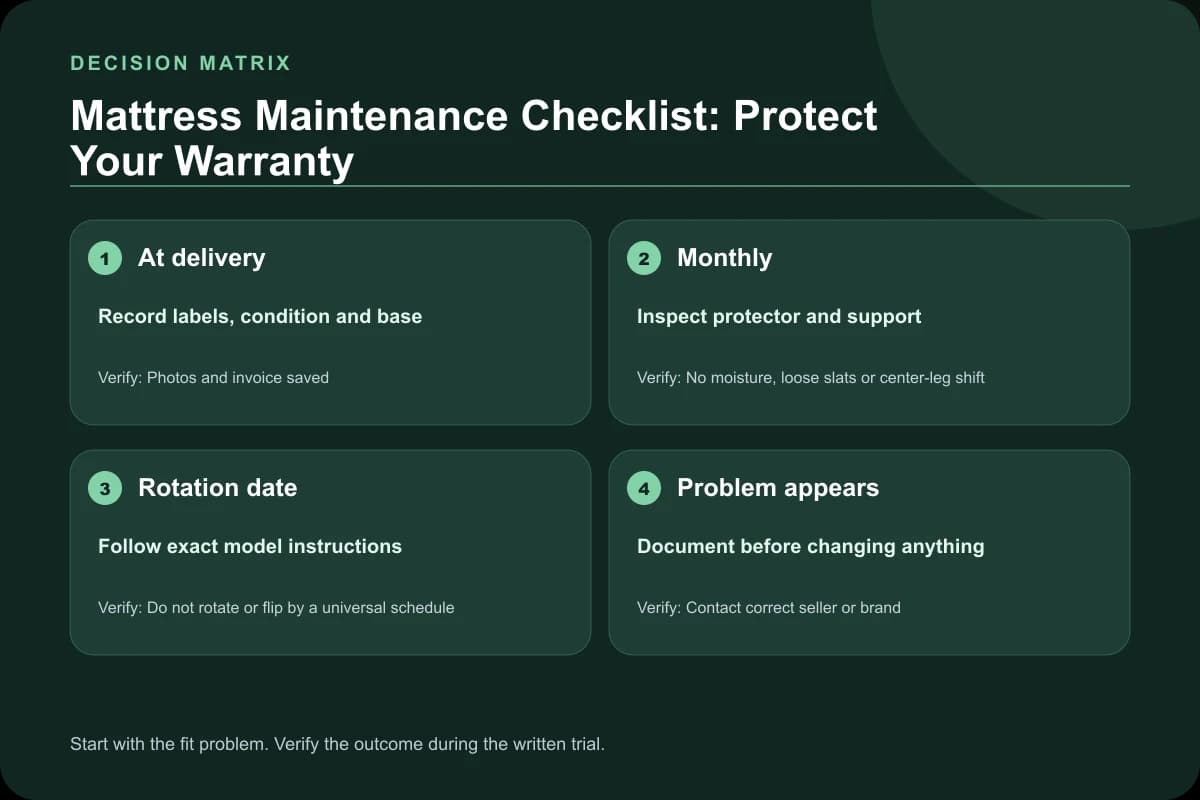
Consistent care keeps comfort stable, prevents avoidable warranty denials, and extends the life of your mattress. Protecting, rotating, and documenting also makes returns or claims faster if you ever need them.
Fast-start maintenance widget
Day 1 setup
- • Use a breathable, membrane-only protector immediately
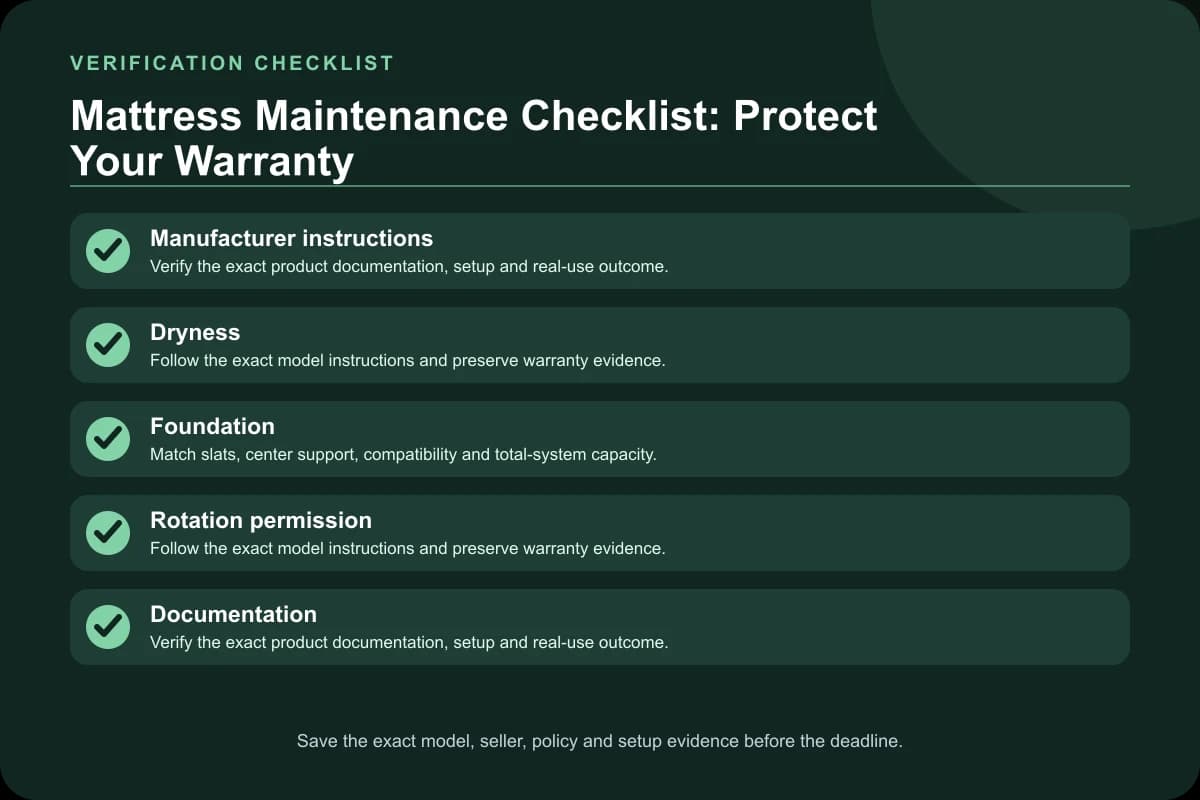
- • Confirm base: slats <3" apart + center support (queen+)
- • Take photos of edges/corners and keep packaging until sure
- • Note delivery date; set rotation reminders now
Rotation schedule
- • Weeks 2, 4, 8: rotate 180°
- • Then quarterly (every 3 months)
- • If 230+ lbs or two sleepers: rotate more often
- • Double-sided? Flip on same cadence
Monthly and quarterly checklist
- Vacuum the surface with a soft brush to remove dust mites.
- Spot-clean stains with enzyme cleaner; never soak foams.
- Air out the mattress and bedding with windows open when possible.
- Inspect protector; wash it monthly, replace if it loses waterproofing or breathability.
- Check slat spacing and center support; tighten bolts to stop flex/squeaks.
- Rotate per schedule; flip only if the mattress is double-sided.
- Photograph edges and top quarterly to track impressions (helps with warranty).
Deep clean steps (without voiding warranties)
- Strip bedding and protector.
- Vacuum top and sides; focus on seams.
- Sprinkle baking soda lightly; let sit ~30 minutes, then vacuum.
- Spot-clean stains: blot (don’t rub) with enzyme cleaner; keep moisture minimal.
- Let mattress dry/air; then re-cover with clean protector and bedding.
Avoid steam cleaners unless the manufacturer explicitly approves—they can void warranties and damage adhesives.
Base and support rules
- Slats: <3 inches apart; center support for queen/king to prevent sag.
- Platforms: allow airflow; if solid, consider risers/vents to reduce moisture.
- Adjustable bases: ensure weight rating covers mattress + sleepers; keep flat when rotating.
- Bunkie board/plywood: fine for extra firmness; wrap in breathable fabric to avoid abrasion and moisture trapping.
Climate-specific tips
- Humid: Air out monthly; use breathable protector and slatted base; avoid storing items under solid platforms that block airflow.
- Cold: Foams stiffen—let room warm before judging comfort; still rotate on schedule.
- Dry/high altitude: Natural fibers (cotton/wool) for protector/sheets reduce static.
- Hot sleepers: Breathable protectors and percale/Tencel sheets; rotate so comfort layers don’t compress unevenly and trap heat.
Movement, pets, and kids
- Pets/kids accelerate wear: rotate more often and use a high-quality protector.
- Trim pet nails to prevent fabric snags; avoid letting pets chew/tear covers.
- For jumpers: reinforce base; consider a bunkie board to reduce flex if kids jump on the bed (and discourage the habit).
Off-gassing and odor control
- For new mattresses: ventilate 24–72 hours with windows open and fans on.
- For lingering odors: baking soda + vacuum; charcoal/coffee grounds nearby (not on the fabric).
- Avoid spraying heavy fragrances directly on fabric; they can leave residues.
Impression tracking and when to act
- Measure dips with a straightedge and ruler; note depth and date.
- Typical warranty thresholds: ~0.75–1.5 inches depending on brand.
- If impressions exceed thresholds within the trial window, document and contact the seller (see Return Playbook).
- Uneven softening? Rotate more frequently; ensure base isn’t flexing.
Annual maintenance day (once a year)
- Full deep clean + protector replacement if worn.
- Recheck base integrity (slats/bolts/center beam).
- Review rotation reminders for the coming year.
- Update photos of edges/top for your records.
Quick decision tree (maintain vs replace vs claim)
- Minor wear < threshold: Increase rotation, verify base, keep logging.
- Within warranty threshold + documented: File a claim with photos/measurements and proof of protector/base compliance.
- Persistent pain despite good maintenance: Consider topper/base tweaks; if unresolved, plan replacement.
- Stains/mold/physical damage: Often voids warranty; replace and protect better going forward.
Buyer scripts (for claims/returns)
- “Here are photos (edges, impressions with measurements), base details (slat spacing/center support), and proof of protector use. Please advise next steps for warranty/return.”
- “Impressions measure [X] inches, documented on [dates]. Mattress is on compliant base with protector from day one. Requesting inspection/pickup per warranty terms.”
Seasonal swaps (bedding)
- Summer: percale or Tencel sheets, lighter duvet, breathable protector.
- Winter: flannel or sateen if you prefer warmth, but keep protector breathable; avoid vinyl-backed pads.
- Shoulder seasons: adjust blanket layers before changing mattress settings.
Storage and moving
- If storing: keep in a dry, climate-controlled space; use original bag/box or a breathable cover. Avoid direct floor contact.
- Moving: use mattress bag; do not bend coils aggressively; keep proof of condition (photos) before/after.
- Split king: move pieces separately; keep hardware labeled.
Final 1-page maintenance plan (copy/paste)
- Protector on day one; wash monthly; replace if compromised.
- Base: slats <3" apart, center support; tighten bolts every quarter.
- Rotation: weeks 2, 4, 8, then quarterly (more if heavy/pets/kids). Flip only if double-sided.
- Clean: vacuum monthly; baking soda + vacuum quarterly; spot-clean only (no soaking/steam).
- Air: open windows/fans monthly to reduce odors/moisture.
- Track: quarterly photos + ruler checks for impressions.
- Climate tweaks: adjust bedding/protector for season; ensure airflow under the bed.
- Pets/kids: protector + extra rotations; trim nails; discourage jumping.
- Store/move: bag it, keep dry, avoid bending coils; document condition.
Consistent, lightweight habits keep your mattress comfortable longer and protect your ability to return or claim warranty if needed.
Material-specific care (foam, latex, hybrid)
Memory foam / polyfoam
- Avoid soaking; moisture can break down foam.
- Keep room humidity moderate (40–60%) to deter mold and odors.
- Use breathable protectors and slatted bases (<3 inches) for airflow.
- Rotate on schedule; foam develops impressions faster in hot spots.
Latex
- Naturally resilient; still rotate quarterly to even out compression.
- Avoid direct sunlight for long periods; UV can degrade latex.
- Air out more often in humid climates; latex resists mold but covers can hold moisture.
- Use breathable protectors; latex runs cool—don’t smother it with vinyl layers.
Hybrids (coil + foam/latex)
- Check center support and slat spacing annually; coils need stable bases.
- Edge rails: avoid sitting in one spot daily to keep rails even.
- Rotate religiously if you share the bed—two-body impressions appear faster.
- Vacuum seams where coils meet foam to reduce dust buildup.
Accident and stain playbook
- Liquids (spills/accidents): Blot immediately with dry towels; apply enzyme cleaner lightly; blot again; air dry with fan. Avoid saturating foams.
- Blood: Cold water + enzyme cleaner; blot, don’t rub. Follow with baking soda to deodorize once dry.
- Urine (kids/pets): Enzyme cleaner is key. After blotting, sprinkle baking soda; let sit; vacuum. Replace protector if it failed.
- Food/oil stains: Mild dish soap solution dabbed on cloth; blot gently; do not soak.
- Odors: Baking soda + vacuum; charcoal/coffee grounds nearby (not on fabric). Ventilate the room.
If the protector failed, replace it immediately and document the incident for future warranty discussions (stains can void claims).
Moisture and mold prevention
- Keep airflow under the bed: slats <3 inches apart or vents in solid platforms.
- Avoid storing boxes directly under solid platforms; leave air gaps.
- In humid climates, run a dehumidifier; target 40–60% RH.
- If you live near the coast, air out monthly with windows/fans on dry days.
- Check walls behind headboards for condensation; pull bed slightly off the wall if needed.
If you spot mold: stop using the mattress, photograph, and contact the seller. Do not attempt to bleach foams.
Pillow and topper maintenance (part of mattress comfort)
- Wash pillow covers monthly; replace pillows every 1–2 years (latex/foam can last longer).
- Fluff fiber pillows weekly; air out foam/latex pillows monthly.
- Rotate toppers monthly; spot-clean as for mattresses; use a protector over toppers if possible.
- Match pillow loft to sleep position (low stomach, medium back, higher side) to keep spinal alignment with your mattress.
Base and frame diagnostics
Use this checklist when something feels “off” before blaming the mattress:
- Measure slat gaps (should be <3 inches).
- Push on center of slats—do they flex or creak? Tighten/replace as needed.
- Check center rail/legs under queen/king; add if missing.
- Inspect bolts; retighten every quarter to stop movement/squeaks.
- On adjustable bases, listen for motor strain; ensure cords are secured.
Heavy sleeper and co-sleeper regimen
- Rotate every 6–8 weeks instead of quarterly.
- Use strongest base: slats <3 inches, center support, sturdy frame.
- Edge use: sit in varied spots; avoid same edge daily to prevent localized compression.
- Document impressions quarterly with photos + ruler; heavier loads show sooner—early claims need evidence.
Pets and kids: damage control
- Always keep a protector rated for liquids; swap immediately after accidents.
- Use pet blankets on top; wash weekly.
- Trim nails monthly to prevent fabric snags.
- If kids jump: reinforce base with bunkie board; discourage the habit to avoid coil/foam damage.
Seasonal/quarterly calendars (printable)
Spring
- Rotate; deep clean (vacuum + baking soda); wash protector.
- Air out with windows open; check for humidity issues after winter.
- Tighten frame bolts; inspect slats.
Summer
- Rotate; swap to breathable bedding (percale/Tencel/linen).
- Run dehumidifier if humid; elevate mattress airflow if needed.
- Inspect for heat-related softening; note impressions.
Fall
- Rotate; wash protector; switch to warmer bedding if desired (still breathable).
- Check base before holiday guests; ensure spare beds have protectors.
- Review photos/logs; plan warranty claims before year-end if needed.
Winter
- Rotate; deep clean; ensure bed height is comfortable with heavier bedding.
- If foams feel firmer from cold, warm room before judging comfort.
- Air out on dry days to prevent stale odors.
Warranty prep: documentation kit
- Keep a folder (cloud or physical) with: receipts, order numbers, listing screenshots, rotation log dates, photos (edges/corners/profile/impressions).
- Log protector use (purchase receipt, wash dates).
- Log base details (slat spacing photos, center support).
- Keep communication with seller/manufacturer in one place (emails, chat PDFs).
If you ever file a claim, this kit shortens the process dramatically.
Travel and storage precautions
- Short-term storage: Keep in original box/bag; store flat if possible; dry, climate-controlled space; off the floor.
- Long-term: Use breathable cover, not airtight plastic (can trap moisture). Avoid attics/garages with temperature swings.
- Moving: Use a mattress bag; do not fold coils sharply; for foam/latex, avoid tight bends. Document condition before/after.
- Vehicle transport: Lay flat for foam/latex; coils can stand on side briefly if supported. Strap gently; avoid sharp angles.
Active issue triage (quick flow)
- Feels softer/less supportive: Check base; tighten bolts; add bunkie board; rotate; log impressions.
- Feels hotter: Swap to breathable protector/sheets; add airflow under bed; consider topper change; rotate to reduce compressed hot spots.
- Edge sag: Confirm base integrity; rotate; if early and pronounced, document and contact seller.
- Odor: Air out; baking soda + vacuum; check humidity; ensure protector is clean.
Cleaning agents do/don’t
- Do: Enzyme cleaners (lightly), mild dish soap solution (sparingly), baking soda, cold water on blood.
- Don’t: Steam clean (unless brand-approved), bleach, saturate foams, harsh solvents.
- Always blot, never rub—rubbing pushes stains deeper.
Child/infant safety notes
- Avoid adding thick toppers in cribs/toddler beds; follow safety guidelines.
- Waterproof crib protectors should be breathable; fit snugly.
- Keep stuffed animals/loose bedding out of infant sleep spaces.
- Rotate crib/toddler mattresses per manufacturer if double-sided; wipe down per instructions.
Mold and allergen monitoring
- If you have allergies/asthma: vacuum mattress surface monthly with HEPA-filter vacuum; wash bedding weekly in hot water.
- Consider dust-mite-proof encasements (breathable) if sensitivities are high.
- Use a hygrometer to monitor room humidity; keep 40–60%.
Mattress toppers and pads: when to replace
- Replace inexpensive fiber/foam toppers every 1–2 years if flattened.
- Latex toppers can last 3–5+ years; rotate them quarterly.
- Cooling pads: check function yearly; PCM/gel effects fade over time.
Upholstered headboard care
- Vacuum monthly; spot-clean per fabric type.
- Keep pillows from rubbing directly on rough upholstery to reduce pilling.
- Check for wall scuffs; use bumpers if headboard shifts.
Rug and floor interface
- Use rug pads under beds to prevent slipping and protect flooring.
- If you roll the bed to clean, lock casters afterward; re-level the frame.
Emergency spill response kit (keep nearby)
- Clean, absorbent towels
- Enzyme cleaner spray
- Baking soda
- Spare protector (so you can swap immediately)
- Trash bags for soiled bedding
- Small hand fan to speed drying
End-of-life and recycling
- If replacing: donate if in good condition (check local rules), or schedule municipal bulk pickup.
- Some brands offer haul-away with new delivery—ask during purchase.
- Cut off handles/tags only after warranty expires (if required for recycling programs).
Expanded logging templates (copy/paste)
Rotation/cleaning log
- Date:
- Actions: Rotate / Flip / Vacuum / Protector washed / Base tightened
- Impressions measured? (Y/N + depth):
- Photos taken? (Y/N; filenames):
- Notes (odor, heat, comfort changes):
Issue tracker
- Date:
- Issue (sag/heat/odor/edge/etc.):
- Base check (slat spacing/bolts):
- Bedding/protector used:
- Changes tried:
- Result:
- Next step (monitor/contact seller):
Myths to ignore (maintenance edition)
- “New mattresses don’t need rotation.” Most single-sided beds still benefit, especially with two sleepers.
- “Protectors make you hot.” Breathable membrane-only protectors do not; vinyl-backed ones do.
- “Flipping fixes everything.” One-sided beds shouldn’t be flipped; rotate instead.
- “Steam cleaning is safest.” Often voids warranties and damages foams; stick to spot-cleaning.
- “Edge sitting is harmless.” Daily edge sitting in one spot accelerates rail collapse.
- “Any base works.” Wrong bases void warranties and cause premature sag.
Putting it all together: 90-day maintenance sprint
- Day 1: Protector on, photos, base check, set reminders.
- Week 2: Rotate; log comfort/heat; tighten bolts.
- Week 4: Rotate; vacuum; wash protector; photo edges.
- Week 8: Rotate; inspect impressions with ruler; adjust base if needed.
- Week 12: Deep clean (baking soda + vacuum), log findings, adjust bedding seasonally.
After the first 90 days, shift to quarterly rotations, monthly protector washes, and quarterly photos/bolt checks. This cadence keeps your mattress in “steady state” for years.
Climate + season troubleshooting case studies
Humid coast, hybrid mattress
- Problem: Musty smell and slight dampness under bed.
- Fix: Add slatted base or risers for airflow; run dehumidifier to 50% RH; air mattress monthly; use Tencel protector/sheets.
- Maintenance: Vacuum monthly; deep clean quarterly; inspect for condensation near walls.
Dry desert, memory foam
- Problem: Static and warm head area.
- Fix: Natural-fiber sheets/protector; ventilated pillow; small fan angled across the bed; keep humidity ~40%.
- Maintenance: Rotate on schedule; monitor for surface drying/cracking (rare with quality foams).
Cold climate, foam feels like a rock
- Problem: Mattress feels extra firm in winter mornings.
- Fix: Warm room 2–3°F before bed; use breathable but warmer bedding; avoid judging firmness until room is at target temp.
- Maintenance: Keep rotation; note comfort once warmed—don’t swap prematurely.
Hot sleeper on foam stack
- Problem: Wakes sweaty at 3 a.m.
- Fix: Swap to percale/Tencel sheets, membrane-only protector; add thin latex topper; consider coil-forward upgrade if still hot.
- Maintenance: Rotate to reduce hot spots; log heat scores with bedding changes.
Heavy couple on hybrid
- Problem: Early impressions at hips.
- Fix: Verify base; add bunkie board if flexing; rotate every 6–8 weeks; document impressions.
- Maintenance: Edge use spread out; quarterly photos + ruler; consider warranty if impressions exceed threshold.
Warranty thresholds and how to measure
- Common thresholds: 0.75–1.5 inches (check your brand).
- Measurement: Place a straightedge across the mattress; slide a ruler at the deepest point without pressing; photograph the reading.
- Take multiple spots (hips/shoulders/center); note date/time and base used.
- Combine with photos of base, protector, and rotation log when filing.
Return vs warranty vs replacement (decision table)
| Situation | Return (trial) | Warranty claim | Replace on your own |
|---|---|---|---|
| Within trial, comfort/heat issues | ✔ | ✖ | ✖ |
| Early defect (edge collapse, torn cover) | ✔ | ✔ | ✖ |
| Impressions over threshold after trial | ✖ | ✔ | Possible if denied |
| Stains/mold (user-caused) | ✖ | ✖ | ✔ (prevent next time) |
| Wrong base caused sag | ✖ | Often denied | ✔ (fix base + new mattress) |
Act early in trial for comfort; use warranty for clear defects; replace if user-caused damage or claims denied.
Accessories maintenance (protectors, sheets, pillows)
- Protectors: Wash monthly; replace yearly or when membrane fails. Breathable only.
- Sheets: Weekly wash (hot if allergies); check pocket depth; rotate sets seasonally.
- Pillows: Wash covers monthly; replace fills on manufacturer cadence (fiber 1–2 years; latex/foam longer).
- Blankets/duvets: Wash per label; consider separate duvets for couples to reduce tugging wear.
Small-space and multi-use strategies
- Use Murphy/daybeds in guest/office combos; keep a stored protector for quick setup.
- Platforms with drawers: ensure clearance; rotate drawers’ load to avoid sagging one side of the frame.
- Loft/bunk in tight rooms: follow safety specs; keep weight within manufacturer limits.
Frequently overlooked items
- Center support legs sometimes loosen—check and re-level.
- Casters on frames can creep; lock or remove if not needed.
- Headboard bolts loosen with movement; tighten quarterly to avoid sway.
- Rugs can bunch under frames; use pads and re-level feet.
- Under-bed storage boxes can block airflow; leave gaps.
Quick wins if you’re short on time
- Wash protector and vacuum surface once a month.
- Rotate at least every quarter (more if heavy/pets/kids).
- Keep a spare protector to swap instantly after accidents.
- Set two recurring reminders: “Rotate + tighten bolts” and “Photo edges/impressions.”
1-page printable (condensed)
- Protector on day 1; breathable only; wash monthly.
- Base: slats <3", center support (queen+); tighten bolts quarterly.
- Rotate: weeks 2, 4, 8, then quarterly; flip only if double-sided.
- Clean: vacuum monthly; baking soda + vacuum quarterly; spot-clean, never soak.
- Air: windows/fans monthly; control humidity 40–60%.
- Track: quarterly photos + ruler for impressions; log rotations/cleaning.
- Pets/kids: extra rotations; trim nails; discourage jumping.
- Store/move: bag it, keep dry, avoid bending; document condition.
- Claim/return: evidence packet ready (photos, logs, base/protector proof).
Keep this by your nightstand or in a notes app to stay on top of the essentials.