
For many older adults, the best mattress is responsive, pressure-relieving, easy to turn on, and paired with a bed height that supports safe transfers. Saatva Classic leads for access, Leesa Sapira for balanced response, WinkBed for firmness choice, and Puffy Lux for deeper pressure relief.
Scope and safety boundary
A mattress cannot prevent falls, treat arthritis, or replace a clinician or occupational therapist. CDC notes that falls are a major risk for older adults; medication, vision, strength, balance, lighting, clutter, footwear, and transfer technique can matter more than mattress branding.
How we reviewed this topic
We evaluated response, edge use, height choices, pressure relief, delivery logistics, adjustable-base compatibility, current policies, and CDC fall-prevention context. We did not conduct transfer testing with users or claim a bed prevents injury.
Our evidence hierarchy puts current manufacturer documentation and relevant primary or standards-body guidance ahead of marketplace copy and star averages. The starting source for this guide is CDC older-adult fall prevention. Consumer reviews can reveal questions to investigate, but they do not verify hidden materials, medical outcomes, durability, or policy eligibility.
Start with the decision, not the product
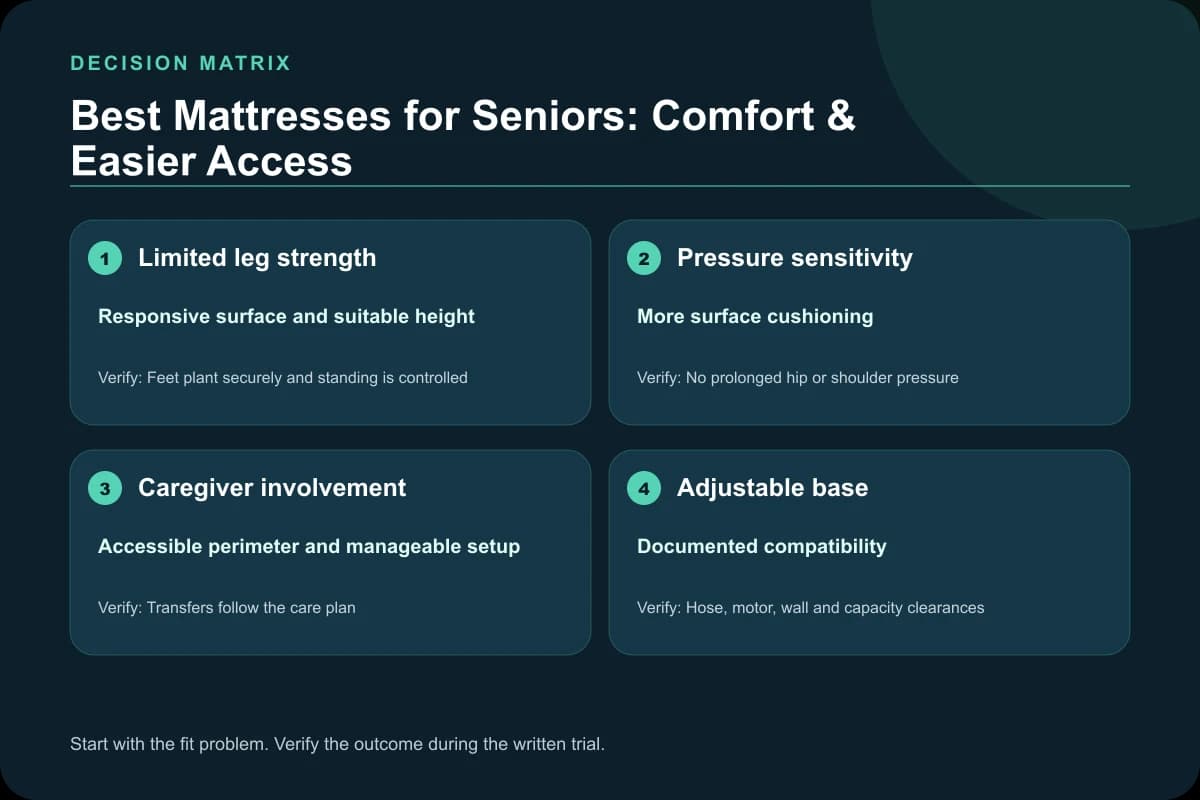
| Need | Starting point | Verify in real use |
|---|---|---|
| Limited leg strength | Responsive surface and suitable height | Feet plant securely and standing is controlled |
| Pressure sensitivity | More surface cushioning | No prolonged hip or shoulder pressure |
| Caregiver involvement | Accessible perimeter and manageable setup | Transfers follow the care plan |
| Adjustable base | Documented compatibility | Hose, motor, wall and capacity clearances |
A row is a starting lane, not a prescription. Two people with the same position or age can compress a mattress differently, use different pillows and bases, or have opposite preferences for bounce and contour. Write down the outcome you need before opening retailer tabs.
What we weighted most
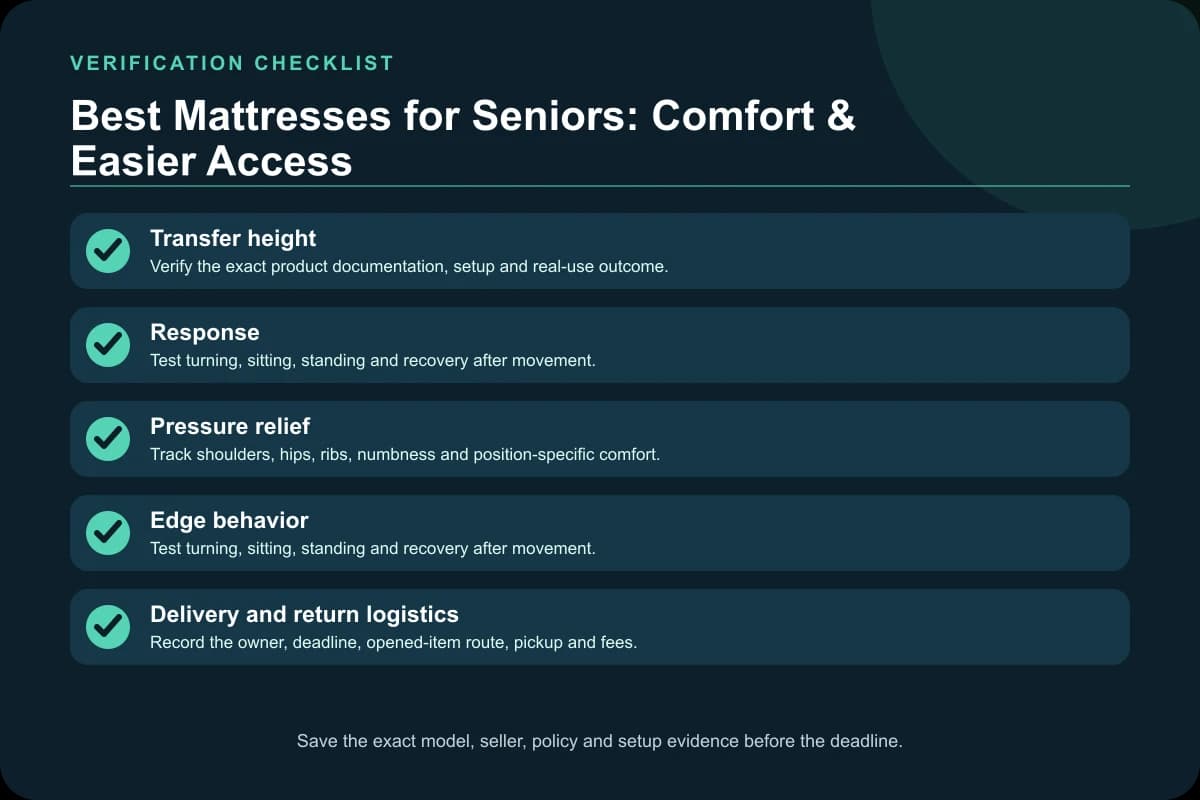
- Transfer height: record what the exact product or setup says, then verify the outcome during the trial.
- Response: record what the exact product or setup says, then verify the outcome during the trial.
- Pressure relief: record what the exact product or setup says, then verify the outcome during the trial.
- Edge behavior: record what the exact product or setup says, then verify the outcome during the trial.
- Delivery and return logistics: record what the exact product or setup says, then verify the outcome during the trial.
These criteria prevent a common error: replacing a real decision with a marketing proxy. A label, component name, rating or badge is evidence only within a defined scope; it is not a guarantee of fit, safety, durability or policy coverage.
Current research shortlist
1. Saatva Classic
Saatva Classic is in this shortlist because it offers firmness and height choices with in-room setup. The reason is a documented construction or policy fit—not an invented score, permanent price, or claim that we personally slept on the current unit.
Main tradeoff: Return fee and total bed height. Match the current model name, height, firmness, seller, trial, warranty and return owner before purchase.
Research Saatva Classic
Compare the exact current model and size. Check the seller, construction, delivered total, opened-item return route and manufacturer warranty eligibility.
Before checkout
Use the listing as the source of truth for current price tier, seller, delivery window, and return terms.
Amazon inventory and policies can differ from the manufacturer site. Save the exact listing and terms before ordering. As an Amazon Associate, we earn from qualifying purchases.
2. Leesa Sapira Hybrid
Leesa Sapira Hybrid is in this shortlist because it offers balanced response and pressure relief. The reason is a documented construction or policy fit—not an invented score, permanent price, or claim that we personally slept on the current unit.
Main tradeoff: Boxed mattress requires setup help. Match the current model name, height, firmness, seller, trial, warranty and return owner before purchase.
Research Leesa Sapira Hybrid
Compare the exact current model and size. Check the seller, construction, delivered total, opened-item return route and manufacturer warranty eligibility.
Before checkout
Use the listing as the source of truth for current price tier, seller, delivery window, and return terms.
Amazon inventory and policies can differ from the manufacturer site. Save the exact listing and terms before ordering. As an Amazon Associate, we earn from qualifying purchases.
3. The WinkBed
The WinkBed is in this shortlist because it offers multiple feels and traditional hybrid response. The reason is a documented construction or policy fit—not an invented score, permanent price, or claim that we personally slept on the current unit.
Main tradeoff: Tall profile may raise transfer height. Match the current model name, height, firmness, seller, trial, warranty and return owner before purchase.
Research The WinkBed
Compare the exact current model and size. Check the seller, construction, delivered total, opened-item return route and manufacturer warranty eligibility.
Before checkout
Use the listing as the source of truth for current price tier, seller, delivery window, and return terms.
Amazon inventory and policies can differ from the manufacturer site. Save the exact listing and terms before ordering. As an Amazon Associate, we earn from qualifying purchases.
4. Puffy Lux
Puffy Lux is in this shortlist because it offers plusher pressure relief. The reason is a documented construction or policy fit—not an invented score, permanent price, or claim that we personally slept on the current unit.
Main tradeoff: Deep sink may increase turning effort. Match the current model name, height, firmness, seller, trial, warranty and return owner before purchase.
Research Puffy Lux
Compare the exact current model and size. Check the seller, construction, delivered total, opened-item return route and manufacturer warranty eligibility.
Before checkout
Use the listing as the source of truth for current price tier, seller, delivery window, and return terms.
Amazon inventory and policies can differ from the manufacturer site. Save the exact listing and terms before ordering. As an Amazon Associate, we earn from qualifying purchases.
Shortlist comparison
| Option | Best research fit | Primary caution |
|---|---|---|
| Saatva Classic | Firmness and height choices with in-room setup | Return fee and total bed height |
| Leesa Sapira Hybrid | Balanced response and pressure relief | Boxed mattress requires setup help |
| The WinkBed | Multiple feels and traditional hybrid response | Tall profile may raise transfer height |
| Puffy Lux | Plusher pressure relief | Deep sink may increase turning effort |
A five-step purchase and trial process
- Freeze the exact identity. Save the model, generation, size, height, firmness, seller, fulfillment party and condition.
- Verify the complete system. Check the mattress, foundation, protector, pillow, room climate and any adjustable base together.
- Read the live policies. Identify the trial owner, minimum-use rule, opened-item return route, pickup cost, warranty eligibility and required support.
- Change one variable at a time. Keep familiar bedding and pillow at first unless one is clearly incompatible.
- Document the trend. Track comfort, pressure, movement, heat, access and visible support while preserving labels, photos and correspondence.
A trial is not permission to ignore health or safety signals. It is a controlled consumer test of comfort and function under the written policy. See our mattress trial checklist before ordering.
Claims we deliberately do not make
- We do not claim personal long-term use, laboratory cooling, pressure mapping or chemical analysis unless such work actually occurred.
- We do not publish static sale prices, future discount predictions or permanent Amazon inventory.
- We do not treat a firmness number, material specification, component count or certification logo as a universal pass/fail score.
- We do not turn customer reviews into medical, durability or safety evidence.
Common mistakes to avoid
- Using senior as one body type.
- Assuming a high edge prevents falls.
- Selecting a very low bed without transfer testing.
- Making medical claims from customer reviews.
When to keep, exchange or return
Keep the product when the documented model is correct, the setup follows support requirements, comfort and function trend acceptably, and no policy or safety problem has emerged.
Exchange when the system is fundamentally sound but the written program permits a clearly better firmness, height or configuration. Do not assume an exchange restarts the trial.
Return or escalate when the wrong model arrived, documentation conflicts, the setup cannot be made compatible, symptoms or access worsen, a material or odor concern persists, or the return deadline is approaching without a workable fit. Get written authorization before donation, disposal or pickup.
Related guides
Best mattress for elderly sleepers with mobility issues
For an older adult with mobility issues, finished bed height and edge behavior can matter as much as pressure relief. Measure from the floor to the compressed sitting surface, then practice a controlled sit-to-stand with a stable helper or clinician-approved support. A high rigid edge can be difficult for a shorter person; a low plush edge can collapse under the thighs and make standing harder.
An adjustable-compatible mattress can help when elevation is part of an approved comfort or care plan, but the mattress must bend without bunching and remain easy to enter. Use our adjustable-bed mattress guide for compatibility checks. Mattress selection cannot diagnose fall risk, replace mobility assessment, or substitute for medical advice.
- best mattresses for back pain
- best mattresses for side sleepers
- best adjustable bed frames on amazon
- mattress trial checklist
Sources and verification notes
Policies, model names, sellers and certifications can change. Recheck the exact product and purchase channel on the day you buy.