
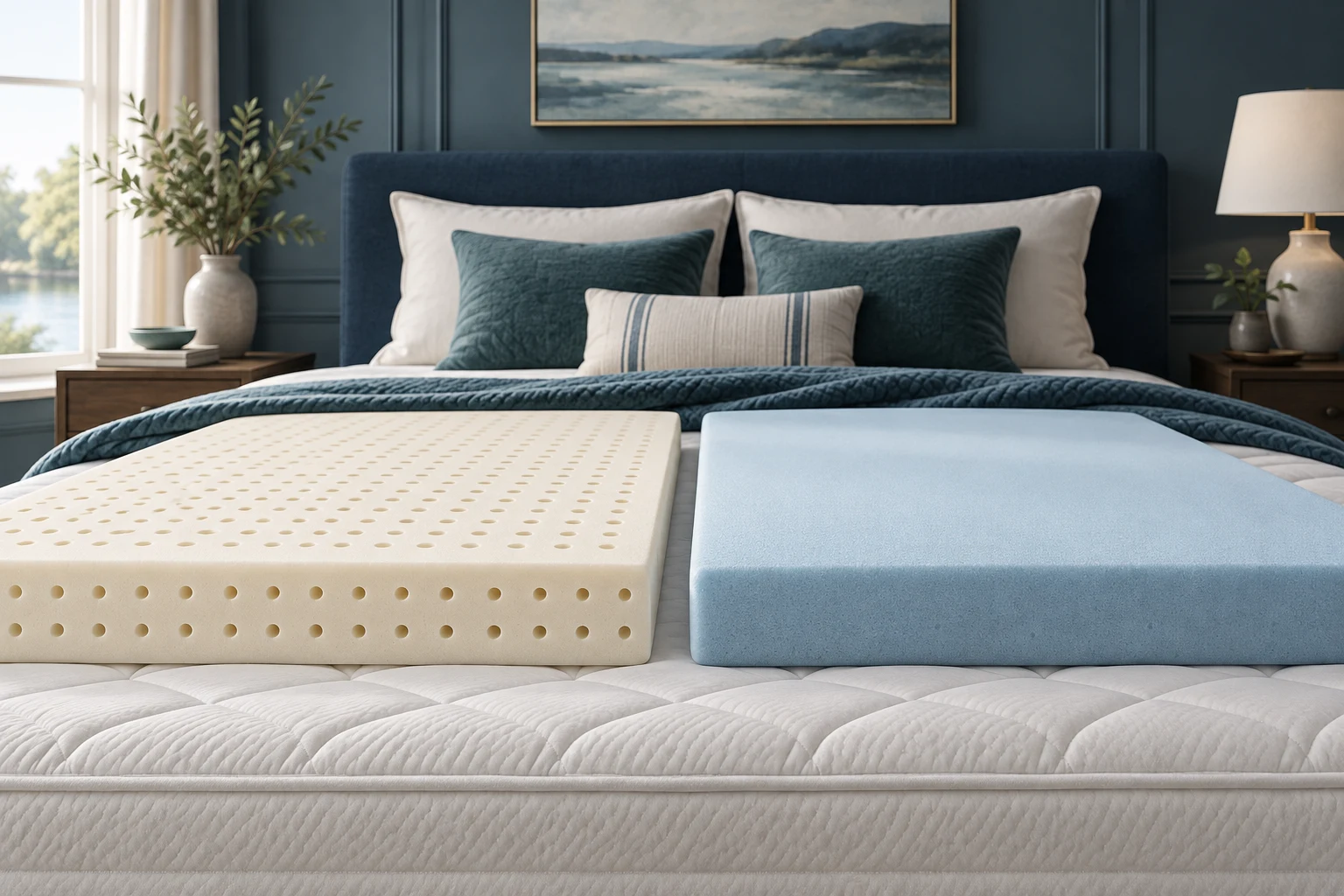
Start with the change you want: latex is a useful route to investigate when you want cushioning with a springier response; memory foam is worth investigating when you want a slower, closer contour. Neither material name tells you the finished topper's firmness, and neither repairs a mattress with a failed support core.
This comparison concerns a removable comfort layer on an existing mattress. For a replacement bed, use our whole-mattress material comparison. We researched manufacturer descriptions and configuration choices; we did not test these toppers or measure their temperatures. Illustrations are conceptual, not photographs of tested products.
First decide whether a topper is the right intervention
A flat mattress that feels too firm is a different problem from a mattress with a permanent hollow. A topper changes the upper comfort layers while the mattress and foundation continue to carry the system. Adding cushioning over a depression does not restore the missing structure. Check the frame and mattress before spending money on either material.
If the bed is still within its return period, compare the cost and complications of a topper with the available return route. Do not let an accessory experiment run past an order-specific deadline. Our topper or new mattress tool helps separate a comfort adjustment from a replacement decision.
Compare the tradeoffs, not a universal winner
| Your priority | What to examine in latex | What to examine in memory foam |
|---|---|---|
| Changing position | Whether the springy surface helps you turn without feeling pushed upward | Whether the contour releases quickly enough for your movements |
| A closer surface hug | Thickness and softness; latex is not automatically firm | Contour and recovery of the actual formulation, not just a foam label |
| Partner movement | The complete bed, shared topper and foundation | Whether reduced surface bounce also works with your existing mattress |
| A small comfort adjustment | A thinner configuration in the appropriate firmness | A thinner layer with a clearly described feel |
| Heat concerns | Cover, bedding and room conditions alongside the foam | The same factors; gel wording is not a measured cooling result |
| Frequent removal | Weight, flexibility and the instructions for supporting the layer | Handling, cover removal and foam-care instructions |
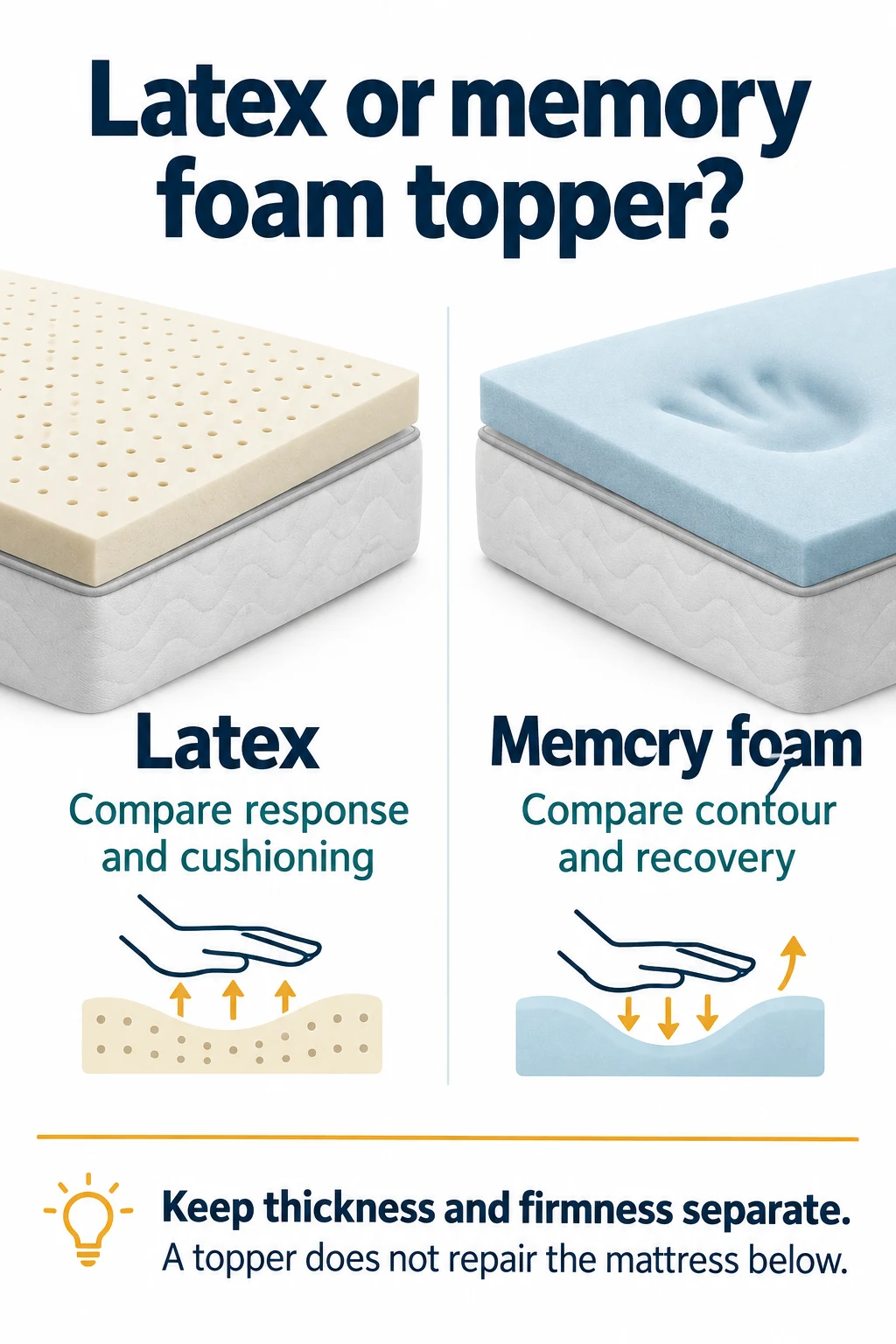
Keep material, thickness and firmness separate
Sleep On Latex's topper configurator offers thickness and firmness as separate selections. That is an important practical distinction: a three-inch Medium layer is not simply a deeper version of a two-inch Soft layer. Compare like with like before deciding whether the difference comes from the material.
Linenspa's gel memory foam topper provides another example of a product family with depth choices. Its gel description should not be turned into a claim that it will keep your particular bed cooler than every latex product. We have no comparable temperature measurements establishing that ranking.
Depth determines how much additional material sits between you and the original surface. Firmness and the mattress underneath help determine what that additional layer feels like. Our two-inch versus three-inch guide explains this separate decision.
Three practical buying scenarios
Your mattress is flat and firm, and you dislike slow sinking. Start by comparing latex configurations that offer the amount of cushioning you need. A responsive surface can still be too firm, too soft or too thick for you. Consider the latex topper shortlist after deciding on the intended change.
Your mattress is supportive, but you want a more enveloping surface. Compare memory foam options and pay attention to whether the depth changes your sleeping position more than expected. For side sleeping, assess shoulder and hip comfort together with turning and overall support. The side-sleeper topper guide separates these product choices.
Your main complaint is overheating rather than firmness. Neither material is a guaranteed fix. First identify whether the problem follows a waterproof cover, heavy bedding or an overly warm room. Read the cooling topper guide before treating an accessory's cooling language as evidence of an overnight temperature reduction.
Handling, covers and care can change the purchase
A bare foam layer and a covered topper are different orders. Confirm whether the pictured cover is included, whether it can be removed, and what cleaning method applies separately to the cover and foam. Linenspa specifies spot cleaning for its topper; do not assume that a washable sheet makes the foam washable.
Plan where you would put the topper while rotating or cleaning the mattress. A large flexible layer can be awkward even when its boxed delivery looked manageable. Follow the manufacturer's handling directions rather than lifting a heavy sheet by one small corner. Check fitted-sheet depth after adding the layer and any protector.
Evaluate the change without losing the return option
Keep the same bedding initially so that you are not changing several variables at once. Record the original problem, then reassess that problem as well as turning, edge access and your pillow position. A softer first impression alone is not proof of a better full-night fit.
An owner discussion about adding a topper to a latex mattress prompted a useful question: must the topper match the material underneath? No matching rule follows from the material names. The reason to choose is the missing comfort characteristic, subject to the mattress and topper instructions. The discussion supplied the question, not performance evidence.
Return to the general topper guide once you can describe the desired change in one sentence. That makes a product shortlist more useful than choosing latex or memory foam in isolation.
Choose your next step
Talk through the tradeoffs
Open an editable question in the Sleep Advisor. Nothing is sent to AI until you submit it.