
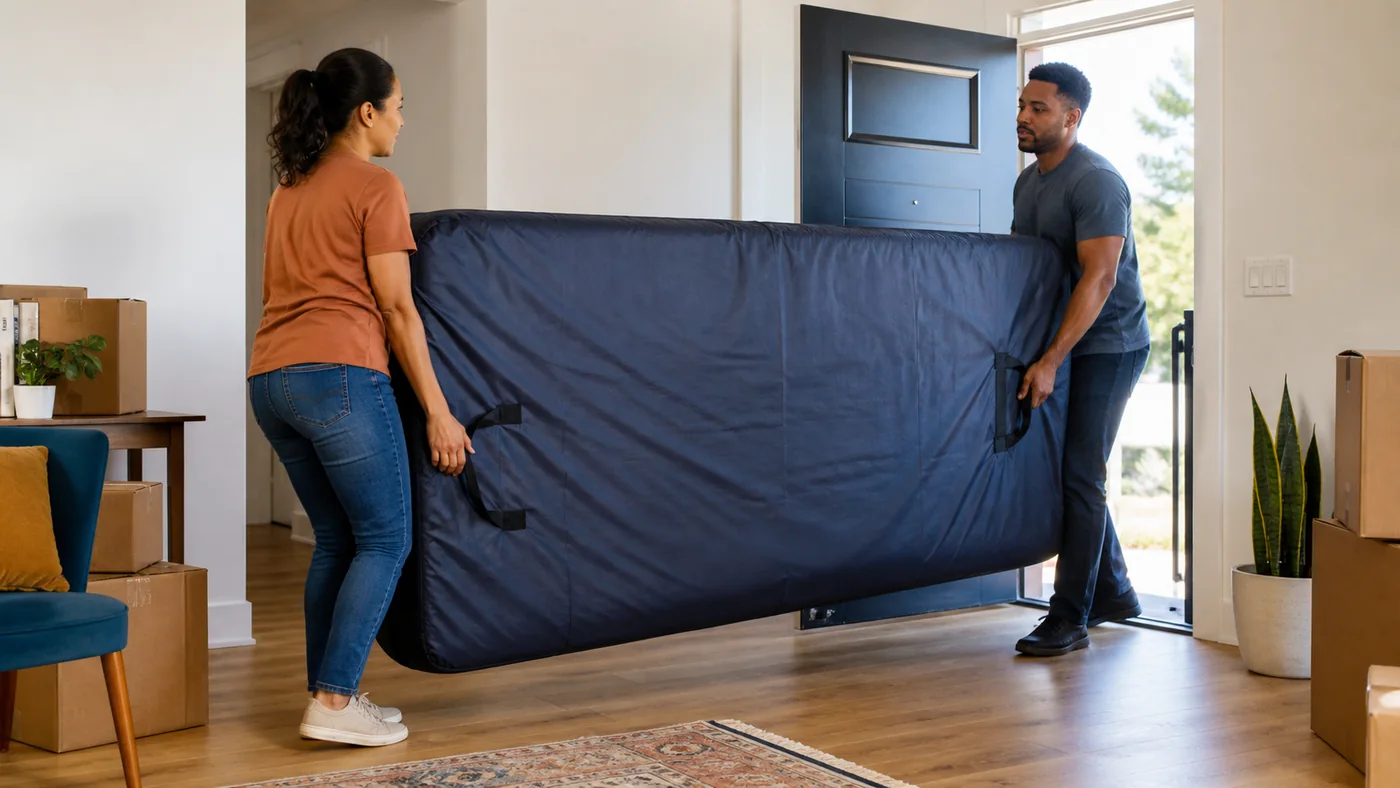
The best way to move a mattress without damaging it is to decide on the crew and route before anyone lifts. Measure the mattress, check its exact product weight, protect it in a fitted bag, clear every doorway and stair turn, and secure it inside a suitable vehicle. A light Twin on a short flat route may be manageable for one capable adult; most Queen, King, stair, long-distance, or heavy-model moves need two people, three people, or professional movers.
There is no universal “safe mattress weight.” OSHA explains that lifting risk depends on much more than pounds: grip, load stability, how far the load sits from the body, twisting, carry distance, and space constraints all matter. A wide, flexible mattress is exactly the kind of awkward load that makes a simple weight cutoff unreliable.
DIY move or professional movers?
Use this shortlist if
- The exact mattress weight is known and within the crew's realistic capability.
- The complete route has been measured, cleared and walked before lifting.
- At least two capable adults are available for a Queen, King, stairs or a long carry.
Use a different route if
- Anyone has a back, joint, grip, balance or mobility limitation.
- The mattress is very heavy, difficult to grip, or wider than the tight stair turns.
- You cannot secure the mattress inside a suitable vehicle or control it at every stage.
Try it before the how-to
Can you move your mattress?
Use the exact manufacturer-sourced weight, then add stairs, distance, and the capable adults available.
Moving equipment: three useful starting points
Buy equipment for the route you actually have. A bag helps protect the surface, two-person straps can improve grip for suitable users, and a dolly can reduce carrying on smooth level ground. None of them turns an understaffed or physically unsuitable move into a safe one.
Decision-first shortlist
Moving-day equipment by job
These are direct, verified Amazon product pages—not generic search results. Match the bag size and use every tool only on a route it is designed for.
1. Best first purchase
Acnusik Reusable Mattress Bag
A heavy-duty reusable transport cover with a side zipper and reinforced handles for protecting and controlling the mattress.
- Best for
- Surface protection, cleaner transport and added handholds
- Avoid if
- You expect the bag alone to support the load or make an unsafe carry safe
- Construction
- PE tarp cover, zipper and reinforced handles
- Price tier
- Confirm the current listing
2. For two capable movers
Shoulder Dolly Moving Straps LD1000
A two-person strap system that can improve grip and coordination when the users and route are suitable.
- Best for
- Two-person carries on a measured, controlled route
- Avoid if
- Either mover has an injury, limited mobility, poor balance or insufficient strength
- Construction
- Two-person shoulder harness and lifting strap system
- Price tier
- Confirm the current listing
3. For flat sections only
WEN Hardwood Furniture Moving Dolly
A low platform dolly for reducing the carry across smooth, level sections when the bagged mattress is secured and controlled.
- Best for
- Long hallways, loading areas and level driveways
- Avoid if
- The route includes stairs, curbs or an unsecured flexible mattress
- Construction
- Hardwood platform with four swivel casters
- Price tier
- Confirm the current listing
Prices, sizes, sellers, availability and return terms can change. Confirm the exact listing before purchase. Amazon buttons are affiliate links; as an Amazon Associate, we earn from qualifying purchases.
How many people does it take to move a mattress?
Use size as an awkwardness signal and the exact model weight as the starting number. Our Mattress Weight Database currently contains 160 manufacturer-sourced model-size records. It shows why “a Queen weighs X” is not reliable enough: material, height, coils, comfort layers and generation can change the load substantially.
| Situation | Conservative starting plan | Why |
|---|---|---|
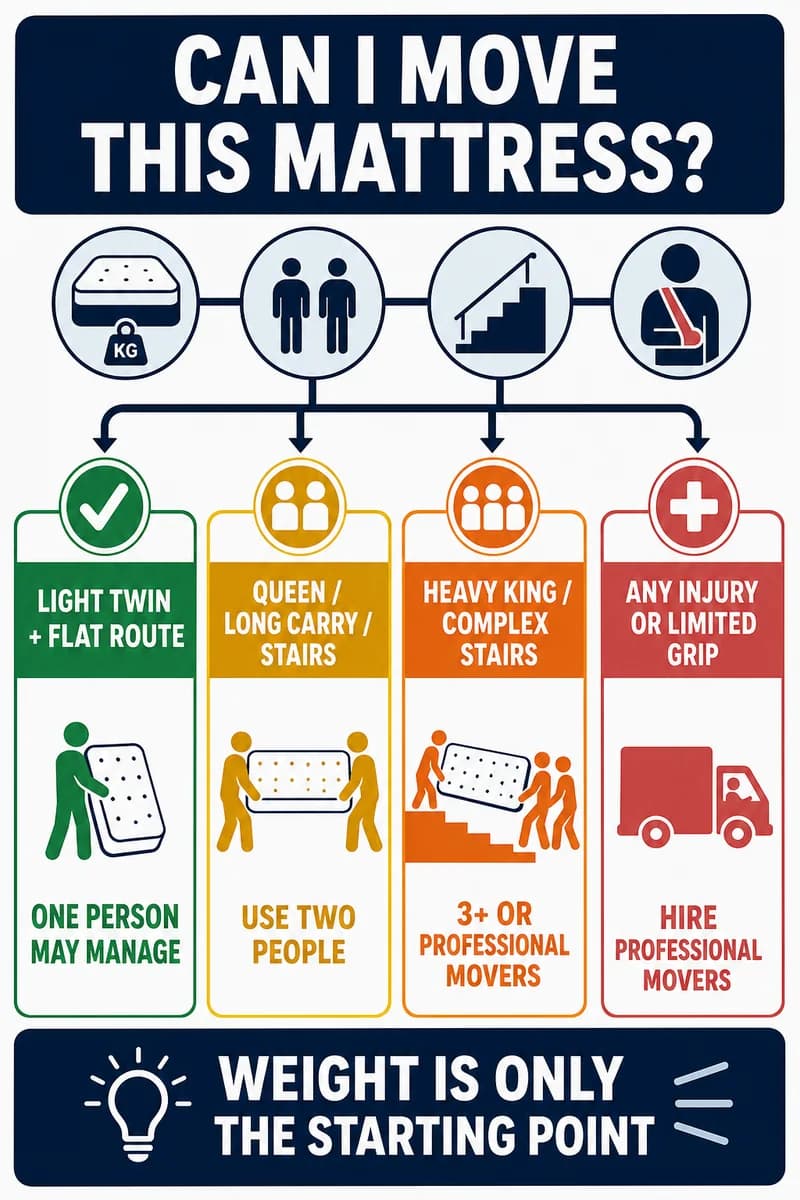
| Light Twin or Twin XL, short flat route | One capable adult may manage; two preferred | Narrower width and lower weight can be controllable when grip and visibility remain good |
| Most Full or Queen mattresses | Two capable adults | Width and flex make solo control difficult even before stairs |
| King or California King | At least two; often three for stairs or heavy models | The width blocks visibility and amplifies turning and balance problems |
| Mattress around 130 lb or more | Three capable adults or movers | The load becomes harder to share and set down under control |
| Mattress around 180 lb or more | Professional movers | Equipment, route control and coordinated handling matter more than adding one untrained helper |
| Any injury, limited grip, balance or mobility | Professional movers | The calculator treats this as a stop signal for DIY carrying |
These are deliberately conservative planning lanes, not occupational lifting limits. OSHA does not set one universal amount that every person can lift. Its ergonomics guidance emphasizes posture, handholds, distance from the body, stability and twisting—the same factors that make mattresses unusually difficult.
Step 1: Decide whether the mattress is worth moving
Moving an old mattress can cost more in time, vehicle space and labor than its remaining useful life justifies. Check for deep sagging, broken edges, persistent odor, stains, tears, exposed materials and new discomfort. Use the Mattress Lifespan Estimator if the decision is not obvious.
Keep the mattress when it is structurally sound, comfortable, hygienic and practical for the new room. Replace or arrange disposal when it already fails the support test, cannot fit the destination, or would require disproportionate professional handling. Do not dismantle a mattress: internal springs, staples and fire-barrier materials create additional risks.
If the mattress is still inside a trial or warranty period, read the condition rules before moving. Tears, stains, liquid damage and improper support can affect eligibility. Photograph all sides, the law label and the current condition before packing.
Step 2: Identify, weigh and measure the exact mattress
Write down five facts:
- Brand and exact model generation.
- Size: Twin, Twin XL, Full, Queen, King or California King.
- Width and length.
- Total height, including any pillow top.
- Product weight—not boxed shipping weight or sleeper capacity.
Start with the manufacturer specification or our filterable weight database. If your model is not listed, use a reliable manufacturer document or contact the brand. Do not guess from a different model with the same size.
Measure the bag as well. A Queen bag that fits a 10-inch foam mattress may not close around a 15-inch pillow-top hybrid. Handles must be stitched for carrying; ordinary storage-bag handles may be intended only for positioning an empty bag.
Step 3: Measure the complete route before lifting
Measure more than the bedroom door. Walk the entire route and note:
- narrow door frames and removable doors;
- hallway width and ceiling drops;
- elevator door, cabin and booking rules;
- stair width, landings, railings and turning radius;
- exterior steps, curbs and uneven ground;
- truck, van or container opening;
- a controlled place to set the mattress down at each stage.
Use the Bed Size Calculator for the destination room, but measure the real mattress and frame separately. Standard-size labels describe nominal dimensions; construction and covers can create small differences.
Remove rugs, lamps, frames, plants, pet gates, cords, boxes and anything that can catch the bag. Keep children and pets away from the route. Open and secure doors before lifting rather than asking a carrier to release one hand mid-move.
Step 4: Protect the mattress correctly
Strip all bedding, toppers and protectors. Vacuum loose debris and make sure the mattress is completely dry. Moisture sealed inside a bag can become a storage problem.
Slide on a fitted mattress moving bag with the mattress supported on a clean surface. Close the zipper or seal the bag opening without putting adhesive tape directly on the mattress fabric. Reinforce vulnerable bag corners with cardboard where the route has unavoidable contact points, but do not create sharp edges or loose flaps.
A bag protects against dirt, scuffs and light exposure during handling. It is not permission to drag the mattress through water, leave it uncovered outdoors, or assume every zipper seam is watertight.
Step 5: Assign roles and commands
Choose one route leader. Agree on short commands such as “lift,” “stop,” “set down,” “step,” and “turn.” Everyone should know the next rest point before the mattress leaves the floor.
The person moving backward must never be surprised by a stair, threshold or curb. Add a spotter when the route blocks the carriers' view, but make sure the spotter is not standing where a falling mattress could pin them.
Two-person lifting straps can help suitable movers maintain grip, but follow the product instructions and practice with a lighter load first. The Shoulder Dolly listing itself warns that the system does not make the users stronger. If either person cannot control their share without twisting or sudden corrections, stop.
Step 6: Carry it without forcing bends or twists
Keep movements slow, synchronized and close to the body where the mattress construction allows. Pivot with the feet instead of twisting the torso. Do not keep going because the destination is “only a few feet away” after grip starts to fail.
Mattress flexibility varies widely. Never assume a bed-in-a-box mattress can be returned to its original compressed roll. Casper says memory foam can be flexible, but it does not recommend folding or rolling its mattresses after unboxing. Hybrids and innersprings can suffer coil, edge and comfort-layer damage when forced into a tight fold.
The rule is simple: only fold, roll or compress the exact model when the manufacturer expressly permits it and provides instructions. Otherwise redesign the route or hire professionals.
Step 7: Handle stairs and dollies as separate stages
A furniture dolly is useful on a smooth, flat route. Secure the protected mattress so it cannot flop into walls or slide off the platform, and keep a capable adult controlling it. Stop before every curb, threshold or stair.
Do not roll a mattress down stairs on a dolly. Casper's moving guidance explicitly says to remove it from the dolly and carry it down the staircase. Complex stairs, low ceilings and tight landings are also where an extra helper or professional crew adds the most value.
On stairs, maintain communication and a controlled pace. If the mattress blocks visibility, cannot clear the turn without force, or leaves no safe place for the carriers' hands and feet, set it down and change the plan.
Step 8: Load and secure it inside a suitable vehicle
An enclosed moving van or appropriately sized truck is the better transport route because it protects the mattress and provides proper cargo anchor points. Support the mattress according to the manufacturer's guidance, secure it against sliding and do not stack sharp, dirty or extremely heavy objects on top.
Avoid improvising with a mattress on a passenger-car roof. NHTSA says every driver is responsible for securing cargo so it cannot drop, shift, leak or escape. A mattress is a large flat surface that catches wind; an error can damage the bed and vehicle or create dangerous road debris.
If outside transport is unavoidable, use a vehicle and rack rated for the load, follow the vehicle manual and applicable law, and use correctly rated cargo restraints. If you cannot verify those conditions, rent suitable transport or hire movers.
Step 9: Inspect, unpack and store it correctly
At the destination, inspect the bag before opening it. Move the mattress to the final room, then use scissors with the cutting edge directed away from the fabric. Avoid driving a box cutter toward the cover.
Check for dampness, tears, deformation and unusual noise. Follow the manufacturer's setup guidance before sleeping on it. If it is going into storage, keep it clean, dry and protected. Long-term storage is generally best flat on a solid surface with nothing stacked on top, but confirm the exact manufacturer's instructions.
Record any new damage with photos. If professional movers handled the mattress, report transport damage under their written process promptly rather than waiting until the next move.
Mattress-type differences that change the move
| Construction | Moving behavior | Main risk | Better plan |
|---|---|---|---|
| All-foam | Can be flexible and hard to keep upright | Layer tearing, cover stress and uncontrolled flopping | Bag, added support and manufacturer-approved bending only |
| Hybrid | Heavy with a mix of flexible foam and coils | Coil or edge damage from forced folding | More helpers, minimal bending and good base support in transit |
| Innerspring | Often more rigid but still awkward | Bent coils and border-wire damage | Keep supported and never force a tight fold |
| Latex | Dense, heavy and very floppy | High weight with difficult grip and layer shifting | More helpers or professional movers; support the full structure |
| Pillow top | Extra thickness and softer edges | Bag fit, snagging and difficult hand placement | Measure depth carefully and protect corners |
When professional movers are the better value
Hire qualified movers when any of these apply:
- the mattress is around 180 lb or more;
- a heavy King must go through stairs or tight turns;
- the route needs lifting above shoulder height;
- there is no safe rest point or clear visibility;
- anyone has a back, joint, grip, balance or mobility limitation;
- the building requires insured movers or an elevator reservation;
- suitable cargo transport and anchor points are not available;
- damage to walls, railings, the mattress or people would cost more than the service.
Professional help is not a failure of planning. It is the correct output when weight, awkwardness and the route exceed what an informal crew can control.
Common mattress-moving mistakes
Using size as a weight estimate. A lightweight Queen and a luxury Queen can differ dramatically. Match the exact model.
Buying the bag on move day. Width and length are not enough; mattress depth and zipper design matter.
Using a dolly on stairs. A flat-route aid becomes an uncontrolled rolling load on steps.
Assuming straps increase strength. Straps can improve grip and coordination, but the users still carry and control the load.
Forcing a fold because the mattress arrived compressed. Factory compression does not mean owners can safely recreate it.
Taping directly to the cover. Adhesive can stain, pull threads or damage finishing materials.
Leaving the mattress unsecured in a vehicle. Sudden braking and turns expose a weak plan immediately.
Storing it damp, upright or under boxes. Moisture and long-term deformation can turn a successful move into permanent damage.
Final moving-day checklist
- Exact model, size, height and product weight confirmed
- Mattress and bag dimensions measured
- Doorways, hallways, elevator, stairs and vehicle opening measured
- Route cleared and doors secured open
- Enough capable adults confirmed
- Physical limitations treated as a stop signal
- Mattress dry, photographed and bagged
- Commands, leader and rest points agreed
- Dolly reserved for flat sections only
- Manufacturer's bending and storage guidance checked
- Vehicle and cargo restraints suitable for the load
- Destination room and foundation ready
Use the full Mattress Moving Calculator whenever the model, route or crew changes. For research and citations, the Mattress Weight Database provides the underlying manufacturer sources and verification dates.