
If a new mattress is arriving, ask the retailer about taking the old one when you schedule delivery. If that is unavailable, look for a recycler or a municipal bulk-waste route before paying a private hauler. Donate only after an organization explicitly confirms it will take the item. Tell every service what you have and what condition it is in.
We checked the linked U.S. program and municipal examples on November 8, 2026. The address, item type and condition determine which instructions apply. A national directory gets you to a provider. The provider and local waste authority confirm the actual pickup or drop-off.
Compare the four routes
| Route | Start here when | Confirm before committing |
|---|---|---|
| Retailer take-back | A replacement is on order | Which units are included, whether pickup is on the delivery day, where the old item must be and any separate charge |
| Recycling drop-off | A facility you can reach accepts the item | Hours, residency, unit type, limits, condition and whether there is a charge |
| Donation | A specific organization wants a clean, usable item of this kind | Acceptance for a used mattress, any documentation and who handles transport |
| Municipal pickup or transfer station | You need address-specific instructions or the item is not accepted for reuse | Collection day or booking, bagging and placement rules, unit limits and fees |
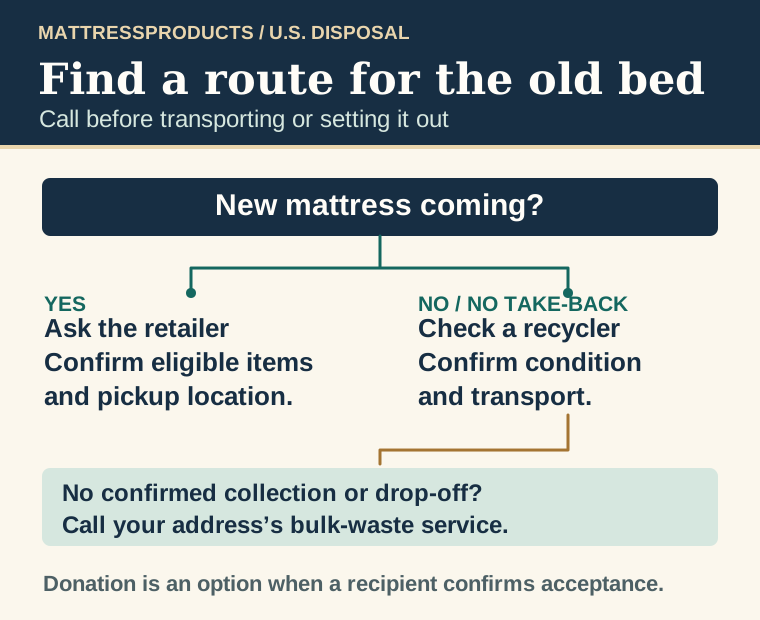
Choose the next call
Decision guide
Which disposal route should you check first?
Use this to pick the next contact. The tool does not determine service coverage, fees or legal requirements.
Choose an option to see your next step.
1. Ask about retailer take-back before delivery day
Have your order number ready. Ask whether one old mattress can be picked up, whether a box spring is included and when both pieces need to be ready. “Room of choice” or “white glove” on a delivery listing is not enough to identify the pickup service. Save the written answer.
For a concrete example, the California retailer pick-up FAQ says retailers delivering mattresses must offer qualifying old-mattress take-back without an additional charge, and describes the separate arrangement when a parcel carrier delivers the new one. It also explains the health and safety exception. Do not expect a parcel driver to remove a mattress simply because the replacement arrived that day. The cited rules apply in California.
2. Find a recycler that accepts this item
The Mattress Recycling Council FAQ describes statewide programs in California, Connecticut, Oregon and Rhode Island. Its facility finder helps identify participating drop-off locations. Outside the four programs, check your local solid-waste department or the Council's broader recycler directory.
Take the receiver's definition seriously. An upholstered mattress and its box spring may be handled differently from a loose topper, an inflatable bed or a frame. The Oregon acceptance page, for example, excludes air mattresses without upholstery material and separately lists futon mattresses and frames as unaccepted. Check the condition rules before transporting something severely soiled or infested. The Council FAQ tells Connecticut and Rhode Island users to contact the site for instructions on those conditions.
Use this call script: “I have one Queen mattress and one box spring from my home. The mattress is dry, with a tear in the cover. Can I drop off both at this location on Saturday? Do I need proof of residence, and is either item charged separately?” Change the description to match what you actually have.
3. Confirm donation before treating it as an option
A clean mattress with usable support can be worth asking about. Look for an organization that expressly accepts the item. Habitat's national ReStore guidance lists mattresses and box springs among items it does not accept. A charity that takes other furniture may have a different rule for mattresses.
If the mattress is being returned under a seller's trial, contact the seller before donating or disposing of it. The return process may require an approved receiver or proof. Keep the instructions and documentation with the order.
4. Use the address-specific bulk collection rules
Search your city or county's official waste site for “mattress” and “bulk collection.” Check whether your address uses municipal or private collection. Ask where the item goes, when to put it out, how it must be wrapped and whether a box spring counts as a separate item. Buildings may also have a designated pickup location.
NYC311 illustrates why the details matter. Its mattress and box spring instructions require sealed plastic for curbside collection and exclude red and orange bags. It ties set-out to the local bulk-trash schedule. That is a New York City example. Use the published rules for your own address before putting anything outside.
Which call to make in four common situations
A new mattress arrives in a box
Ask whether the old item is collected separately. Give the retailer the order number, old item type, delivery address and date. Ask whether a box spring is included and whether collection is in-room or from a designated set-out point. Get the appointment and preparation instructions in writing. See the California take-back FAQ for that state's parcel process.
You live in a walk-up and have no vehicle
Call the building office and waste service for the address. Confirm whether the building uses municipal collection or a private hauler. Ask where and when the mattress can be set out. If you need an elevator reservation, book it after collection is confirmed. Compare the full cost of moving the mattress to the curb with a private in-room pickup that includes stairs and preparation. For a private collection, ask where the item goes and keep the receipt.
You have a mattress, box spring and loose topper
List each separately. A site may accept the mattress and box spring as two pieces and decline the topper. The Oregon acceptance list illustrates this distinction. Ask whether the site limits pieces per visit and where the topper and frame should go. Confirm the drop-off hours and preparation before loading the vehicle.
The mattress is wet, heavily soiled or potentially infested
Describe its condition when you call. The receiver may require specific preparation or a separate route. Follow the waste authority's instructions before moving it through shared areas. Tell building management if there is a set-out procedure for your building. The Mattress Recycling Council FAQ provides program-specific directions on when to call the destination.
What happens to a mattress at the recycler?
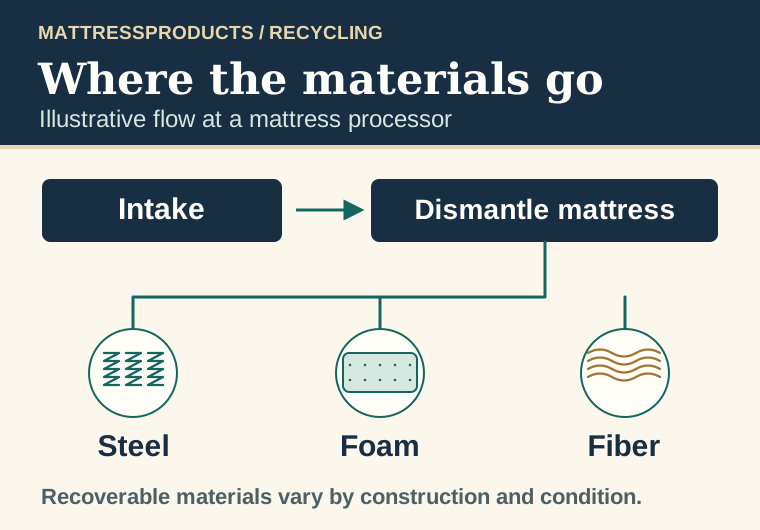
The drop-off location may consolidate mattresses and send them to a separate processor. At the processor, accepted mattresses are dismantled. Where the construction and condition permit, steel, foam and fibers can be separated for recovery. Check the receiver's instructions before taking an item apart at home. Loose pieces may be handled differently from a whole mattress. See CalRecycle's program overview.
Save the disposal plan before move-out day
Write a short record while you make calls. Start with the pickup address or destination, the exact number of pieces, and whether the item is dry, stained or otherwise needs special handling. Record the first available date, price including extras, who does the lifting and what packaging is required. If recycling matters to you, write down the receiver that confirmed acceptance. A service name on an invoice may not identify where the item is processed.
| What the service said | What to confirm before paying or setting it out |
|---|---|
| “Take-back is included” | Appointment, accepted pieces, pickup point and any preparation |
| “Drop-off is free” | Residency or other eligibility rules, item condition, hours and quantity limits |
| “Put it out with bulk trash” | Collection date and time, packaging and the address-specific set-out point |
| “We pick it up from your room” | Stairs, elevator rules, extra-item costs, final price and destination |
If a pickup falls through
Keep the mattress in a permitted location and contact the company or address-specific service before setting it out a second time. Check if there was a condition or packaging problem, a collection limit or a wrong day. Ask for a replacement appointment and update building management if needed. When time is short, confirm the backup route's hours and total before paying a second provider.
For a warranty return, a store exchange or a trial refund, use the seller's directions before arranging any of the routes above. A confirmation from your recycler can be useful if the seller has approved it. A receipt on its own may not satisfy the seller's process. Save the instructions and completion record together.
Compare the whole cost and record the plan
Compare the service fee, transport, bags and any extra charge for a second unit. A recycler might accept a mattress at no charge while a third party still charges to collect it. If you use a hauler, ask for a written total and clarify what will happen to the item. If a route needs a lift you cannot safely manage, ask for a collection option and the service's placement instructions.
Write down the address or pickup window, the exact pieces accepted, any packaging or proof requirements and the total. Keep the receipt if you need to document a return. If you are taking a usable mattress to another home instead, the mattress moving guide covers transport and protection separately.