
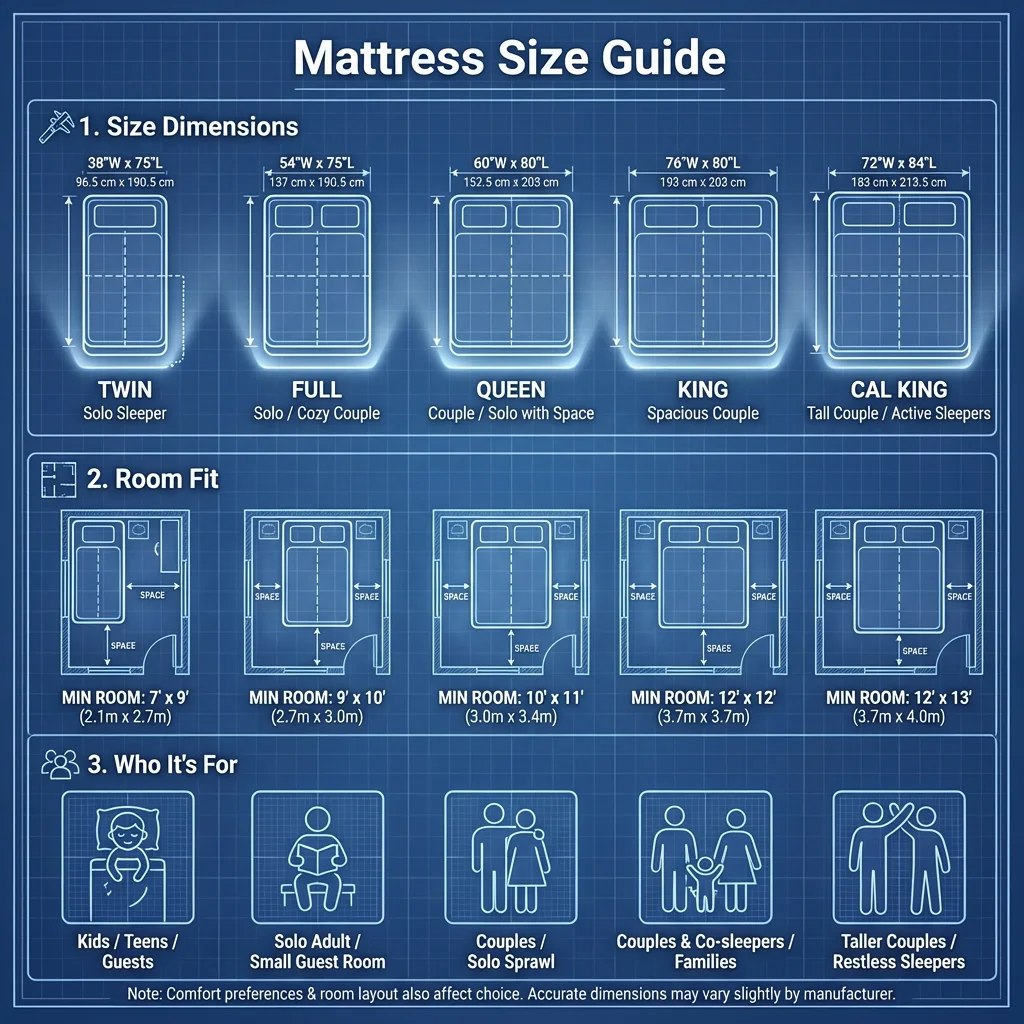
Queen is the broad default for two adults, King adds width, and California King trades four inches of width for four inches of length. Twin XL is the long narrow option and also forms a conventional Split King pair. Measure the exact mattress, frame, room, route and bedding before ordering because brands can vary.
Scope and safety boundary
Nominal U.S. mattress dimensions are conventions, not a promise that every finished product is exact. Bunk beds and adjustable bases have model-specific size, thickness and compatibility rules.
How we reviewed this topic
We compared common U.S. nominal dimensions, room and delivery constraints, split configurations, and CPSC bunk-bed guidance. We excluded static price premiums and universal minimum room sizes.
Our evidence hierarchy puts current manufacturer documentation and relevant primary or standards-body guidance ahead of marketplace copy and star averages. The starting source for this guide is U.S. Consumer Product Safety Commission bunk-bed guidance. Consumer reviews can reveal questions to investigate, but they do not verify hidden materials, medical outcomes, durability, or policy eligibility.
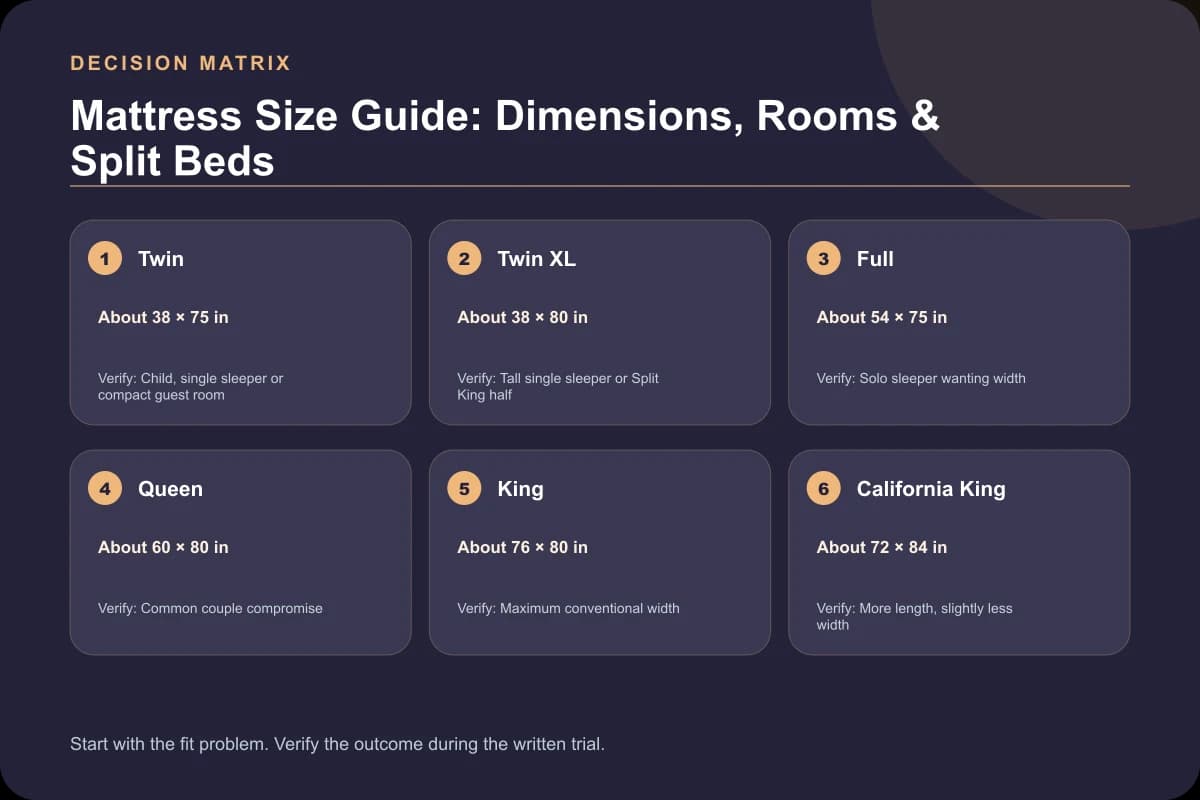
Start with the decision, not the product
| Need | Starting point | Verify in real use |
|---|---|---|
| Twin | About 38 × 75 in | Child, single sleeper or compact guest room |
| Twin XL | About 38 × 80 in | Tall single sleeper or Split King half |
| Full | About 54 × 75 in | Solo sleeper wanting width |
| Queen | About 60 × 80 in | Common couple compromise |
| King | About 76 × 80 in | Maximum conventional width |
| California King | About 72 × 84 in | More length, slightly less width |
A row is a starting lane, not a prescription. Two people with the same position or age can compress a mattress differently, use different pillows and bases, or have opposite preferences for bounce and contour. Write down the outcome you need before opening retailer tabs.
What we weighted most
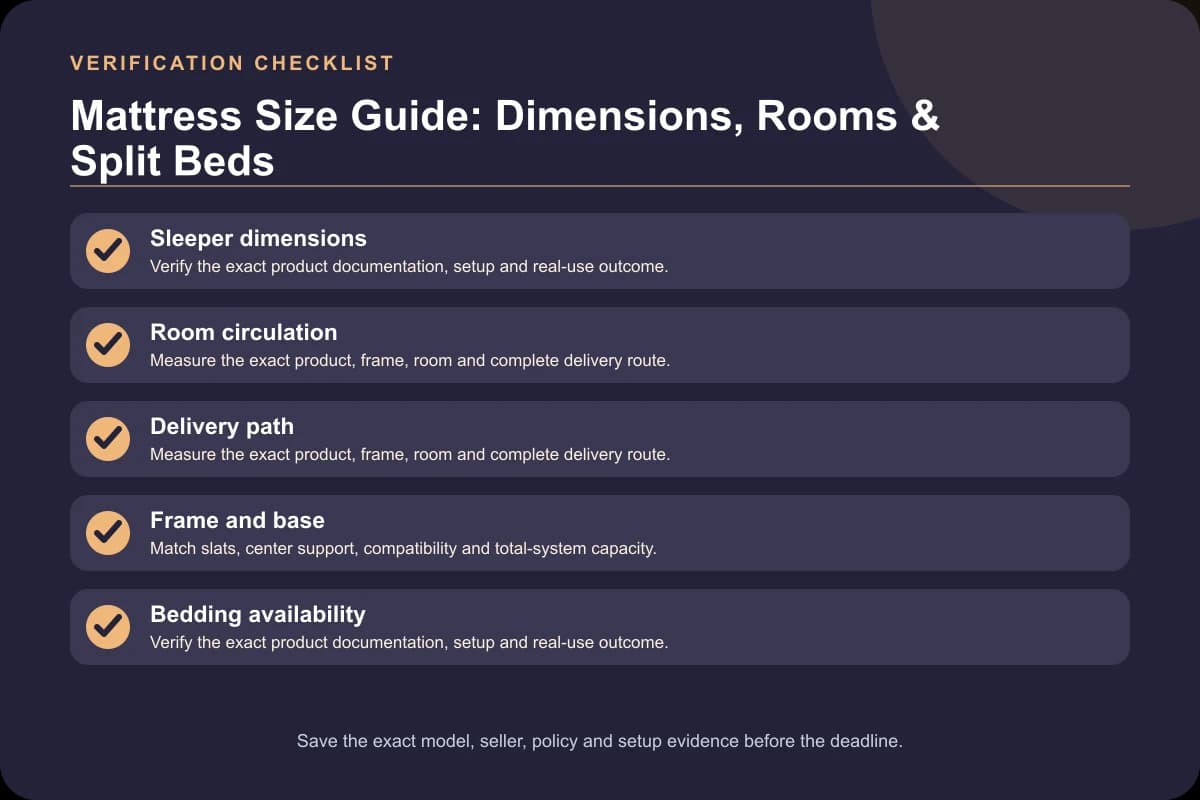
- Sleeper dimensions: record what the exact product or setup says, then verify the outcome during the trial.
- Room circulation: record what the exact product or setup says, then verify the outcome during the trial.
- Delivery path: record what the exact product or setup says, then verify the outcome during the trial.
- Frame and base: record what the exact product or setup says, then verify the outcome during the trial.
- Bedding availability: record what the exact product or setup says, then verify the outcome during the trial.
These criteria prevent a common error: replacing a real decision with a marketing proxy. A label, component name, rating or badge is evidence only within a defined scope; it is not a guarantee of fit, safety, durability or policy coverage.
A five-step purchase and trial process
- Freeze the exact identity. Save the model, generation, size, height, firmness, seller, fulfillment party and condition.
- Verify the complete system. Check the mattress, foundation, protector, pillow, room climate and any adjustable base together.
- Read the live policies. Identify the trial owner, minimum-use rule, opened-item return route, pickup cost, warranty eligibility and required support.
- Change one variable at a time. Keep familiar bedding and pillow at first unless one is clearly incompatible.
- Document the trend. Track comfort, pressure, movement, heat, access and visible support while preserving labels, photos and correspondence.
A trial is not permission to ignore health or safety signals. It is a controlled consumer test of comfort and function under the written policy. See our mattress trial checklist before ordering.
Claims we deliberately do not make
- We do not claim personal long-term use, laboratory cooling, pressure mapping or chemical analysis unless such work actually occurred.
- We do not publish static sale prices, future discount predictions or permanent Amazon inventory.
- We do not treat a firmness number, material specification, component count or certification logo as a universal pass/fail score.
- We do not turn customer reviews into medical, durability or safety evidence.
Conventional U.S. dimensions at a glance
Use the interactive bed-size calculator to test these dimensions against your actual room, or download our embeddable U.S. mattress-size chart for a scale-consistent visual reference.
| Size | Nominal width × length | Practical starting use |
|---|---|---|
| Twin | About 38 × 75 in | Child, compact guest room or single sleeper |
| Twin XL | About 38 × 80 in | Taller single sleeper, dorm or Split King half |
| Full/Double | About 54 × 75 in | Solo sleeper wanting more width |
| Queen | About 60 × 80 in | Common couple compromise or spacious solo bed |
| King | About 76 × 80 in | Two adults prioritizing personal width |
| California King | About 72 × 84 in | Taller sleepers willing to trade some width for length |
Treat these as nominal planning dimensions. Foam can expand slightly, quilted edges can vary, and brand tolerances differ. Use the finished dimensions on the exact product page when matching a tight frame, fitted sheet, wall bed, RV opening or replacement half.
Measure the room as a movement system
Mark the proposed mattress and frame footprint with painter's tape. Include the headboard, footboard, side rails and any frame overhang—not only the mattress rectangle. Open doors, drawers and closets. Walk the nighttime route from the bed to the bathroom and check whether a partner can pass while another person is dressing.
There is no universal minimum room size because door placement, furniture, mobility devices and local codes vary. Record the narrowest circulation point and decide what clearance your household actually needs. A large mattress that blocks storage or creates a trip path is not an upgrade.
Use our interactive Bed Size Calculator to compare Twin through California King in your measured room. It calculates side and foot clearance for a centered layout; treat the result as a planning start, then subtract the actual frame, furniture, doors and accessibility space.
Measure the delivery route
For a boxed foam or hybrid mattress, measure the shipping carton and plan where it can be safely opened. For an uncompressed mattress or rigid foundation, measure doorways, stair width, landings, ceiling height, elevator doors and turns. Remove doors only when safe and permitted; do not assume a King foundation bends.
Split foundations can solve delivery problems without changing the mattress. A Split King mattress system uses two Twin XL mattresses conventionally. A Split California King is a different, less standardized product; confirm the complete dimensions, base and bedding rather than combining approximate halves.
Couples: width, length and independent movement
For a complete two-mattress setup, our split-king buying guide covers matching heights, separate bases, fitted sheets and what the center seam means in use.
A Queen gives each partner roughly 30 inches if divided evenly. A conventional King gives about 38 inches each, similar to two Twin XL widths. A California King gives about 36 inches each but adds length. These figures describe geometry, not comfort or motion isolation.
Couples should also check edge use, different firmness needs, adjustable-base plans, pets and children. Split systems allow independent articulation and sometimes different feels, but create a center seam and require compatible sheets and protectors.
Bunk, trundle, daybed and wall-bed rules
Special frames override generic size advice. For an upper bunk, the permanent label and manufacturer instructions specify the allowed mattress dimensions and maximum thickness. CPSC requires the top of the guardrail to remain at least five inches above the mattress surface; measuring only the mattress height without the frame label is insufficient.
Trundles have both footprint and closed-height limits. Daybeds may need a specific Twin depth to clear rails. Wall beds can impose weight, thickness and flexibility requirements. RV mattresses frequently use short, narrow or radius-corner dimensions that do not match residential labels.
Bedding and base compatibility
Match fitted sheets to both width/length and finished mattress depth, including any topper. Deep-pocket labels are not standardized. For split adjustable systems, decide whether you need separate fitted sheets, a split-top sheet, individual protectors or connected bedding.
Confirm that the foundation supports the exact size without overhang and follows center-support rules. Do not place a Queen mattress on a Full frame or a California King on a standard King base simply because one dimension looks close.
Common mistakes to avoid
- Assuming Full is long enough for every adult.
- Confusing Split King with Split Cal King.
- Using a universal room minimum.
- Ignoring bunk labels.
When to keep, exchange or return
Keep the product when the documented model is correct, the setup follows support requirements, comfort and function trend acceptably, and no policy or safety problem has emerged.
Exchange when the system is fundamentally sound but the written program permits a clearly better firmness, height or configuration. Do not assume an exchange restarts the trial.
Return or escalate when the wrong model arrived, documentation conflicts, the setup cannot be made compatible, symptoms or access worsen, a material or odor concern persists, or the return deadline is approaching without a workable fit. Get written authorization before donation, disposal or pickup.
Related guides
- california king mattress guide
- mattress buying guide overview
- best mattress for kids teens
- best adjustable bed frames on amazon
Sources and verification notes
Policies, model names, sellers and certifications can change. Recheck the exact product and purchase channel on the day you buy.