October 12, 2025

Mattress Buying Guide Overview: Your 2025 Amazon Playbook

A concise blueprint that links all our deep-dive articles, checklists, and comparison tools to simplify your mattress shopping.

How to use this hub

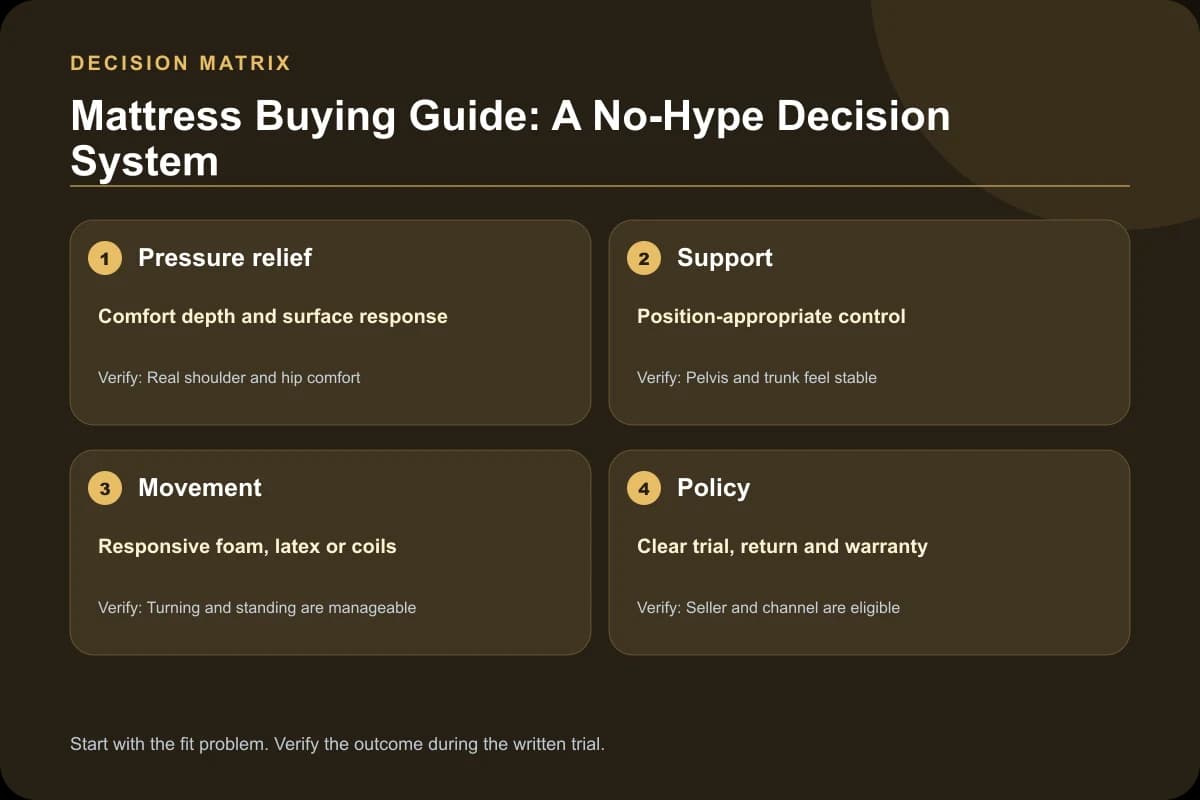
This is your launchpad: pick firmness, shortlist, check cooling, lock policies, and set up maintenance. Keep this open in a tab while you explore deep dives.

Shopping for a mattress on Amazon in 2025 presents both opportunities and challenges. The platform offers unprecedented selection, competitive pricing, transparent reviews, and generous return policies that traditional mattress stores can't match. However, this convenience comes with information overload—hundreds of brands, conflicting specifications, aggressive marketing, and the inability to test before purchase create decision paralysis for most shoppers.

This guide serves as your central navigation system, connecting specialized deep-dive articles into a cohesive shopping strategy. Rather than reading every guide front-to-back, use this overview to identify which resources address your specific concerns, then dive deeper only where needed. Whether you're a first-time buyer overwhelmed by options or a seasoned shopper looking to optimize your next purchase, this playbook keeps you oriented and prevents common mistakes that lead to returns, discomfort, or buyer's remorse.

The Amazon mattress advantage explained

Amazon's marketplace has fundamentally changed mattress retail by eliminating showroom overhead, enabling direct-to-consumer brands to compete with legacy manufacturers, and forcing transparent pricing through public review systems. Traditional mattress stores markup products 200-400% and use confusing model names to prevent price comparison. Amazon's environment exposes these tactics and rewards brands that deliver genuine value.

Key benefits include:

Price transparency: Historical pricing tools like CamelCamelCamel reveal true sale patterns and help you avoid fake discounts. You can track a mattress for months and purchase at its genuine low point rather than falling for artificial urgency.

Verified purchase reviews: While review manipulation exists, Amazon's verified purchase badge and detailed review filtering help identify authentic experiences. Look for reviews from users with similar body types and sleep positions to yours.

Generous return infrastructure: Most Amazon mattress sellers offer 100-365 night trials with free pickup. Compare this to traditional stores where returns often require re-delivery fees, restocking charges, or store credit limitations.

Direct brand access: Message sellers directly through Amazon's platform to request specifications, certifications, or clarifications. Response speed and quality signal brand reliability.

Common misconceptions that cost buyers money

Before diving into the five-step process, understand these widespread myths that lead to poor purchases:

Myth 1: Firmness labels are standardized. One brand's "medium-firm" is another's "firm." Always request ILD numbers for foam layers or coil gauge specifications rather than trusting subjective labels.

Myth 2: Higher coil count always means better support. A mattress with 2000 thin 16-gauge coils will feel softer and less durable than one with 800 thicker 13-gauge coils. Gauge thickness matters more than raw count.

Myth 3: Gel infusions solve heat retention. Gel provides minimal cooling benefit once it reaches body temperature (15-20 minutes). Airflow design, breathable covers, and material choice drive real temperature regulation.

Myth 4: You need to break in a mattress for 90 days. Most mattresses reach their final feel within 14-30 nights. Waiting longer often means you've missed the return window while hoping discomfort magically resolves.

Myth 5: Memory foam is the only option for pressure relief. Latex, hybrid constructions with zoned coils, and even high-quality polyfoam can deliver excellent pressure relief with better breathability and response time.

Navigation Tip

Each major section below links to detailed guides. Bookmark this page and return here to jump between resources rather than trying to read everything linearly.

Quick-start widgets

5-step roadmap

  1. 1) Set firmness (feel 1–10), sleep position, body weight
  2. 2) Shortlist 3 models (flagship/budget/cooling)
  3. 3) Check price history + sale timing
  4. 4) Read return terms; plan photos/notes
  5. 5) Prep base, protector, pillows; rotate on schedule

Spec guardrails

  • • Comfort: 3–4+ lb/ft³ memory foam or latex; 3"+ thickness for pressure relief

  • • Base: 1.8–2.2+ lb/ft³ foam or 12–13 gauge pocketed coils (~900+ queen)

  • • Profile: 11–14" (avoid mystery "plush" 9–10" builds)
  • • Cover: Tencel/cotton/phase-change; avoid thick polyester-only
  • • Edge: Perimeter coils or 2.0+ lb/ft³ edge rails

These guardrails represent minimum thresholds based on analyzing hundreds of Amazon mattresses and their long-term review patterns. Mattresses below these specifications consistently show premature sagging, durability complaints, and comfort degradation within 1-2 years. While higher numbers don't guarantee satisfaction, staying above these minimums significantly reduces the risk of structural failure.

Understanding density specifications

Foam density (measured in pounds per cubic foot) is the single most reliable predictor of durability. Higher density means more material packed into each cubic foot, resulting in better compression resistance and longer lifespan.

Comfort layer density targets:

  • Memory foam: 3.0-5.0 lb/ft³ (3.0-3.5 for budget, 4.0+ for premium)
  • Polyfoam comfort layers: 2.5-3.5 lb/ft³
  • Latex: 4.0-5.5 lb/ft³ (natural latex is denser than synthetic blends)

Base layer density targets:

  • Support foam: 1.8-2.2 lb/ft³ minimum (2.0+ for longevity beyond 7 years)
  • Transition layers: 1.8-2.0 lb/ft³
  • Edge reinforcement foam: 2.0-2.5 lb/ft³

Why sellers hide density: Low-density foam costs 40-60% less than high-density alternatives. Budget mattresses often use 1.2-1.5 lb/ft³ base foam that compresses rapidly but keeps initial costs low. If density isn't listed, assume it's below recommended minimums and request specifications before purchase.

Coil system specifications decoded

For hybrid mattresses, coil specifications matter as much as foam density. The gauge (wire thickness) and coil count work together to determine support characteristics.

Coil gauge reference:

  • 12-12.5 gauge: Extra firm, best for stomach sleepers or individuals over 250 lbs
  • 13-13.5 gauge: Firm to medium-firm, universal support for most body types
  • 14-14.5 gauge: Medium, good for side sleepers under 180 lbs
  • 15-16 gauge: Soft, may lack support for heavier individuals

Coil count context:

  • Queen size: 800-1200 coils is optimal range
  • Below 600 coils: Lacks contouring and will feel uniform rather than responsive
  • Above 1500 coils: Diminishing returns unless coils are zoned for specific support

Zoning configurations: Premium hybrids use different gauge coils in different body zones. Common patterns include firmer coils under the lumbar region (13 gauge) with softer coils under shoulders and legs (14-15 gauge). This maintains spinal alignment across sleep positions better than uniform coil systems.

Step 1: Lock your firmness target

Firmness dictates comfort more than brand hype. Read the Mattress Firmness Guide, then write down your preferred feel (1–10 scale), sleep position, and body weight. That trio drives every shortlist and helps you ignore "plush/firm" marketing fluff.

The firmness-matching process eliminates 70-80% of mattresses immediately, saving hours of comparison paralysis. Most shoppers waste time comparing models across the entire firmness spectrum when their body type and sleep position limit them to a narrow 2-3 point range on the 1-10 scale.

The firmness-body weight-position matrix

Your optimal firmness isn't subjective—it's determined by physics. Your body weight creates compression force, mattress materials resist with support force, and the balance between these determines pressure point relief and spinal alignment.

Primary sleep position influence:

  • Side sleepers: Need softer surfaces (3-6 on 1-10 scale) to allow shoulder and hip sinkage that maintains spine alignment. Firmer mattresses create pressure points that cause numbness and pain.
  • Back sleepers: Require medium to medium-firm surfaces (5-7) that support the lumbar curve without excessive sinkage in the hip region. Too soft allows the pelvis to drop, creating a hammock effect.
  • Stomach sleepers: Need firm to extra-firm surfaces (7-9) that prevent lumbar hyperextension. Softer surfaces allow the hips to sink below the shoulders, creating an arched back position.
  • Combination sleepers: Target medium-firm (5-6) as a compromise that works across positions. Prioritize your dominant position if you spend 60%+ of the night in one orientation.

Body weight adjustments:

The matrix above assumes 150-200 lb individuals. Adjust firmness up or down based on these weight brackets:

  • Under 130 lbs: Shift 1-2 points softer (side sleepers may need 2-3 firmness)
  • 130-180 lbs: Use standard recommendations
  • 180-230 lbs: Shift 1 point firmer
  • 230-280 lbs: Shift 2 points firmer
  • Over 280 lbs: Shift 2-3 points firmer and prioritize high-density bases

Partner firmness conflicts: When partners have different firmness needs (common with significant weight differences or position preferences), solutions include:

  1. Split king mattresses with individual firmness on each side
  2. Compromise mattress with separate mattress toppers for customization
  3. Medium-firm base (5-6) satisfies the most body types as a neutral starting point
  4. Adjustable air mattresses that allow per-side firmness control

Firmness testing without store visits

Amazon's return policies effectively make your bedroom the showroom, but you can improve first-purchase accuracy with these assessment techniques:

The hotel mattress audit: Most mid-range hotels use medium-firm mattresses (5-6 on the scale). If hotel beds feel too firm or too soft, adjust your target accordingly.

Current mattress baseline: Lie on your current mattress in your primary sleep position and have someone photograph your spine alignment from behind. A neutral spine appears straight in side sleepers and maintains its natural S-curve in back sleepers. If your shoulders/hips sink excessively or if your spine arches, note whether you need firmer or softer.

The floor test: Lie on a carpeted floor in your sleep position for 5 minutes. This represents firmness level 9-10. Now add folded blankets until you feel comfortable—each blanket represents approximately 1-1.5 firmness points. This gives you a rough target.

Critical Reminder

Firmness labels like "plush," "luxury firm," and "medium" have no industry standards. Always request ILD numbers (foam) or coil gauge (hybrids) and use the 1-10 scale to compare across brands objectively.

Documenting your firmness profile

Create a simple reference document to carry through the shopping process:

Your firmness profile template:

Primary sleep position: [Side/Back/Stomach/Combo]
Body weight: [lbs]
Secondary position (if combo): [position] - [% of night]
Partner weight (if applicable): [lbs]
Partner primary position: [position]
Current mattress feel: [Too soft/Too firm/About right]
Target firmness (1-10 scale): [X]
Acceptable range: [X-X]
Deal-breakers: [Excessive heat/Motion transfer/Edge collapse/etc.]

This profile becomes your filter when evaluating models. If a mattress doesn't fall within your acceptable firmness range, remove it from consideration regardless of price or reviews—firmness mismatch is the leading cause of returns.

Step 2: Build your short list (3 models)

Rather than comparing 15+ mattresses, identify exactly three models that address different priorities. This forces clear decision criteria and prevents analysis paralysis while maintaining backup options.

Cross-link with side/back/stomach/firm guides if you have specific alignment needs.

The three-model strategy explained

Model 1: The primary choice (flagship all-arounder): This is the mattress you'd buy if price wasn't a constraint within reason ($800-2000 range). It checks every box on your firmness profile, has strong durability specifications, and shows consistent positive reviews from users matching your profile. This represents your quality target.

Model 2: The specialized option (cooling/organic/specific support): Addresses a secondary priority that your primary choice doesn't fully satisfy. If you sleep hot, this might be a latex hybrid despite preferring memory foam feel. If you have chemical sensitivities, this might be an organic model. This is your "worth the trade-off" option.

Model 3: The budget fallback: Represents the minimum acceptable mattress that meets your firmness requirements with adequate specifications. If unexpected expenses arise or the primary options aren't on sale, this ensures you don't impulse-buy something inadequate. Target 60-75% of your primary choice's price.

Shortlist qualification criteria

Every model on your shortlist must pass these minimum thresholds:

Specification requirements:

  • ✓ Falls within your firmness range (±0.5 points)
  • ✓ Meets minimum density/coil specifications from the guardrails
  • ✓ Total height 10-14 inches (ensures adequate support layers)
  • ✓ Trial period of 90+ nights
  • ✓ Warranty of 10+ years (signals manufacturer confidence)

Review quality indicators:

  • ✓ At least 500 reviews with 4.0+ average rating
  • ✓ Recent reviews (within 6 months) remain positive
  • ✓ Verified purchase reviews from similar body types show positive experiences
  • ✓ Negative reviews cite specific issues (too firm/soft) rather than structural failures
  • ✓ Seller responds to complaints professionally and offers solutions

Price and availability:

  • ✓ Currently in stock with Prime shipping
  • ✓ Price within your budget or has historically dropped to that range
  • ✓ Multiple size options available (indicates established product line)
  • ✓ Seller has been active on Amazon for 2+ years

Review analysis techniques

Amazon reviews require critical evaluation. Use these filters to identify reliable insights:

Red flags in positive reviews:

  • Written within 1-2 weeks of delivery (insufficient testing time)
  • Generic praise without specific details ("great mattress, very comfortable")
  • Perfect 5-star rating with no mentioned drawbacks or context
  • Reviewer has few other reviews or reviews unrelated products
  • Language sounds promotional or uses brand talking points

Green flags in reviews:

  • Written 60-180 days after purchase (adequate break-in period)
  • Mentions specific measurements (height, weight, sleep position)
  • Describes both positives and minor negatives realistically
  • Includes photos of the mattress in use or measurement details
  • Reviewer has a history of detailed, balanced reviews on various products
  • Discusses setup process, return experience, or customer service interactions

Analyzing negative reviews:

Not all negative reviews signal problems. Filter by these categories:

  • Expectation mismatch: Complaints about firmness when the reviewer didn't check specifications (less concerning)
  • Shipping damage: Isolated incidents of torn covers or delayed delivery (seller can resolve)
  • Structural defects: Sagging, spring breakage, or cover splitting within 1-2 years (major concern if pattern emerges)
  • Health reactions: Odor sensitivity, allergic reactions, or pain increases (relevant only if you share these sensitivities)

If 10%+ of reviews mention the same structural issue (premature sagging, coil failure, cover tears), that's a pattern requiring investigation. Contact the seller asking how they've addressed the issue before purchasing.

Comparison spreadsheet template

Track your three shortlisted models using this structure:

SpecificationModel 1 (Primary)Model 2 (Specialized)Model 3 (Budget)
Brand/Model[Name][Name][Name]
Price (current)$XXX$XXX$XXX
Price (12-mo low)$XXX$XXX$XXX
Firmness (1-10)XXX
Comfort foam (type/density/thickness)Memory 4lb 3"Latex 5lb 3"Poly 3lb 3"
Support system13ga coils/900ctAll-latex1.8lb foam 7"
Total height12"11"10"
Cover materialTencel/CottonOrganic cottonPolyester blend
Trial period120 nights100 nights90 nights
Warranty20 years15 years10 years
Review avg4.6 (2,400)4.5 (1,200)4.3 (3,100)
Ships within2 days5 days1 day
Special featuresZoned coilsGOLS certifiedCertiPUR-US

This visualization makes trade-offs explicit and helps you justify the price premium of your primary choice or pivot to alternatives when budget dictates.

Step 3: Price and timing

Patience saves 20-40% on mattresses. Amazon's dynamic pricing and predictable sale cycles reward buyers who track prices and time purchases strategically.

  • Use CamelCamelCamel or Keepa to see 12-month price history
  • Best sale windows: Prime Day (July), Labor Day (September), Black Friday/Cyber Monday (November)
  • Set alerts 2–3 weeks ahead; screenshot listing details (price, trial, warranty)

Price tracking fundamentals

Many Amazon mattresses show inflated "list prices" to create the illusion of discounts. A mattress listed at "$1,299, was $2,499" may have never sold at $2,499. Price tracking tools reveal the true price history and help identify genuine sales.

CamelCamelCamel setup:

  1. Install the browser extension for instant price history on Amazon product pages
  2. Create a free account to set price alerts
  3. Set your alert threshold at 15-20% below current price for popular models
  4. Track all three shortlisted models simultaneously

Keepa advantages:

  • More granular price history with hourly data points
  • Tracks seller changes (important for warranty continuity)
  • Shows availability tracking (warns of stock-outs during sales)
  • Offers more detailed charts for identifying patterns

Annual sale calendar with purchase strategies

January (New Year sales): Minor discounts 10-15% as brands clear inventory. Good for immediate need purchases but not the year's best pricing.

February-March (dead period): Worst time to buy. New models launch in spring, so brands hold prices firm. Only buy if you have an urgent need.

April-May (Memorial Day buildup): Prices begin dropping 15-20% on older models as new versions launch. Good time if you don't mind previous-generation mattresses.

June-July (Prime Day peak): Amazon's biggest mattress sale event. Expect 25-40% discounts on major brands, flash deals, and limited-time coupons. Set alerts 3 weeks early—popular models sell out quickly.

August (back-to-college): Moderate 15-25% discounts targeting students and parents. Selection is good but not as deep as Prime Day.

September (Labor Day weekend): Second-best sale window with 30-40% discounts on many models. Three-day weekend creates urgency but better stock than Prime Day.

October (pre-holiday calm): Prices stabilize or rise slightly. Only buy if you're sure better deals aren't coming in November.

November (Black Friday/Cyber Monday): Matches or exceeds Prime Day discounts with 30-45% off many models. Better selection than Prime Day but more competition from other shoppers.

December (holiday liquidation): Early December sees minor discounts; post-Christmas week offers 20-30% off as brands reduce inventory before year-end.

Pro timing strategy: Track your shortlist starting in April. If prices drop 25%+ before Prime Day, buy then—waiting for July may mean missing the deal if stock sells out. If not, Prime Day or Labor Day represent your best odds for maximum savings.

Screenshot documentation protocol

Amazon listings can change after purchase—specifications, trial periods, or warranty terms may be modified. Screenshots create evidence for disputes or returns.

What to capture:

  1. Full product title and ASIN (Amazon Standard Identification Number)
  2. Complete product description including all specifications
  3. Trial period and return policy section
  4. Warranty terms and coverage details
  5. Current price and any listed discounts
  6. All product images showing construction cutaways
  7. Top 10 most helpful positive and negative reviews
  8. Q&A section, especially answers from the seller
  9. Your order confirmation email and invoice

Organization system:

Create a folder named [Brand-Model-Date] and save all screenshots with descriptive names:

Zinus-12inch-Hybrid-2025-01-15/
  - 01-listing-overview.png
  - 02-specifications.png
  - 03-trial-policy.png
  - 04-warranty-terms.png
  - 05-price-history.png
  - 06-reviews-positive.png
  - 07-reviews-negative.png
  - 08-qa-section.png
  - 09-order-confirmation.pdf

This documentation proves invaluable if the seller claims you bought different terms than advertised or if product specifications change post-purchase.

Common Trap

Some sellers rotate product listings, creating "new" ASINs for the same mattress to reset reviews and pricing. Always check seller storefronts for similar models and read reviews mentioning "previous version" or "old model" to understand the full history.

Lightning deal and coupon stacking

Amazon offers multiple discount mechanisms that can sometimes be combined:

Lightning Deals: Limited-time offers (4-12 hours) with restricted quantities. Set up mobile notifications for tracked products to catch these. They typically offer 15-30% off during non-peak sale periods.

Coupons: Appear as clickable checkbox beneath price. Stack with Lightning Deals and sale prices for maximum savings. Typical value: $50-150 off.

Subscribe & Save: Rarely applies to mattresses but occasionally appears on toppers, protectors, or pillows bundled in "complete sleep systems." Can save 5-15% additional.

Amazon Prime credit card: Earns 5% back on all Amazon purchases. On a $1,000 mattress, that's $50 back. If you're making a large purchase, applying for the card makes sense even if you don't use it long-term.

Maximum stacking example:

  • Regular price: $1,299
  • Prime Day sale: -$350 (27% off) = $949
  • Coupon: -$100 = $849
  • Prime card 5% back: -$42 = $807 effective price
  • Total savings: $492 (38% off)

Always check if multiple discounts apply before clicking "Buy Now."

Step 4: Return safety net

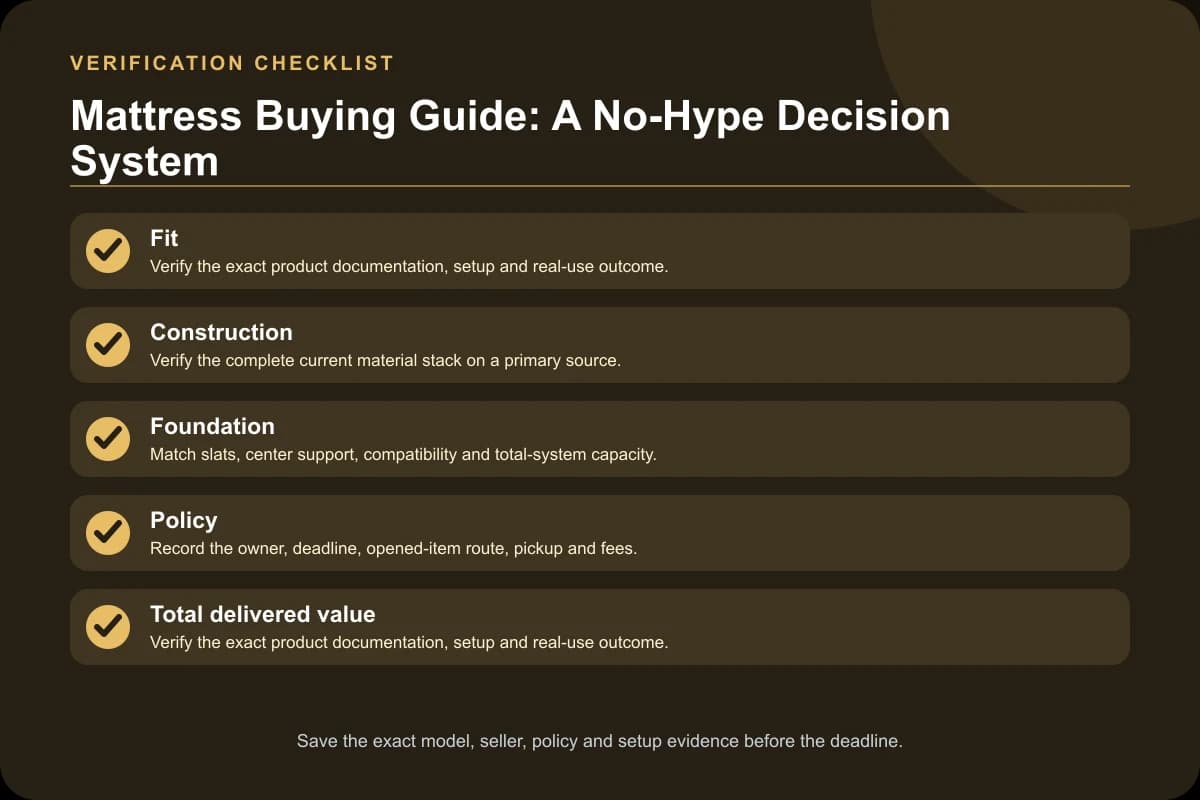
Never buy a mattress without understanding the return process completely. Read the Amazon Mattress Return Playbook: know trial length, impression threshold, who arranges pickup, and if re-boxing is required.

  • Keep packaging or request a return sleeve immediately if you are unsure
  • Plan to take day-1 photos (corners, edges) and a profile photo of you on the bed

The return policy is your insurance against making an expensive mistake. Approaching it systematically removes the fear from sight-unseen purchases and empowers you to make confident decisions.

Decoding Amazon's mattress return landscape

Amazon mattress returns operate under three different policy frameworks depending on who's selling:

Scenario 1: Sold by Amazon, Shipped by Amazon

  • Standard Amazon return policy applies (30 days)
  • Free return pickup in most areas
  • Refund processes within 3-5 days of pickup
  • No restocking fees
  • Easiest return experience

Scenario 2: Sold by third-party, Fulfilled by Amazon (FBA)

  • Seller sets trial period (typically 90-365 nights)
  • Return initiated through Amazon but seller approves
  • Pickup usually free but confirm before purchase
  • Refund timing varies by seller (5-14 days typical)
  • Slightly more complex but still Amazon-backed

Scenario 3: Sold and Shipped by third-party

  • Seller controls entire return process
  • Must contact seller directly (not Amazon returns portal)
  • Pickup arrangements vary widely
  • May require photos of the mattress
  • Refund timing completely seller-dependent
  • Potential for disputes

Always buy FBA or Amazon-sold mattresses when possible. The buyer protection is significantly stronger and return friction much lower.

Trial period versus return window confusion

Many shoppers conflate "trial period" with "return window" when they're distinct concepts:

Return window: The timeframe Amazon allows standard returns (30 days unless extended holiday returns apply). This is your baseline right.

Trial period: An extended period offered by the mattress seller (90-365 nights) where they'll accept returns beyond Amazon's standard window. This is a seller-specific policy.

The critical gap: If a seller advertises a 120-night trial but you buy through Amazon's standard purchase, you may only have 30 days unless you separately register the purchase with the seller. Always verify trial activation requirements at purchase.

How to confirm trial coverage:

  1. Check the product listing for "trial period" or "sleep trial" language
  2. Screenshot the exact terms listed
  3. After purchase, email the seller: "I purchased [model] on [date], order [number]. Please confirm my 120-night trial period is active and provide trial terms."
  4. Save their response as proof if disputes arise

Photo documentation system

Photos serve three purposes: tracking break-in changes, documenting defects for warranty claims, and providing evidence for returns. Implement this system from day one:

Day 1 (delivery):

  • All four corners showing construction quality
  • Full mattress from each side
  • Close-up of stitching, handles, and labels
  • Foundation/slats with mattress in place
  • Any visible damage or defects

Week 2 (post break-in):

  • Impression patterns in common sleeping areas
  • Edge sitting test (sit on corner, photo profile view)
  • You lying in primary sleep position (shows body alignment)

Month 1, 3, 6:

  • Repeat impression photos from consistent angle and lighting
  • Measure impressions with ruler in frame for scale
  • Any wear patterns, cover pilling, or new issues

If returning:

  • Fresh photos showing current condition
  • Comparison images (original vs. current) highlighting changes
  • Ruler measurements of impressions/sag
  • Any stains, damage, or concerns that might affect return approval

Photo specifications:

  • Use good lighting (natural daylight preferred)
  • Include a dated newspaper or your phone showing date
  • Take photos from same angle each time for consistency
  • Store originals at full resolution (don't compress or crop)

Impression thresholds and warranty claims

Mattress warranties typically specify acceptable body impressions of 1-1.5 inches depending on manufacturer. Understanding measurement methodology prevents disputes.

Proper impression measurement:

  1. Remove all bedding and let mattress rest uncompressed for 24 hours
  2. Place a yard stick or straight edge across the impression area
  3. Measure the gap between the ruler and the lowest point of the impression
  4. Document with photos showing the ruler, measurement, and full mattress context
  5. Repeat measurements in multiple areas (shoulder zone, hip zone, edge)

Common measurement disputes:

  • Seller claims: "That's normal compression, not defect-level sagging."

  • Your evidence: Photo series showing progression from delivery to current state, with consistent measurement methodology.

  • Seller claims: "You didn't follow foundation requirements, voiding warranty."

  • Your evidence: Day-1 photos showing proper platform/slats, documentation of specifications matching requirements.

When to invoke warranty:

  • Impressions exceed stated threshold (typically 1.5 inches)
  • Coil poking through cover
  • Cover zipper failure or significant fabric tears (not from abuse)
  • Structural breakdown causing uneven support across surface

When not to invoke warranty:

  • Firmness preference changes (this is your subjective response, not defect)
  • Minor softening during break-in period (1st 30 days)
  • Odor complaints (off-gassing isn't a warranty issue)
  • Normal compression that doesn't exceed threshold

Return logistics and timing

Optimal return timing: Days 25-35 of a 100-night trial or days 90-100 of a 120-night trial. This gives adequate testing time while leaving buffer before deadline.

Return initiation steps:

  1. Contact seller through Amazon messaging with your order number
  2. State clearly: "I'm initiating a return under the [X]-night trial policy"
  3. Provide impression measurements and photos if relevant
  4. Ask: "Do you arrange pickup or do I coordinate? Any pickup fees?"
  5. Request confirmation of refund amount and timeline
  6. If no response within 48 hours, escalate to Amazon customer service

Pickup coordination:

  • Most sellers partner with freight companies for free pickup
  • Confirm pickup window and be home (someone must sign)
  • Keep mattress accessible near front door if possible
  • Don't repackage unless specifically required (rare for mattresses)
  • Get tracking number for pickup confirmation
  • Follow up if refund doesn't process within stated timeline

Re-boxing requirements: Very few mattress sellers require original packaging. Compressed mattresses cannot be re-compressed without industrial equipment. If a seller claims re-boxing is mandatory, this is likely unenforceable. Document this requirement in writing and contact Amazon if they refuse pickup without original packaging.

Step 5: Maintenance from day one

Proper maintenance extends lifespan, preserves warranty eligibility, and ensures consistent comfort. Most mattress failures stem from neglect rather than manufacturing defects.

  • Protector on at unboxing (breathable, membrane-only)
  • Rotate at weeks 2, 4, 8, then quarterly
  • Check slat spacing (less than 3 inches) and center support
  • Log impressions and comfort monthly with photos; this supports warranty claims

Protector selection criteria

Not all protectors are created equal. The wrong protector negates the breathability and feel you paid for.

Material hierarchy (best to avoid):

  1. Tencel/Lyocell membrane: Plant-based waterproof barrier, excellent breathability, premium price ($80-150)
  2. Cotton terry with polyurethane laminate: Good balance of protection and airflow, mid-range ($40-80)
  3. Bamboo rayon with PU membrane: Similar to cotton, slightly cooler, mid-range ($40-70)
  4. Basic cotton with vinyl backing: Waterproof but hot, budget option ($25-40)
  5. Thick quilted polyester: Avoid—changes mattress feel and traps heat

Fit specifications:

  • Pocket depth must exceed mattress height by 2-3 inches
  • Queen mattress 12" tall = 14-16" pocket depth protector
  • Too shallow = corners pop off during sleep
  • Too deep = excess fabric bunches and creates uncomfortable lumps

Washing schedule:

  • Wash every 4-6 weeks in cold water on gentle cycle
  • Tumble dry low or line dry (high heat degrades waterproof membranes)
  • Have a backup protector for wash days (swap immediately)
  • Replace every 2-3 years as membranes lose effectiveness

Rotation schedule and technique

Why rotation matters: Your body concentrates pressure in specific zones (hips and shoulders). Without rotation, these areas compress faster than unused portions, creating permanent impressions and uneven support.

First-year intensive schedule:

  • Week 2: First rotation (180 degrees head-to-foot)
  • Week 4: Second rotation (180 degrees)
  • Week 8: Third rotation (180 degrees)
  • Month 3: Fourth rotation (180 degrees)
  • Month 6: Fifth rotation
  • Month 9: Sixth rotation
  • Month 12: Seventh rotation

Years 2+ maintenance schedule:

  • Rotate every 6 months (set calendar reminders)
  • Continue 180-degree head-to-foot pattern
  • Never flip unless mattress is specifically designed as double-sided

Rotation technique:

  1. Strip all bedding completely
  2. Vacuum mattress surface while exposed
  3. Inspect for stains, wear, or damage
  4. Rotate mattress 180 degrees (enlist help for queen and larger)
  5. Check foundation slats and center support while mattress is off
  6. Remake bed with fresh sheets

Why not flip: Modern mattresses are single-sided with comfort layers on top and firm support bases on bottom. Flipping puts the hard base against your body—uncomfortable and potentially harmful to your back.

Foundation maintenance and inspection

Mattress warranties often require proper foundation support. Regular inspection prevents foundation failures that void coverage.

Monthly foundation checklist:

  • Walk around bed checking for visible sag in platform or slats
  • Test center support beam (should not flex when pressed)
  • Inspect slat spacing with measuring tape (must be under 3 inches)
  • Tighten any loose bolts or screws
  • Listen for squeaks (indicates metal-on-metal contact needing lubrication)
  • Check legs/feet for even floor contact

Common foundation failures:

Problem: Slats bowing downward creating hammock effect Solution: Add center support beam or sister additional slats alongside existing ones

Problem: Platform cracking near corners Solution: Reinforce with L-brackets or replace platform before mattress damage occurs

Problem: Box spring showing wear Solution: Add bunkie board (thin plywood platform) on top to create rigid surface

Problem: Adjustable base stops at odd angles Solution: Contact manufacturer immediately—mechanical failure often worsens rapidly

Monthly comfort logging system

Tracking comfort changes helps you identify patterns, optimize your sleep environment, and build warranty claim evidence if needed.

30-day testing template

Keep a simple log for the first 30 nights, then monthly thereafter:

Daily entries (first 30 nights):

  • Date: [MM/DD]
  • Day number: [1-30]
  • Pillow used: [height/material—loft changes affect neck alignment]
  • Sleep position distribution: [% side / % back / % stomach]
  • Morning comfort scores (1-10):
    • Shoulders: [X/10]
    • Hips: [X/10]
    • Lower back: [X/10]
    • Neck: [X/10]
    • Overall: [X/10]
  • Temperature comfort: [Too hot / Just right / Too cold]
  • Woke due to discomfort: [Yes/No—how many times?]
  • Edge use: [Did you sit/sleep near edge? Any rolloff feeling?]
  • Partner disturbance: [Felt partner movement: Yes/No]
  • Notes: [Any changes made—topper added, different pillow, foundation adjusted]

Monthly entries (ongoing):

Simplified version tracking trends rather than daily variations:

  • Month: [Month Year]
  • Average comfort score: [X/10]
  • Impression depth: [measurement in inches with photos]
  • Temperature issues: [Frequency of overheating per week]
  • Pain or discomfort: [New issues or improvements]
  • Maintenance performed: [Rotation, washing, foundation check]
  • Overall satisfaction: [Keep / Monitor / Consider return/exchange]

Digital logging options:

  • Spreadsheet (Google Sheets for access anywhere)
  • Notes app with date-stamped entries
  • Sleep tracking app that allows custom notes
  • Physical journal kept on nightstand

Using logs for decisions:

  • If comfort scores decline over weeks 2-4, mattress may be too firm/soft (return candidate)
  • If scores improve weeks 1-3 then stabilize, break-in working as expected (keep)
  • If specific body area consistently scores below 5/10, investigate pillow or mattress issue
  • If temperature complaints increase over time, evaluate bedding before blaming mattress

Pro Strategy

Share your comfort log with your doctor or physical therapist if you have chronic pain. Objective data helps them provide better recommendations for sleep surface modifications or alternative treatments.

Common pitfalls (skip these)

Learning from others' mistakes saves money and frustration. These patterns appear repeatedly in negative reviews and return stories.

Pitfall 1: Buying ultra-low-profile mattresses without density data

The mistake: Purchasing 9-10 inch "plush" or "luxury" mattresses advertised as hotel-quality when no foam densities or coil specifications are listed.

Why it fails: Thin mattresses achieve low prices by using minimal material. Without adequate support layers (6-8 inches minimum), comfort layers compress directly to the foundation within months. If the seller won't disclose density, assume it's below acceptable thresholds.

How to avoid: Never buy a mattress under 10 inches total height unless it's specifically for a child's bed. Always request foam density specifications in writing before purchase.

Pitfall 2: Using old box springs or damaged foundations

The mistake: Placing a new mattress on an existing box spring from a previous mattress, assuming "it still looks fine" means it provides adequate support.

Why it fails: Box springs wear internally even when externally intact. Sagging springs or broken slats create uneven support that causes premature mattress wear and voids warranties. Most modern mattresses don't need box springs at all—they require rigid platforms.

How to avoid: Inspect your foundation thoroughly before delivery. If it's over 5 years old, sags visibly, or feels soft when pressed, replace it. Use a solid platform or closely-spaced slats instead of traditional box springs for optimal support.

Pitfall 3: Ignoring pillow height and neck pain correlation

The mistake: Blaming the mattress for neck pain and shoulder discomfort when the actual culprit is pillow loft mismatch.

Why it fails: Pillows affect spinal alignment as much as mattresses. Side sleepers need 4-6 inch loft to fill the gap between shoulder and head. Back sleepers need 3-4 inches. Stomach sleepers need 2-3 inches or no pillow. Wrong loft creates neck strain that feels like mattress problems.

How to avoid: Evaluate your pillow simultaneously with your mattress. Measure your current pillow's compressed height (with your head on it). If you wake with neck pain but body feels comfortable, try a different pillow loft before returning the mattress.

Pillow-mattress interaction: Softer mattresses require taller pillows because shoulders sink deeper. Firmer mattresses need shorter pillows because shoulders stay elevated. If you change mattress firmness significantly, reassess pillow height too.

Pitfall 4: Believing gel infusions solve heat retention

The mistake: Buying memory foam mattresses with "cooling gel" or "gel-infused foam" expecting dramatic temperature reduction.

Why it fails: Gel provides slight cooling for 15-20 minutes until it reaches body temperature, then becomes thermally neutral. The foam's density and airflow design matter far more for ongoing temperature regulation. Marketing emphasizes gel because it's visible (blue color) and sounds high-tech, but physics limits its effectiveness.

How to avoid: If temperature is a primary concern, choose hybrid mattresses with coil bases (promotes airflow), latex (naturally breathable), or memory foam with open-cell structure and breathable covers. Gel is a minor bonus, not a solution.

Pitfall 5: Missing trial deadline due to "waiting for break-in"

The mistake: Experiencing discomfort at week 2, deciding to "give it more time," then realizing at day 95 of a 100-night trial that the mattress still isn't working.

Why it fails: Most break-in completes by day 30. If you're still uncomfortable at week 4, the mattress likely doesn't match your needs. Waiting longer just reduces your return window buffer and creates pressure for last-minute decisions.

How to avoid: Set multiple calendar reminders:

  • Day 25: First evaluation checkpoint
  • Day 40: Second evaluation (if uncertain at day 25)
  • Day 80: Final decision deadline (for 100-night trials)
  • Day 90: Last chance reminder

If comfort hasn't improved significantly by day 40, initiate the return process. Don't gamble on magical transformation happening in the final weeks.

Pitfall 6: Assuming "organic" or "natural" means low-odor

The mistake: Buying natural latex or organic mattresses expecting zero off-gassing, then being surprised by the earthy rubber smell.

Why it fails: Natural latex has an inherent rubber scent from the organic compounds in tree sap. It's non-toxic and different from chemical off-gassing, but still noticeable for sensitive noses. "Organic" refers to growing practices, not odor levels.

How to avoid: Plan for 48-72 hour airing in a ventilated space for all-latex mattresses. Don't unbox directly in your bedroom if you're scent-sensitive. The odor dissipates faster than synthetic foam smells but isn't instant.

Sales timing and prep checklist

Execute these tasks 2-3 weeks before your target purchase window to ensure smooth ordering and delivery.

Pre-sale preparation (3 weeks before):

  • Measure bedroom doorway, hallway, and stairwell clearances
  • Measure current mattress and confirm desired new size
  • Clear delivery path of obstacles
  • Identify mattress disposal method (some sellers remove old mattress, many don't)
  • Set price drop alerts on all three shortlisted models
  • Create screenshot folder with current listings
  • Verify Prime membership is active for free shipping

Two weeks before sale:

  • Order mattress protector (arrives before mattress)
  • Evaluate pillow loft and order replacement if needed
  • Inspect foundation and slats; order repairs/replacements if needed
  • Prep current mattress for removal or donation
  • Confirm someone will be home for delivery (signature often required)

One week before sale:

  • Check price tracking tools daily for early deals
  • Add shortlisted mattresses to cart for quick checkout
  • Enable mobile notifications for Lightning Deals
  • Verify payment method and shipping address
  • Screenshot current listing details one final time

Day of purchase:

  • Compare current prices across all three models
  • Check for stackable coupons or Lightning Deals
  • Screenshot final price and complete order details
  • Save order confirmation email
  • Add delivery date to calendar
  • Set trial period reminder (day 25, day 80)

Day of delivery:

  • Clear path from door to bedroom
  • Have scissors or box cutter ready
  • Phone charged for documentation photos
  • Protector ready to install
  • Plan 2-4 hours for unboxing and setup

Time-Saving Tip

Create a "mattress purchase" folder in your email and browser bookmarks. Move all screenshots, tracking tools, seller communications, and order confirmations here. This centralization saves hours during returns or warranty claims.

Buyer scripts you can reuse

Copy-paste these message templates when contacting sellers through Amazon's platform. Professional, specific questions get faster, more useful responses.

Script 1: Specification verification

Subject: Specification Confirmation for [Model Name]

Hello,

I'm interested in purchasing the [Model Name] and need to confirm specifications before ordering:

1. Comfort foam: What is the density (lb/ft³) and thickness of each foam layer?
2. Support system: What is the coil gauge and count (for queen size), or support foam density if all-foam?
3. Cover material: What percentage is cotton/Tencel/polyester?
4. Edge reinforcement: What type and density?

Please provide these specifications in writing so I can make an informed purchase decision.

Thank you,
[Your Name]
Order/Account: [Your Amazon account email]

Script 2: Trial and return clarification

Subject: Trial Period and Return Process Confirmation

Hello,

Before purchasing [Model Name], I need to confirm your trial and return terms:

1. Trial period length: How many nights from delivery date?
2. Return process: Do I contact you directly or use Amazon's return system?
3. Pickup: Do you arrange free pickup, or am I responsible?
4. Repackaging: Is original packaging required, or can the mattress be returned unboxed?
5. Refund timeline: How long after pickup until refund processes?
6. Fees: Are there any return shipping fees, restocking fees, or deductions from refund?

Please confirm these details in writing.

Thank you,
[Your Name]
Order: [Pending]

Script 3: Warranty claim investigation

Subject: Warranty Claim Process - [Order Number]

Hello,

I purchased [Model Name] on [date], order [number]. I'm experiencing [specific issue—sagging, impression depth, coil protrusion] and want to understand the warranty claim process:

1. Current impression depth: [X inches] in [hip/shoulder] area
2. Foundation: [Platform/slats specification] as required
3. Photos: Attached showing impression with ruler measurement
4. Purchase date: [Date—currently within warranty period]

What are the next steps for warranty evaluation? Do you need additional documentation?

Thank you,
[Your Name]
Order Number: [XXXXX]

Script 4: Edge reinforcement specifics

Subject: Edge Support Construction Details

Hello,

I'm considering [Model Name] and edge support is critical for my needs. Can you clarify:

1. Edge reinforcement type: Perimeter coils or high-density foam rails?
2. Foam density: If foam rails, what is the density (lb/ft³)?
3. Width: How many inches from edge is reinforced?
4. Weight capacity: Maximum weight for edge sitting?

I've had previous mattresses with edge collapse and want to ensure this won't have that issue.

Thank you,
[Your Name]

These scripts demonstrate you're an informed buyer, which typically results in more detailed and honest responses. Sellers know vague answers won't satisfy educated shoppers.

Maintenance mini-calendar (year one)

Track maintenance tasks systematically to maximize mattress lifespan and preserve warranty eligibility.

MonthTaskWhyEstimated Time
1Rotate at weeks 2, 4, 8Evens early softening in high-pressure zones10 min each
2-3Vacuum surface; spot-clean coverKeeps fibers breathable, removes dust mites and allergens15 min
3First quarterly rotationContinue evening wear patterns10 min
4Check slats/bolts; tightenPrevents flex, squeaks, and foundation failure20 min
5Deep clean protector or replace if wornMaintains hygiene and waterproof effectiveness30 min
6Rotate; photo edges and topDocuments impressions for warranty; mid-year inspection15 min
7Vacuum and inspect stitchingSummer moisture check; look for cover wear15 min
8Foundation stability checkEnsure no summer humidity damage to wood/metal15 min
9Quarterly rotationContinue wear distribution10 min
9Wash protector; replace if wornPrepare for winter heating season30 min
10Check for allergen buildupFall allergen season requires extra attention15 min
11Pre-winter foundation inspectionPrevent issues during heating season20 min
12Final rotation; inspect impressionsYear-end evaluation; decide on warranty if needed20 min
12Photo documentation updateAnnual comparison to delivery condition15 min

Total first-year maintenance time: Approximately 4-5 hours spread across 12 months (20-25 minutes monthly average)

Long-term maintenance (years 2+):

  • Bi-annual rotation (January and July)
  • Quarterly vacuuming (every 3 months)
  • Annual deep inspection with photo documentation
  • Protector washing every 6-8 weeks
  • Foundation check every 6 months

Advanced optimization strategies

Once you've mastered the basics, these advanced techniques fine-tune your sleep system for maximum comfort and longevity.

Topper strategy for firmness fine-tuning

If your mattress is 85% perfect but slightly too firm or soft, toppers offer cheaper fixes than returns:

Too firm solutions:

  • 2-3 inch memory foam topper (2.5-3.5 lb/ft³ density)
  • Adds 1-2 firmness points softer
  • Cost: $80-200 depending on size and quality
  • Useful lifespan: 2-4 years

Too soft solutions:

  • 1-2 inch firm latex topper (35-40 ILD)
  • Adds support without sacrificing all conforming
  • Cost: $150-300
  • Useful lifespan: 5-8 years

Temperature adjustment:

  • Gel-infused or copper-infused memory foam (marginal cooling)
  • Latex topper (naturally cooler than memory foam)
  • Wool mattress pad (wicks moisture, regulates temperature)

When toppers make sense: If you're at day 60 of a 100-night trial and the mattress is "good but not perfect," a topper may optimize comfort cheaper than returning and risking a worse replacement. If you're at day 10 and uncomfortable, return the mattress—toppers are bandaids, not fixes for fundamentally wrong choices.

Sleep position transitions and mattress longevity

As you age or your physical condition changes, sleep position preferences often shift. Understanding this helps you choose mattresses with adaptability:

Common transitions:

  • Stomach sleeper → side sleeper (pregnancy, aging, back pain)
  • Back sleeper → side sleeper (sleep apnea development)
  • Any position → back sleeper (post-surgery recovery)

Future-proofing your purchase:

If you're in your 20s-30s and currently sleep on stomach, consider medium-firm (6-7) instead of extra-firm (8-9). As you age into your 40s-50s, you'll likely shift to side or back sleeping, and the medium-firm remains functional while extra-firm becomes too hard.

If you're pregnant or planning pregnancy, recognize your preferred firmness will temporarily shift 1-2 points softer during and immediately after pregnancy. A mattress bought pre-pregnancy may feel too firm during pregnancy, then correct again post-pregnancy.

Seasonal adjustment techniques

Temperature and humidity changes affect mattress comfort. Small seasonal adjustments optimize year-round sleep:

Summer (heat and humidity):

  • Switch to lighter sheets (linen or lightweight cotton)
  • Remove mattress pad if using quilted type (use thin protector only)
  • Lower bedroom temperature 2-3 degrees
  • Increase fan usage for air circulation
  • Rotate mattress to "fresher" areas that haven't absorbed as much humidity

Winter (cold and dry):

  • Add mattress pad for extra insulation
  • Use flannel or heavier cotton sheets
  • Maintain bedroom humidity 30-40% (prevents static and dry air discomfort)
  • Raise bedroom temperature slightly
  • Check foundation for moisture/mold if mattress is on floor or low platform

Partner compatibility optimization

Couples face unique mattress challenges when body types and preferences differ significantly:

Split configurations:

  • Split king: Two twin XL mattresses side-by-side on king frame
  • Each partner selects ideal firmness
  • Requires two fitted sheets or specialty split sheet
  • Small gap down middle can be minimized with mattress connector

Motion isolation testing:

  • Place a wine glass on one side while partner moves on other side
  • If glass tips or liquid ripples significantly, motion transfer is high
  • Hybrid and memory foam isolate better than all-latex or innerspring
  • Consider upgrading if motion transfer disrupts sleep regularly

Edge-to-edge sleeping:

  • If one partner sleeps at extreme edge, prioritize edge support
  • Test by sitting at corners and edges before trial period ends
  • Reinforced perimeters prevent rolloff feeling and maximize usable surface

Temperature compromises:

  • Hot sleeper + cold sleeper = hybrid with breathable cover
  • Use separate blankets/duvets for temperature control
  • Hot sleeper takes side with better airflow (near window/fan)
  • Consider dual-zone heated mattress pad (heated on cold sleeper's side only)

Final reminder

Specs beat slogans. Start with firmness + body weight + position, pick three contenders, time your purchase, document everything, and maintain from day one. This overview plus the linked guides keeps you oriented so you can buy once, sleep better, and keep your options open inside the trial window.

Mattress shopping feels overwhelming because of information overload and high stakes—you'll spend 2,500-3,000 hours per year on this product. But by following the systematic approach in this guide, you transform an emotional decision into a logical process with clear criteria and documented evidence.

The buyers who succeed follow this pattern:

  1. Define requirements precisely (firmness, position, weight, special needs)
  2. Shortlist ruthlessly (three models maximum that meet requirements)
  3. Time purchase strategically (track prices, buy during major sales)
  4. Document comprehensively (screenshots, photos, comfort logs)
  5. Maintain consistently (rotation, cleaning, inspection)
  6. Evaluate objectively (logs reveal patterns emotions obscure)
  7. Act decisively (return/keep decision by day 40, not day 95)

This guide provides the framework. The specialized deep-dives provide the details. Your diligence in following the process determines your outcome.

Remember: a mattress return is not a failure—it's data collection. Each trial teaches you about your true preferences versus imagined preferences. Some buyers need 2-3 attempts to find their perfect match. The trial period exists specifically for this learning process.

Budget 20-30 hours total for the entire process from initial research through purchase and setup. That time investment protects your $800-2,000 purchase and optimizes the 2,500+ hours you'll spend sleeping on it annually. It's the highest-ROI time investment in your home outside of choosing the home itself.

Start with Step 1 (firmness target) tomorrow. Once you've defined that clearly, everything else follows logically. The decision paralysis breaks when you eliminate 80% of options immediately by knowing your non-negotiable specifications.

Sleep is foundational to health, productivity, and quality of life. Treating mattress selection as a systematic process rather than an impulse purchase honors that importance and dramatically improves your odds of satisfaction.

Good luck with your search, and sleep well.


Ready to test a new mattress?

Compare prices and availability directly on Amazon. Many of our featured mattresses offer generous trials and fast delivery.

Shop mattresses on Amazon

Deep-dive pillars to bookmark

Every blog article connects back to our long-form pillars so you can zoom out, compare specs, and share printable checklists with anyone helping you shop.

Frequently asked questions

Where should I start if I'm overwhelmed?

Begin with the Mattress Firmness Guide to identify your feel target, then shortlist 2-3 models from the Flagship Amazon list and read the return playbook before buying.

How many nights should I test a mattress?

Give it 14-30 nights unless pain is severe. Log comfort daily and reference our return playbook before the trial window closes.

Do I need special foundations for Amazon mattresses?

Most need a rigid platform or slats under 3 inches apart. Check the listing; weak foundations void many warranties.

What if I sleep hot?

Pair a breathable hybrid or latex mattress with cooling sheets and a protector. See the Cooling Innovations and Best Cooling Mattresses posts for specifics.

Related reading