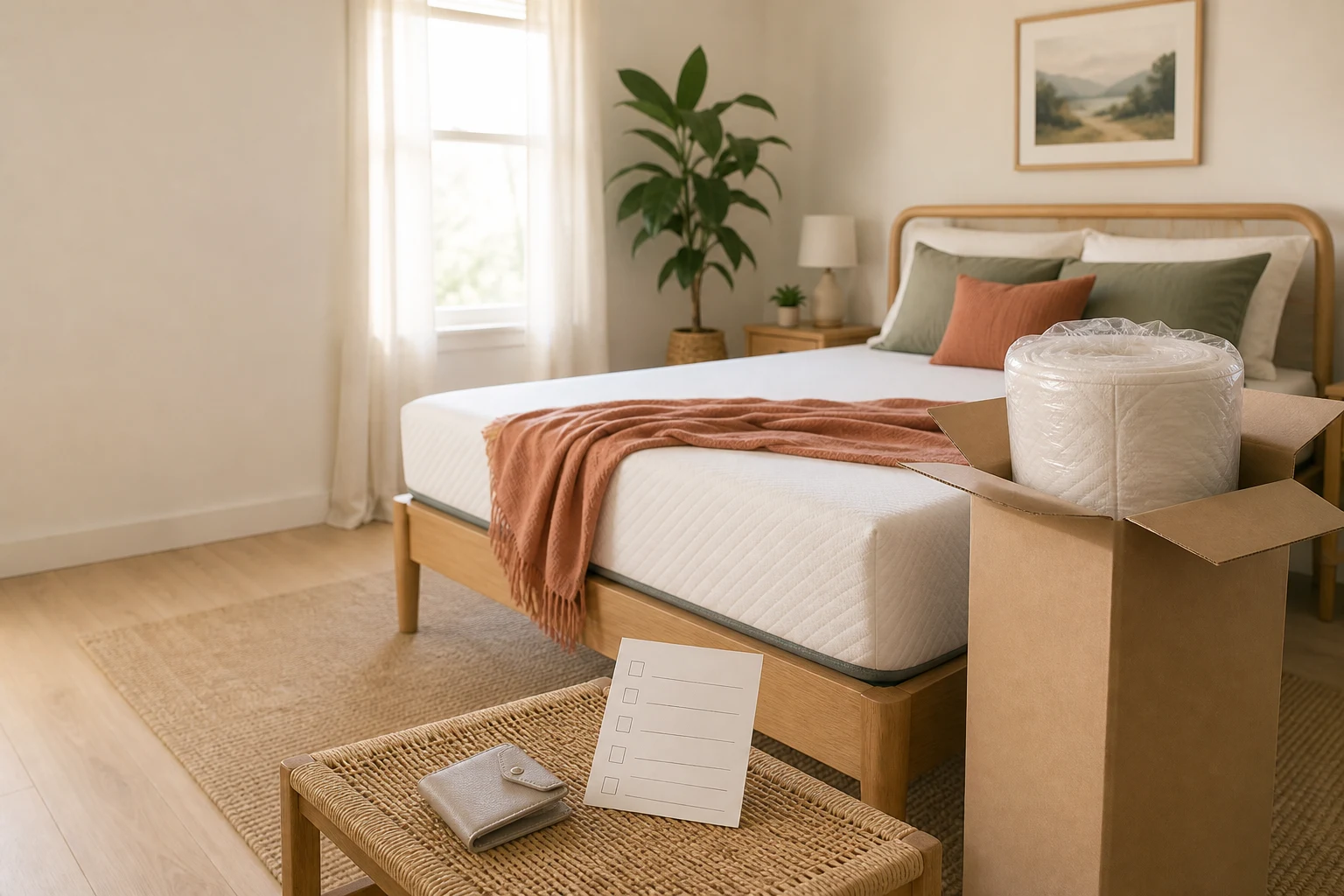
The best budget mattress under $500 is the exact size and offer that fits the sleeper while leaving enough budget for a compatible base and a usable return path. Zinus Original Green Tea is our foam starting point, Linenspa Memory Foam Hybrid is the simpler hybrid route, Novilla Vitality is a taller hybrid to compare, and Dreamfoam Essential is the height-based foam alternative. None is guaranteed to remain below the cap on Amazon.
Is an under-$500 shortlist the right route?
Use this shortlist if
- The final delivered total for your exact size must stay within a strict cap.
- You understand that guest-room, lighter-use and primary-bed needs may justify different compromises.
- You will verify the seller, current model, foundation cost and opened-mattress return route.
Use a different route if
- Combined couple load, strong edge use or a very specific firmness makes the cheapest qualifying listing a poor fit.
- You are treating a crossed-out price or another size's price as proof that your cart is under the cap.
- You cannot accept a simpler construction or save longer for a more suitable primary bed.
Decision-first shortlist
Fast pick: the verified direct foam listing
Zinus is the exact product page we verified for this guide. Linenspa, Novilla and Dreamfoam remain comparison routes below, but we keep their generic Amazon searches out of the early purchase block until an exact current listing is validated.
1. Verified foam starting point
Zinus Original Green Tea
A straightforward all-foam route when the live cart total matters more than premium edge support or advanced cooling.
- Best for
- Guest rooms, first apartments and value-focused shoppers
- Avoid if
- You need stronger edge support, advanced cooling or a substantial hybrid feel
- Construction
- 10-inch memory-foam mattress
- Price tier
- Budget; confirm the live size-specific cart
Prices, sizes, sellers, availability and return terms can change. Confirm the exact listing before purchase. Amazon buttons are affiliate links; as an Amazon Associate, we earn from qualifying purchases.
How we researched budget models
We reviewed current manufacturer product pages, published construction, care instructions, direct-purchase policies, warranty language, certification claims, and marketplace channel risks. We did not conduct long-term sleep trials, cut open mattresses, measure foam density, or predict Amazon pricing.
This guide therefore uses conditional picks. A model remains in the shortlist only while the exact size and seller fit the live cap and policy requirements. Manufacturer performance descriptions are identified as claims, not converted into our test results.
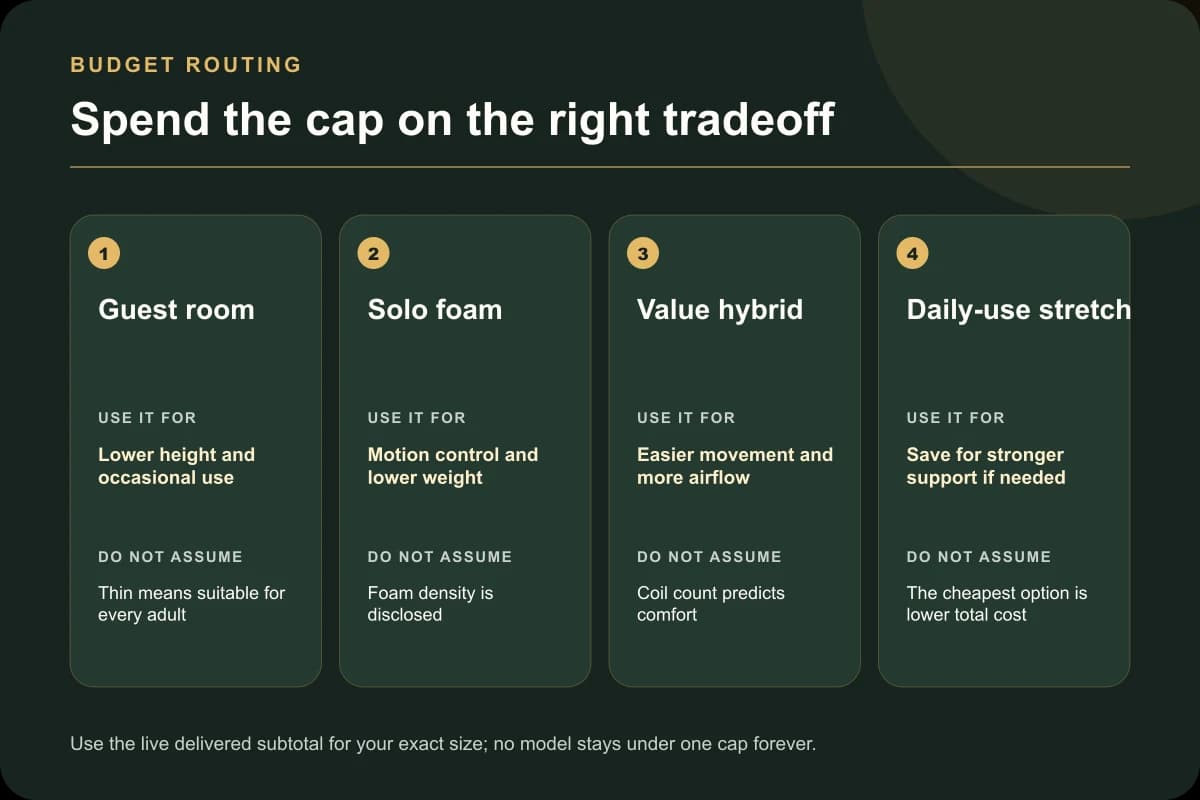
Current budget shortlist
| Model to check | Construction | Useful starting point | Main caution |
|---|---|---|---|
| Zinus Original Green Tea | All-foam | Side sleepers and shoppers wanting contour | Match current fiberglass-free generation; do not remove cover |
| Linenspa Memory Foam Hybrid | Foam over coils | Guest rooms and easier movement | Several heights and feels can share similar names |
| Novilla Vitality Hybrid | Taller pocket-coil hybrid | Shoppers wanting more cushioning over coils | Verify current certifications, seller, and return owner |
| Dreamfoam Essential | All-foam with height-based feel | Unusual sizes, bunks, RVs, or firmness-by-height routing | Direct policy and Amazon policy may differ |
Zinus Original Green Tea: foam starting point
The current Zinus Original Green Tea page describes a 10-inch all-foam model with CertiPUR-US participating foams, a fiberglass-free construction claim, and a cover that should not be removed. Zinus's own trial language applies to direct purchases; an Amazon order needs its own policy check.
This model is the starting point for someone who wants a quieter, more contouring foam surface. It is not our cooling pick, and the words “green tea” do not establish independent durability or odor control.
Zinus Original Green Tea Memory Foam Mattress
Match the current Original Green Tea model, exact size, seller, fiberglass statement, cover care, return route and warranty eligibility.
- Best for
- Guest rooms and budget-focused shoppers
- Avoid if
- You sleep hot or rely heavily on the edge
- Construction
- 10-inch memory-foam mattress
- Price tier
- Budget; confirm the live cart
Before checkout
Use the listing as the source of truth for current price tier, seller, delivery window, and return terms.
Verified Queen listing: ASIN B0CKYZ3B83. Confirm the exact size, seller and final delivered total. As an Amazon Associate, we earn from qualifying purchases.
Linenspa Memory Foam Hybrid: simple hybrid route
Linenspa currently sells several Memory Foam Hybrid heights. The brand describes foam over steel coils, identifies CertiPUR-US foam participation on product pages, and instructs users to allow compressed models time to expand. The exact 8-, 10-, or 12-inch version matters because feel and layer space change.
Choose this route for a guest room, lighter-use bed, or shopper prioritizing easier movement over deep foam contour. Do not impose a universal coil-count cutoff: Linenspa does not need to satisfy an invented number for the construction to be considered, and a count alone would not predict comfort.
Research Linenspa Memory Foam Hybrid on Amazon
Confirm height, firmness description, seller, expansion instructions, warranty, and opened-mattress return process.
Before checkout
Use the listing as the source of truth for current price tier, seller, delivery window, and return terms.
Prices, coupons, availability, shipping, and return terms change often. Confirm current details on Amazon before purchase. As an Amazon Associate, we earn from qualifying purchases.
Novilla Vitality: taller hybrid route
The current Novilla Vitality is a 12-inch hybrid with pocketed coils and foam layers. Novilla publishes a fiberglass-free brand statement and a warranty for eligible purchases from the brand or authorized sellers.
It is the comparison route when you want more surface cushioning than a low-profile hybrid. Claims about cooling, pressure relief, or motion isolation remain manufacturer descriptions; we did not measure those outcomes. Ask Novilla whether the exact Amazon seller is authorized.
Research Novilla Vitality Hybrid on Amazon
Verify exact model, authorized seller, fire-barrier statement, return owner, warranty, and delivered total.
Before checkout
Use the listing as the source of truth for current price tier, seller, delivery window, and return terms.
Prices, coupons, availability, shipping, and return terms change often. Confirm current details on Amazon before purchase. As an Amazon Associate, we earn from qualifying purchases.
Dreamfoam Essential: height-based foam alternative
Dreamfoam's current Essential product page offers multiple heights, and the brand maps those heights to different feels. That can be useful for bunks, RV sizes, guest rooms, and shoppers who need a less common dimension.
The direct product currently carries its own trial and return fee terms. Do not import those terms into an Amazon order without confirmation, and do not assume the tallest version remains within the cap for every size.
Research Dreamfoam Essential on Amazon
Check exact height, size, seller, live subtotal, direct-versus-retailer trial, return fee, and warranty path.
Before checkout
Use the listing as the source of truth for current price tier, seller, delivery window, and return terms.
Prices, coupons, availability, shipping, and return terms change often. Confirm current details on Amazon before purchase. As an Amazon Associate, we earn from qualifying purchases.
What the cap should include
Best mattress under $300: use a stricter evidence filter
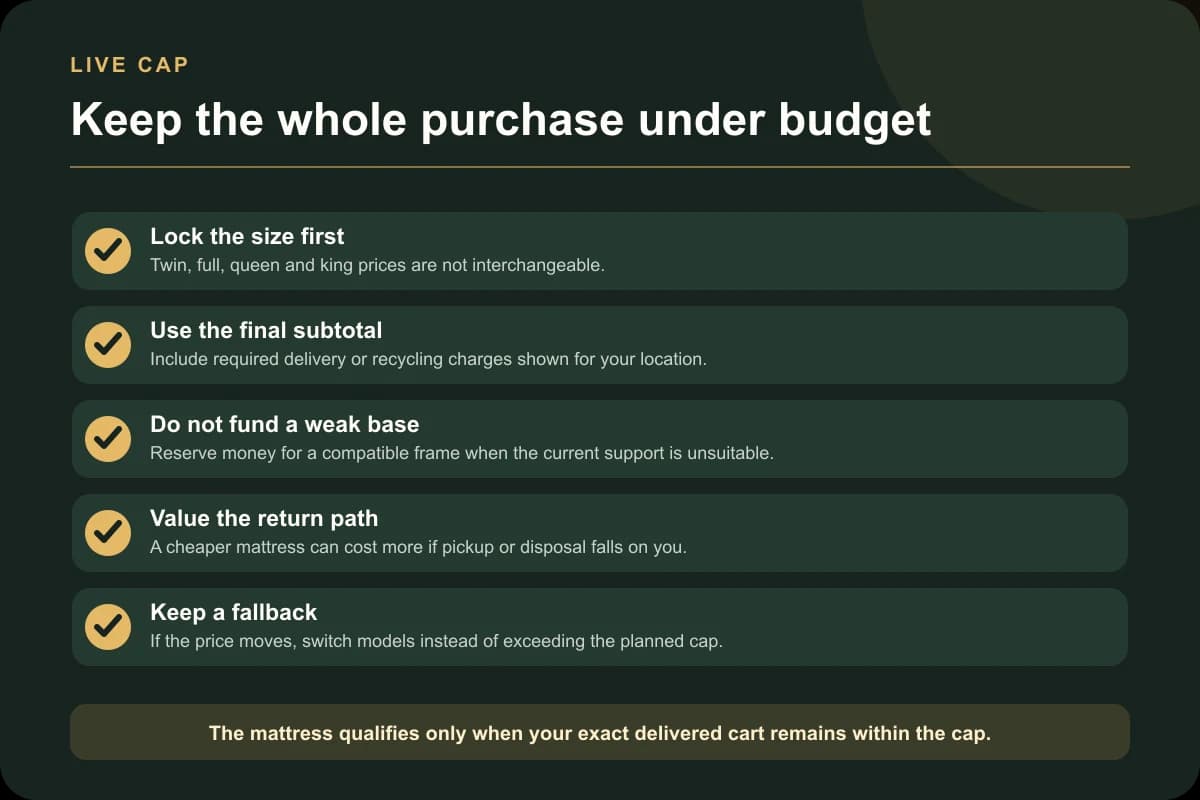
The useful way to shop for the best mattress under $300 is by exact size and delivered total, not by a sale banner. A Twin or Full may fall below the cap while the Queen does not. Delivery surcharges, a required foundation, setup help, and an uncovered expanded-mattress return can erase the apparent saving.
At this level, start with a current low-profile model such as the Siena Essential 8-inch or compare the Zinus Original Green Tea Hybrid when its exact size fits the live cap. Verify height, current generation, fiberglass statement, seller, support rules, and trial. Do not treat a thin comfort stack as automatically defective, but do not expect it to provide the same pressure-relief depth or edge structure as a larger premium build.
Under $300 is a live filter, not a permanent product badge
A model belongs in this tier only when the exact size, seller, delivery, required support, and realistic return cost remain under the cap at checkout.
The mattress is not truly under budget when a required replacement foundation, location fee, or uncovered return makes the total exceed the plan. Include:
Setup cost also depends on whether you can move the expanded mattress safely. Our source-backed mattress weight database provides verified weights across six standard sizes and helps flag beds that realistically need two people.
- the exact selected size;
- required delivery or recycling charges displayed for your location;
- a compatible base when the current one fails the warranty requirements;
- setup help if you cannot safely move the boxed mattress;
- the possible cost of pickup or disposal when not covered.
Do not automatically add a topper. If the mattress is predictably too firm, too soft, or too weak for the sleeper, choose another mattress. A topper adjusts surface feel; it does not replace core support.
Who should consider saving longer
A very tight cap is less suitable when:
- two adults need strong edge use every night;
- one or both sleepers have higher body weights and need a verified support design;
- the preferred feel is unusually soft or unusually firm;
- mobility makes an unstable edge or deep sink difficult;
- the current foundation must also be replaced;
- the seller cannot explain an expanded-mattress return.
Our guide for heavier sleepers emphasizes construction and fit rather than treating one weight number as a diagnosis. The under-$1,000 guide provides the next research tier.
Materials, odor, and certifications
Compressed foam can have a new-product odor, but odor intensity does not identify toxicity, fiberglass, or product quality. Ventilate according to the manufacturer's instructions and see our off-gassing guide.
CertiPUR-US covers participating flexible polyurethane foam under its program criteria. It does not certify a complete mattress. For a fiberglass claim, match the exact current model and generation and follow the cover-care label; our fiberglass-free verification guide explains the evidence hierarchy.
Budget fit matrix
| Sleeper or use | Better starting construction | Why | Watch closely |
|---|---|---|---|
| Occasional guest room | Lower-profile foam or simple hybrid | Lower cost can make sense for intermittent use | Adult support, edge use, and return deadline |
| Lighter solo side sleeper | Contouring foam | More surface pressure relief may be available within the cap | Heat, deep sink, and current fire-barrier disclosure |
| Back sleeper wanting easier movement | Medium or firmer hybrid | Coils can add response | Thin comfort layers can feel abrupt |
| Couple using the full surface | Reinforced hybrid if documented | Response and perimeter may be more usable | Partner disturbance and combined load |
| Bunk or trundle | Height-appropriate foam | Clearance and weight can matter more than plushness | Guardrail clearance and manufacturer age guidance |
| Higher body weight nightly use | Often save for a purpose-built option | Support and edge requirements can exceed this tier | Do not buy by height or coil count alone |
The matrix is a routing tool, not a prescription. A sleeper's body weight, shape, position, mobility, and preferences change how a material compresses.
What specifications are worth asking for?
Ask for the complete layer stack, not an arbitrary pass/fail number. Useful details include:
- mattress height and thickness of each comfort layer;
- foam type and density when the manufacturer publishes it;
- whether coils are interconnected or individually wrapped;
- whether the perimeter uses a separate reinforcement design;
- exact fire-barrier composition and cover-care instructions;
- compatible foundations, slat spacing, and center-support rules;
- total and per-sleeper load guidance when published.
Do not invent a 500-coil minimum, a foam-density guarantee, or a universal thickness requirement when the manufacturer does not provide comparable engineering data. A transparent lower-spec model can be easier to evaluate than a listing filled with unstandardized “premium” labels.
A realistic home evaluation
Before opening
Confirm model, size, seller, return deadline, and visible damage. Photograph the label and box. If the product differs from the order, contact the seller before expansion.
During expansion
Follow the current manufacturer's time and ventilation instructions. Do not sleep on a compressed corner to accelerate it, remove a non-removable cover, or use heat to force expansion. Measure only after the stated window when a size issue remains.
During normal sleep
Keep a short log for pressure, midsection sink, movement, heat, edge stability, and partner disturbance. Use the planned pillow and foundation. Avoid adding a topper before you understand whether the problem is surface firmness or inadequate support.
Before the deadline
Decide under the actual Amazon or seller return clock. A direct brand's adjustment request may not extend the retailer deadline. Ask for return instructions while there is still time to resolve pickup logistics.
Budget mattress red flags
Do not proceed when:
- the same listing mixes unrelated heights, materials, or brand names;
- the seller uses the brand's direct trial without explaining eligibility;
- the law-label material list or delivered height conflicts with the page;
- medical benefits or guaranteed pain relief are promised;
- “no chemicals” replaces a complete material explanation;
- the cover is shown unzipped while care instructions prohibit removal;
- warranty support depends on a seller the brand will not authorize;
- the return requires you to re-box an expanded mattress without a feasible method.
Why lifespan promises are especially weak in this tier
An article cannot responsibly promise that one budget mattress lasts a fixed number of years. Two households can load and use the same construction very differently. Edge sitting, combined sleeper weight, humidity, foundation flex, rotation instructions, pets, children, and manufacturing variation all matter.
Warranty duration is not a durability forecast. A warranty covers defined defects under defined conditions; it usually excludes ordinary softening, preference changes, stains, misuse, and inadequate foundations. Read the remedy as carefully as the term length.
Amazon versus direct purchase
Some budget brands sell through both channels. Compare exact construction and delivered total, then consider policy clarity. Linenspa states that its direct return policy applies to direct purchases. Zinus likewise describes a direct trial for eligible Zinus.com orders. That is why an Amazon listing needs its own return check even when the manufacturer page displays a longer trial.
If the Amazon seller is not the brand, ask both parties who handles defects and comfort returns. Save the answer with the invoice. A low price is not enough when the support route disappears after delivery.
Sources
- Zinus Original Green Tea Memory Foam Mattress
- Linenspa mattress collection
- Linenspa warranty
- Novilla Vitality Hybrid
- Novilla fiberglass statement
- Dreamfoam Essential
- Amazon seller-return overview
Final verdict
Start with Zinus for contouring foam, Linenspa for a simple hybrid, Novilla for a taller hybrid, and Dreamfoam for height-based sizing. Then apply the hard rule: if your exact size, seller, delivered total, foundation needs, and return path do not fit the cap, the mattress is not an under-$500 pick today.