
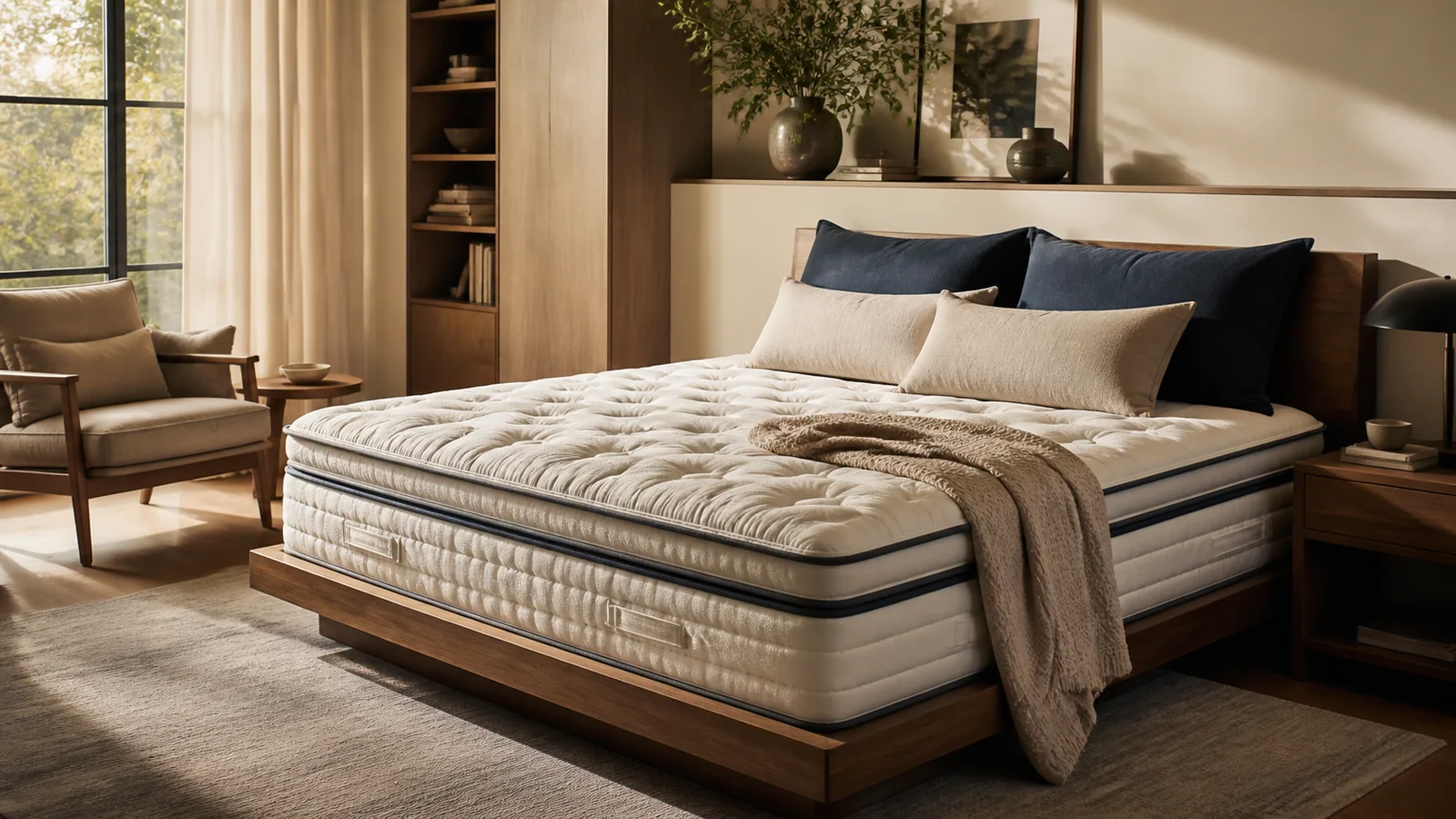
Use $2,000 as your spending ceiling, not a minimum price for good sleep. Compare DreamCloud Classic for a foam-and-coil construction, Nectar Classic for a memory-foam construction, and the original Purple Mattress for its elastic grid over foam. Each changes the feel in a different way; none is a universal best choice.
Budget status — September 13, 2026: Amazon product identity was readable for DreamCloud and Nectar Queen, but a current Amazon price was not. Their manufacturer pages each displayed $699 for Queen during this review. That is a dated direct-store reference, not a confirmed Amazon offer or delivered total. Purple's current price and an exact Amazon ASIN were not established. Treat all three as candidates until your selected order passes the budget check below.
Decision-first shortlist
Two Queen listings and one research alternative
DreamCloud and Nectar link to specific Queen Amazon pages. Purple is a search with no exact offer confirmed. Listing identity is not proof of the current price, seller authorization, return eligibility or independently tested performance.
1. Best responsive hybrid route
DreamCloud Classic Hybrid
A coil-and-foam option for shoppers who want a substantial profile, easier movement and a more traditional supportive response.

- Best for
- Back and combination sleepers, couples and shoppers moving from an innerspring
- Avoid if
- You want a plush surface or a slow foam hug; the listing describes a firm feel
- Construction
- 12-inch foam-and-coil hybrid
- Price tier
- Amazon total unconfirmed; check against your $2,000 ceiling
2. Best contouring foam route
Nectar Classic
An all-foam candidate for shoppers who prefer memory-foam contour. Motion isolation and edge performance have not been measured in this review.

- Best for
- Shoppers who prefer memory foam and can assess the exact firmness during the authorized trial
- Avoid if
- You expect a plush feel from the foam label alone; the Amazon overview says firm
- Construction
- 12-inch all-foam mattress
- Price tier
- Amazon total unconfirmed; direct-store reference below
3. Best buoyant pressure-relief route
Purple Mattress
A distinctive elastic-grid route for shoppers who want pressure redistribution without the slow sink of conventional memory foam.
- Best for
- Shoppers specifically interested in the elastic-grid feel
- Avoid if
- You dislike the grid feel, want a classic pillow top or need a very firm edge
- Construction
- Original Purple: 2-inch GelFlex Grid over foam; 9.25-inch profile
- Price tier
- Price and exact Amazon offer not established
Prices, sizes, sellers, availability and return terms can change. Confirm the exact listing before purchase. Amazon buttons are affiliate links; as an Amazon Associate, we earn from qualifying purchases.
First, make the $2,000 comparison fair
Compare a new Queen mattress without a base bundle, from an identified seller, in the same model generation and firmness. A Twin teaser price, a used unit, financing installment or conditional coupon is not a comparable Queen offer. The original Purple Mattress is also different from PurplePlus and Restore Hybrid.
For a strict $2,000 purchase ceiling, add the mattress price, tax and required delivery or service charges. If your ceiling covers the bedroom setup too, reserve money for a necessary foundation and removal before choosing the mattress. Do not count a coupon until its conditions apply to your order.
| Candidate | Identity / source checked September 13, 2026 | Price evidence | Budget decision |
|---|---|---|---|
| DreamCloud Classic Hybrid | Amazon B0F75Q1K1Y: Queen, 12-inch, firm; manufacturer Classic page | Manufacturer page displayed $699 Queen; Amazon price not returned | Candidate only; verify Amazon checkout total and seller |
| Nectar Classic research route | Amazon B0DCXFXGBM: Queen, 12-inch memory foam, firm overview; manufacturer Classic page | Manufacturer page displayed $699 Queen; Amazon price not returned | Confirm generation as well as total: Amazon title does not explicitly say Classic |
| Original Purple Mattress | Manufacturer original-model page; no exact Amazon ASIN established | No current comparable price established | Research alternative; do not count it as an under-$2,000 offer yet |
The two $699 observations show why there is no reason to impose a $1,200 spending minimum. They do not establish a sale history, a permanent price or a saving against another seller. If an upgraded mattress costs more, identify the exact construction or service difference that matters to you before paying the gap.
Compare the construction you actually receive
DreamCloud Classic Hybrid: foam over coils
The reviewed Amazon listing identifies a 12-inch Queen hybrid and describes a firm feel. The manufacturer's Classic page is the reference for the current model family. This is a useful starting point when you specifically want a coil-based support system with foam above it.
The open question is how that particular configuration feels to you. A quilted top is not proof of plushness, and a coil core does not establish strong sitting edges or low motion transfer. Check those during the permitted trial. Do not import Premier or other DreamCloud upgrade specifications into Classic.
Read our DreamCloud review for the broader model discussion, then return to the exact seller's terms before ordering.
Nectar Classic: memory foam over a foam support system
The current Classic manufacturer page describes a 12-inch memory-foam model with a medium-firm feel. The linked Amazon Queen page has a broader Nectar title and calls the feel firm in its overview. That difference is a reason to confirm the generation and specification, not to average the two labels into a numerical score.
Consider this route if you prefer memory-foam contour and do not need a spring core. We have not measured its cooling, motion isolation or edge compression against DreamCloud or Purple. Compare the delivered model to the current Classic specification before applying a manufacturer's claim to the unit.
Original Purple: grid over foam, not a latex hybrid
The original Purple product page identifies a 2-inch GelFlex Grid over foam and a 9.25-inch Queen profile. It is a materially different option from a coil hybrid or a latex mattress. The grid's feel is worth trying in person if you have not experienced it.
This is a research alternative because a matching Amazon ASIN and current price were not established. The search may return other Purple models or accessories. Keep the original-model specification in view, and exclude any offer whose total exceeds your ceiling. Its lower profile also illustrates why a blanket 12-inch minimum would be a poor selection rule.
Model map · September 13, 2026. Schematics are not to scale and do not rank cooling, support or durability. Sources are linked in the comparison above.
DreamCloud Classic
Queen / 12-inch listing. Firm description. Amazon total still to check.
Nectar Classic route
Queen / 12-inch listing. Confirm generation and firmness wording.
Original Purple
9.25-inch manufacturer profile. No exact Amazon offer established.
Your gate: exact Queen model + identified seller + acceptable return route + total below $2,000.
What deserves an upgrade price?
An upgrade should solve a specific problem. A different firmness, a construction you prefer after trying it, documented access requirements or a useful delivery service can justify paying more. A taller sidewall, a premium-sounding fabric or a large crossed-out price alone cannot.
| Your priority | Compare before purchase | Evaluate during the authorized trial |
|---|---|---|
| Surface comfort | Exact model, firmness option and comfort-layer materials | Pressure and comfort in your usual sleeping positions |
| Easier movement | Grid, foam or coil construction; try a showroom model where possible | Turning over and getting out of bed |
| Partner disturbance | Model-specific test evidence if available; no material-only winner | Whether normal partner movement actually wakes you |
| Temperature | Whole construction and any model-specific cooling evidence | Several nights with familiar bedding and room settings |
| Sitting edge | Published reinforcement details, if disclosed | Stability when using the edge as you normally would |
| Handling | Exact size weight, packaged dimensions and delivery service | Whether delivery and setup match the agreed service |
See the firmness guide to interpret descriptions. Firmness scales are not standardized between brands, and body weight alone does not determine a required number. For higher loads or limited mobility, obtain the model's load and foundation requirements rather than inferring capacity from height or coil count.
For material disclosures, our foam-density guide explains what a density value can and cannot tell you. If a specification is absent, mark it as unknown. Do not replace it with a universal coil gauge, layer thickness or promised lifespan.
Cooling claims: ask for the comparison
A cool-to-touch cover describes a surface sensation; it does not by itself establish all-night temperature control. Graphite, copper, gel or phase-change wording needs evidence for the exact model and the conditions tested. Ask what the advertised improvement was compared against, how it was measured, and whether your selected model has the tested construction.
This review includes no controlled cooling measurements. Keep bedding and room conditions reasonably consistent while assessing your own comfort. If cooling is the deciding factor, use our hot-sleeper guide for a more focused comparison rather than treating a luxury badge as evidence.
The return route is part of the value
A manufacturer's direct-store trial is not automatically the policy for an Amazon order. Before checkout, record the seller and fulfillment party, return deadline, any minimum-use requirement, opened-mattress eligibility, who arranges collection, and any transport or removal charge.
Read warranty coverage separately from the comfort trial. A long warranty is not a lifespan prediction or a promise to exchange a mattress you find uncomfortable. Check the exact foundation requirements and exclusions. No universal slat spacing, impression threshold, rotation interval or adjustable-base approval applies to all three candidates.
Use the trial checklist and Amazon return playbook to save the relevant instructions. Never assume a generic packaging sleeve, donation or disposal route is authorized for your order.
A practical purchase and evaluation plan
- Choose the construction. Narrow the decision to coil hybrid, memory foam or grid over foam. Write down your most important comfort and access needs.
- Compare the same offer over time. Track model, size, seller and delivered total. A sale name does not guarantee a lower price; do not delay an urgent replacement for an assumed discount.
- Confirm the setup. Check your existing base against the exact model's requirements and measure the delivery route. Include any necessary replacement base or removal service in your budget.
- Save the order evidence. Keep screenshots of the offer, materials and return terms. At delivery, photograph the product labels and any damage before setup. Follow the model's unpacking and care instructions.
- Assess before the actual deadline. Use familiar bedding and record comfort, heat, movement and edge use. Set a reminder comfortably before your order's return deadline; do not rely on a generic 30- or 60-day schedule.
If the mattress is wrong or uncomfortable, contact the responsible seller while the return route is open. Do not improvise plywood supports, frequent rotation or multiple toppers to rescue a poor fit without checking the model's instructions. An accessory purchase should address a clear need and should not consume the remaining budget merely to justify keeping the mattress.
Final choice
Start with DreamCloud if a coil-based construction interests you, Nectar if you want to compare memory foam, or the original Purple if the grid feel is the feature you value. The first two have specific Queen Amazon links; Purple remains a research search. None is represented here as a currently verified Amazon checkout total below $2,000.
Buy only when the chosen model, seller, written terms and total satisfy your requirements. Spending less than the ceiling is a valid outcome; paying more should buy a difference you can identify.
Sources and review limits
Reviewed September 13, 2026: manufacturer construction pages and the available DreamCloud/Nectar Amazon product details. Manufacturer Queen price observations are dated references, not live Amazon prices. No independent laboratory comparison, certification audit, seller-authorization check or checkout purchase was performed. Product photos come from the linked Amazon pages and do not prove hidden materials.
- DreamCloud Classic manufacturer construction and Queen price reference
- Nectar Classic manufacturer construction and Queen price reference
- Original Purple construction and specifications
For the broader shortlist, use the Amazon mattress guide or our brand comparisons.