

A platform bed includes a mattress-support surface; a rigid foundation supplies that surface on a separate frame; a traditional box spring contains springs. Sellers sometimes use “box spring” loosely for rigid products, so inspect the construction and your mattress instructions rather than the title alone.
Choose compatibility first and bed height second. A support unit that raises the mattress to a comfortable height can still be the wrong construction for it. This guide explains the terms and the checks to make; it does not certify an unknown frame or impose one slat-gap rule on every mattress.
Separate the frame from the support surface
| Item | What it normally supplies | What still needs checking |
|---|---|---|
| Bed frame | Structure around or beneath the sleep system | Whether it includes a complete mattress-support surface |
| Platform bed | Frame with an integrated rigid deck or slats | Mattress approval, slats or deck, center support and load limits |
| Rigid foundation | A separate non-sprung support unit | A compatible supporting frame and exact mattress approval |
| Traditional box spring | A separate sprung support unit | Whether the specific mattress permits spring-based support |
| Adjustable base | An articulating support platform | Approval, dimensions, weight limits and clearance through movement |
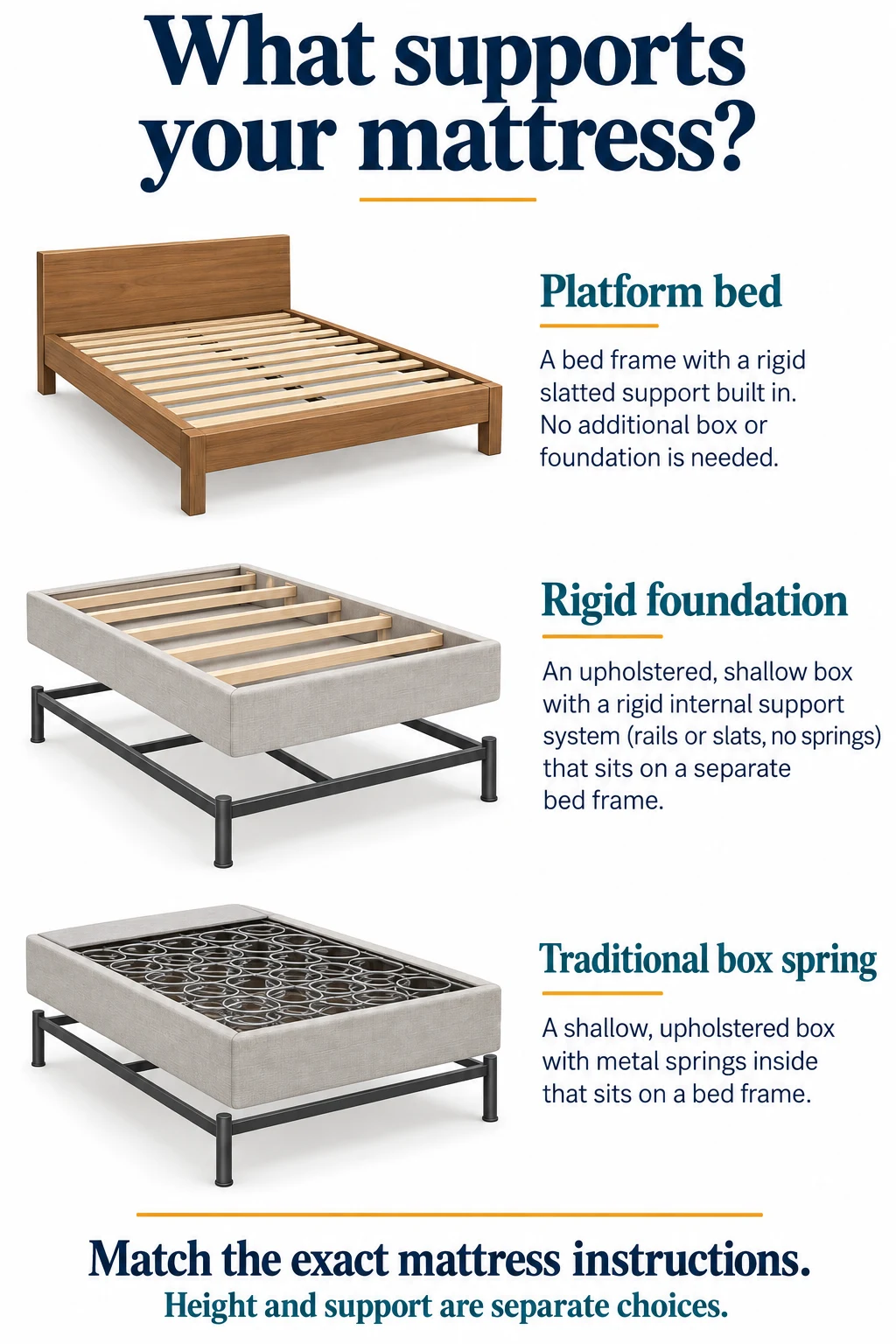
Tempur-Pedic describes a foundation as a rigid support rather than a traditional spring-containing unit. For an integrated platform example, Helix says its Madison Bed Frame has built-in support and does not require an additional foundation. These examples show why two similar-looking bed systems can need different parts.
Why there is no universal slat rule
The mattress maker's requirements govern the mattress; the frame maker's instructions govern assembly and the structure. You need a setup that satisfies both.
For example, Tempur-Pedic's base guidance rejects traditional box springs and also rejects certain improvised support arrangements. Helix's base guidance describes its own slat and support requirements. Do not borrow one manufacturer's spacing allowance or suggested adaptation for a different mattress.
Measure the clear gap between slats, not the distance from one slat's center to the next. Also record width, condition and any required center rail or floor-contact legs. A narrow gap does not compensate for broken slats or a missing structural component. If instructions conflict, obtain a compatible documented setup instead of averaging the requirements.
Choose height after compatibility
Measure the finished sleeping surface from the floor: frame or base contribution, separate foundation if used, mattress and any topper. Avoid counting an integrated platform twice. Compare the result with sitting and getting in or out of the bed; a tall-looking product photo is not a fit measurement.
You have a platform with approved built-in support. A second foundation may add unnecessary height. Confirm the intended arrangement rather than stacking parts because your previous metal frame needed them.
You have a perimeter metal frame without a complete support surface. A compatible foundation may be the missing part. The mattress should not simply bridge an opening that the system was designed to support with a separate unit.
You have a traditional sprung box spring from an older mattress. Do not carry it into a new purchase by default. Check whether the new mattress permits that support type and whether the unit is still structurally sound.
Adjustable bases are a separate decision
An adjustable base already supplies an articulating support surface. Adding a conventional foundation above it would defeat the intended movement unless an explicitly designed system says otherwise. Compare the exact mattress approval and base instructions, including clearance and any surrounding decorative frame.
For split king systems, check each half, independent movement, mattress retention and the complete weight limits. A shared accessory across two moving halves may interfere with their independence. Use the split king guide and adjustable-frame shortlist for that buying route.
Bring this checklist to the product pages
- Record the exact mattress model, size, height and listed weight.
- Identify whether the proposed bed has integrated support or requires a separate unit.
- Compare permitted support types, slat requirements, center supports and attachment instructions.
- Check what the load rating includes: sleepers, mattress and accessories may be described differently by different manufacturers.
- Measure total height, room access and relevant moving clearances.
- Follow ventilation and placement instructions. Do not assume a solid board or floor placement is an approved substitute.
- Save the current assembly and mattress-support instructions with the order details.
Our bed-frame compatibility tool organizes those checks; it cannot replace model-specific approval. The room and delivery resources help with measuring before the parts arrive.
When none of these is a sufficient answer
A new foundation is not proof that an old mattress has recovered, and a new mattress does not repair a damaged frame. Diagnose movement, missing components or permanent mattress depressions separately before replacing a part at random.
An owner question about a bed requiring a box spring prompted an especially useful checkout question: does the seller mean a sprung unit or simply a separate rigid support? Ask for the construction and intended assembly. The wording alone cannot settle compatibility.
Return to Bedroom Setup for the complete system, or use the platform-bed mattress guide once the support arrangement is clear.
Choose your next step
Talk through the tradeoffs
Open an editable question in the Sleep Advisor. Nothing is sent to AI until you submit it.