

On the same base, a 12-inch mattress raises the top of your bed by two inches compared with a 10-inch mattress. That matters if the bed is already hard to get into or if your current fitted sheet barely reaches under the corners. It tells you very little about which mattress will feel more supportive.
Start by deciding how high you want the finished bed and whether its frame limits the mattress thickness. Then compare the materials and firmness of models that work within those boundaries. We checked the examples and frame guidance below on November 8, 2026. The height comparisons use nominal geometry, not measurements on a person or a specific bed.
Which thickness belongs on your shortlist?
| Nominal mattress height | What to check | When to investigate it |
|---|---|---|
| Around 6 inches | Comfort depth, base requirements and ability to close or clear the frame | A shallow frame, trundle or other height-constrained setup whose instructions permit that profile |
| Around 8 inches | How the comfort layers feel over their support, especially where your shoulder or hip sinks | You want a relatively low bed and can compare the actual mattress rather than buying by height |
| Around 10 inches | Support design, finished bed height and fit with your current sheets | A starting comparison for an adult bed with no special mechanism |
| Around 12 inches | What the added two inches change and where that height goes | A model offers the comfort or support configuration you want and still fits the room |
| Around 14 inches | Sitting height, handling, pockets on sheets and any headboard interference | A particular taller construction fits the setup and has a useful difference you can identify |
These are planning examples, not weight, comfort or performance categories. An IKEA ÅSVANG Queen is listed at 4¾ inches and uses polyurethane foam with a quilted cover. A Brooklyn Bedding CopperFlex Hybrid is listed at 12 inches and adds a coil support system. The difference includes the construction. You cannot isolate firmness or quality by comparing those two heights.
Compare the whole stack
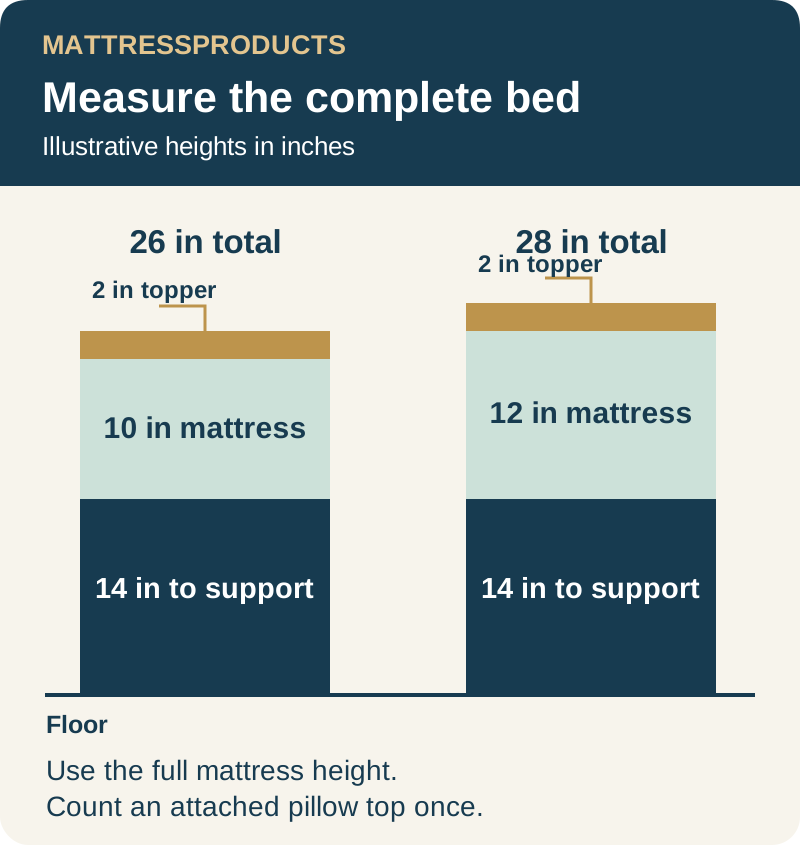
Measure the floor-to-support surface, not the top of the side rail. If you use a foundation on a frame, measure to the top of that foundation. Add the mattress height from the selected size and model documentation. Add a separate topper if you plan to use one. A factory-attached pillow top belongs in the mattress measurement.
For example, a support surface 14 inches off the floor with a 10-inch mattress and a 2-inch topper gives a nominal 26-inch finished bed. On the same support, a 12-inch mattress with the same topper reaches 28 inches. Taking the topper off the second setup brings it back to 26 inches, although it still won't feel like the first combination.
Bed height comparison
Compare the top of the finished bed
Measure from the floor to the surface that supports the mattress. Include the full base in that measurement and enter any separate topper once.
Enter a base measurement from 0 to 72 inches and a topper height from 0 to 12 inches. Use 0 for a setup without a separate topper.
These figures describe unloaded geometry. Follow the bed manufacturer’s fit instructions and check the real sitting height with the person who will use the bed.
If your current bed is comfortable to sit on, measure it before replacing anything. Treat that as a personal reference for comparison. Foam and upholstery can compress at the edge, so a calculated unloaded height and the actual seated experience can differ. Evaluate the person, base and exact mattress together.
Separate the hard limits from comfort preferences
Bunks, trundles and wall beds
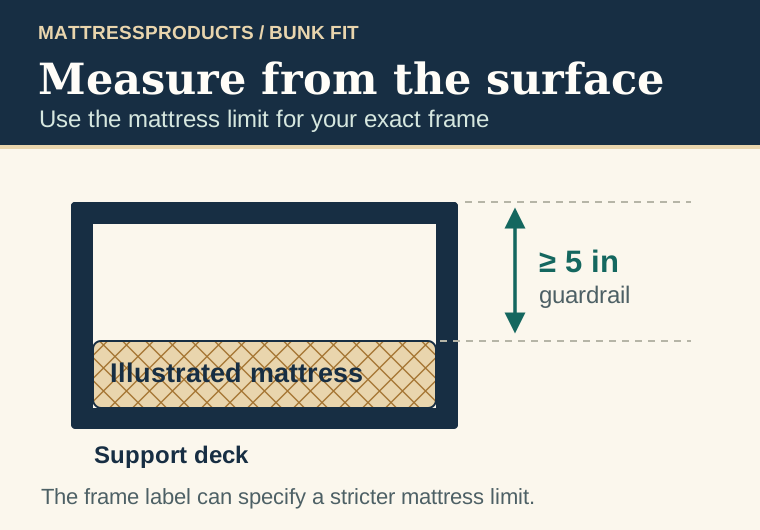
Follow the frame's model label and instructions. A shallow trundle must close with the specified mattress in place. A wall bed can have separate limits for depth, weight and the shape that fits its mechanism. The bunk mattress guide covers model-specific thickness and guardrail checks. The CPSC bunk-bed guidance describes a guardrail top at least five inches above the top of the mattress. The number does not replace the manufacturer's limit or verify the rest of the bunk design.
The base changes the height without changing the mattress
If you like a 12-inch model but it sits too high on your current setup, compare a lower approved platform or foundation. Use the exact mattress manufacturer's support requirements. Some mattresses need a rigid surface with particular slat spacing or center support. See the platform, boxspring and foundation guide to compare those systems before removing anything.
Think about the sheets and room before checkout
Measure height at the corner where the fitted sheet turns under. Compare the total mattress-and-topper thickness against the sheet's published pocket depth. A deeper pocket can be appropriate, but the specific sheet still has to reach under your mattress securely. Check how much of the headboard will remain visible and whether the delivered package can get to the room. A mattress can have a smaller boxed cross section than its finished size, which is a separate number to request.
Work through four room and frame examples
Low platform with a 10-inch or 12-inch mattress
Suppose your new slats are 12 inches off the floor and you can sit comfortably on your current bed at about 24 inches. A 12-inch mattress on the new frame gives you the same nominal height. A 10-inch mattress gives you 22 inches. If you prefer the 10-inch mattress, a compatible 14-inch support deck brings the total back to 24. Check the compressed edge in person if getting up easily matters.
Replace a pillow top and reuse the bedding
Your current 12-inch mattress and two-inch topper make a 14-inch stack. If you order a 14-inch mattress and keep the topper, the new depth is 16 inches. Measure the sheet pocket and check the manufacturer's fit range and how far the elastic wraps underneath. You can try the new mattress without the topper first to see whether you prefer the surface and whether the current sheets fit.
Trundle or upper bunk with a strict limit
A trundle with seven inches of open space still needs clearance to close. Read the model's instructions for the approved depth. The upper bunk may have a separate limit on the same frame. If the label gives a six-inch maximum, stay within it and follow its instructions for size and guardrail setup. A topper adds height. See the CPSC bunk-bed guidance and the instructions for the frame.
Low headboard and a delivery turn
Measure from the support surface to the lowest rail, trim or obstruction. Use tape to mark the planned height on the headboard, then place your pillows where they will sit. Check whether the new surface would interfere with a shelf or footboard. For delivery, find out whether the exact size ships compressed or full-size. Measure the doors and the short stretch after a tight turn, including the stair ceiling. Follow the maker's expansion instructions before measuring a compressed mattress at full height.
After these checks, compare the support core, upholstery and firmness of the mattresses that still fit. An extra two inches might come from a quilted top, an additional foam layer or a different support unit. Ask what changed between the exact models so you can compare the part of the mattress you are paying for.
Measure a mattress you already have
Remove the pillows, sheets and topper. Set a straightedge across the top near the side and measure vertically from the support surface to the straightedge without pressing down the quilt. Note whether the mattress sits down inside a recessed frame. The exposed sidewall above the rail can understate depth. Measure the mattress alone for frame and replacement comparisons. Then add the topper back and measure again for fitted sheets.
Write down three separate numbers: the mattress depth, the height from the floor to the surface you sit on, and the stack under the fitted sheet. For example, a 13-inch-high support surface with an 11-inch mattress and a two-inch topper gives a 26-inch sitting height and 13 inches under the sheet. The sheet does not go around the support surface. If you replace that setup with an un-topped 12-inch mattress, the top sits at about 25 inches and the sheet wraps around about 12 inches.
| What you need to answer | Measure this |
|---|---|
| Will it fit below the bunk or trundle limit? | Mattress plus any permitted layer above the deck, then compare with the exact frame specification |
| Will my feet reach the floor from the edge? | Finished edge height on the assembled bed and how the edge feels when you sit |
| Can I keep my fitted sheets? | The depth and shape of the stack the fitted skirt has to wrap under |
| Will an old headboard still show? | Distance from the floor to the mattress and pillows, compared with the visible headboard |
When the published height and your tape disagree
Check the exact variant on the law tag or order. A pillow top or different model generation may change the nominal measurement. For a compressed mattress, check the expansion period and measurement instructions before deciding you received the wrong profile. Photograph the tape and the order label if there is still a meaningful mismatch. If it will not meet a hard frame limit, contact the seller before trying to force it into the space.
Choose between 10 and 12 inches in this order
- Check fit. Use the exact model height and your actual support surface. Rule out models that exceed a frame constraint.
- Ask what changed. Compare the comfort material, support core and listed feel. If the extra height is just a pillow top you did not want, keep the simpler option on the list.
- Sit at the edge and try your sleep position. Compare how the actual bed feels with your bedding and how you get in and out.
- Check the order. Keep the size, profile, seller and written return terms together. When the model is sold at multiple heights, save the exact selection.
Thickness narrows the choices. The firmness guide helps with the separate decision about how the surface should feel.