
No mattress treats sleep apnea. The best mattress is the one that makes your clinician-directed sleep position and prescribed therapy easier to sustain. For many adults, the broadest starting point is a responsive medium or medium-firm hybrid: enough cushioning for side sleeping, enough pushback to turn without struggling, a stable edge, and compatibility with an adjustable base if elevation has been recommended.
Our best balanced research pick is Leesa Sapira Hybrid. Saatva Classic is the strongest mobility-and-edge option, Tuft & Needle Mint Hybrid is the responsive pressure-relief route, and Puffy Lux is the plush route. These are comfort candidates, not medical devices or treatment recommendations.
Medical boundary
Sleep apnea can have serious health consequences. A mattress does not diagnose, treat, or cure obstructive or central sleep apnea. Keep using prescribed PAP, oral-appliance, positional, surgical, or other care unless your clinician changes it. Seek medical evaluation for witnessed breathing pauses, gasping, severe daytime sleepiness, or other concerning symptoms.
How we reviewed mattresses for sleep apnea
This is an editorial research review, not a medical study or hands-on laboratory test. We reviewed current model construction, responsiveness, edge design, adjustable-base compatibility, trial terms, and the practical needs created by side sleeping and PAP equipment. Medical boundaries come from the National Heart, Lung, and Blood Institute and the American Academy of Sleep Medicine PAP guideline.
NHLBI says PAP is the most common treatment for sleep apnea and notes that a healthcare provider may recommend side sleeping for some people. AASM says PAP treatment should be based on an objective diagnosis and followed appropriately. Neither source recommends a particular mattress brand or firmness.
We did not diagnose sleepers, review sleep-study data, measure apnea-hypopnea index, test oxygen saturation, or sleep on these models for months. We therefore do not assign a “sleep apnea score” or claim a mattress changes breathing events.
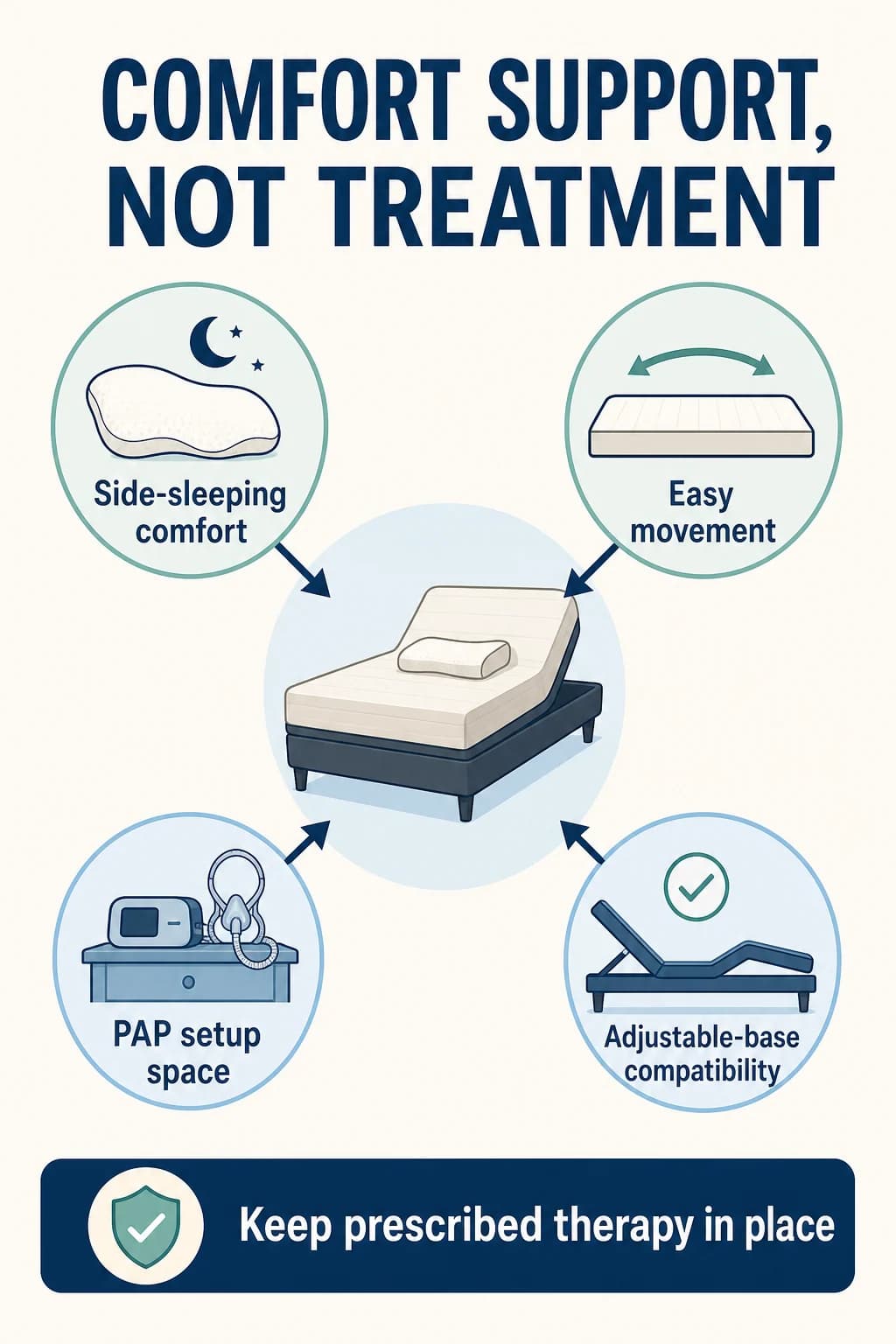
What a mattress can and cannot do
| A mattress can support | A mattress cannot establish |
|---|---|
| Comfortable side or clinician-directed positioning | Whether you have obstructive or central sleep apnea |
| Easier turning and getting out of bed | Your apnea-hypopnea index or oxygen level |
| Stable placement for pillows and PAP hose routing | The correct PAP pressure or mask type |
| Adjustable-base compatibility | That elevation is appropriate for you |
| A less disruptive setup for a partner | That prescribed treatment can be stopped |
This distinction matters because “anti-snore,” “airway support,” and “sleep apnea mattress” are often marketing categories, not regulated clinical outcomes. Comfort can improve adherence indirectly—if side sleeping or wearing a mask is less uncomfortable, the setup may be easier to live with—but that is not the same as treating the disorder.
Mattress shortlist by practical need
| Starting point | Why it may fit the setup | Main caution |
|---|---|---|
| Leesa Sapira Hybrid | Balanced foam-and-coil design, responsive movement, edge support, adjustable-base compatibility | Medium feel may not suit people needing very plush or very firm comfort |
| Saatva Classic | Strong perimeter, three comfort choices, no compressed unboxing, adjustable-base option | Taller coil-on-coil design feels bouncier and return pickup has a processing fee |
| Tuft & Needle Mint Hybrid | Responsive foam, coils, pressure relief, easier repositioning than slow memory foam | Confirm the current model generation and retailer-specific trial |
| Puffy Lux Hybrid | Plush pressure relief with coil support for people who struggle on firmer beds | Deep cushioning can feel too soft or make movement harder for some bodies |
Best balanced starting point: Leesa Sapira Hybrid
The current Sapira Hybrid pairs foam comfort layers with individually wrapped coils and is compatible with an adjustable base. The construction makes it a practical general candidate for side sleepers who need shoulder and hip cushioning without the deep, slow sink of a thick all-memory-foam bed.
It is not medically better for sleep apnea. It is simply the most balanced combination in this shortlist for pressure relief, movement, airflow, and couple use. Higher-weight sleepers who compress medium hybrids deeply should compare the reinforced Leesa Plus or our mattresses for people over 230 pounds.
Research Leesa Sapira Hybrid
Confirm the exact model, seller, adjustable-base compatibility, trial, warranty, and return channel before buying.
Before checkout
Use the listing as the source of truth for current price tier, seller, delivery window, and return terms.
Prices, coupons, availability, shipping, and return terms change often. Confirm current details on Amazon before purchase. As an Amazon Associate, we earn from qualifying purchases.
Best for edge stability and getting up: Saatva Classic
Saatva Classic uses a coil-on-coil design and offers multiple comfort choices on its current product page. It arrives through in-room delivery rather than compressed in a small box, which can be valuable when lifting and setup are difficult. A stable perimeter also makes sitting before standing more predictable.
The tradeoff is more bounce and a distinct innerspring feel. Saatva's current 365-night trial has a pickup processing fee, so review the current trial terms, not an old “free returns” summary.
Compare Saatva-Style Responsive Hybrids
Saatva is primarily a direct-buy model; use Amazon only to compare construction and verify who controls delivery, trial, and warranty.
Before checkout
Use the listing as the source of truth for current price tier, seller, delivery window, and return terms.
Prices, coupons, availability, shipping, and return terms change often. Confirm current details on Amazon before purchase. As an Amazon Associate, we earn from qualifying purchases.
Best responsive pressure-relief route: Tuft & Needle Mint Hybrid
The current Mint Hybrid combines responsive foams, microcoils, and a pocketed-coil support unit. That type of surface can cushion a side position while making it easier to roll than slow-response memory foam.
Tuft & Needle says Amazon orders receive a 100-night trial but must be returned through Amazon. That illustrates why purchase channel belongs in the comfort decision: the same brand name does not always mean the same return workflow.
Research Tuft & Needle Mint Hybrid
Check the exact Mint generation, seller, current trial, return route, warranty eligibility, and adjustable-base instructions.
Before checkout
Use the listing as the source of truth for current price tier, seller, delivery window, and return terms.
Prices, coupons, availability, shipping, and return terms change often. Confirm current details on Amazon before purchase. As an Amazon Associate, we earn from qualifying purchases.
Best plush route: Puffy Lux Hybrid
Puffy Lux is the most cushioned choice here. A plush hybrid can help a pressure-sensitive side sleeper maintain a lateral position, but it can also make turning or getting out of bed harder when the sleeper sinks too deeply. This is why “soft for side sleeping” is not enough; mobility has to be tested in the trial.
Puffy currently limits its 365-night trial to eligible direct purchasers, requires at least 30 nights, and caps returns at two per household over a lifetime. See our Puffy mattress review for the full model and policy comparison.
Research Puffy Lux Hybrid
Verify model generation, seller, trial eligibility, warranty, return channel, and whether the plush feel still allows easy movement.
Before checkout
Use the listing as the source of truth for current price tier, seller, delivery window, and return terms.
Prices, coupons, availability, shipping, and return terms change often. Confirm current details on Amazon before purchase. As an Amazon Associate, we earn from qualifying purchases.
Side sleeping and positional sleep apnea
NHLBI notes that a provider may recommend side sleeping because it can help keep the airway open for some people. That does not mean every person with sleep apnea has a positional form or that right and left sides have identical comfort. A sleep study and clinician interpretation are what connect position to the individual's breathing events.
For mattress shopping, translate a clinician-directed side position into four comfort tests:
- the shoulder sinks enough to avoid sharp pressure;
- the pelvis does not collapse so deeply that turning becomes difficult;
- the pillow keeps the neck comfortable without pushing the head sharply upward;
- the mattress stays supportive near the edge used for getting in and out.
Our side-sleeper mattress guide goes deeper on cushioning and body-weight differences.
What about head-of-bed elevation?
Small clinical studies have reported improvements in measured outcomes for some participants using head-of-bed elevation. A 2017 study of 52 OSA patients evaluated mild 7.5-degree elevation, while a 2025 pilot randomized study also used 7.5 degrees. These are not instructions to set every adjustable bed to one angle, and other studies used different populations and methods.
Treat elevation as a question for the sleep clinician. If it is recommended, a compatible adjustable base can make it repeatable. Test whether you slide toward the foot, whether the mattress bunches, whether the pillow changes mask seal, and whether the hose pulls during position changes. Never use a pile of loose pillows as a substitute for a stable full-torso setup if it bends the neck or causes sliding.
See our adjustable bed frame guide for mechanical and policy checks.
PAP-friendly bedroom setup
The mattress is only one part of a usable PAP setup. Keep the machine on a stable surface with the clearance required by its manufacturer. Route the hose so it can move without pulling the mask, and keep power cords out of the walking path. A hose lift or headboard routing may help some sleepers, but it should not kink the tube or interfere with the device.
If a new mattress position increases leaks, dry mouth, discomfort, aerophagia, or awakenings, do not self-adjust prescribed pressure based on a mattress article. Contact the equipment provider or clinician.
Couples, mattress size, and split adjustment
Sleep apnea treatment can add equipment, hose movement, and nighttime position changes to an already shared bed. A queen may be adequate for many couples, but the useful width depends on body size, PAP placement, whether either person sleeps near the edge, and whether an adjustable base will be split.
A split king lets each side elevate independently, but it also introduces a center seam, two Twin XL mattresses, separate sheet requirements, and possible height differences when the mattresses or settings do not match. A standard king on a split adjustable base usually cannot provide fully independent articulation because one mattress spans both halves. Confirm the approved configuration with both the mattress and base manufacturers.
Test partner disturbance under the real setup: mask adjustment, hose movement, elevation motor noise, getting out of bed, and changing from back to side. Motion isolation is useful, but an excessively slow surface can trade less vibration for harder repositioning.
Pillow loft and bed height
Pillow loft should support the neck in the position actually used. Side sleepers often need enough height to fill the shoulder-to-head space, but body width, mattress sink, mask style, and elevation change the requirement. A pillow that is too high or too low can be uncomfortable; this article cannot prescribe a therapeutic neck angle.
Bed height also affects adherence to the nightly routine. Sit at the edge with feet supported and check whether standing requires excessive effort. Include the mattress, foundation, adjustable base, and frame in the total height. A thick mattress on a tall adjustable base may look luxurious while making entry, exit, or equipment access harder.
When the clinician—not the trial—needs the next call
Do not wait for a mattress return deadline to address persistent gasping, worsening daytime sleepiness, chest symptoms, major PAP intolerance, or concerns shown by prescribed monitoring. Mattress comfort notes can help describe the setup, but treatment effectiveness requires clinical interpretation. Likewise, do not infer that quieter snoring proves apnea control; snoring and measured breathing events are not interchangeable outcomes.
How to test the mattress during the trial
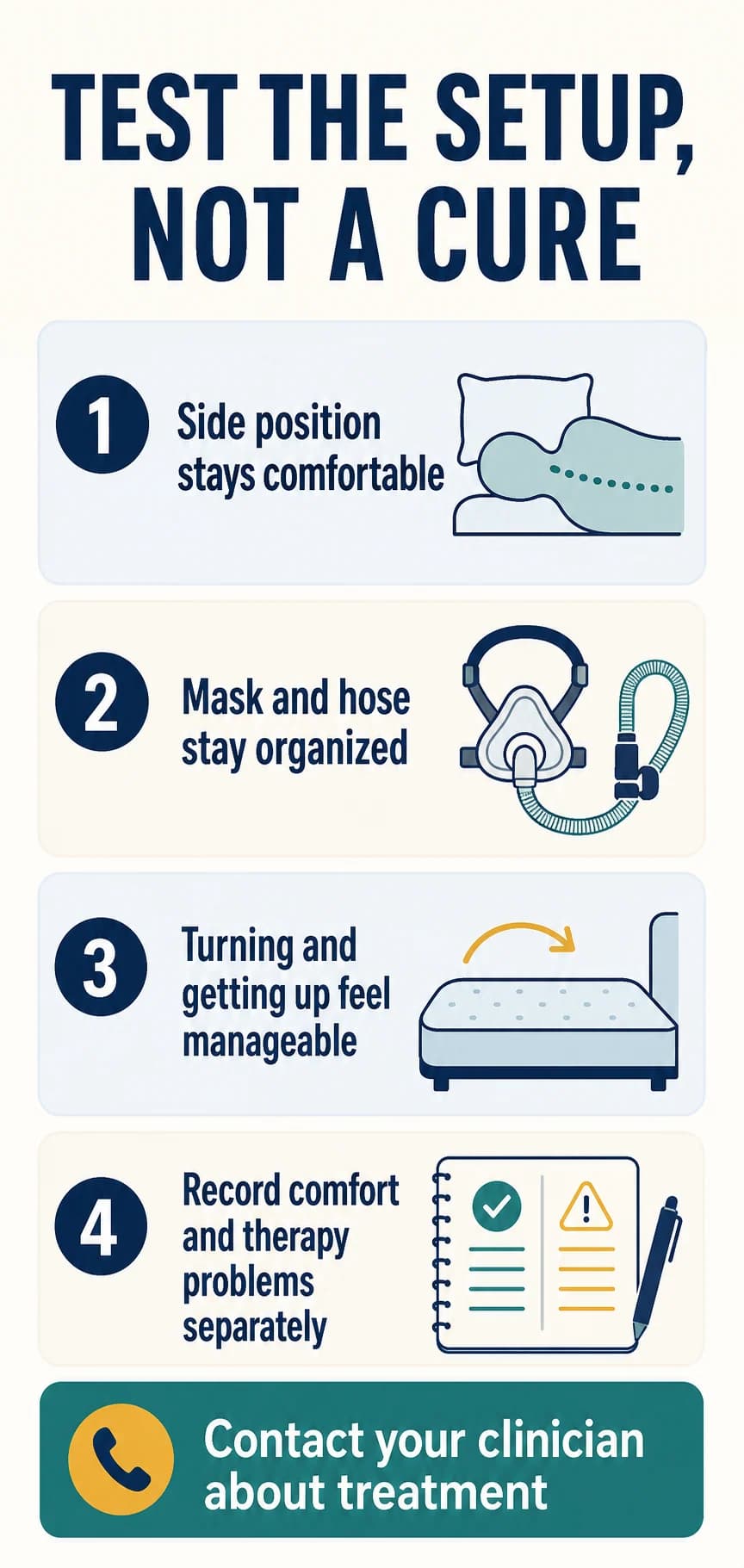
Use the first weeks to answer comfort questions, not to declare the sleep apnea “better.”
- Keep prescribed therapy and usual clinician-directed positioning consistent.
- Record shoulder, hip, back, and neck comfort each morning.
- Note how many times turning or getting out of bed feels difficult.
- Check whether mask and hose stay stable in the positions you actually use.
- Track heat, edge confidence, partner disturbance, and sliding on elevation.
- Take therapy problems, persistent symptoms, or PAP data questions to the clinician.
Before ordering, save the trial and return terms with our mattress trial checklist. A long trial is only useful if the seller, minimum-use period, pickup process, and mattress-condition rules work for your household.
Final verdict
Leesa Sapira Hybrid is our best balanced comfort starting point; Saatva Classic is the better mobility-and-edge route; Tuft & Needle Mint Hybrid emphasizes responsive pressure relief; and Puffy Lux is for people who know they need a plusher surface.
The medically responsible decision is simpler than the marketing: keep treatment first, choose a mattress that makes the prescribed setup comfortable and manageable, and use the trial to test pressure, movement, heat, equipment organization, and partner fit—not to infer a cure.