
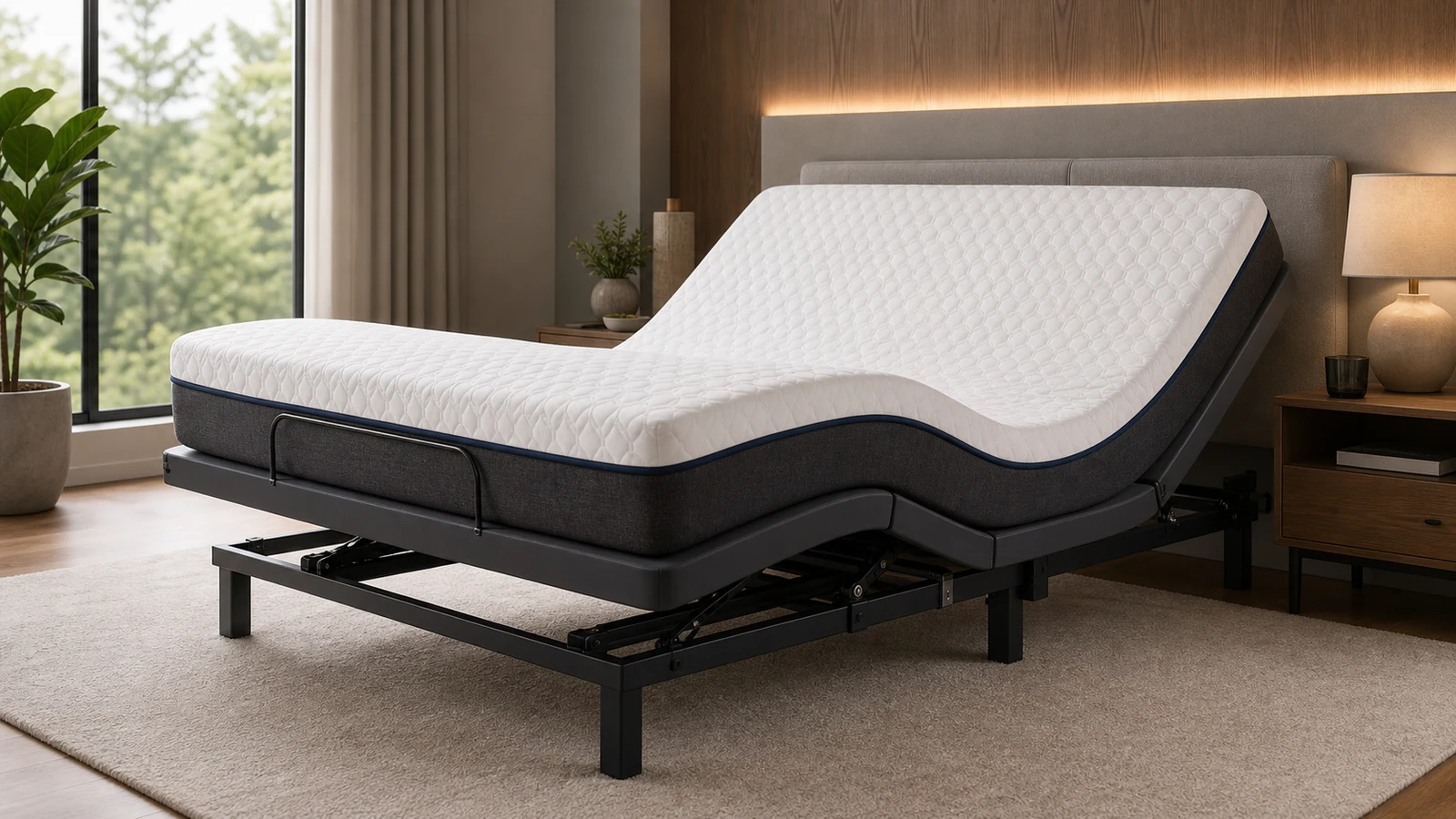
Adjustable bed frames on Amazon range from simple lifestyle upgrades to serious mechanical systems that lift a heavy mattress and sleeper every night. The problem is that many listings make cheap bases sound premium by emphasizing massage, USB ports, or a large static weight number while saying little about the motor system, steel structure, clearance, or warranty.
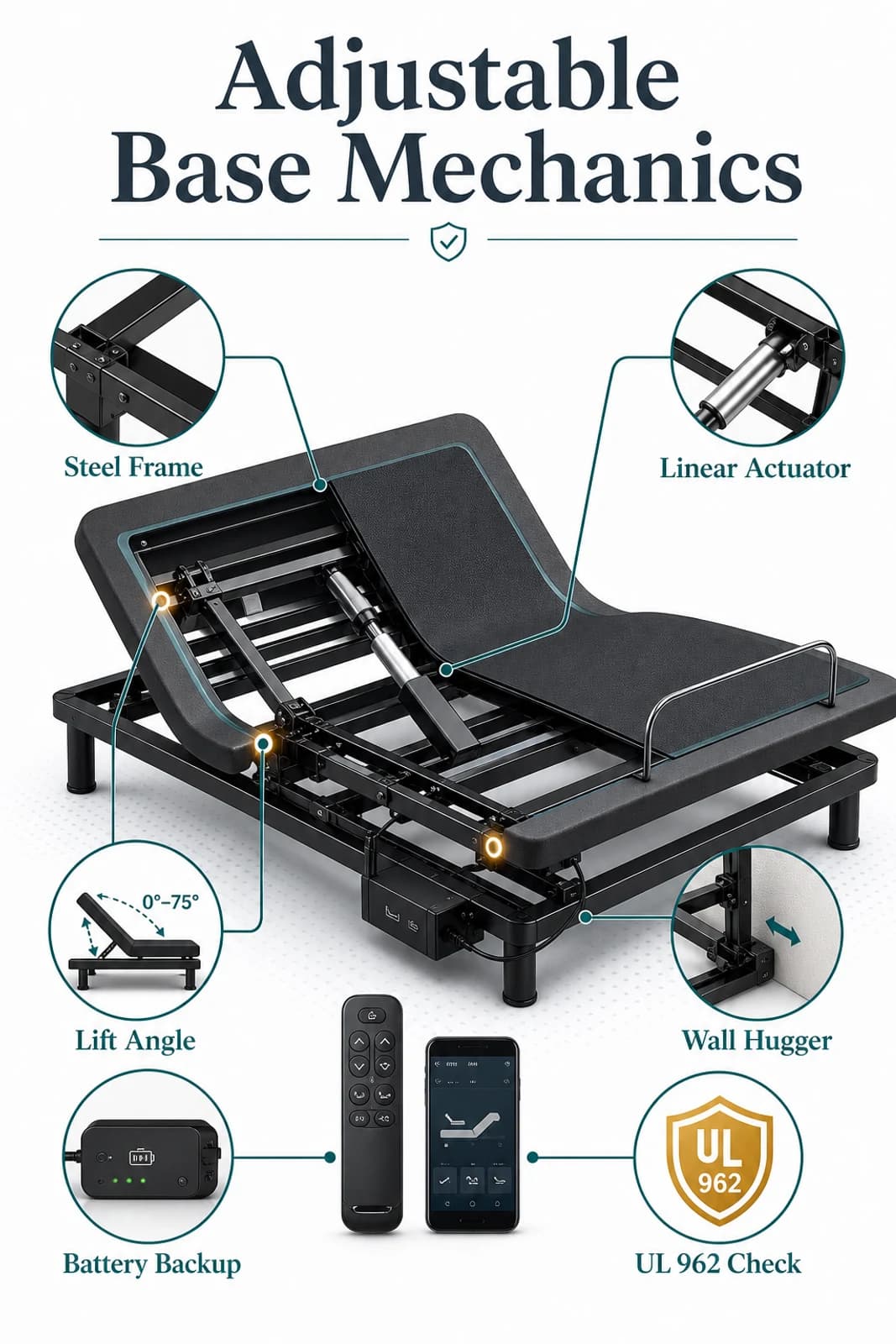
This guide uses a stricter lens: frame rigidity, linear actuator load, lift geometry, zero-clearance installation, wall-hugger movement, battery backup, mattress retention, and safety documentation. It is still a consumer buying guide, not medical advice. If you use an adjustable base for diagnosed sleep apnea, severe GERD, post-surgical recovery, fall risk, or mobility limitations, confirm the setup with a clinician or durable medical equipment professional.
For the mattress side of the decision, see our mattress buying guide, best mattresses for back pain, and best mattresses for seniors.
Not sure which support system you need? Our platform, foundation and box spring comparison also explains why an adjustable base is a separate articulating construction.
The mechanical trap Amazon shoppers miss
The weakest adjustable bed frames are not always obvious in photos. They may look clean, ship quickly, and include a wireless remote, but the hidden risk is a thin frame plus underpowered actuators.
The stress is highest at the beginning of the lift. When the deck is flat, the actuator starts from a shallow angle and must overcome mattress weight, sleeper weight, hinge friction, and frame flex. A dense latex mattress or tall hybrid can add a surprising load before the motor even moves the sleeper. If the motor, mounting bracket, or steel rail is undersized, the base may strain, bind, click, or eventually lift unevenly.
That is why this guide treats "heavy duty" as an evidence question. Good listings and manuals should help you verify the load rating, motor warranty, clearance mode, frame design, and support terms. If a seller only says "quiet motor" and "strong steel" without specifics, treat that as a yellow flag.
Safety note for medical-adjacent buying
Use head elevation and zero-gravity positioning as comfort tools, not as self-treatment for diagnosed medical conditions. For sleep apnea, severe reflux, post-operative recovery, fall risk, edema, or major mobility limits, use clinician guidance and verify that the base can safely return flat during power loss.
Specs that actually matter
| Spec | Why it matters | What to verify before checkout |
|---|---|---|
| Linear actuator system | The motors and drive rods create the lift force that moves the deck under load. | Motor warranty, smooth travel, stated lift/load details where disclosed, and support for your mattress weight. |
| Duty cycle | Consumer actuators are not designed for constant cycling. | Manual language about rest periods, overheating protection, and what voids motor coverage. |
| Steel frame and weld quality | Thin rails can twist under asymmetric loading, especially when sitting on the edge. | Reinforced crossmembers, stable corner support, no vague "premium steel" claim without warranty backup. |
| Zero-clearance architecture | Required when the base sits directly on a platform/storage frame. | Listing or manual explicitly says zero clearance, platform compatible, or leg-free operation. |
| Wall-hugger glide | Slides the upper deck back as it rises so nightstand reach stays practical. | True wall-hugger/wall-saver language; many cheap bases lift on a fixed pivot only. |
| Battery backup | Lets the base return toward flat during an outage. | Emergency lowering instructions, included battery pack, or compatible backup procedure. |
| Mattress retention | Keeps the mattress from sliding during articulation. | Foot retainer bar, corner guards, non-slip deck, or micro-hook style surface. |
| Electrical and RF documentation | Wireless remotes and powered controls should be documented. | UL 962 or equivalent safety language where available, FCC Part 15 RF compliance language, and clear support contacts. |
Quick selector matrix
Use the matrix below before comparing prices. The right base depends less on the most dramatic product photo and more on your actual failure point: reflux elevation, back comfort, platform compatibility, or heavier dynamic load.
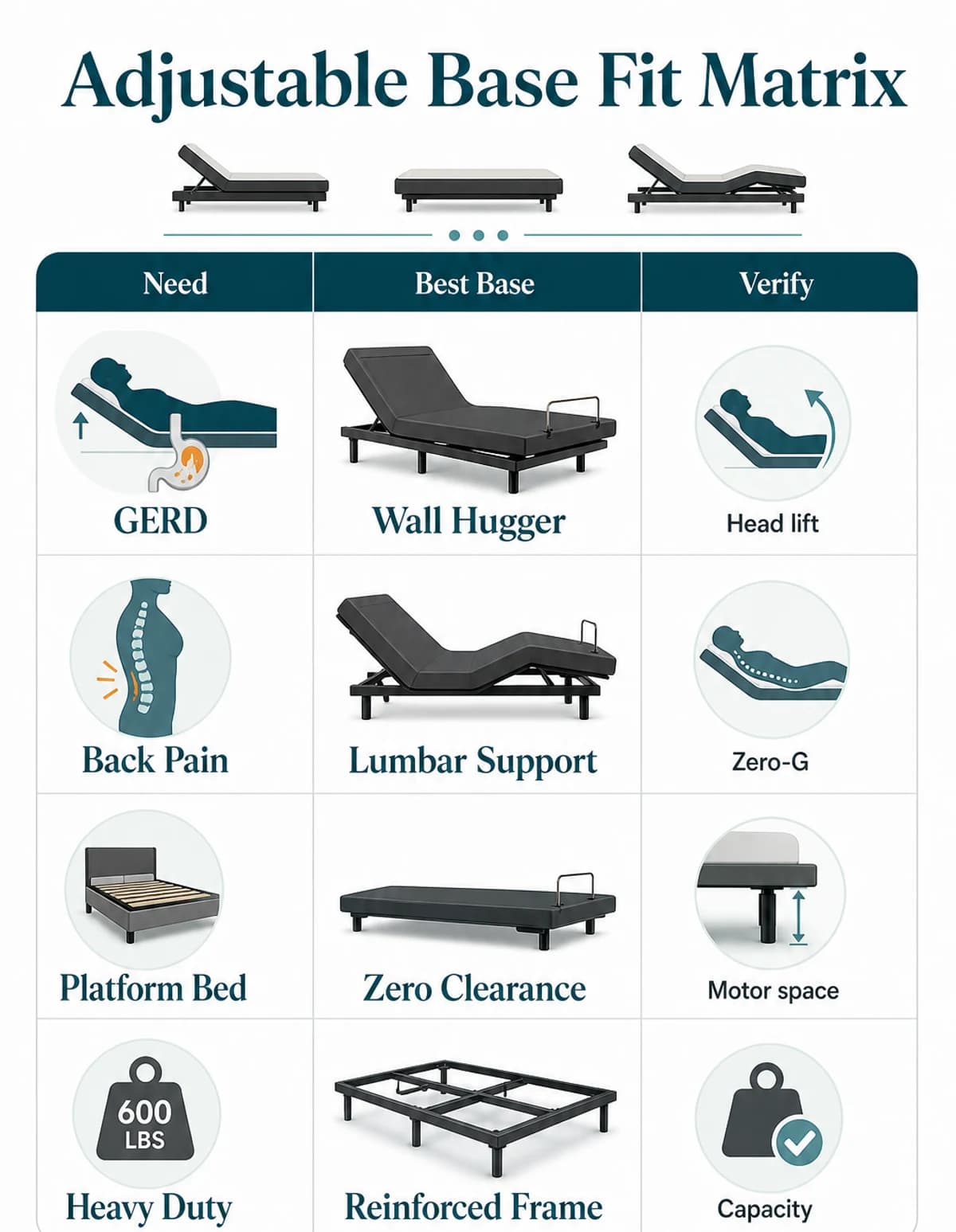
| Buyer profile | Prioritize | Avoid |
|---|---|---|
| GERD or reflux comfort | Stable head elevation, wall-hugger reach, simple remote, reliable return-to-flat function. | Treating a bed base as a replacement for medical reflux care. |
| Chronic low back discomfort | Zero-G preset, smooth head/foot sync, optional lumbar support, mattress that still supports neutral alignment. | Over-soft mattress plus high head lift that folds the torso sharply. |
| Platform bed owner | Zero-clearance design, low under-deck motor profile, clear manual support for platform use. | Bases whose linkages require open space below the frame. |
| Heavy sleeper or heavy mattress | Reinforced frame, stronger warranty, stable legs/corners, realistic capacity buffer. | Cheap "heavy duty" listings with no motor or frame warranty detail. |
| Couples | Split king option, dual remotes, sync cable when needed, mattress pair that bends independently. | One-piece king base if partners want different sleep angles. |
Best adjustable bed frames on Amazon
The product picks below are not ranked only by features. They are matched to specific buyer situations: premium mechanical comfort, value setup, custom presets, storage-bed compatibility, and brand-backed motion furniture.
1. Sven & Son Platinum Adjustable Bed Base
Best for: premium adjustability, lumbar comfort, and sleepers who want more than basic head/foot lift.
The Sven & Son Platinum is the strongest fit when the buyer wants a feature-rich adjustable base rather than a simple lift platform. The Amazon listing highlights head and foot lift, lumbar support, head-pillow tilt, massage, under-bed lights, and USB. Those features matter most when you will actually use the bed for reading, TV, back-comfort positions, or long evening elevation.
The reason it belongs near the top is the combination of mechanical comfort features: pillow tilt helps refine upper-body angle after the main head deck is raised, while lumbar support gives a separate adjustment point instead of relying only on mattress contouring. Verify the current size, included remote functions, warranty language, and whether your selected variant is frame-only or bundled with a mattress.
Sven & Son Platinum Adjustable Bed Base
A premium feature set for buyers who want head/foot lift, pillow tilt, lumbar support, massage, lighting, USB and split-king options.
- Best match if you want comfort tuning beyond basic head and foot lift.
- Confirm the exact variant because frame-only and mattress-bundle options can appear on related listings.
- Use the current Amazon listing for live warranty, delivery, and return terms.

Before checkout
Use the listing as the source of truth for current price tier, seller, delivery window, and return terms.
Prices, coupons, availability, shipping, and return terms change often. Confirm current details on Amazon before purchase. As an Amazon Associate, we earn from qualifying purchases.
2. Lucid L300 Adjustable Bed Frame
Best for: value shoppers who want a cleaner, simpler adjustable base without paying for every premium feature.
The Lucid L300 is the practical value pick. The Amazon listing emphasizes USB, memory position, remote control, and an ergonomic adjustable frame. That is enough for many shoppers who want head/foot elevation, anti-snore style head lift, and a zero-gravity preset without stepping into a much more expensive base.
The tradeoff is that the L300 is not the strongest choice for people chasing advanced wall-hugger movement, powered lumbar, or clinical-style positioning. It is best evaluated as a simple daily-use base. Verify your size, whether you need zero-clearance installation, and the current return window before choosing it for a platform bed.
Lucid L300 Adjustable Bed Frame
A value-focused adjustable base with remote control, USB, memory position and simple head/foot lift for everyday comfort.
- Strong fit for buyers who want core lift features without premium add-ons.
- Less ideal if wall-hugger glide, powered lumbar or advanced tilt is a must-have.
- Check current size options and seller terms because Amazon variants can change.

Before checkout
Use the listing as the source of truth for current price tier, seller, delivery window, and return terms.
Prices, coupons, availability, shipping, and return terms change often. Confirm current details on Amazon before purchase. As an Amazon Associate, we earn from qualifying purchases.
3. iDealBed 4i Custom Adjustable Bed Base
Best for: buyers who want a fuller preset and convenience package in the mid-to-premium range.
The iDealBed 4i is built around convenience: wireless control, massage, dual USB charging, nightlight, zero-gravity, anti-snore, and memory presets. It is a strong candidate when you want the base to feel like a finished bedroom system rather than a bare mechanical lift.
For this category, the key is not just how many buttons the remote has. Check whether the frame sits correctly in your existing furniture, whether the mattress retainer setup works with your mattress cover, and whether the motor/control warranty is clearly documented. The 4i is most compelling when the current price is close to mid-range options while preserving the feature set.
iDealBed 4i Custom Adjustable Bed Base
A feature-rich adjustable base for shoppers who want zero-gravity, anti-snore, massage, memory presets, USB charging and night lighting.
- Good fit if convenience presets matter as much as the lift itself.
- Verify current dimensions, clearance needs and warranty details before using it inside furniture.
- Use the Amazon listing to confirm which remote and accessories are included.

Before checkout
Use the listing as the source of truth for current price tier, seller, delivery window, and return terms.
Prices, coupons, availability, shipping, and return terms change often. Confirm current details on Amazon before purchase. As an Amazon Associate, we earn from qualifying purchases.
4. Blissful Nights z4 Adjustable Bed Frame
Best for: storage-bed and furniture setups where compatibility matters as much as comfort.
The Blissful Nights z4 listing calls out storage-bed use, massage, anti-snore, Zero G, USB charging, wireless remote, head/foot incline, and no-tools assembly. The important part is the storage-bed angle: many shoppers do not want an adjustable base standing visibly on its own legs, and they need a cleaner furniture integration.
Treat the z4 as a compatibility-first candidate. Measure the inside of the bed, confirm the base can operate without the legs if that is your plan, and make sure motors and cables will not hit slats, drawers, or platform supports. This is where "zero clearance" needs to be verified, not assumed.
Blissful Nights z4 Adjustable Bed Frame
A compatibility-minded adjustable base for storage-bed shoppers who still want massage, anti-snore, Zero G, USB and wireless control.
- Best considered when furniture fit is a central requirement.
- Measure slats, drawers and under-deck clearance before ordering.
- Confirm current assembly, leg and platform instructions in the listing or manual.

Before checkout
Use the listing as the source of truth for current price tier, seller, delivery window, and return terms.
Prices, coupons, availability, shipping, and return terms change often. Confirm current details on Amazon before purchase. As an Amazon Associate, we earn from qualifying purchases.
5. Leggett & Platt Prodigy Adjustable Bed
Best for: shoppers who want a known motion-furniture manufacturer and premium positioning features.
Leggett & Platt is a major name in bedding components and motion furniture, so the Prodigy-style listing earns attention from buyers who want more brand history behind the base. The Amazon title highlights pillow tilt, lumbar support, wall-hugger movement, Bluetooth and memory positions. Those are the right premium signals for a base that needs to support daily use, nightstand reach, and refined upper-body positioning.
The main buying caution is variant control. Amazon listings for premium bases can shift by size, seller, bundle, and availability. Check the exact model name, remote, included accessories, motor/control warranty, delivery method, and return terms before comparing it against lower-priced alternatives.
Leggett & Platt Prodigy Adjustable Bed
A premium motion-furniture option for buyers prioritizing wall-hugger movement, lumbar support, pillow tilt, Bluetooth and memory positions.
- Best for buyers who want premium positioning and a known component manufacturer.
- Strong candidate when nightstand reach and lumbar tuning are worth the higher price.
- Confirm the exact seller, size, warranty and return terms on the live listing.
Before checkout
Use the listing as the source of truth for current price tier, seller, delivery window, and return terms.
Prices, coupons, availability, shipping, and return terms change often. Confirm current details on Amazon before purchase. As an Amazon Associate, we earn from qualifying purchases.
Side-by-side buying table
| Pick | Best for | Mechanical reason to consider | Main caution |
|---|---|---|---|
| Sven & Son Platinum | Premium comfort tuning | Pillow tilt plus lumbar support creates more position control than a basic two-zone base. | Verify frame-only vs bundle and current warranty terms. |
| Lucid L300 | Value baseline | Focuses on core lift, USB, memory and remote without overpaying for every add-on. | Not the best target if wall-hugger or powered lumbar is required. |
| iDealBed 4i | Convenience presets | Combines Zero-G, anti-snore, massage, USB, nightlight and memory settings. | Confirm clearance and included remote/accessories by variant. |
| Blissful Nights z4 | Storage-bed setups | The listing targets storage-bed compatibility plus head/foot lift and Zero G. | Measure furniture carefully before assuming platform fit. |
| Leggett & Platt Prodigy | Premium motion furniture | Wall-hugger, lumbar and pillow tilt are high-value mechanical comfort features. | Price, availability and seller terms can shift. |
Budget tiers: what you are really paying for
Economy bases: usually under about $400
The attraction is obvious: head lift, foot lift, remote, and a low price. The risk is that these bases often hide the details that matter most: frame thickness, actuator quality, duty cycle, warranty, and replacement support.
Economy bases can make sense for light, occasional use with a flexible mattress. They are less compelling for heavy mattresses, heavy sleepers, mobility-limited users, split-king couples, or anyone relying on nightly elevation for comfort.
Mid-range bases: roughly $400 to $800
This is the most practical range for many shoppers. You should expect wireless remote control, memory positions, USB, Zero-G, quieter DC-style motion, better deck stability, and clearer warranty coverage.
The best mid-range base is not the one with the most icons. It is the one that clearly fits your furniture, mattress, load requirement, and support expectations.
Premium bases: roughly $800 and up
Premium models justify the price when they add real mechanical capability: wall-hugger glide, pillow tilt, powered lumbar, stronger support language, better split-king control, more stable decks, and better availability of replacement parts or service.
This tier is worth considering if the base is used every night, the sleeper has limited mobility, the mattress is heavy, the bedroom layout requires nightstand reach, or a couple needs independent settings.
Compatibility checklist
Buying two independently moving sides? Use the split-king system checklist to match mattresses, bases, quantity and bedding before comparing bundle prices.
Capacity calculations must include the mattress itself, not just the sleepers. Check the exact model in our manufacturer-sourced mattress weight database before deciding how much safety margin the base provides.
Confirm these details before buying
- Your mattress is adjustable-base compatible under its warranty.
- The combined sleeper and mattress load leaves a real capacity buffer.
- The base fits the inside dimensions of your bed frame or platform.
- Zero-clearance support is explicit if you plan leg-free installation.
- Motors, wiring and linkages will not hit slats, drawers or support rails.
- The remote is simple enough for the person who will use it daily.
- There is a clear return-to-flat procedure during power loss.
- The seller, delivery method, return window and warranty are acceptable.
Size labels deserve extra care: a split king and a split California king are different configurations, and not every adjustable base supports both. Our California king mattress guide covers dimensions, room fit, bedding, and split-base checks before purchase.
Feature priority: what to pay for and what to question
Pay for a stronger frame, smoother motion, clear warranty, zero-clearance compatibility, wall-hugger glide, split control for couples, and a stable mattress-retention system. These features change daily use and reduce buyer regret.
Question weak massage, gimmicky speakers, vague sleep tracking, and overstuffed remotes. Massage on adjustable bases is often vibration, not therapeutic massage. Built-in electronics can also become failure points if the core mechanical system is not strong.
Setup and maintenance
After delivery, inspect the frame before placing the mattress on it. Look for bent rails, loose bolts, pinched wires, damaged power bricks, missing retainer bars, and uneven leg contact. Test the full travel range without the mattress first, then again with the mattress installed.
During the first week, listen for clicking, grinding, or one side lagging behind the other. Re-check bolts after several nights because shipping compression and first-use movement can reveal small assembly issues. Keep cables away from moving linkages, and do not store boxes or bedding under a base unless the manual explicitly allows it.
Troubleshooting quick guide
| Symptom | Likely cause | First fix |
|---|---|---|
| Base will not move | Power, remote pairing, obstruction, overloaded motor protection. | Check outlet, remote batteries, cables, under-bed clearance, and manual reset steps. |
| Mattress slides | Smooth mattress bottom or missing retainer. | Install retainer bar, add approved non-slip layer, or verify micro-hook surface. |
| Motor clicks or stalls | Load strain, binding linkage, frame twist, or defect. | Remove obstruction, reduce load, check legs/bolts, and contact seller if repeated. |
| Head rises too far from nightstand | Fixed-pivot design without wall-hugger. | Move the base forward or choose wall-hugger/wall-saver if reach matters. |
| Platform bed interference | Under-deck motor or linkage hits slats/drawers. | Stop use, raise on legs if allowed, or switch to verified zero-clearance base. |
Final recommendation
If you want the safest buying shortcut, choose the adjustable base that explains its structure, compatibility, support, and warranty most clearly. For premium adjustability, start with the Sven & Son Platinum or Leggett & Platt Prodigy. For a value baseline, compare the Lucid L300. For a more feature-rich mid-range setup, look at iDealBed 4i. For storage-bed compatibility, scrutinize the Blissful Nights z4 and measure before purchase.
The best adjustable bed frame is not the one with the most buttons. It is the one that can lift your actual mattress and body load smoothly, fit your furniture without mechanical interference, keep the mattress in place, return safely during power problems, and remain supported by the seller after the first month.