
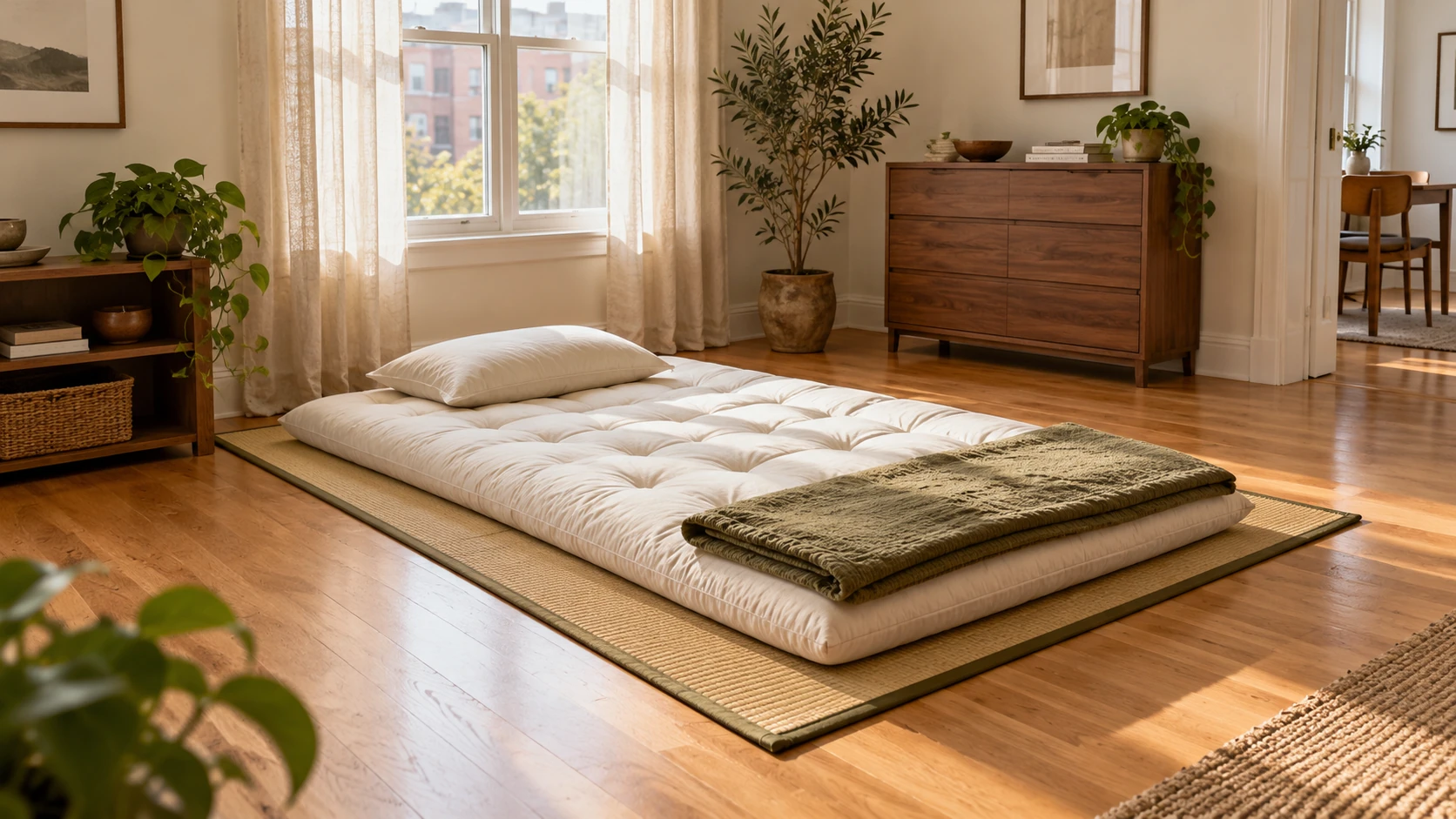
A floor futon is worth considering when you want bedding that can free the room during the day and can realistically maintain it. It is a less convenient choice if getting down to the floor is difficult, there is no practical place to air the bedding, or you need a forgiving money-back trial while discovering whether a thin floor bed suits you.
Our US buying references are the FULI Standard Queen, Futon Beds From Japan's Shinsha shikibuton, and The Futon Shop's latex/wool shikibuton. We checked manufacturer materials, size charts, care and return pages on October 30, 2026. We have not slept on these products, tested their moisture behavior or measured pressure relief. Their different constructions do not justify a universal comfort or health ranking.
Know which part of the bedding you are buying
The shikibuton is the lower sleeping mattress. A kakebuton is the quilt placed above the sleeper. A removable cover, tatami mat and complete bedding set can be separate products. For example, the Shinsha product page expressly excludes the quilt and protective covers from the mattress-only purchase.
A Western futon sofa mattress must work on a folding seat-and-back frame; our futon sofa guide handles that question. A three-panel foam guest pad belongs in the folding-mattress comparison. “Japanese-style” also does not establish Japanese manufacture, cotton filling or an absence of synthetic materials.
Compare three constructions and ownership routines
| Researched reference | What the maker currently describes | Useful reason to investigate | Main limitation |
|---|---|---|---|
| Futon Beds From Japan Shinsha | Japanese-made cotton-filled bedding; a separate fire-barrier fabric for US/Canada shipments | A cotton-filled import with a clearly published metric size chart | Made to order, import costs and no general comfort return after shipment |
| FULI Standard Queen, FJFM-Y06Q2 | Cotton surface; FAQ specifies polyester-containing batting and a polyurethane core | A different lightweight floor-bed construction to compare when foam is acceptable | Conflicting all-cotton marketing and conflicting public availability signals |
| The Futon Shop latex/wool shikibuton, SHIKIFUTON-L_CONFIG | US-made Dunlop latex and wool, with organic-cotton ticking; 3- or 5-inch choices | A Japanese-style latex/wool alternative when those materials are the preference | Appropriate support and routine airing, flipping and rotation; trial eligibility depends on paid mattress price |
Shinsha: cotton filling, with a US-specific material detail
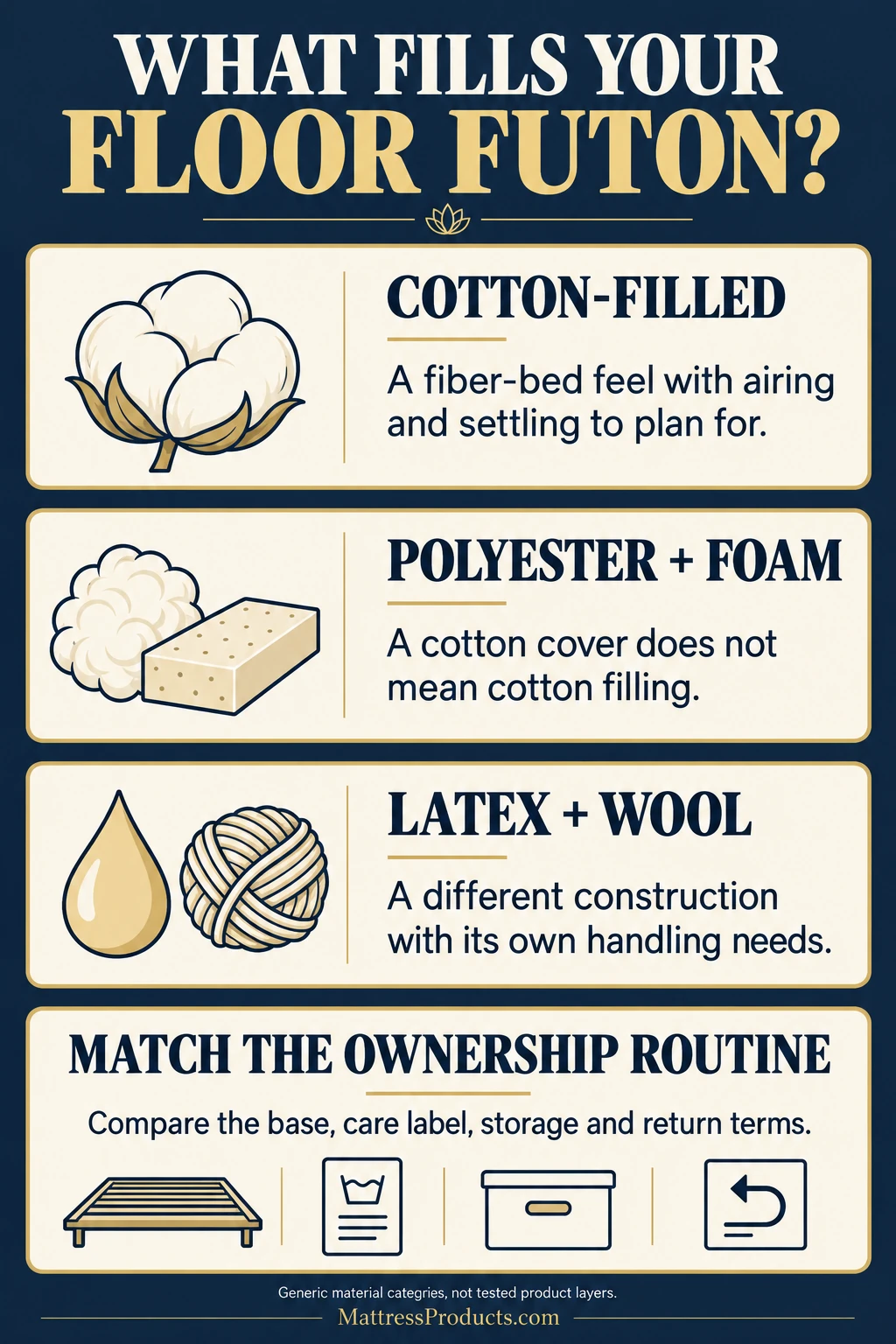
Futon Beds From Japan identifies its Shinsha as handmade in Japan and describes cotton filling and a cotton outer fabric. The buying attraction is that fiber-bed construction, not a claim that it reproduces a foam mattress's contour. Expect the decision to include handling, drying and how a cotton bed's loft changes with use.
The FAQ adds a detail an all-cotton headline can hide: US and Canadian shipments include a separate fire-barrier fabric around the filling. The seller does not fully identify that fabric's fiber composition there. “Cotton-filled” is therefore more accurate than declaring every component of the finished US product to be cotton. We do not recommend removing or altering a fire barrier.
Its size table identifies Single as 90 × 200 × 12 cm. The inch labels are approximate and do not convert perfectly: 12 cm is about 4.7 inches, while the table also uses roughly 4½ inches. Treat that as nominal uncompressed loft, not guaranteed thickness under your hips or a uniform measurement across a tufted surface.
The maker also explains that vacuum packing can temporarily reduce the apparent dimensions and that the corners matter when measuring its curved sides. Follow those instructions before declaring a new delivery the wrong size. Its quoted filling weight is not necessarily the finished weight you must carry, so we do not use it as a handling-test result.
FULI Standard: distinguish the cotton surface from the core
The current FULI Standard product is a different route from a cotton-filled Shinsha. Its material FAQ identifies a cotton surface, polyester-containing batting and a 40 mm polyurethane core. Some product-page marketing broadly says 100% cotton. We cannot reconcile that broad wording as a full-material declaration, and do not describe this model as all-cotton or foam-free.
This matters if the purpose of changing beds is to avoid polyurethane or polyester. A cotton cover alone does not accomplish that. If those materials are acceptable, consider the actual floor-bed arrangement and cleaning limitations rather than treating a natural-looking fabric as proof of the interior.
Our selected official-store reference is Queen FJFM-Y06Q2. Its manufacturer size chart lists Queen at 59 × 79 × 2 inches. A standard US Queen cover or fitted sheet designed around 60 × 80 inches and a much deeper mattress may fit loosely. Other FULI listings can have different names or generations; do not replace the selected model's specifications with an unsourced three-inch claim.
At the check, the official store exposed only Full, Full XL, Queen and King in the Standard selector, even though its general size chart also includes Twin and Twin XL. The selected Queen variant data indicated availability, while page text included unavailable/backorder language. That is unresolved stock information, not evidence of an immediately dispatchable order. We would clarify that contradiction before ordering for an imminent guest visit.
Research FULI Japanese floor-futon listings
Compare the actual model, size and material label with the manufacturer references above. Standard, Premium and differently described older listings should not be merged.
This is a search, not a verified exact Amazon listing or price. Retailer stock and returns may differ from FULI's direct store. As an Amazon Associate, we earn from qualifying purchases.
The Futon Shop: a latex/wool alternative with different care
The latex and wool shikibuton, configuration SHIKIFUTON-L_CONFIG, is a US-made Japanese-style model. Its page describes Dunlop latex, wool and organic-cotton ticking, with three- and five-inch options. Twin is listed as 39 × 75 inches; Queen is 60 × 80 inches. This is not the same footprint or construction as either import above.
Consider it when the latex/wool combination is your specific preference. The maker positions the thicker version for more everyday cushioning, but we have no comparable loaded-height, pressure or ease-of-folding measurements. More nominal thickness can also mean a larger, harder-to-handle bundle. Do not turn its “lightweight” description into an assurance that every user can manage every size.
This model calls for a tatami, tatami bed or coir arrangement rather than direct placement on a hard floor. Its care instructions include routine airing, flipping and rotation. That last point is not universal: Futon Beds From Japan explicitly says its directional cotton futons do not need flipping. A generic futon maintenance schedule would give the wrong instructions to at least one owner here.
We do not repeat the page's zero-off-gassing, allergy or health language as independent evidence. The useful comparison is the disclosed construction, required support, intended use and realistic upkeep.
Fit the room, body and cover separately
Lay a sheet or painter's-tape outline to the exact futon's published footprint before choosing a size. Walk around it, open the door and identify where the bedding goes after airing. A size that technically lies flat can still block a closet or leave no useful spot for a drying rack.
Japanese Single is not a translation of US Twin. FULI's general chart even lists its Twin XL at 39 × 83 inches, rather than the usual nominal US Twin XL length of 80 inches. Use the selected product's chart and cover requirements. A brand's global size chart does not establish that every size is currently sold through its US-facing store.
Keep floor support and cushioning separate. A mat can change the interface with the floor; it does not promise the feel of a thick mattress or eliminate moisture care. A slatted base must also be appropriate for the bedding, with any required mat or support layer. The fact that one maker allows a clean dry floor does not override another model's explicit support requirement.
For a couple, include the handling problem in the size decision. Two smaller beds may be easier to move independently but create a seam and require two care routines. One large futon may reduce the seam but be awkward to air in a small apartment. We have not measured which arrangement is more comfortable; the tradeoff starts with the people and space actually available.
Build a drying routine you can keep
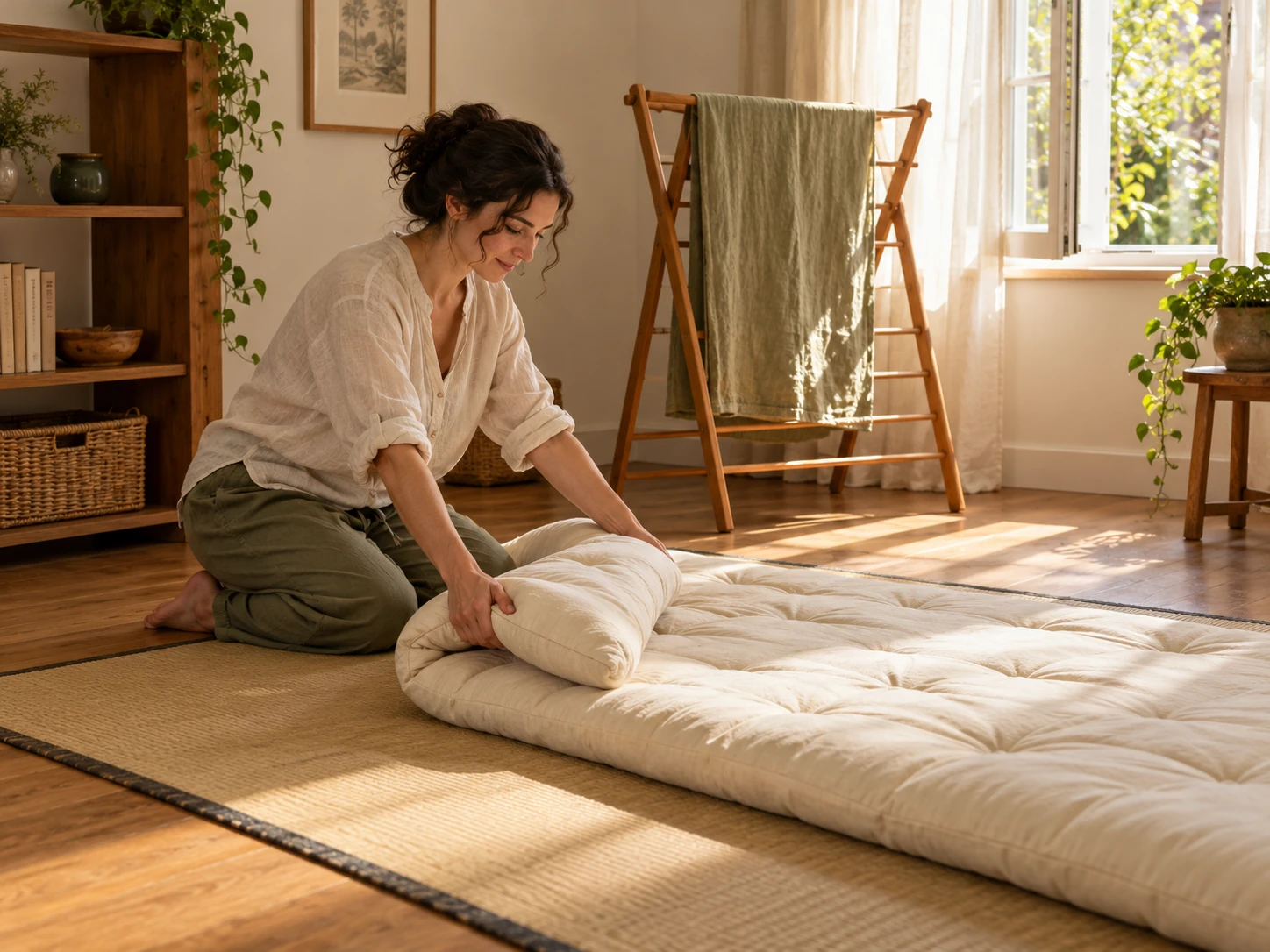
Plan a place to air both the underside of the bedding and its base, not just a closet to hide the folded bed. FULI's care FAQ calls for a morning airing routine and dry storage. The Futon Shop's model instructions require routine airing too. A tatami layer can itself retain moisture; it should be inspected rather than treated as a permanent moisture barrier.
Fold back the upper bedding, lift or support the futon as its maker permits, and check the underside and floor or mat. Store only when dry. The relevant frequency depends on the model, room and use; a single weekly rule does not establish that a damp underside is acceptable for the remaining days.
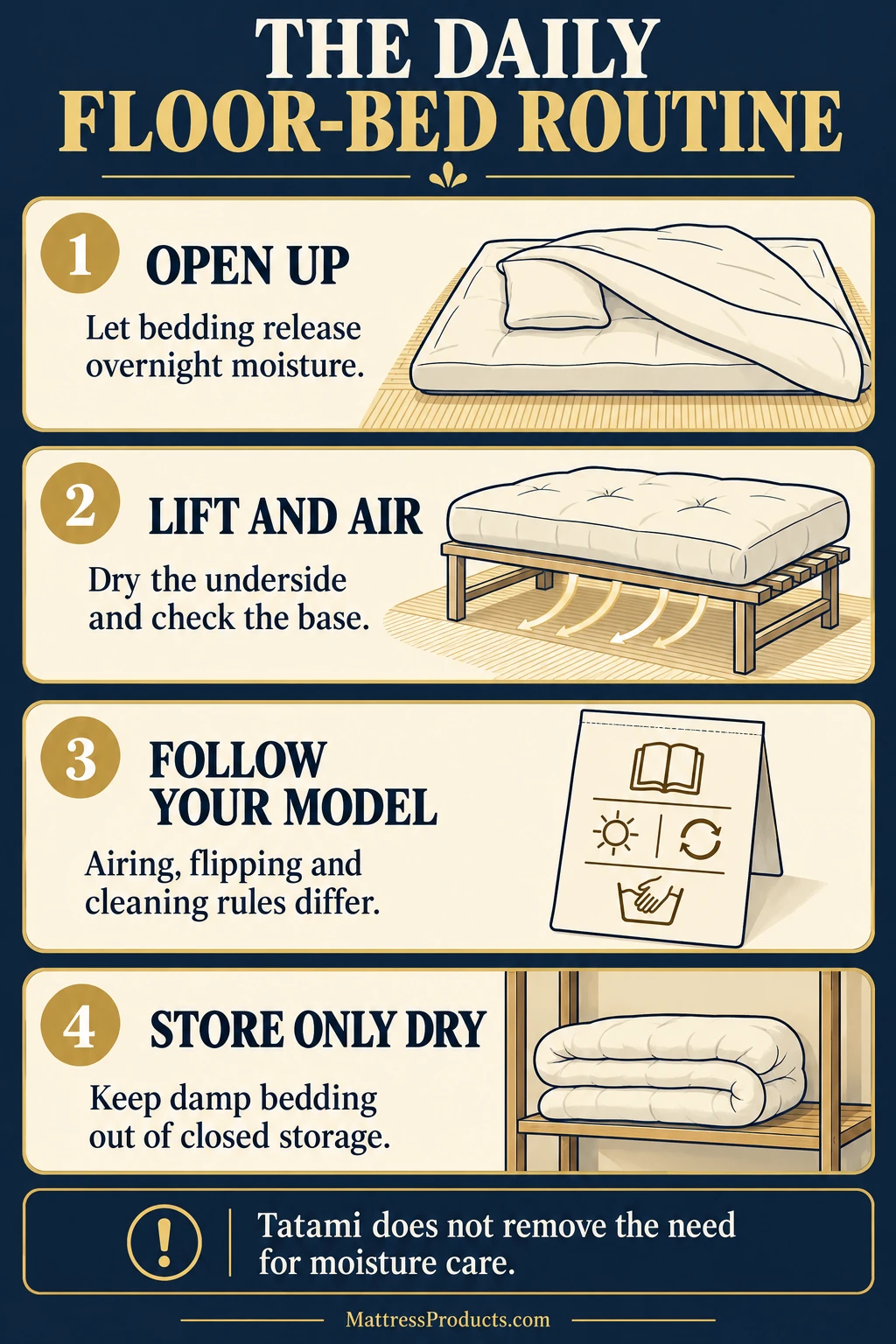
Washable sheets do not make a filled futon washable. FULI specifically says its foam-core bedding cannot be washed; its FAQ describes surface cleaning followed by thorough drying. Avoid transferring a cotton-futon cleaning tip to a latex/wool model or saturating a core that cannot be rinsed and dried properly.
Do not treat sunlight as verified sterilization or as a remedy for mold inside a porous mattress. The EPA notes that mold can be difficult or impossible to remove completely from porous materials. Visible mold or persistent dampness calls for addressing the moisture problem and appropriate cleanup, not covering the area with fresh bedding. Neither “natural” fibers nor a foam core establishes immunity to moisture problems.
Budget for the complete setup and the return limit
| Cost reference checked | What the displayed amount actually represents | Important qualification |
|---|---|---|
| FULI Standard Queen: $422 | Selected Queen variant in the official product data | Stock signals conflict; it is not an Amazon quote or a Twin price |
| Shinsha: $540 displayed starting price | Product-page starting display before a confirmed size configuration | Covers and quilt are separate; seller says shipping is included but customs import charges are not |
| The Futon Shop latex/wool: from $472.98 | Unconfigured starting display | Size, thickness, handles and other options can change the total; a tatami/coir base and cover may be separate |
These are different sizes or configuration states, so they do not form a lowest-price ranking. Include the required base, fitted cover, delivery and any applicable import charges in your actual budget. We do not calculate a US tariff from the seller's informal rate statement; obtain the current order-specific import total instead.
The return distinction is more consequential than a small advertised discount:
- FULI's formal US-facing policy limits returns to specified defects, damage or incorrect items and requires notification within seven days of delivery. Its product FAQ says seven business days; use the stricter formal-policy deadline when seeking instructions. This is not a change-of-mind comfort trial.
- Futon Beds From Japan describes sales as final once shipped, with same-product replacement for transit damage or manufacturing defects. Ordering a custom size or discovering that you dislike floor sleeping is not a general refund route.
- The Futon Shop's current main policy offers a 30-night refund-or-exchange route only for eligible mattresses with a paid mattress price of at least $759, after discounts. Return transport is the customer's responsibility. Adding a mat to the cart does not automatically make a lower-priced mattress eligible. The product page also retains older exchange-only wording, so obtain written confirmation for the configured order.
Marketplace orders follow their own actual seller terms. Do not assume a direct-store policy or an external review's “trial” number applies to an Amazon listing.
Research method and the final decision
We used current manufacturer product pages, the FULI size chart, variant data and formal policies to separate material, size, stock and purchase-channel claims. Relevant owner discussion of cotton shikibuton use and care in a humid apartment informed practical questions. Different products, climates and personal experiences do not establish comparative performance or a defect rate.
Investigate Shinsha for its cotton-filled Japanese-made route, FULI Standard when its documented foam-core construction is acceptable and the exact order can be clarified, or The Futon Shop's latex/wool model for that distinct material choice and support arrangement. If the drying routine or the floor-level access does not suit the household, a daybed or trundle may solve the space problem more conveniently. None of these beds is presented as a treatment for back pain or another medical condition.