

Pillow fit is a relationship between your position, shoulder width, head shape, mattress sink and pillow compression. Coop Original is the adjustable all-rounder, Saatva Latex the responsive route, Purple Harmony the ventilated premium option, and TEMPUR-Neck the shaped-foam choice.
Scope and safety boundary
A pillow can change comfort and neck position but cannot diagnose or treat persistent pain, numbness, weakness, severe headache, trauma, or sleep-disordered breathing.
Is a new pillow the right next step?
Use this shortlist if
- Your current pillow collapses, bunches or no longer fills the neck-to-mattress gap.
- You can test loft with the same mattress and sleep position instead of changing the whole bed at once.
- You understand that shoulder width and mattress sink change the height you need.
Use a different route if
- Persistent numbness, weakness, severe headache or pain after trauma needs medical assessment.
- The mattress itself visibly sags or tilts your torso before the pillow enters the equation.
- You plan to stack pillows without checking whether that pushes the chin toward the chest.
Decision-first shortlist
Fast picks: adjustability first, softer value second
These are exact current Amazon product pages verified on August 12, 2026. The premium latex and molded-foam options remain brand-direct research routes below because we did not validate exact current Amazon listings for those models.
1. Best adjustable starting point
Coop Original Adjustable Pillow
Remove or add shredded foam-and-fiber fill until the pillow fills your personal neck-to-mattress gap.
- Best for
- Side, back and combination sleepers who are unsure about loft
- Avoid if
- You dislike reshaping shredded fill or want a one-piece molded pillow
- Construction
- Adjustable cross-cut memory foam and microfiber fill
- Price tier
- Mid range
2. Best soft-value two-pack
Beckham Hotel Collection Bed Pillows
A softer down-alternative pair for shoppers who want an inexpensive, compressible starting point rather than a rigid contour.
- Best for
- Back, stomach and lighter side sleepers who prefer soft compression
- Avoid if
- You need precisely adjustable loft or strong molded neck support
- Construction
- Down-alternative fiber pillow, two-pack
- Price tier
- Budget
Prices, sizes, sellers, availability and return terms can change. Confirm the exact listing before purchase. Amazon buttons are affiliate links; as an Amazon Associate, we earn from qualifying purchases.
How we reviewed this topic
We reviewed current loft options, adjustability, material response, care instructions, return terms, and position fit. We did not measure cervical angles or sleep on every pillow long term.
Our evidence hierarchy puts current manufacturer documentation and relevant primary or standards-body guidance ahead of marketplace copy and star averages. The starting source for this guide is FTC online-shopping guidance. Consumer reviews can reveal questions to investigate, but they do not verify hidden materials, medical outcomes, durability, or policy eligibility.
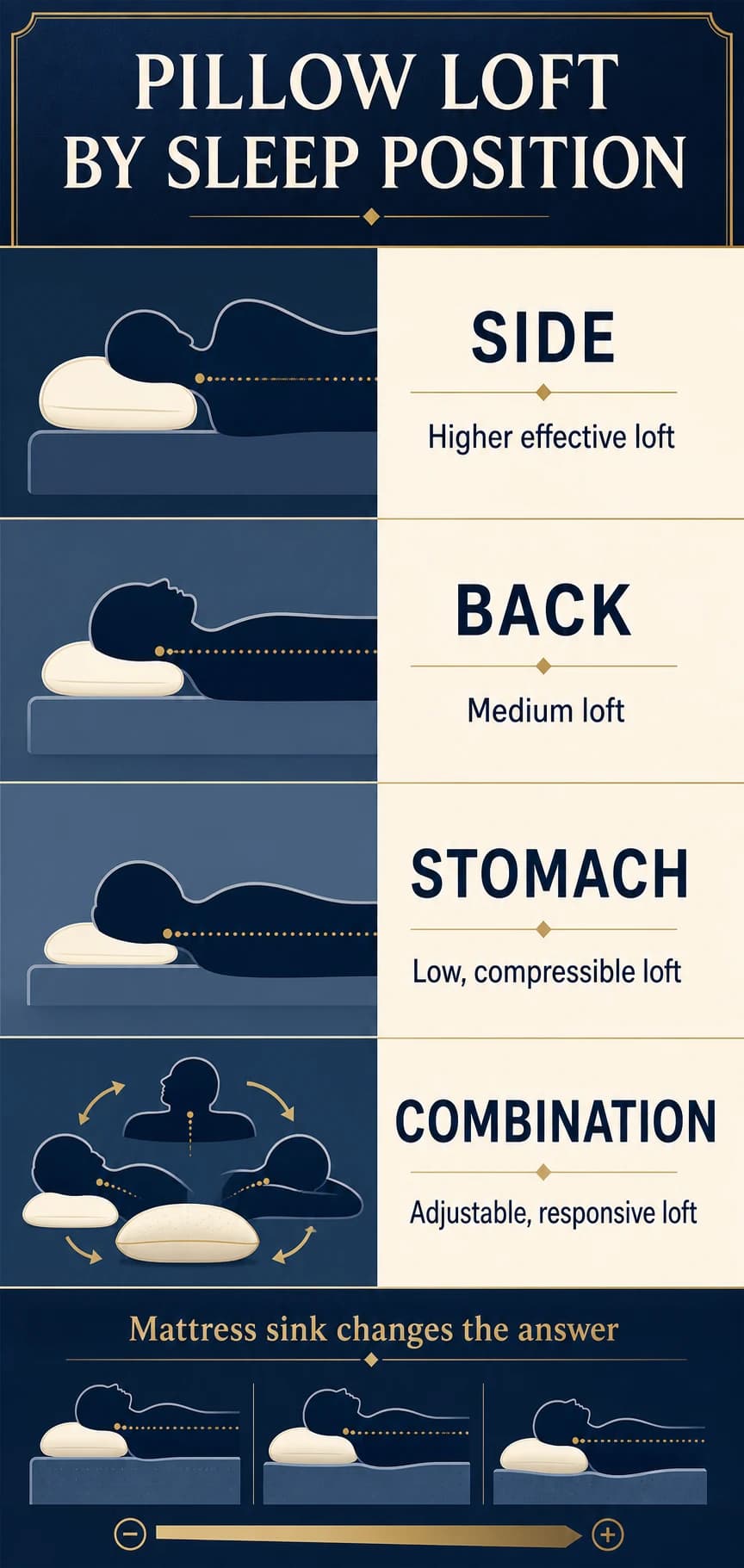
Start with the decision, not the product
| Need | Starting point | Verify in real use |
|---|---|---|
| Side | Higher effective loft with shoulder clearance | Neck stays neutral without ear pressure |
| Back | Medium loft with head cradle | Chin is not pushed toward chest |
| Stomach | Low, compressible loft | Neck is not forced upward |
| Combination | Responsive or adjustable fill | Pillow recovers after position changes |
A row is a starting lane, not a prescription. Two people with the same position or age can compress a mattress differently, use different pillows and bases, or have opposite preferences for bounce and contour. Write down the outcome you need before opening retailer tabs.
What we weighted most
- Effective loft: the height that remains after your head compresses the fill, not the unloaded edge measurement.
- Compression: how quickly the pillow gives way and whether it rebounds after you change position.
- Mattress interaction: a soft mattress lowers the shoulder and often reduces the loft needed; a firm surface usually leaves a larger gap.
- Temperature: airflow through the core, total head contact and the pillowcase matter more than a single cooling label.
- Care and returns: distinguish a removable washable cover from a washable whole pillow, then check whether opened pillows are eligible for return.
These criteria prevent a common error: replacing a real decision with a marketing proxy. A label, component name, rating or badge is evidence only within a defined scope; it is not a guarantee of fit, safety, durability or policy coverage.
How mattress feel changes pillow loft
Pillow height cannot be chosen in isolation. On a plush mattress, the shoulder and torso sink farther, so the distance from the neck to the sleep surface becomes smaller. The same person may need a lower pillow there than on a firm mattress that keeps the shoulder higher. This is why copying another sleeper's pillow height—or even your own height from a different bed—often fails.
Use a simple at-home check after settling into your normal position for several minutes:
- Side: the nose should point roughly forward rather than toward the ceiling or mattress. The pillow should fill the shoulder-to-neck space without folding the ear.
- Back: the head should feel cradled without the chin being pushed sharply toward the chest. A pillow that looks moderate can still compress too little.
- Stomach: minimize head elevation and rotation. Some stomach sleepers prefer no head pillow, while others need a very thin, compressible layer.
- Combination: prioritize recovery and adjustability. A pillow that stays permanently compressed after side sleeping may feel too low after rolling onto the back.
Photograph the setup from behind or from the side rather than relying only on the immediate feel. A pillow can feel plush while still holding the head too high.
Current research shortlist
1. Coop Original Adjustable Pillow
Coop Original Adjustable Pillow is our broadest-fit starting point because its fill can be added or removed instead of forcing the sleeper to accept one fixed profile. The current brand page lists cross-cut memory foam and microfiber fill, a washable cover and a 100-night brand-direct guarantee. Marketplace terms can differ.
Main tradeoff: Shredded fill needs occasional redistribution. Match the current model name, height, firmness, seller, trial, warranty and return owner before purchase.
Coop Original Adjustable Pillow
The verified Queen listing is the classic adjustable cross-cut foam-and-fiber model. Confirm size, seller and personal-item return terms before checkout.
- Best for
- Uncertain loft and combination sleeping
- Avoid if
- You want a molded one-piece pillow
- Construction
- Adjustable shredded foam and microfiber
- Price tier
- Mid range
Before checkout
Use the listing as the source of truth for current price tier, seller, delivery window, and return terms.
Verified Queen listing: ASIN B00EINBSEW. Recheck seller and opened-pillow return eligibility. As an Amazon Associate, we earn from qualifying purchases.
2. Saatva Latex Pillow
Saatva Latex Pillow uses a shredded latex core inside a down-alternative outer layer. Its loft choices make it a more specific decision than a universal all-position pick: higher loft better suits many side sleepers, while the lower option is the more plausible route for back or stomach sleepers.
Main tradeoff: Loft may be high for some stomach sleepers. Match the current model name, height, firmness, seller, trial, warranty and return owner before purchase.
3. Purple Harmony Pillow
Purple Harmony Pillow pairs a responsive core with Purple's elastic grid-style outer structure and comes in multiple height directions. It makes more sense for sleepers who dislike slow shredded-foam compression and value quick rebound, but its unusual feel and premium price make it a poor blind buy without a usable return route.
Main tradeoff: Distinct feel and premium cost. Match the current model name, height, firmness, seller, trial, warranty and return owner before purchase.
4. TEMPUR-Neck Pillow
TEMPUR-Neck Pillow is a firm molded contour for back and side sleepers. The manufacturer currently lists small, medium and large profiles at approximately 3.5, 4 and 4.75 inches and recommends choosing with shoulder measurement. That specificity is useful, but the molded shape is less forgiving for frequent position changes.
Main tradeoff: Less adaptable for frequent position changes. Match the current model name, height, firmness, seller, trial, warranty and return owner before purchase.
Shortlist comparison
| Option | Best research fit | Primary caution |
|---|---|---|
| Coop Original Adjustable Pillow | Adjustable fill for changing loft | Shredded fill needs occasional redistribution |
| Saatva Latex Pillow | Responsive latex-and-fiber construction | Loft may be high for some stomach sleepers |
| Purple Harmony Pillow | Ventilated responsive design with height options | Distinct feel and premium cost |
| TEMPUR-Neck Pillow | Shaped foam for sleepers who prefer a contour | Less adaptable for frequent position changes |
Material tradeoffs that matter after loft
Adjustable shredded foam reduces the risk of choosing the wrong height, but it needs periodic redistribution and can feel less uniform than molded foam. Molded memory foam holds a defined contour and absorbs movement, yet it is difficult to alter if the profile is wrong. Latex responds quickly and usually feels less enveloping, but it is springier and often more expensive. Down-alternative fiber compresses easily and can be inexpensive, although support may change more during the night and over time.
Washability also needs precise reading. A removable cover being washable does not mean the entire foam insert can go into a washing machine. TEMPUR-Pedic, for example, separates cover care from foam care and currently excludes pillows from its return policy because they are personal-use items. That policy risk belongs in the buying decision, not in the fine print after checkout.
A five-step purchase and trial process
- Freeze the exact identity. Save the model, generation, size, height, firmness, seller, fulfillment party and condition.
- Verify the complete system. Check the mattress, foundation, protector, pillow, room climate and any adjustable base together.
- Read the live policies. Identify the trial owner, minimum-use rule, opened-item return route, pickup cost, warranty eligibility and required support.
- Change one variable at a time. Keep familiar bedding and pillow at first unless one is clearly incompatible.
- Document the trend. Track comfort, pressure, movement, heat, access and visible support while preserving labels, photos and correspondence.
A trial is not permission to ignore health or safety signals. It is a controlled consumer test of comfort and function under the written policy. See our mattress trial checklist before ordering.
Claims we deliberately do not make
- We do not claim personal long-term use, laboratory cooling, pressure mapping or chemical analysis unless such work actually occurred.
- We do not publish static sale prices, future discount predictions or permanent Amazon inventory.
- We do not treat a firmness number, material specification, component count or certification logo as a universal pass/fail score.
- We do not turn customer reviews into medical, durability or safety evidence.
Common mistakes to avoid
- Using position alone.
- Buying by star score.
- Ignoring pillow return exclusions.
- Stacking pillows without checking neck angle.
When to keep, exchange or return
Keep the product when the documented model is correct, the setup follows support requirements, comfort and function trend acceptably, and no policy or safety problem has emerged.
Exchange when the system is fundamentally sound but the written program permits a clearly better firmness, height or configuration. Do not assume an exchange restarts the trial.
Return or escalate when the wrong model arrived, documentation conflicts, the setup cannot be made compatible, symptoms or access worsen, a material or odor concern persists, or the return deadline is approaching without a workable fit. Get written authorization before donation, disposal or pickup.
Related guides
- best mattresses for side sleepers
- best mattresses for stomach sleepers
- best mattresses for back sleepers
- mattress buying guide overview
Sources and verification notes
- FTC online-shopping guidance
- Coop Original construction and care
- TEMPUR-Neck sizes, care and return policy
Policies, model names, sellers and certifications can change. Recheck the exact product and purchase channel on the day you buy.